A Close Look at the Ulysses S. Grant Memorial
Transcript
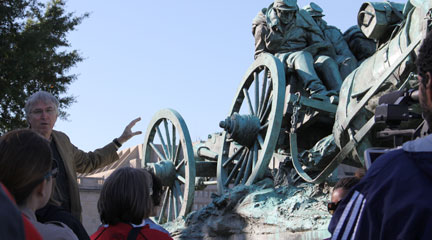
Christopher Hamner: We’re going to look at a couple of monuments today, and I want to approach it from this idea of what is it telling us about the moment and the way that Americans are struggling with their memory of a particular event. Think about the Mall. There will be a thousand people passing through Air and Space between 9am and 9:10 this morning; so in 10 minutes, that’s a career’s worth of people who may be getting all their history out of just going through those exhibits. The World War II Memorial, which we’re going to visit in the afternoon, gets 4.4 million people per year. So in terms of shaping the way people think about events and history, this is really powerful stuff. And I think it’s important to think about, well, who made this? And what did they make it for? And what were the circumstances under which this was put up and why does it look the way it looks? For my money, the one that we’re going to look at first is the single best, most interesting, most fascinating memorial in the entire city. It’s the Ulysses S. Grant Memorial. What makes it so interesting is that you can walk past it and only get a tiny, tiny piece of what’s going on. You have to really study…you have to spend a little time kind of engaging the monument to kind of get the full experience. And one of the thinks that’s so cool [is] that you can talk about it as a piece of history [and] you can also talk about it as a piece of art. And this is one of the neater sculptures, both on this side and on the other side. The sculpture is so well done that if you walk around it, it almost seems to move. You see different things at different spots as you kind of make the semicircle. So maybe we should start there. Just kind of start here—and just like we’ve been talking about, you know, images, music, all sorts of things that you can read closely—look closely for the detail and try to figure out what’s going on here.
Teacher 1: He’s riding one of the horses. Each one.
Teacher 2: There’s two riders.
Teacher 3: Are they both shot? It looks like this guy’s shot over here; he’s shot here. This guy’s avoiding being shot just like these guys, they’re ducking, they’re using them as shields.
Christopher Hamner: Alright, if you just look at it—if you’re just standing here for example and you just take the most cursory look at it what does it look like? If you only spend 40 seconds like most tourists, you take a shot from here and you move on, what do you get out of it?
Teacher 4: It’s a wagon, going from one place to another. It’s moving.
Christopher Hamner: It’s kind of the heroic—it looks like a standard—you’ve got the horses rearing back, it’s soldiers, it’s kind of heroic, there’s a guy leaning back, he’s got the U.S. artillery flag. It looks like a pretty standard war memorial. When you take a little more time to look at it, what’s going on? What is it, first of all? We’ve got a bunch of guys on horses—
Multiple Teachers: It’s artillery.
Christopher Hamner: It’s horse-drawn artillery, it’s got an artillery caisson, it appears to be moving up to the front someplace. Everybody got that, right? What’s going on?
Teacher 5: They’re stuck in the mud.
Teacher 6: They’re under fire.
Teacher 7: Yeah, they’re in battle.
Teacher 5: I got stuck in the mud and cold, suffering.
Teacher 8: And this guy looks like he’s getting shot. And it looks like they’re avoiding being shot.
Christopher Hamner: Okay, that’s one way to interpret it. One thing, if they were close enough to the front that they were taking fire the battery would probably be disengaged and wheeled in. So it would be rare to get that close. But everybody’s kind of gotten the sense that it’s in the process of crashing. Right? Let’s go around to the other side. What’s happening over here?
Teacher 9: From this side you can definitely tell that it’s more tilted, the part where they’re sitting.
Christopher Hamner: Okay, so.
Teacher 5: The axle is breaking.
Christopher Hamner: The axle is snapping; you can see the slack in the tackle there. But notice there’s a lot of slack here, they’re rearing up, it’s in the process of crashing. I mean look at the wheels are akimbo. I think what’s happening here is not that these guys are getting shot but, the horses have reared, it’s just at this moment—it’s full of energy, it’s just at this moment where it’s about to crash. These guys, I don’t know if they’re ducking fire of if they’re just tired in the back. Especially this guy on the right, I mean, that is just exhaustion in his face. These guys have been towing this thing around for months or years. But they’re not even aware that in four tenths of a second the momentum of the artillery case is going to carry them into this huge mess of horseflesh. And these guys are trying to rein in the damage. But, this is a picture of a crash about to happen. Think of how different that is from what you would normally see in a heroic military monument. This isn’t a tribute to efficiency, or a tribute to the sheer power of the army, so much as a honest portrayal of how easy it is for things to go wrong. I especially like the guys riding in the back, just the exhaustion there. And think about how atypical that is for a military monument. When do you think this was put up?
Teacher 10: After Grant died.
Christopher Hamner: Yes! When? So that would cover roughly 130 years.
Teacher 10: I was thinking post-World War I.
Christopher Hamner: Good! I like that. Post-World War I is a good guess, why?
Teacher 10: Because we struggled with modern warfare there and lots of people came home, and Veterans Affairs was formed.
Christopher Hamner: That is a great guess, but not correct. That’s what’s interesting about this. This is pre-First World War by like 20 years, which is really kind of unusual when you think of all the other Civil War statues that we’ve looked at. We looked at Stonewall Jackson, you know, superhero, Superman, steroids, muscles bulging—that’s much more traditional, that’s sort of heroic, he looks indestructible, he looks incredibly powerful. This is not indestructible.
Teacher: On the right, on the back he’s got both of his hands bracing him on the other side like he’s getting ready—
Christopher Hamner: This is kind of the sense of energy…there’s nothing that these guys can do. This is going to go very badly for them in a second or two. And there’s a kind of resignation and exhaustion and a realism that is really unusual. You don’t normally see a country putting up a military monument that depicts a crash and I think it says something kind of interesting about where the nation was 25 years after the Civil War when they started putting this up. How do we want to remember this event? What are we going to put up? What are we going to show? How are we going to show it?
Teacher: Maybe like you were saying, when you really look at war and teach it you should look at the tough side of it and don’t glorify it. Like you were saying, it was a struggle, it broke our country apart.
Christopher Hamner: I think that’s exactly where we’re going with this, there’s even more interesting stuff on the other side. But think about how unusual that is. And it will become, I think, even clearer as we get to World War II, which does not have this kind of gritty realism to it.
Christopher Hamner: What’s the kind of tone of the memorial?
Teacher 1: Charge!
Teacher 2: The cavalry is making a charge.
Christopher Hamner: It’s a cavalry charge and it’s kind of got those iconic touches: there’s the captain in front, he’s got his saber up, and they’re pointing forward, and there’s flags streaming and there’s muscles rippling in the horses. It kind of feels like a traditional, heroic celebration. What’s going on when you look at it more carefully?
Teacher 3: This guy on the side here he’s shielding his face. This guy is about to get his day ruined.
Christopher Hamner: What’s happened to this guy?
Teacher 3: His horse is down.
Christopher Hamner: His horse has either been hit or has tripped. What is about to happen, what is the story that’s going to unfold here?
Teacher 4: It’s going to be a domino effect.
Christopher Hamner: There’s a cascade of—the guys in the back are totally unaware of what’s happened in front. And the officer leading the charge has got this heroic pose and a heroic look on his face, but is oblivious to the fact that this is, like the other one, kind of in the process of falling apart. What’s gonna happen to this guy?
Teacher 4: He’s going to have his head stepped on.
Christopher Hamner: There’s a pretty good chance he’s gonna be trampled because the horses are going to be unable to stop. That is supposed to represent Shrady, the sculptor, in fact, the face is modeled after his face, which is a kind of odd touch. He didn’t live to see the entire thing cast and commissioned. But you’ve got the same kind of sense that there’s energy coming, but if you look closely there is the beginnings of a sort of disaster happening. You have to look for it. If you just step back and say oh, standard cavalry charge, it looks a lot like the heroic monuments you would see at Gettysburg or Antietam; look more carefully and it’s kind of brutal realism. Not everybody—the charges didn’t always work, the horses fell down. What’s going on on the ground in both of them? There’s like mud in motion. How many monuments do you recall seeing where there’s so much attention to the ground and how nasty—I mean, there’s a chopped-down tree trunk on the other side. It recognizes that these Civil War battles didn’t happen on a manicured golf course, that they happened in really nasty conditions and there’s—it’s all in motion too, it’s mud that’s being kicked up. It’s kind of a dirtier, grittier, more realistic version of warfare. This is pre-World War I, and this is really, really different. If you look at most statues of generals, particularly from the Civil War, or a statue of Washington, they’re turned out in their general regalia, their officers coats, and their insignia, standing erect and their chests are out—it’s a heroic celebration. This is something different. You get a little bit of that in the front, but it’s kind of got this ironic twist in that this glorious charge that he’s leading is about to meet with a sort of disastrous end.
Teacher 5: I was noticing a few of the other elements that usually you don’t see in statues. As you mentioned the mud and the tree back there, but look at the horses’ mouths. About three or four of the horses they’re exhausted, the tongues are hanging out, especially the one on the far side here. The one on the near side has a wide-open mouth. So they’ve been charging for a while, this isn’t automatically happening, you know, we’re not just starting it.
Christopher Hamner: That one sort of looks terrified, too. In the horses and on the artillery side there’s a sense that they’re portraying the fear, which is a real part of the experience, that again you don’t normally see. What do you think that the people who put this up, who donated money to it, who designed it, who cast it, who erected it—how do they want you to think about the war?
Teacher 6: A more realistic view. Which is kind of before their time.
Teacher 7: It’s certainly—for me, I’m trying to contextualize it within the end of the Gilded Age and the beginning of imperialism and I’m trying to make sense of it and it doesn’t jive with my preconceived notions of what to expect out of a monument during that time. They were in to stuff that was grandiose and heroic; and this is heroic in a very raw way. It’s not—
Teacherr 5: Raw. Raw, I like that word.
Christopher Hamner: If—this should have been erected in 1918 or 1919, right? That would fit in with the narrative of how we understand that people kind of gave up their glorious view of warfare and adapted a more realistic tone. But it doesn’t.
Christopher Hamner: Turn around and take a look at U.S. Grant up there. There’s some interesting stuff going on with the depiction of Grant, just the way he’s portrayed. But there’s also the relationship between the two lower pieces, the cavalry on this side and the artillery on the south side and where Grant is located. What do you know about—what is your sort of thumbnail understanding of Grant as a Civil War general. This is after his presidency, which is generally regarded as something of a disappointment. So he’s depicted here in his more successful incarnation as a general. You can kind of work backwards from there and one of the reasons that Grant accepted the surrender is that he was the victorious general, he is the general after that incredibly torturous process of trial and error, plugging these guys in and we cover this a little bit in the summer, that there was this revolving parade of generals who had been disastrous—you know, Pope, McClellan, Burnside, Hooker, these guys who just could not get it done. And then in the summer of 1863 Grant distinguishes himself at Vicksburg, comes west, and it’s Grant who is the head of the armies in the last two years of the war. And who finally grinds down the army of Northern Virginia and forces its surrender. How does he do that?
Teacher 1: He picked up on the war of attrition.
Christopher Hamner: The thing that Grant did differently that none of the generals previous to him did—So many of those generals were about maneuver and about trying to get behind Lee’s army or trying to get between Lee’s army and Richmond and trying to win the war without fighting a really bloody battle. Grant was one of the first to embrace a more modern sensibility that said you cannot win a war in this day by capturing the enemy capital, you have to win the war by destroying the enemy army and they only way you can do that is by meeting it on the battlefield and fighting it. Remember the Union had that huge advantage in its, the manpower pool it could draw on, its productive capacity; and the South didn’t. The South had a much smaller population and they had much less capacity to produce ammunition and weapons. What had happened in the first two years of the war in a general way is that there that would be a big battle and both armies would kind of pull back. That allowed the South to keep fighting for a long time. Grant is the first commanding officer who really understood that they were going to have to fight them and keep fighting them. Remember when we did the campaigns of 1864; there is just horribly bloody battle after horribly bloody battle from May to July of 1864. They are fighting a massive, deadly engagement every couple of days, this is the Wilderness qne Spotsylvania Courthouse. There were more than 60,000 Union causalities in a six-week period during that point. That’s—they’re fighting a major battle every couple of days. Remember, we were talking about the bottom-up experience, what it’s like not just to be a soldier, but to be the wife of a soldier, or the mother of a soldier, someone on the home front, and imagine what it’s like to get that newspaper every other day and to flip right to the back page, which was called the “Butcher’s Bill,” and to read over the individual names and be praying that it’s not your loved one that’s going to be listed there. And that’s kind of an interesting contrast to our 20th-century experience. We do a lot of the same things today, but in the Iraq and Afghanistan conflicts four deaths in a day is a horrible tragedy—and it is—but imagine that there are 400 deaths every day and that it just keeps going on and that there are 4,000 deaths some day. It’s a kind of warfare that reaches into Union homes, homes in the North, in a way that was really unprecedented. Grant was extraordinarily unpopular. They began to get a real kind of respect for Grant—who was the total antithesis of a lot of the generals they had had before. McClellan was a little Napoleon, he was always very turned out in polished brass and very much looked the part of a general. You can see that Grant doesn’t. A lot of the soldiers saw him as someone that was more relatable. At the same time this is a guy who’s continually plunging them into battle. In the spring of 1864 it’s not at all clear that that’s going to have a successful conclusion.
Christopher Hamner: What’s coming across here about him as a general? What is the tone or what adjectives would you use to describe how he’s being portrayed.
Teacher 1: Alone.
Christopher Hamner: Where do you get that?
Teacher 1: Well, obviously there’s no one else up there with him. You just see the sight of him looking straight, he’s in his own thoughts, his own world, he’s battling the elements, the wind is blowing past him, the horse’s tail is swept; yet he’s going to stand fast, like he’s determined to have whatever he has in his mind fulfilled.
Christopher Hamner: There’s like three or four things we can dig into there. First in terms of him being alone, look at how separate he is from the troops that he’s leading. He is, what is that, 30 feet? Maybe more? He is physically separated from them; he is also 30 feet above them. He’s away from them on this axis and also on the vertical axis.
Teacher 2: He could theoretically have been placed in one side or the other in terms of the way that they portray him in his dress.
Teacher 3: All of these guys on both sides they don’t look like they’re wearing like summer—they look bundled up like the weather is bad. I mean, the mud, the rain.
Christopher Hamner: And Grant’s got that going on too. The adjectives that you guys threw out—resolute. But he’s lonely up there. And he’s not interacting with the soldiers.
Teacher 4: He’s in the middle of it all; he’s in the weather. You have the same type of weather theme being done, but he’s still somehow above it all.
Christopher Hamner: Literally above it! Right? He’s kind of figuratively above this but he’s also literally above it. There’s a kind of sense of determination, he’s got a fist on his hip. You get this sense of how resolute people wanted to imagine him as. This is a guy who understood that there was not a way to win the war except to do a lot of fighting and an incredible amount of dying, and you can kind of see the weight of that on his shoulders.
Teacher 3: He sort of famously internalized a lot of the—I feel like you can see that, his shoulders are kind of hunched forward.
Teacher 2: He’s not postured the way that you see Stonewall Jackson.
Teacher 5: He seems kind of hunched forward.
Christopher Hamner: And remember, they had 20 years to think about this. They did not decide to raise the money for the statue on Monday, throw it together on Thursday, and commission it on Friday. There were 20 years of planning and artist models that they work a lot in clay on miniature before they cast something in bronze. There were all sorts of different potential ways to portray Grant. They didn’t have to do it the way that they did it. And unlike other kinds of historical texts, where you can say sure you can change that, it’s not written in stone—this is written in stone and cast in iron!
Teacher 6: One thing that’s striking me is that he’s also surrounded by four lions. And typically what is a lion known as? The king of the jungle. I think that’s speaking out to me right there, too.
Christopher Hamner: Well, and then there’s something else we haven’t talked about, there’s the sort of relief that’s on the pedestal. Can you guys make out on both sides?
Teacher 3: The cavalry again. And then the infantry on this side.
Christopher Hamner: The soldiers are present, they’re there. And again, that’s a little more of a realistic depiction of the soldiers.
Teacher 1: Thinking about both sides of the relief, they could have put that relief anywhere. But look where they put it. And what is the relief supporting? Grant. So the underlying message is his men supported him and his decision that he’s making on that horse right now.
Christopher Hamner: And you notice it’s got this kind of realism that I think is really unprecedented, particularly for the time and it’s still pretty rare. But, was it Brian pointed out the lions, there’s the kind of marble pedestal. It’s not the Korean Memorial where you can actually walk around the figures, it still has these nods to more traditional, classical form. But it also incorporates the stuff that’s new and I think that makes it just so complicated and so interesting. There’s a series of choices here and I think they tell us something about where the nation was at the close of the 19th century and remembering this war and figuring out where it fit into our national narrative.
Historian Christopher Hamner leads teachers through a close examination of the Ulysses S. Grant Memorial in Washington, DC. Just like a document or photograph, Hamner says, monuments and memorials reward questioning and analysis.