Ford's Theatre: Lincoln's Second Inaugural Address
Transcript
Sarah Jencks: First take: What are some of the things you notice, both about the content, what he’s saying, and also about the way he goes about saying it? Just a quick phrase or what words or phrases stick out to you here?
Teacher: Well, there’s some old Biblical references.
Sarah Jencks: Yeah, he calls on the Bible a lot, absolutely
Teacher: That’s strange for us in the 21st century
Sarah Jencks: And he also, it’s clear he assumes people know that those quotes are from the Bible, right, because he doesn’t say these are Bible quotes, he just does it. What else?
Teacher: He brings sort of a why he said some things in the first inaugural address and how this is going to be different, lays out and prepares for what he’s going to say.
Sarah Jencks: He definitely starts off by saying this is a new day, this is a different time. Absolutely. What else? What other things do you notice in here? Yeah.
Teacher: Malice towards none is sort of the start of the Reconstruction.
Sarah Jencks: So yeah. So at the very end of the speech, he’s definitely moving forward and he’s setting a tone for what his expectations are. Absolutely. What else?
Teacher: I think he reaffirms the notion that we’ve seen since the Emancipation Proclamation, that originally the war was about preserving the Union, but now he’s very clear that it was about ending slavery.
Sarah Jencks: Absolutely. Yeah, he really states it. He even goes further than that. We’ll talk a little bit more about that. What else? What else do you notice? Anything about the structure?
Teacher: I’m just struck by the rather severe comment that God wills the retribution.
Sarah Jencks: Yeah, there’s nothing light or casual about this middle paragraph. Anything else? Okay, let’s try to take a second pass at this, and as we’re doing it, I want you to think about those things, about the references, the Biblical references, and let’s also—we’ll pay attention to these different paragraphs. He starts by saying it’s a new day, then he goes into talking about what it was like in the country at the beginning of the Civil War in the next paragraph, and then he goes into this really intense paragraph about slavery and about why this war—he’s got an idea why this war happened. And then moving us towards post-war times. And just quickly I want to remind you, do you all know what the day was that Abraham Lincoln was assassinated? Do you remember? [Murmuring answers]
Sarah Jencks: April 14th. He was assassinated on the 14th, he died on the 15th. And what is this date right here? March 4th. So it’s how much earlier? Yeah, just like a month and a half. It’s not much. He hardly had a second term.
Teachers reading: Fellow-Countrymen: At this second appearing to take the oath of the Presidential office there is less occasion for an extended address than there was at the first. Then a statement somewhat in detail of a course to be pursued seemed fitting and proper. Now, at the expiration of four years, during which public declarations have been constantly called forth on every point and phase of the great contest which still absorbs the attention and engrosses the energies of the nation, little that is new could be presented. The progress of our arms, upon which all else chiefly depends, is as well known to the public as to myself, and it is, I trust, reasonably satisfactory and encouraging to all. With high hope for the future, no prediction in regard to it is ventured.
Sarah Jencks: Okay, let’s stop for a second and talk about some of the things he’s doing in this first paragraph. It’s funny, I’ve been doing this for three years, and I just noticed a new thing, so what, what are some of the—he’s very skilled in the way he’s structuring this. What are some of the things that he’s doing in this first paragraph. How is he—what is he trying to do as he introduces this speech? What do you see?
Teacher: Well, ’high hope for the future, no prediction in regard to it is ventured.’ Like, he has a plan, he’s not quite sure how it’s going to go and how it’s going to be accepted.
Sarah Jencks: Yeah, and, you know, that’s the part that I just noticed something for the first time. He doesn’t ever say in this speech, and the Union is going to win, which was clear by then. It was clear by March 4th that the Union was going to win. Why wouldn’t he say that? Why might he choose not to say that in this speech? Given what else he knows?
Teacher: He feels he’s a president of all the states.
Sarah Jencks: He doesn’t want to stick it to the South. He’s specifically saying no prediction is ventured, I’m not going to go there. It’s an interesting way for him to start this.
Teacher: So he’s already thinking about healing.
Sarah Jencks: Exactly, exactly. Yeah, yeah, we’re not going to start this speech by saying we’re winning, we’re doing it.
Teacher: Well, he even has sense before, ’reasonably satisfactory,’ he doesn’t go jump and say that we’ve won, pretty much, it’s very—
Sarah Jencks: I just heard, I’m sorry, I don’t know—yes. Yeah. And very measured. He’s very careful how he does that.
Teachers reading: On the occasion corresponding to this four years ago all thoughts were anxiously directed to an impending civil war. All dreaded it, all sought to avert it. While the inaugural address was being delivered from this place, devoted altogether to saving the Union without war, insurgent agents were in the city seeking to destroy it without war—seeking to dissolve the Union and divide effects by negotiation. Both parties deprecated war, but one of them would make war rather than let the nation survive, and the other would accept war rather than let it perish, and the war came.
Sarah Jencks: Okay, let’s stop again. Um, he’s still talking about the previous inauguration and the beginning of the war here, and he does a lot of this ’then and now.’ If you notice, in the first paragraph, he says ’then the statement seemed fitting and proper, now, we don’t need it anymore.’ So, what do you notice about this paragraph, what are some of the things you notice about what he’s saying at this paragraph? I’m going to say one—are there any hands back there that I’m missing? Yes.
Teacher: I was just going to say he’s very balanced. He’s not placing blame. And, you know, in these last few sentences, he states what one party did, then what the other party did, and then response one party did, and the other party did. He’s very—it gives a very balanced perspective.
Sarah Jencks: And what’s the—this is just a little grammar thing that I sometimes do with kids when I’m looking at this. In that very last clause of the paragraph, who’s taking the action?
Teacher: The war itself.
Sarah Jencks: Yeah. Isn’t that interesting? It’s not a person on either side. It’s the war is the subject.
Teacher: And he also does a similar thing by saying that insurgent agents, he’s not saying the whole South, the government, you know, or the leaders of the South, like agents, like I know it’s not everyone, it’s just these few.
Sarah Jencks: And he also says in that second sentence, notice the way he says all dreaded it, all sought to avert it. Nobody wanted war.
Teacher: I think he does nail, though, who he feels started it.
Sarah Jencks: Yeah, yeah. It’s true.
Teacher: Makes it clear.
Sarah Jencks: It’s true. He says one of them would make war rather than let the nation survive. And the other would accept it. No, you’re absolutely right, you’re absolutely right. I mean, he’s not saying nobody’s responsible here, but he is really being careful about the way he phrases it. Um. We’re ready to keep going.
Teacher: Okay.
Sarah Jencks: Okay.
Teachers reading: One-eighth of the whole population were colored slaves, not distributed generally over the Union, but localized in the southern part of it. These slaves constituted a peculiar and powerful interest. All knew that this interest was somehow the cause of the war. To strengthen, perpetuate, and extend this interest was the object for which the insurgents would rend the Union even by war, while the Government claimed no right to do more than to restrict the territorial enlargement of it.
Sarah Jencks: Okay, I’m going to stop us here, because this is a really long paragraph. What’s he doing here? He’s moving on from talking about what happened at the beginning and who was responsible. He’s going a little deeper here. What’s he doing?
Teacher: He’s kind of always said that the cause of the war was to save the Union, but here he’s saying that even though we always said it was to save the Union, we knew that this was slavery and this institute had something to do with it.
Sarah Jencks: And who knew? According to him?
Teacher: Everybody.
Sarah Jencks: Everybody. He does it again. All dreaded it, all sought to avert it. All knew that this interest was somehow the cause of war. He’s not letting anyone off the hook here. What else? Do you recognize any language here, from other studies of slavery or anything?
Teacher: A peculiar institution.
Sarah Jencks: Exactly. A peculiar and powerful interest. Absolutely. And I think it’s really interesting the way he says to strengthen, perpetuate, and extend this interest was the object to which the insurgents would rend the Union even by war. I love that image, his use of that word, to rend the Union, because I always think of sort of tearing fabric or something.
Teacher: He’s also in the next part of that sentence talking about, you know, I didn’t say that I was going to abolish slavery at the beginning, I was not—I was going to let the states deal with it, the territory. He says, hey, you know.
Sarah Jencks: Other “than to restrict the territorial enlargement.” Part of what I like about this speech also is that it sort of like gives you like, the whole history of, you know, the early part of the 19th century. He addresses so many issues that you can then make connections to. Okay, let’s keep going.
Teachers reading: Neither party expected for the war the magnitude or the duration which it has already attained. Neither anticipated that the cause of the conflict might cease with or even before the conflict itself should cease.
Sarah Jencks: Okay, stop for just a second. What is he saying here? He’s addressing something that happened in January 1865 here. The cause of the conflict should cease before the conflict itself should cease. Does anybody know? Do you remember from down—
Teachers: The Emancipation Proclamation.
Sarah Jencks: The Emancipation Proclamation, yes, that was in 1863. January 1865, the Congress passed the 13th Amendment. And so it hadn’t been ratified yet, it wasn’t ratified until December 1865, but it had been passed by Congress. And so he lived to see that happen, and that was yet another sign that it was—we were in the endgame.
Teachers reading: Each looked for an easier triumph, and a result less fundamental and astounding.
Sarah Jencks: I love that sentence because the kids often, they think, they’re not used to these words being used in such a powerful way. A result less fundamental and astounding. Just changing the whole country. Keep going.
Teachers reading: It may seem strange that any men should dare to ask a just God’s assistance in wringing their bread from the sweat of other men’s faces, but let us judge not, that we be not judged. The prayers of both could not be answered. That of neither has been answered fully. The Almighty has His own purposes.
Sarah Jencks: Okay, let’s stop again. So he’s making a transition here from determining what the cause of the war was to what? What’s going on here?
Teacher: It’s in God’s hands.
Sarah Jencks: It’s in God’s hands. Where do you see that?
Teacher: It’s just the [unintelligible] that I’m getting from the actual—the whole Bible and everything else, it’s just kinda like this is fate now.
Sarah Jencks: He’s doing something more here with that. The way he was using ‘all’ before, he’s using—do you see he’s using that here as well? What words does he use here to bring people together?
Teacher: Neither.
Sarah Jencks: Neither and also—does anybody see anything else? Both. Yep, neither and both. He’s bringing everybody—he’s saying, we may not be seeing this from the same perspective, but we’re all seeing it together.
Teacher: And I take that both sides here have lost. Neither side is jumping for joy.
Sarah Jencks: Yeah. Yeah, absolutely. Absolutely. And he really is bringing everybody together. Let’s talk about that dig for a second. What’s his dig here?
Teacher: That the prayers of both could not be answered.
Sarah Jencks: The prayers of both could not be answered. That of neither has been answered fully. They could—we can’t—we’re not—we’re not going to be satisfied. What’s he—his previous sentence, though, may seem strange.
Teacher: Yeah.
Sarah Jencks: What’s going on in that sentence? Anybody want to read it aloud again? Somebody just go ahead. Go ahead.
Teacher: Uh, okay. ’It may seem strange that any men should dare to ask a just God’s assistance in wringing their bread from the sweat of other men’s faces, but let us judge not, that we be not judged.’
Teacher: Is that a dig against slavery, then?
Teacher: Yeah.
Sarah Jencks: What’s he—how do you take that?
Teacher: You’re making money from someone else’s work.
Sarah Jencks: Yeah. But who do you think he’s talking to there?
Teacher: I think to the South.
Sarah Jencks: You think he’s talking—okay, tell me more about that.
Teacher: Slaveowners.
Sarah Jencks: Slaveowners. Okay. And the workforce. Think about the Northerner here, for a second. Why might that sentence—and I’m just thinking of this right now, so don’t think I’m so far ahead of you here. Why might that sentence be addressed to a Northern audience?
Teacher: He’s critical in that the Northerners really didn’t maybe speak up more loudly against it, that they even have labor issues themselves.
Sarah Jencks: Remember he quotes the Bible here, though. He says it may seem strange that slavery exists, but, let us judge not, that we be not judged. So yeah, he’s bringing up issues of labor in the North, and he’s saying hey, you Northerners, you abolitionists, you may think those Southerners are pieces of white trash, but let us judge not so that we be not judged. You’re not God. It’s interesting because he’s got many many audiences here, and we’re going to be playing with that in the minute.
Teacher: I was thinking similar to the reference that he used, let he who casts the first stone be without sin, so, you know, it seems like another Biblical reference or reference to that part of the Bible.
Sarah Jencks: Yeah, absolutely. Let’s keep going. Let’s go.
Teacher: Woe—
Sarah Jencks: My apologies for cutting you off.
Teacher: It’s okay. ’Woe unto the world because of offenses; for it must needs be that offenses come, but woe to that man by whom the offense cometh.’
Sarah Jencks: What does this mean? What does this Biblical quote mean? Let’s break it down, because it’s not an easy one. ’Woe unto the world because of offenses; for it must needs be that offenses come, but woe to that man by whom the offense cometh.’
Teacher: I mean, to go back to the Biblical language, he’s saying something along the line of it’s a shame that we have to live in a world of sin, this is a sinful world, so we should feel sorry for ourselves, and this is a place where sin is going to happen, but God help the sucker who commits the sin.
Teacher: Yeah.
Teacher: Bad things happen, but this could have been avoided.
Sarah Jencks: Right, and also you’d better not be the one who’s actually doing it. Yeah, absolutely, and what he’s doing, it almost looks here like he’s setting up the South, but then let’s see what comes next.
Teacher: You wonder if there’s a little confusion in the speech. He starts out saying it’s about saving the Union, then he ends up saying, well, this is really about retribution for slavery. Which is it?
Sarah Jencks: It’s the big question of the Civil War, isn’t it?
Teacher: It strikes me, realistically, you can’t have it both ways, even though he wants it that way.
Teacher: Couldn’t you read it, though, as more of a superficial understanding—
Teacher: Superficial is my middle name.
Teacher: No, no, I mean, the whole thing about preserving the Union, that sort of, you know, the reading of it, initially, but then, you know, we spent the whole week studying Lincoln and how he agonized over this stuff in his summer retreat and then at a deeper level, he’s looking for a more meaningful way to frame the whole thing, so that it’s not necessarily contradictory, but just deeper readings of the same situation.
Sarah Jencks: I would throw out to you also that Abraham Lincoln was the consummate politician. He was a great leader. That’s separate from his having been a great politician. And that he was very conscious of the laws of the land and the way that he handled this war in the first half of the war. And in the second half, he started to become much—he was looking for a deeper meaning. For himself, with the death of his son and the death of all of these soldiers, whom he was mourning. And he really started drawing on—looking for a deeper meaning in a different way. So that doesn’t answer your question.
Teacher: Back in the 19th century, didn’t most Americans, or at least, you know, the elites believe that democracy was a divine act? I mean, Reagan wasn’t the first person to say that United States was a city on the hill. You know, you’ve got Melville[?] and all these other guys referring to it that way, so for Abraham Lincoln, couldn’t that also be the case. That to preserve the Union was to keep God’s purposes, God’s will going on Earth, because as long as democracy was there, justice could be done.
Sarah Jencks: That’s really interesting. Yeah, and that was, it was Winthrop, it was that early on, the city on the hill concept started.
Teacher: Remember that, yesterday, talking about how the Declaration of Independence was the apple, yeah, the Constitution is the rain. Goes right back to that.
Teachers reading: With malice toward none, with charity for all, with firmness in the right as God gives us to see the right, let us strive on to finish the work we are in, to bind up the nation’s wounds, to care for him who shall have borne the battle and for his widow and his orphan, to do all which may achieve and cherish a just and lasting peace among ourselves and with all nations.
Teacher: I mean, this is what brings the whole thing full circle. From the introduction, what Mike said about it started out trying to preserve the Union. Yes, slavery was a major part of it, but, I think, you know, events change people. You’ll have a belief when you’re a younger person and then as you get older and as experiences start to mold and shape you, you start to—especially having a child or something else—it makes you think differently. And this war, with the loss of his own child and the loss of all these mother’s children, changed him. So he needed to get back to a place that brings us back together.
Sarah Jencks: I see also that he’s using this whole Biblical kind of exegesis almost to set up what he says in the last paragraph. Because if none of us are responsible, then we have to move forward, we have to strive on with malice towards none and charity for all. We can’t hold it against anyone.
Teacher: Especially when he said back a few sentences before that both sides have committed sins during the course of this war.
Teacher: Yet does he really say that nobody’s responsible, or does he say that we’re all responsible. I sort of get the sense he’s saying that we’re all responsible.
Sarah Jencks: Yes, I agree with you. I totally agree with you. We are all responsible.
Teacher: But he still names the insurgents.
Sarah Jencks: Yes.
Teacher: We’re still pointing the finger somewhere.
Teacher: I still wonder, to what degree does Lincoln himself take personal responsibility for all this tremendous loss. I mean, in the first inaugural, I lot of you are remembering, he said, I’ve taken an oath to preserve the Union. So I’m this passive agent, essentially, and I must follow my oath. But of course he didn’t have to follow his oath exactly as he saw it. He had other choices.
Teacher: And I think—
Teacher: What do you think?
Teacher: He wasn’t passive. You know, he used the Constitution to his benefit and that other times he expanded powers in it and stretched things and kind of toyed with it in order to achieve a goal. And you’re saying he’s a master politician, he wasn’t just—he wasn’t, in my opinion, this ’I’m a moral person that’s just following my oath,’ he was very deliberate in what he did, he was very calculated in what he did, and the way things that he followed in the Constitution, things that he chose to kind of stretch a little bit, it was all for his kind of for his goal to win the war.
Teacher: Very Machiavellian. Ends justify means.
Sarah Jencks: One of the phrases that I find really powerful from—I don’t know if you all are ever trying to make these connections, I can’t imagine you’re not, but I’m always looking for those threads that sort of go through the 19th century or follow from the Declaration, you know, the different political threads, through to the Civil War and beyond, and Lincoln was a great follower of Daniel Webster, the Whig politician. And one of Webster’s phrases, or his sayings, which is actually on the wall of the National Constitution Center if you ever get to go up there in Philadelphia, it’s ’one country, one Constitution, one destiny.’ And they were struggling with these same issues in, you know, the middle and the early part of the 19th century, too. It didn’t just happen.
Teacher: [Unintelligible]—time we were a country—
Sarah Jencks: Yeah. You’re absolutely right. And so Webster said that. Well, if you go down to the coat in the lobby, Lincoln had those words, ’one country, one destiny,’ embroidered in his overcoat. Literally, an eagle of the Union, with the words ’one country, one destiny,’ embroidered in his overcoat.
Sarah Jencks: So what I’d like to do is to start off by looking at some of the things, specific things that might have been, you know, when we hear presidential speeches and other speeches today, commentators and even regular people can see things, and then you think, oh my gosh, I see they said that, that’s going to be—that’s a buzzword or there’s that kernel of an idea, it’s going to keep going forward, I know it’s going to be an issue. And so the idea here is to partner up and to look for, to try to articulate, we’ve talked a lot about these, but the theory, the sort of proposition about the war that Lincoln makes, and then, secondly, what the policy is that he’s proposing. He makes a statement of a proposition of what the war was all about, and then he proposes a policy.
Teacher: These two people get along fantastically—this person didn’t want to fight the war at all. This person didn’t want a war that would disrupt the institution of cotton and slave [uncertain], because his livelihood would be
Teacher: Right—
Teacher: But he could always turn a blind eye to how the cotton was being produced.
Teacher: Alright, so the theory we’re going with is that there’s blame to go around, right?
Teacher: Right, and the South is not going to be punished. And I guess that’s what she was getting to, in order to understand what happens next, why Lincoln’s assassination was a tragedy is because we know that Reconstruction went in a million different directions.
Teacher: The war is God punishing us for slavery.
Teacher: No, all parties are [unintelligible].
Teacher: Right. Because, I mean, he’s really not talking a lot here about the war to preserve the Union, to preserve states’ rights, he’s really focusing on the slavery issues a lot more.
Sarah Jencks: I call these the POV cards, your point-of-view cards. I want to first ask you, does anybody feel particularly good about what you wrote, not to show off, but you feel like you could—you’d be willing to share with us either your theory or your policy and/or did it bring up any questions that anyone wants to raise with the—
Teacher: We kind of felt that people of the North who really felt that they were sort of fighting to fight would see this as controversial. What do you mean we shared the blame, you know, we don’t have slavery, we’re trying to preserve the Union, and now you’re telling us that we’re partly to blame. I think maybe that’s where some of the controversy lies.
Sarah Jencks: Interesting. Okay. Yes.
Teacher: We also felt that neither the North, kind of going on what Nancy said, that neither the North nor South is going to be happy with his plan of no blame and that, you know, he wanted to move quickly, like the South now is going to be forced to join the Union, which they’re going to be upset about, and the North is going to be angry that they’re not, you know, held as this victorious winner, that he’s really got enemies on both sides now.
Teacher: Northerners don’t want to accept Southerners, Southerners don’t want to accept Northerners, and that 10% loyalty cutoff[?] of which 90% of the population in that Confederate state doesn’t want to be there.
Sarah Jencks: Did any—I don’t know how much you all got to talk about or you read about in the basement museum the election of 1864. What were Lincoln’s chances? What happened? Can anybody sort of revisit that?
Teacher: I think it depended on victory.
Teacher: Yeah.
Sarah Jencks: I’m sorry, say it again?
Teacher: Well, it depended on victory.
Sarah Jencks: Yeah, military victory. So, how was he doing before Sherman started succeeding in the fall? Yeah, it was not looking good. It was all over. And there are amazing images, again, of what happened on the Library of Congress website and on other places, in Atlanta and Savannah. And at the same time just remember, you know, if he hadn’t done that, where would we be? It’s a conundrum. It’s a little bit like the conundrum, when you investigated, of should we have dropped the atomic bomb on Hiroshima?
Teacher: Well, Grant as well. I mean Mike was talking about should Lincoln take the responsibility of the death toll, where if you look at a Sherman or a Grant, their strategy was attrition and just keep throwing bodies at the problem until they run out of bullets.
Sarah Jencks: Yeah, I mean, there’s a lot of controversy over what the best military practice is here. We do a play called The Road from Appomattox and it’s a meeting between Grant and Lee the day after the surrender, which we know took place. We don’t know what happened in it, but we know it took place. Or at least in their memoirs they both say it took place. And one of the things that Lee says is this is the last war that will ever be fought according to conventional rules of war as we know them. And I think that was true in many ways. So.
Sarah Jencks: What else? What else is coming through here, in terms of the controversy of his theory, his controversial theory, or what his proposal was. What is the policy that he’s beginning to articulate here? Maybe we can move on to the policy. Yes.
Teacher: The whole ’malice towards none, charity for all’ is remarkable.
Sarah Jencks: So what’s he saying there? If you were thinking of it from policy terms?
Teacher: Well, it’s directed towards the South. We’re not going to hang the leadership like many wanted to do up north, and after four years of hell, that’s pretty remarkable, that he would keep that focus, on reuniting the country.
Sarah Jencks: Just to repeat myself, is it just directed towards the South, do you think? I mean, what about those Northerners?
Teacher: Stop looking for revenge.
Sarah Jencks: And the border states, it was a really big issue. As you begin to look at Andrew Johnson, one of the issues that we come up against with Andrew Johnson is that he was from a border state. He had been holding out for four years, as a member of the Union, as a legislator and a senator from a state that, essentially, had seceded. But he was maintaining his presence, which was why he was named vice president in the 1864 election. From a state that essentially had seceded from the Union, Tennessee. He was full of vengeance. He couldn’t have been more the opposite of Lincoln.
Sarah Jencks: So having thought about these two, having articulated this theory and then the resulting policy he’s proposing, I want you to take a look at these different Americans—almost all of them are Americans, one is not an American—that you have in front of you on these POV cards. And by the way, I have one more—if anybody needs one, I have one more. And take a moment to think both about how they would have responded to the speech and then, as a follow-up, how they would have responded to the assassination. Abraham Lincoln’s family was from Kentucky, originally, and they—his parents left their Baptist church because it was pro-slavery and they were not. So these are—and even if you can’t make a clear decision, start to think of what the questions are, you know. Okay, in his very last speech before he was assassinated, Lincoln proposed that what he described as ’very intelligent Negroes’ and those who had fought for the Union should be eligible for the vote.
Teacher: Okay.
Sarah Jencks: So. . . .
Teacher: That would give hope, but—
Teacher: Yeah.
Teacher: But this is after the assassination, right?
Sarah Jencks: What happened in South Carolina afterwards actually was that it became the state with the most black legislators during Reconstruction.
Teacher: Right.
Sarah Jencks: Right, so. . . .
Teacher: And that only lasts about 10 years.
Sarah Jencks: Right. Not even. Alright, so. Good questions you guys are bringing up, though. I’m not going to ask you to tell—to go around and say what your person would have thought. But instead, if you want to reflect on some of the questions that you were struggling with or that came up or some of the issues that you had to ask—
Teacher: How about if we know what the person would have thought?
Sarah Jencks: If you know? If you feel certain, then I think you should say what were some of the things that made you know. Okay? Alright. Go ahead. Whoever wants to start, raise your hand or just shout out. Anybody? Okay.
Teacher: Well, we got Andrew Johnson the [unintelligible] legislator from Tennessee, so we already know that he was a little angry and wanted revenge, but was politically-minded enough to go with Lincoln until, you know, his time came. But then because I mouthed off, she gave me another one. And this one was a white merchant in San Francisco, formerly of Delaware. Apparently Delaware was a very small, slaveholding state—
Sarah Jencks: Yeah, but border state.
Teacher: —and this gentleman moved to San Francisco, obviously probably during the Gold Rush, so our idea was we really don’t think this guy cares. He’s in San Francisco, he’s trading, he’s involved with all sorts of ethnic groups and nationalities and he’s there just to make money. So I really don’t think his political opinions are going to be very strong, since he moved from a very small state to a state with more people where there could be more opportunity.
Sarah Jencks: But California came—was strongly in which camp during—
Teacher: In the free state category—
Sarah Jencks: In the free state category.
Teacher: —since the Compromise of 1850.
Sarah Jencks: Okay. Excellent. Good thoughts. What else? Who else? What did you—what were you thinking about as you were going through this process?
Teacher: Right. We were a white Georgetown DC dockworker. We’re wondering why we were unable to fight, but—
Sarah Jencks: Maybe you had like a leg that had a—you broke your leg when you were little.
Teacher:: You have to build your character.
Teacher: Our options are really limited, so we’re really worried now with the freeing of slaves, because all this cheap black labor is going to be coming up from the South and if this—if what you’re saying is basically our case, we have very few options economically to turn to. So if we lose this job. . . .
Sarah Jencks: Not to mention that the Potomac River is about to silt up and there isn’t going to be a dock in Georgetown in 10 years, but you don’t know that.
Teacher: Man.
Sarah Jencks: What else?
Teacher: I just thought it was interesting how you guys think about their reaction to the speech and then to the assassination, and the role that we had was a Massachusetts writer with strong abolitionist ties. And we have very different reactions to the speech and the assassination, that, you know, they’re disillusioned by the speech, and this is not enough. You know, you’ve soft-pedaled down, you’ve taken more of a centrist stance. But the assassination still devastates them because this is, you know, your revered leader who did speak out.
Sarah Jencks: Interesting.
Teacher: We also struggled as an abolitionist with the idea of, you know, having a religious sort of approach to this whole thing, would we have been insulted that, okay, now we’re being lumped in with the sinners who perpetrated this horrible institution, and how dare you try to make us be with them. And then maybe we become more zealous once Lincoln was assassinated—see, now you didn’t want to punish them, now they killed the president on top of it, just sin upon sin on the South, and I’m not part of that. You know, even more stronger regional identity of not wanting to be seen as part of that bigger—
Sarah Jencks: Yeah. Very interesting.
Teacher: And one of our controversies was, just because you’re an abolitionist didn’t mean you believed in equal rights.
Sarah Jencks: So true. That’s so true. Absolutely. There were a lot of Northerners who did not—we sort of tend to say that the Northerners were oh, they were antislavery. Not so much, you know. That was unusual. Absolutely. So the last thing I want to ask you all is if you were to take this into your classrooms, what kinds of things might you want to do to enhance your ability to assess students and/or to develop this into something that would actually work for you. And I know this is really fast, but let’s just quick do some popcorn ideas about this. And the last piece is if you were to use this, is there anything that you feel like you would need to do to scaffold it differently? Yeah.
Teacher: I mean, I teach global, so we were thinking of ideas, possibly doing this with, like, the French Revolution and giving out different characters, or Caesar or any revolution for that matter, and really, you know, coming up with different types of characters and seeing what the kids do.
Sarah Jencks: It does require some research, though. Because as you noticed as I was going—it can be your research or the kids’, you can decide, sort of. You can use it as an assessment tool, or you can give it to them and then say you need to go find out more about these people.
Teacher: We had an Illinois regimental soldier, [unintelligible] Taylor, and we were trying to think what battles that soldier would have fought in. So that would be a springboard to do a little more research about that regiment, get background on—
Sarah Jencks: One thing that has occurred to me just while we’ve been doing this here is that you could potentially do this in part as a Google map activity. You could use Google maps to actually pin where each of the different people were from, and to upload, you know, something so that you’re creating a class project as a result that might allow you to—everybody can make use of it as a tool, ultimately.
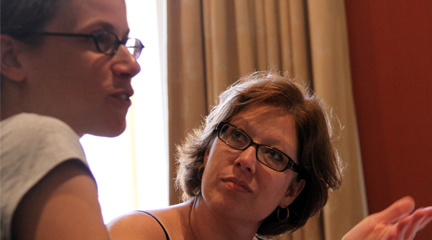
Ford’s Theatre Society’s Sarah Jencks leads a group of TAH teachers through analysis of Abraham Lincoln’s Second Inaugural Address. After taking a close look at Lincoln’s techniques in the speech, the teachers engage in a roleplaying activity, suggesting the reactions of a selection of historical characters to the speech and to Lincoln’s assassination.