Massive Resistance Political Cartoons
Transcript
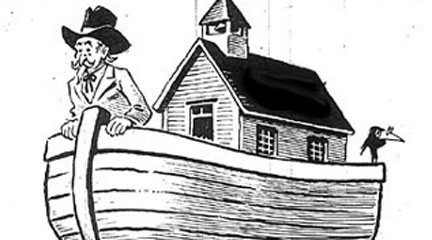
These are political cartoons, which typically do appear on the editorial page and are a comment on the major political events of the day. The first cartoon from May of 1954 entitled “Now What,” was drawn and published in the immediate aftermath of the Supreme Court’s Brown decision.
Typically, the editorial cartoonists will reflect the editorial position of the newspaper. Certainly in the Richmond Times-Dispatch in the 1950s, the cartoonists would’ve more or less reflected the editorial position of the newspaper. By the time you get to the ’50s, you cannot avoid talking about massive resistance, you can’t avoid commenting on the Brown decision, you can’t avoid commenting on the imminent closing of the public schools. These are single images that convey a quite bit of information. Once you really begin to look deeply at this, you start to understand and to see where Virginia has gone in the four years from the Brown decision.
Virginius Dabney was the editor of the Times-Dispatch from the ’30s until late 1960s. And he recognized that massive resistance itself was not going to lead to anything productive, but the publisher of the paper, the Bryan family, were firm supporters of massive resistance, and so the bargain that essentially was worked out is that Dabney just didn’t say much about massive resistance. He certainly didn’t editorialize against it.
This is actually, I think, quite typical of the elites in Virginia, He was certainly amongst those, but Virginius Dabney once famously described massive resistance as an aberration from Virginia’s heritage of sound leadership and forward-looking thought. So, he was able to sort of dismiss this four- or five-year period as a blip on an otherwise excellent record when, in fact in many, many ways, massive resistance is the logical culmination of a particular type of race relations that people like Virginius Dabney did support.
Dabney is a complicated figure in this in that he was somebody who always editorialized for the better treatment of African Americans in Virginia. But within this paternalistic vein that had developed in Virginia; at one point in time he was seen as a liberal in the ’30s because he was advocating better treatment of blacks and anti-lynching. By the ’40s he’s more moderate, by the late ’50s and ’60s he’s actually seen as quite conservative.
Richmond had two papers. There was the Times-Dispatch which was the morning paper and then the News Leader which is the afternoon paper. The editor of the News Leader was James Kilpatrick who was one of the real leaders of massive resistance in many ways. In Norfolk, you have the Norfolk Virginian-Pilot, the other major paper in the state and it was the only one of the white papers that opposed massive resistance. Not that they embraced and desired integration, but that they recognized that the Supreme Court was the law of the land, that the Justice[s] had spoken and it was a responsibility to adhere to those decisions.
The Norfolk Journal & Guide and the Richmond Afro-American were black papers of the time. They were weeklies, and they had a relatively small readership. I think that most African Americans felt they had the Supreme Court ruling on their side and that ultimately that would have to prevail, but getting there wasn’t easy. Richmond was the capital, the power center, and so the Richmond paper certainly was the most important in the state and then the Norfolk paper after that in terms of overall readership.
The 13th Amendment simply abolished slavery towards the end of the Civil War. The 14th Amendment said that no citizen of the United States can be denied the equal protection of the laws. What was so important about the 14th Amendment was that it basically said that any citizen of the United States is first and foremost a citizen of the United States and secondarily, a citizen of their individual state and therefore it meant that no state could deny any individual any of the guarantees that were made by the federal government.
The 15th Amendment said that no person could be denied the right to vote based on race or previous condition of servitude. It doesn’t say that you can’t be denied the right to vote for other reasons, so what you end up with is the implementation of Jim Crow. Because of the 15th Amendment, no state could pass a law which said blacks can’t vote, but what they did instead was come up with all sorts of other methods for achieving essentially the same purpose.
Understanding clauses were educational tests where it was up to individual registrars to decide who passed certain tests. One of the problems with the literacy tests and understanding clauses is that there were in fact many uneducated whites who might have failed those tests. This is where you get grandfather clauses in which states would pass a law which said that if your grandfather could vote, then you can vote. There was no black person whose grandfather could vote because you’re talking about the slave era.
It was under the guise of the 14th Amendment that in Brown, the Supreme Court basically says that the court in Plessy was wrong, that equal protection laws do not allow for segregation. The 14th and 15th Amendment are quite important in terms of understanding the whole edifice of white supremacy and of Jim Crow. It’s not until 1965 with the Voting Rights Act that the vestiges of the disfranchisement laws are finally put to rest.
In the late 19th century you have the implementation of series of state laws, many of them begin with railroad transportation and quickly spread to other aspects of public life. As public schools come into being, they are fully segregated. The segregation laws tend to have to do with public separation of the races in public places.
The whole notion of Plessy v. Ferguson in 1896 when the Supreme Court gives its permission for the South to maintain and build a segregated state. Homer Plessy, who was a man who was one-eighth black, wanted to test the law. The state of Louisiana had passed a law which said that the races could not sit together on railroad cars. He did so anyway. He was arrested, charged with a violation of the law.
The case went to the Supreme Court and by an eight-to-one decision, the Supreme Court said that laws that mandated segregation were okay as long as facilities for both blacks and whites were equal and so the phrase separate but equal comes out of this, talking about parks, playgrounds, schools, trolley cars, then later buses, railroad cars, any sort of place of where the public might mingle.
The standards definition of desegregation is the abolishment of racial segregation and integration, as the full equality of all races in the use of public facilities. A distinction I often find helpful especially in the context of understanding massive resistance, and even more so with what happens after massive resistance is that I think that in many respects desegregation means the end of state-sponsored segregation. Desegregation comes to mean the absolute minimum necessary to comply with the law. What really happens in the wake of massive resistance is that you end up with token integration, at least for another decade until another series of court decisions force more complete integration.
On a national level Brown v. Board of Education was the culmination of a nearly two-decade campaign led by the NAACP to attack segregated education at the professional and graduate school—the whole notion of Plessy v. Ferguson in 1896 when the Supreme Court gives its permission for the South to maintain and build a segregated state.
The NAACP began winning a series of precedents: in the Maryland courts, then Missouri, in Texas, Oklahoma. NAACP recognized that they could keep doing this forever and ever, they basically were arguing that there was nothing equal about segregation, that the states were failing to meet their constitutional mandate under Plessy. The hope was not that they’ll simply increase funding and we’ll have a separate but equal society, but that they would recognize that to do so would be so prohibitively expensive, that real meaningful change would have to take place.
The case of Brown v. Board of Education, which was five cases which all examined the question of segregation in the public schools at the pre-collegiate level—these cases worked their way through the different courts and then finally they were bundled together by the Supreme Court and we know them as Brown v. Board of Education.
In the early ’50s we know Virginia provided one of the cases that was bundled in Brown, the case out of Prince Edward County which started when a group of young students led by Barbara Johns, who was a junior at Moton High School—the facilities in Farmville are horrific and the students finally say enough. Many of their parents are scared because their parents’ jobs depend upon not causing trouble and so the students don’t tell their parents about this. One day they march down to the superintendent’s office and have a protest of their own.
It would be simply wrong to suggest that African Americans in Virginia weren’t demanding more change. Even though the Brown case comes out of Kansas, it’s every bit as much about life in Virginia. People often assume that the Brown decision dealt with segregation and all of its guises and aspects, but the Brown decision actually was limited to segregation in the schools.
Part of the problem with Brown and part of what why we end up with massive resistance is that the court they’re obviously worried about the reaction in the South. So they actually did not in 1954 issue an actual implementation ruling. They could have said all public schools in the South must be desegregated beginning in September, but they did not. They left it up to the district courts and they said they must move with quote unquote “all deliberate speed” and this provides the context for massive resistance.
The NAACP basically said look you’ve got to do this now, or else the white South is going to stall and certainly the NAACP proved to be quite right about this. So, the court decision comes down in May of 1954 and the initial response in Virginia is sort of like this cartoon suggests. The Virginia constitution guarantees every child the right to a public education. So, there were some who thought well maybe if we get rid of that guarantee then we don’t have to run public schools. There were others who thought you know that was going a bit too far. So you have this ferment in the summer or fall of 1954 who are trying to figure out what to do.
We have an ocean with no land in sight whatsoever, but a giant rock sticking up right in the middle. It says “Supreme Court Segregation Decision,” in reference to the Brown decision which declared segregation of the schools unconstitutional. The ship itself is sitting on top of the rock. It’s on the point of the rock so you could imagine if the weight shifted too much one way or the other that it would fall into the ocean. The water itself is pretty still.
The ship is an old wooden vessel labeled The South. Inside the ship there is a schoolhouse. It says public schools. In the front, presumably the captain of the ship is a man that looks like a throwback from the Confederate era. He’s got the trademark long moustache and long, pointed beard. The big top hat, almost a 10-gallon hat except we’re not in Texas but otherwise similar to that. Almost the type of man that you would imagine as a model for Colonel Sanders of Kentucky Fried Chicken fame. This is an old Confederate general, the embodiment of the myth of the lost cause if you will, of the Southern confederacy, and yet here he is in 1954 at the helm of the ship The South standing at the front, but firmly inside the boat, gazing out to sea to look and see whether or not help might be coming.
The overall message is that the Supreme Court decision has put the South in a very difficult spot with regard to the public schools, but disaster is not necessarily imminent. There may yet be a way out of this. The ship is not breaking apart as far as we can see. It’s stuck but not coming apart. The title of the cartoon itself “Now What” suggests some ambivalence about where things are headed.
The Byrds would have to be considered the most prominent political family in Virginia in the 20th century. Harry Byrd, Sr., was the dominant political figure in Virginia from the early 1920s until his death in the mid 1960s. He was elected governor in 1925 as a very young man. Recognized as the head of what comes to be known as the Organization—a small tightly-knit group of important political figures that revolved around the county courthouse the county clerk and the county judge and the county sheriff. He was brilliant at maintaining contact with people, at knowing how to relate with people. People around the state loved Harry Byrd and he was as a governor in some respects progressive for the time, but certainly on issues of race and many others, quite, quite conservative. He went to the U.S. Senate, until 1965 when he became very ill and he actually resigned his seat so that the governor could appoint his son, Harry Byrd, Jr., and then Harry Byrd, Jr., occupied that Senate seat until he retired in 1982.
It’s interesting to note the ways in which the political dynamics of Virginia and the South shifted. Up until the 1960s, Virginia, like every other Southern state, was virtually all Democrats. The Democrats were the party of white supremacy, which makes sense if you think about the Republicans as the party of Lincoln and of Reconstruction. The Democrats regained control in the late 19th century, and it was very much a one-party state until the advent of the civil rights movement when the national Democratic party embraces civil rights beginning in 1948 and then accelerating in the 1960s, you begin to see many southern Democrats switching parties.
A lot of the South was watching to see what Virginia would do. In the fall, the governor appoints what’s known as the Gray Commission in November of 1955. The Gray Commission issues a report. The key provision, and the most controversial one, was a recommendation that the state begin to make available tuition grants so that any white family that objected to sending their child to a school which was integrated could get a tuition grant from the state to go to private school. In January of 1956 the state overwhelmingly voted to amend the Constitution to allow for tuition grants.
The Gray Commission would actually have allowed some integration in places. It was very clear that Arlington especially was ready to integrate its schools. Also, the mountainous parts of Virginia, there’re very few African Americans and they would’ve made financial sense to integrate the schools because running two separate school systems was costly. So the fear was that there were parts of the state that would in fact comply with the court decision and for a lot of people in the southern part of the state, that was untenable.
So, it’s in the spring/summer of 1956 that Harry Byrd and others began to try to formulate a plan and this leads to the real showdown in August and September of 1956 when the governor calls a Special Session of the legislature and what come to be known as the Massive Resistance Laws are passed. The most important components of Virginia’s Massive Resistance Laws were that the people placement was taken out of the hands of local officials and put in the hands of a state people placement board, so that meant that people in Arlington, for instance, could not automatically send to a formerly white school a handful of black students.
Secondly, the Massive Resistance Laws provided for tuition grants. Most importantly, though, what the Massive Resistance Laws did is that they empowered the governor to take control of and close down any schools which integrated as a result of court orders.
On the other side of the issue, there were various people who made very clear that they were more committed to public education than they were to segregation. I think if you had surveyed most white Virginians at the time of the Brown decision they would have preferred to maintain segregation, but that doesn’t mean they’re necessarily willing to defy the Supreme Court. If forced to choose between segregation and public education, they would prefer public education.
The portions of the state, which had the heaviest concentration of African Americans, most of whom were prevented from voting by a variety of reasons, were vastly overrepresented in the Virginia legislature. In the 1956 Special Session when the Massive Resistance Laws were implemented, the key vote in the state Senate was 21 to 17. The 17 who voted against massive resistance actually represented more Virginians than did the 21 who voted to implement the law.
The second cartoon is from late September 1958 and clearly things are quite different. The ship is still intact but somehow it has managed to get off the rock. We have huge waves. There’s massive lightning bolts which appear that they might be headed towards the ship even if they haven’t hit quite yet. The storm is clearly in full force and presumably the waves have risen high enough to pull the ship off of the rocks.
The title “Riding Out the Storm” suggests that there is a way out of this. The fact that the ship has not turned over. It’s still upright. We still have the Confederate-era gentlemen at the helm. He’s now identified specifically as Virginia as opposed to the South. He’s looking out to see what’s ahead, and the presumption is that there is a possibility of still riding out the storm, however severe it now seems to be.
This isn’t a cartoon that has an image of an integrated classroom that somehow leads to some catastrophe. But it certainly suggests that it’s important to maintain segregated schools. Integration is seen as a cause of a storm that’s going to somehow damage or change the way of life.
The character is the same person in both cartoons and yet in the first cartoon, it says “The South,” certainly a sense that the South as a whole is sort of stuck looking for a way out, whereas in the second one, it doesn’t say “The South” anywhere. It does say “Virginia” and so in that case it’s more a sense of this is Virginia’s path because by 1958 much of the rest of the South is watching to see what Virginia will do. The message of the first cartoon is that the Supreme Court decision has caused some problems for the South. It’s not entirely clear what’s going to happen next, but what does that actually mean in practical terms.
By 1958, four years later, quite a lot has happened, both on the national level but especially in Virginia. Those who are most committed to keeping the schools segregated have now taken quite a different step. Instead of the ship saying “The South” on the side, it actually now says “public school closing.” This is the point just a few weeks before schools actually are closed. There’s still a message here that Virginia can navigate its way through the waters. Despite the Supreme Court edicts, this is somehow a viable strategy to get through this crisis, although it’s become much more problematic.
This was a public relations disaster for the state. Histories of massive resistance are often quick to credit a group of businessmen and bankers in Richmond who quietly said you’ve got to do something to stop this, this is hurting the state’s reputation, it’s hurting business.
I think we should be very careful because these individuals said nothing for four years, so to give them credit for stepping in when they should’ve done so much earlier I think is problematic. By the end of 1958, early 1959, the NAACP and others were challenging the constitutionality of the Massive Resistance Laws in both federal and state courts. In January of 1959, both state and federal courts ruled the Virginia Massive Resistance Laws unconstitutional.
So in the spring of 1959, you have a final showdown between those who want to return to the local option, but with tuition grants, always giving white students the option of getting out of integrated schools at state expense and then those who continued to resist despite all the court decisions. What you really end up with is very token integration. The percentage of black students attending white schools is quite small until the late 1960s. In 1968, the Supreme Court finally said enough of ‘all deliberate speed.’ It’s been 15 years since the Brown decision.
Start with what appears to be the obvious and then draw out from that what the different components represent. What does this ship represent? What does the person at the helm represent? What is it that’s going on in the sea here? What might the cartoonist not be telling us or not sharing with us? Asking them to explain what do they see here, what do they think is likely to happen?
I think it’s important to pay attention to all of the details, to really look at each particular component both on its own and also collectively. See how these pieces fit together. You could look at the cartoons without the caption at the top and it would be interesting to see whether the caption is one that you would necessarily come up with yourself based on the image. In reading any cartoon or any image it’s important also to ask what’s not in the picture. And one way you might answer that question is think about how would other newspapers have portrayed the series of events. And in Virginia certainly if you looked at either of the African American newspapers you would have gotten a very different perspective.
The northern Virginian Pilot is the only major white newspaper in the state that opposed massive resistance. And certainly if you were to compare this to cartoons that they had at the time you would see a very different image. They would’ve suggested what they argued editorially, which is that it was doomed to fail. That it could not possibly pass constitutional muster. That by prolonging the inevitable, you’re simply heightening tensions.
It would be very interesting to compare the cartoons with the actual written editorials of those papers. It would be interesting to think about the different ways in which public opinion is reflected. Newspapers aren’t necessarily always accurate. Public documents, to compare what a newspaper is reporting with what the actual public statements are, whether it’s a press release of the governor or looking at the actual laws, looking at election returns. One of the things that’s quite fascinating is to look at private letters, what people are saying behind the scenes. What is the cartoon telling us about the event versus what does it tell us about the person who’s actually created the image. The more sources you can find the better because you’re going to often get conflicting points of view and then it’s important to try to understand those sources in a way that makes those seeming disparities make sense.
Historian J. Douglas Smith contextualizes and analyzes two political cartoons commenting on Virginia government’s reactions to Brown vs. Board of Education and the call for desegregation.