Paintings About Segregation
Transcript
Suzannah Niepold: Some of you jumped right into this, but what’s going on in this picture right here?
Speaker 1: Segregation.
Suzannah Niepold: Segregation. What do you see that makes you say that?
Speaker 1: The big wall in the middle of the room.
Suzannah Niepold: Big wall in the middle of the room. What more can you find?
Speaker 1: Not equal. You’ve got the fan on the one side; the bartender is on the white side.
Suzannah Niepold: The bar tender is on the white side of the bar; the fan is on that side of the bar.
Speaker 2: Is the bartender holding a paper?
Speaker 3: Yeah, I was trying to figure that out, it kinda looks like a face.
Suzannah Niepold: What about his face?
Speaker 3: No, this looks like a face, like, I feel like it’s one of those cartoons, this is like the nose. We’re trying to figure it out.
Suzannah Niepold: Yes, it almost looks like there’s a profile in possibly the newspaper he’s holding; the shadow creates the image of a face. If that was intentional, what do you think the artist was trying to do there? What could it mean?
Speaker 4: Have the white man looking at himself and actually reflecting upon what he’s created, essentially. Looking at himself in the mirror, so to speak.
Suzannah Niepold: Looking at himself in the mirror and reflecting on what he’s created. And what has he created?
Speaker 4: A segregated society, inequality, and divisiveness.
Speaker 5: Unhappiness from the looks of all the people.
Suzannah Niepold: So divisiveness, unhappiness, inequality. Are these kind of separate but equal? We talked about the fan and about the fact that he’s sitting on this side of the bar. Is there anything else you notice that’s different about the two sides?
Speaker 3: There are physically more people on that side versus this side.
Speaker 6: Am I mistaken, is this a woman on this side?
Suzannah Niepold: In red, I believe. I would read that as a woman.
Speaker 6: Okay, so that means something—I’m not sure what.
Speaker 7: I don’t know whether the character is either—I think he’s dancing.
Suzannah Niepold: The man with his hand up this way? Okay, that’s one way to sort of read that pose.
Speaker 7: And then over his shoulder there’s another face.
Suzannah Niepold: So there’s maybe someone facing him and dancing with him. What does that tell you about this side of the room? There’s a woman here, and maybe a second woman dancing with the man. Do you get a sense of the mood or the personality of this side as opposed to this side?
Speaker 8: This one looks much more happy. This one, everyone looks angry or shady, or like something’s going down.
Suzannah Niepold: Shady, what do you see that makes you say shady?
Speaker 8: I mean, this guy’s like looking over his shoulder, that guy has his hat pulled down. And this side as much as it’s not equal, they don’t have the fan and things, I feel like they’re having a better time. It’s almost like they have their own—it’s a different type of freedom.
Suzannah Niepold: So some of the expressions and poses on this side are very—hat pulled down, over the shoulder, kind of angry looking or “shady,” as you said.
Speaker 9: The back of the bar’s like lopsided—I don’t know if that makes sense.
Suzannah Niepold: How—well, tell me about the lopsided idea.
Speaker 9: Well, it’s not equal—it’s not straight, I don’t know.
Speaker 10: I think it’s really the white guy’s perspective, too. You can tell that he’s over here, if he’s looking at it. So he painted himself on that side of the picture.
Suzannah Niepold: So the artist put himself on the white half of the picture so that the person looking at it sees off to one side. We’re not looking at it straight on, with the wall just being a thin shape, we’re seeing the line of the wall.
Speaker 1: A lot of bars have mirrors on the back, so, actually, the artist could be sitting—
Suzannah Niepold: Yes, could be facing the mirror.
Speaker 10: What’s the year?
Suzannah Niepold: 1941.
Speaker 11: And the doorways, maybe it’s just the angle, but the doorways are shorter—one’s larger than the other, it appears.
Suzannah Niepold: But we notice there’s two doorways.
Speaker 11: There’s two doorways, exactly.
Suzannah Niepold: Okay, so what else does that tell us?
Multiple Speakers: They have separate entrances.
Suzannah Niepold: Okay, so separate entrances. Almost trying to create two entirely separate spaces. What’s interesting about the date this work was created is that Lawrence, as a Northern artist—he’s born in New Jersey, he moves to Harlem, spends most of his life in Harlem. This is his first trip to the South, so it’s his first experience with segregation. And he chooses to paint this. This is the year after his famous Migration Series, and if you know that series you know he’s painted the South a great deal; he’s kind of told those stories but he’s never actually been there himself. So this is representing his first experience of being in a segregated place.
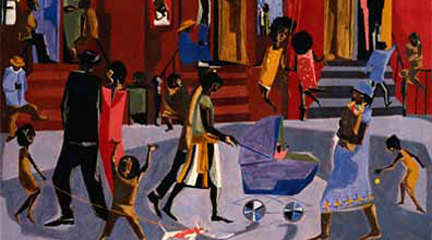
Suzannah Niepold: Next to this is another Jacob Lawrence, he painted this as a study for a mural for New York State on the theme of “Community.” Notice again, it’s hard to see unless you come up a little bit closer to it. How is the mood of this piece maybe a little bit different from the mood of this piece?
Speaker 1: It’s a little bit lighter; everyone’s together.
Suzannah Niepold: Lighter, everyone is together. There’s not that big wall in the middle.
Speaker 2: Lots of smiles.
Suzannah Niepold: Yes, really exaggerated smiles on the faces of the people.
Speaker 3: A sense of cooperation, people are bringing their tools, somebody’s already started working.
Suzannah Niepold: So it’s a cooperative, productive environment of creation.
Speaker 4: It’s not so much social, versus professional—for lack of a better term.
Suzannah Niepold: And then the other contrast we can draw on this wall is this piece over here. This is later, this is 1962. And it’s interesting having it in the context of other works by African American artists, especially dealing with civil rights, because it is, of course, very different—it’s abstract. How can you read—in fact, come up closer, I’m sorry to make you keep moving, but you really need to see. What do you notice about this piece here?
Speaker 1: Red, white, and blue.
Suzannah Niepold: Okay, so red, white, and blue—we associate with America, American flags.
Speaker 2: We’re looking at regionalism here in the United States? I don’t know.
Speaker 3: Each color is in its own area.
Suzannah Niepold: So how would you—where does the United States fit into this? Where do you see that?
Speaker 2: Red, white, and blue, but **then I can take West Coast, I can take the North, the Northeast, the Mid-Atlantic, the Southeast.
Suzannah Niepold: So are you saying that you see the shape of the country?
Speaker 2: If you wanna see it you can, yeah.
Suzannah Niepold: That is the joy of abstract art, right? No, you’re not the only one to see the shape of the country in the colors; so maybe we’re looking at regional differences. Knowing that this is about civil rights, does anything start to emerge with the colors?
Speaker 4: Upside-down peace symbol?
Speaker 5: Abstract Klansmen.
Suzannah Niepold: Can you point any out specifically?
Speaker 5: I don’t know, that kind of strikes me—
Speaker 6: Horsemen there, and this turns into flames when you put—
Suzannah Niepold: So then the white maybe represents the white robes of the Klan, what might the other colors start to represent? Blood, flames, smoke, absolutely. So the red, white, and blue is kind of transformed into something very different. The title of the work is “Evening Rendezvous.” Why choose the title “Evening Rendezvous” rather than, you know, “Meeting of the Klan”?
Speaker 7: It sounds a lot better.
Suzannah Niepold: But it sounds better in what way?
Speaker 7: I mean, it doesn’t sound bad.
Speaker 3: Nothing bad is happening.
Suzannah Niepold: Nothing bad is happening, it’s part of what’s going on.
Speaker 8: They did things in secret; if people knew they were coming, they’d probably run.**
What did the experience of segregation look like? Suzannah Niepold of the Smithsonian American Art Museum guides teachers in analyzing three paintings on segregation: Jacob Lawrence’s Bar and Grill (1941) and Community (1986) and Norman Lewis’s Evening Rendezvous (1962).