Slave Life at Mount Vernon
Transcript
Tour Guide: In archaeology we see the real hidden lives. So we’re going to go around and see where they lived.
Saida Patel: I’ve never been to Mount Vernon before, and when you walk through the mansion or the slave quarters, you see that most of the places are defined by the people and I’ve never really communicated that with my students. I’ve never told them that place is defined by people. I hope to use that in different units that we do and talking about different places and how you can learn about people through studying those places and how people define those places as well.
Tour Guide: Well, don’t forget, you lived where you worked. Who were the skilled workers? The men. And most of the females are agriculturists.
Samantha Brewer: The tour was really like, this is the information, this is the history, I’m going to tell it to you.
Tour Guide: Now, Washington really wanted there to be positive incentives for working.
Samantha Brewer: And the activities were much more what can you as an observer, as an intelligent person who has some amount of background knowledge, deduce from this without me telling you anything, just what can you see in the situation here.
Voice off-screen: Who has the clipboard?
Teacher 1: Alright, we’re looking at things. Alright, start talking and I’ll start writing. We do have some guiding questions, do you have your detective hats on, I don’t notice them.
Teacher 2: It’s close quarters, just a common little cough, common little sneeze, could infect everybody here.
Teacher 3: And there’s not really a lot of ventilation.
Teacher 4: Right, and it’s dark.
Teacher 2: Dark and a little damp.
Teacher 3: They wouldn’t have had these lights.
Teacher 5: The window is like cross ventilation there.
Teacher 3: Yeah, but that’s the only—‘cause there are these windows but—
Visitor 6: ‘Cause I was thinking the stairway from the kitchen that might have been where the main slave woman in the house that might be—have been her quarter.
Multiple Visitors: Oooh.
Saida Patel: We were supposed to put what we knew behind. So, we went with a clear mind and we were assigned into groups. We had daily life with the slaves. She told us to go in as “foreigners” and look at the objects there and analyze them: Why were they used? Why do you think this was here? What is this? Which I really enjoyed and I think it would be great to use with the students as well because it engages them automatically with the material.
Samantha Brewer: It’s really transferable to any sort of place, even if it’s some place that we haven’t studied or a place that I personally don’t know a lot about going into it.
Meagan Rafferty: Sometimes you’re going to have a teacher that comes in and their only thing that they really what to do here and take away from here is seeing the mansion. And other teachers say, you know, it meant everything to me to go on a slave life tour and learn more about the history of the enslaved community. And then still others say, you know, I just really wanted to do a hands-on workshop and walk away with these materials that I know I can just translate right into my classroom. Often times the group leader will have different expectations than the group members themselves. And so the way that I try to mitigate that is I try to put something in the schedule for everyone.
Esther White: One of the things that we’ve been talking about a whole lot is, you know, when you go into these places every single thing that’s there, it’s all there for a reason. Someone has thought about even the direction that it will be placed on the thing and what is next to it and why it’s there and every single one of those objects is supposed to sort of tell you a whole story about something.
Teacher 1: One thing I found a little bit hard was the shaving kit, the actual little brush that people used to put the shaving cream on their face—
Esther White: What I’m going to give you this afternoon is our internal memo that kind of goes through all the highlights of what’s actually there and some of the decision-making processes that the curators used to get stuff back. So, yeah, the shaving kit is based upon a period shaving kit.
Samantha Brewer: It’s really not enough to just say this is what history was. You really have to ask people—kids—to really think about it and draw their own conclusions and take their own interpretations and that the process of evaluating different sources and different places really leads them to a much deeper, richer understanding of history that really stays with you and gives you things that you can actually work with in everyday life.
Esther White: I know probably on your slave life tour, right, it came up—let’s see, what always comes up? Was George Washington a good master? I don’t even know why we have to talk about that, right, he owned slaves. How do you put “good” with that, right? That’s just a funny—
But I think then the challenge is how do we take that and expand the story? Expand it out. We’re starting with that idea that, you know, yes, there are slaves here. Fact. There’s either 316 or 317 depending upon the way you count the census, so I’m always a little bit fuzzy about that. But there’s, you know, over 300 enslaved folks here. Now, you guys were looking at two bunkrooms, right?
Teacher 1: I would think showering is more of a maternal thing.
Teacher 2: And shaving would indicate male quarters.
Teacher 3: And the children, you know, if you think about it—
Esther White: What did you guys observe about work, or free time, from looking at the stuff in the those quarters?
Visitor 1: Well, I guess one thing we said, that some of the things that they might have been doing that were part of work could be used also for leisure, like knitting or sewing, you know, cooking food. We did see some other activities related to children in women’s quarters, like marbles, and we noticed that there was a doll.
Esther White: Maybe a lot of leisure activities cross over. From stuff you’re doing maybe for fun or for relaxing and stuff you’re doing for work.
Visitor 2: We noticed also that what they did for work they also had to do for their home, as you could call it, if that’s what it was. What they did for work—they also had to do laundry, mansion [laundry and] laundry for themselves; cooking at the mansion, cooking for themselves. Like she said, some of those kind of crept over into leisure—not really leisure, but you know what I mean.
Esther White: But that’s not really leisure, right? Where’s Group Two?
Teacher 3: Oh, right here.
Esther White: What themes did you guys have?
Teacher 3: Food.
Teacher 1: Washington’s stuff is in the bags over there.
Esther White: Did it surprise you guys about the variety of food that there was?
Teacher 3: Yes, I was.
Teacher 4: I was surprised.
Esther White: That’s one of the things—
Teacher 5: Well, we couldn’t see the variety that was in the sacks.
Esther White: Okay.
Teacher 5: We could assume there was grains, flour—
Teacher 3: And was what was in the sack for them or was that—
Esther White: For elsewhere? Oh, good question.
Teacher 3: Right. It said GW on the bags.
Teacher 5: Because you asked us to try to differentiate foods that were rations and foods that were theirs, we assumed that those were rationed out foods from GW. And is that right?
Esther White: I think that’s what they’re supposed to be. They are rationed out foods and they are rationed out cornmeal. So all those sacks are only cornmeal.
Teacher 3: And in the women’s quarters there seemed to be much more cooking going on. You see the cornbread made, you see some stews. And in the men’s you see a rabbit, you see a duck.
Esther White: Yeah, I always notice that when I go in. The man has the rabbit and the women are doing the cooking. So is he going down with his rabbit and saying, you know, what that might be? “Hey, I’ve got a rabbit. Oh, I’m sweet on you, would you like to cook it up for me?” Or?
Teacher 5: Or I caught the rabbit, you cook it, let’s eat it together.
Esther White: Right, because I’d like to spend time with you. Or I’m in charge of hunting and you’re in charge of cooking and that’s just the way that we have negotiated our spaces up here because we have got to get along. And you can just pull it apart in lots of different ways and begin to really think about individuals and what we know about them and where they’re living, and then begin to concoct bits and pieces of their lives.
What does a place tell you about the lives and work of its inhabitants? Educators tour Mount Vernon’s slave quarters and ask questions of artifacts and architecture.
Related Topics
Pockets from the Past: Daily Life at Monticello
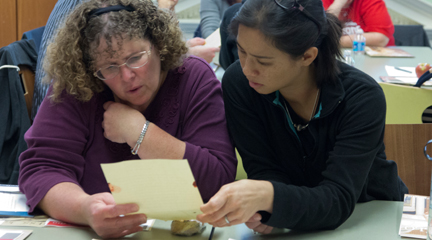
What do the contents of pockets say about their owners? TAH teachers model strategies for examining and questioning …
Abraham Lincoln Presidential Library and Museum
Teaching Abraham Lincoln and the Civil War? Explore this storehouse of Lincolnian history.