The Salem Witch Trials
Transcript
17th-century America was a very religious world. And people believed fervently in God, and along with that was a belief in the Devil. And so, what being a witch meant to people in the 17th century was that somebody—usually a woman, but not always—had signed a contract with the Devil. That contract gave the Devil permission to go into that person’s body, to take their shape and go around and harm other people.
First of all since they did live in a religious world, they had to go to church services; they heard about God and the Devil all the time during a regular week. Ministers were always talking about God and Satan and how you had to be careful not to go down Satan’s path, basically. The important part for this is that Puritans were very concerned that if they—they were looking for signs to see whether or not they were among the “elect.” And that meant whether or not they would go to heaven once they died. So they were also looking for signs that they were actually going to hell. And looking for signs that maybe Satan was taking them along that path.
So all of this business about witchcraft, when the witchcraft accusations started in 1692, it didn’t come from out of nowhere. They were just very used to thinking about God and the Devil in these kind of very . . . proximate ways—that God and the Devil were always around.
In New England there were over 200 accusations during the Salem crisis. So all of those records of people being accused, of people being—undergoing an examination, going to trial, all of this was written down. One of the questions that sometimes comes up when I teach this material is, “Why would a person confess to witchcraft?” It doesn’t seem like it would have a good outcome. . . . Why? Because the rule was “thou shalt not suffer a witch to live,” which meant that somebody who was a witch was going to be killed, so why would you confess to this? It doesn’t seem to make any sense. Well, one of the reasons—but this didn’t come to light until pretty far into the whole process—but one of the reasons was that all of the confessors ended up living. And all of the people who denied ended up being hanged.
Now people didn’t know this was going to happen in the beginning of the whole process, but I find this really interesting. What was going on here? At first, the confessors, they just kept them in prison. The reasoning was that they wanted them to confess, and name more names, you know, who else was involved in this witchcraft scheme? So they kept them in jail hoping that that would happen. And then ultimately when the whole thing was over they were released.
The deniers, as we’ll see, were just never believed. When a person, supposedly, became a witch that meant that they had given themselves over to the Devil by signing this pact. So that was kind of like the worst thing that you could do on a spectrum of sin; I mean obviously signing the Devil’s pact, that’s the absolute worst thing that you could do. But it was a sin and there was a spectrum of sins in the Puritan world. And so what we see with the deniers is that they try to deny this. “No I had nothing to do with the Devil! I had nothing to do with signing his pact! Really, I’m a wife, I’m a mother, I do everything right!” And they would have supporters come in to court saying, “Yes, my wife or my aunt or my cousin or daughter—whoever—was the model of Puritan womanhood.” They didn’t say it in those words, but “she’s just perfect, she could never have done this pact with the Devil.” And then they would try to push the person to see, “Well, haven’t you done some sin? Haven’t you let the Devil in the door even just a little bit?” Then these women who were good Puritan women kind of had to admit that, “Yeah, okay, maybe a little bit I let Satan in the door.” Then the accusers—the court—would just kind of seize on that saying,“Really? You let the Devil in your heart? What did he look like? What shape? When did he come to you?” And kind of push them, push them.
So let me give an example of that. Okay, so this is a woman named Rebecca Eames. She was accused of witchcraft, and her confession—I’ll just read this. You can see how several things are blending together here in her confession. She says:
She explains to the court that after making a black mark with her finger, sealing the covenant.
So she’s admitting that she signed the Devil’s book. And this is a quote from the source:
She was then in such horror of conscience that she took a rope to hang herself and a razor to cut her throat by reason of her great sin and committing adultery. And by that the Devil gained her, he promising she should not be brought out or ever discovered.
So that’s her confession. It doesn’t really say anything about witchcraft, doing anything wrong, harming any other people. What it says is that she signed this compact with the Devil because he told her she wouldn’t get found out about the sin of adultery. So she’s bringing something else up all together, this is one of the occasions where I want to just yell back to Rebecca, “Don’t mention the adultery! That’s not what they’re asking you! Just talk about witchcraft, you didn’t do it.” So this confession really displays this terrible confusion on the part of some women who confessed, and we’ll see how they talk about the deniers in kind of a different way. But the idea is that some women I think unwittingly said, “Yes, I signed the Devil’s book” when really they meant “Yes, I’ve done some sin in my life”—as everybody did, there wouldn’t have been any person who would have said, especially not a woman, “I’m free from sin.” That just wasn’t part of their worldview of how sin and godliness worked.
Okay, so let’s look at this Rebecca Nurse’s denial:
Rebecca says, “I have none but old age.”
This is coming in the middle of a several-page exam and the question to which she’s responding here, they ask her something like, “What infirmities do you have? Why haven’t you been to church meeting? What’s wrong with you?” basically. And she says, “Nothing, I’m just old.”
And then the magistrate says, “You do know whether you are guilty and have familiarity with the Devil? And now when you are here present to see such a thing as these testify a black man whispering in your ear and birds about you, what do you say to it?”
And she says, “It is all false, I am clear.”
And the magistrate says, “Possibly you may apprehend you are no witch. But have you not been led aside by temptations that way?”
She says, “I have not.”
And the magistrate says, “What a sad thing it is that a church member, here and now another of Salem, should be thus accused and charged.”
And then the narrator says, “Mrs. Pope fell into a grievous fit and cried out, ‘a sad thing, sure enough!’ And then many more fell into lamentable fits.”
So even if you just take that paragraph you can see how the magistrates are pushing her to admit to something. She was an elderly woman, really pious, everybody agreed—everybody was surprised that she had been accused of witchcraft because it just seemed that that would be the farthest thing from anything that she would do. She says that she’s clear, but they say, “Okay, maybe you’re not a witch but haven’t there been any temptations that have come your way?” And she says no here, but as it goes on you can see how they’re just trying to get her to say, “Okay, fine!” but she doesn’t. So she ends up denying the whole thing, she sticks with her denial, and in the end she is hanged for this because she couldn’t prove—as it was hard for any of the deniers to prove—that not only did they not sign the Devil’s book, but they were perfect in every respect, they had done no sin. That was just something that wouldn’t have been believed because everybody kind of agreed that people were sinners, and they were more likely to believe that women were sinners than men.
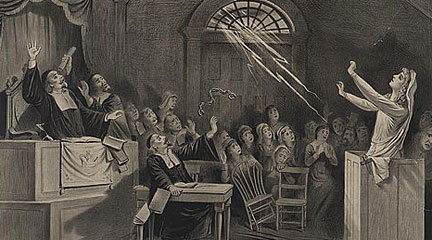
Okay, so the other thing that’s compelling here is that—this part where it says, “Mrs. Pope fell into a grievous fit and cried out. . . .” The broader context is that it’s happening in what’s become a courtroom—the church meeting house has basically become a courtroom—and everybody in the town is there. It’s not like today’s court where somebody would say, “Quiet down or I’m going to kick you out!” There was a lot of raucousness going on and people were screaming out, saying, “Yes, she is a witch!” And it was hard, even for Rebecca Nurse, for people to dismiss all that.
The magistrate says, “Well, then, give me an answer now, do you think these suffer against their wills or not?
She says, “I don’t think these suffer against their wills.”
“Why did you never visit these afflicted persons?”
She says, “Because I was afraid I should have fits too.”
And then the narrator says, “Upon the motion of her body fits followed upon the complainants abundantly and very frequently.” So if she ran her hand through her hair or something, then the people who were doing the accusations would also run their hands through their hair and mimic what she was doing. Which again, this is something that seems ridiculous to us, but to them it seemed very compelling. What could be better proof that something strange is going on here?
At the very end the magistrate says, “Do you believe these afflicted persons are bewitched?”
And she says, “I do think they are.”
Now, she feels that she has nothing to do with it, but even the fact that she’s saying, “I do think they are,” that kind of implicated her even further because everybody assumed that she probably did have a hand in it. Even though Rebecca Nurse knew she was innocent and fought for her innocence until they hanged her, she had some sense that she wasn’t free from sin. Not that that meant that she deserved this or she had signed the Devil’s book according to their theories, but you can see that this made me think that a lot of women probably shared this sentiment. She says, “Well, as to this thing, I am innocent as the child unborn, but surely,” she said, “what sin [has] God found [out] in me unrepented of that He should lay such an affliction upon me in my old age.” She knows she is not a witch, but she is trying to search her innermost thoughts to think, “Well, what have I done that I still haven’t repented for that this is my punishment?”
So the confessions are very different. We can look at a confession by a woman, Mary Osgood. I asked this question earlier, and I ask my students, why would a person confess to witchcraft? Partly I think the reason is that after a while—and by September when she confessed, this might have been her situation—that she thought that she’d get off if she confessed because they didn’t seem to be hanging the confessors; so that seemed like a good strategy. But more than that what I like to look for in these confessions is, what was compelling to the magistrates? You couldn’t just say, yeah, I did it, and call it a day. You had to—the confessions had to be realistic, it seems weird to say they have to be realistic, they sound so preposterous, but realistic to the audience. I think what we have here in the confessions is a justification and a legitimation as to what the court was doing. Because there was some criticism about the way the court was handling the whole thing. So in these confessions, in a lot of them, you have a lot more going on than just a simple, yes, I did it.
She confesses that “about 11 years ago when she was in a melancholy state and condition she used to walk abroad in her orchard, and upon a certain time she saw the appearance of a cat at the end of the house, which yet she thought was a real cat. However, at that time it diverted her from praying to God, and instead there of she prayed to the Devil. About which time she made a covenant with the Devil, who as a black man came to her and presented her a book. Upon which she laid her finger and that left a red spot. And that upon her signing, the Devil told her he was her god and that she should serve and worship him. And she believes she consented to it. She says further that about two years ago she was carried through the air in the company of Deacon Frye’s wife, Ebenezer Baker’s wife, and Goody Tyler to Five Mile Pond where she was baptized by the Devil, who dipped her face in the water and made her renounce her former baptism and told her she must be his soul and body forever and that she must serve him, which she promised to do.”
So there’s a lot going on here. She is really giving the court exactly what they want to hear. Because—and also what people in the audience and the ministers and everything would have recognized this kind of language because for one thing, beyond the bounds of the witchcraft crisis, ministers would have told people in church on Sundays and other days of the week that you have a choice between God or the Devil, its up to you—you can choose to go God’s path, you can take Satan’s path. So she’s basically saying that back, that she had a former baptism but then the Devil came to her, presented her with this book, she had to renounce her former baptism, go with him. The key part here is that she consented to it. She confesses she has afflicted three persons, and she mentions the people and that she “did it by pinching her bedclothes and giving consent that the Devil should do it in her shape. And that the Devil could not do it without her consent.” So she says this a number of times, and I think this was appealing to the court to hear this, to the magistrates, to hear this. It’s like, “Oh, look, we are doing the right thing. The Devil just can’t go and take anybody’s shape, or he doesn’t seem to want to do that, he wants to get their consent. He wants to get these witches’ consent, that’s what makes somebody a witch.” So I think it was very legitimating to their whole process, even though they were under some fire for the way they were proceeding.
Another thing that she says that’s important, that also would have resonated with people at the time. The question is, “Do you know the Devil can take the shape of an innocent person and afflict?” And she says, “I believe he cannot.” And they say, “Who taught you this way of witchcraft?” And she says, “Satan,” and that he “promised her abundance of satisfaction and quietness in her future state, but never preformed anything. And she has lived more miserably and more discontented since than ever before.” So this would have also been an interesting thing for them to hear and kind of a realistic thing because in the context of a weekly sermon the minister might have said, “If Satan tries to lure you into his clutches, he might promise you a lot of things. You might think that he’s going to come through on those things but he never does. So that’s not a good idea to go down his path.” So she’s kind of mimicking exactly what the ministers might have said. He promised her things, but never performed anything; and not only that, but she’s been miserable ever since. So I can almost imagine people saying, “Yep, yep, that’s how the Devil is. He’s very clever that way. That’s how it works.”
Anyway, so there are these elements in a confession that show, to me, that one of the key issues to look at is not so much why people confessed, but how they confessed. What were the important elements that made for a successful confession? And a “successful confession” meaning one that you didn’t die as a result of. I think in general Puritans were more likely to—even though they thought that men and women were equally available to bond with the Devil—they thought that women were more likely to. That women were—had a predisposition to bond with Satan.
Sometimes [my students] ask about the people doing the accusing, what was motivating them? Didn’t they feel bad that people were dying as a result of what they were doing?
One of my responses is that, have you ever said something, and you knew it wasn’t exactly right, but people seemed to respond in the way that you wanted. So you couldn’t go back and say, “Oh, no, no, that was an exaggeration, I made that up.” You’d get in trouble or whatever. And they all can relate to that.
Also I think this speaks to this question that there was a lot of confusion going on, so maybe the accusers were just doing it out of malicious intent or they had a history of bad feelings about a particular family that they were accusing the woman of. But maybe something bad did happen to them that they really did think that this person caused it. People were talking all the time about “so-and-so walked by the house five years ago. After that, our cow died.” This didn’t seem preposterous to them; witchcraft was a way of answering certain strange things that happened in their world. Again, very credible to actually think, “Yeah, my cow died and it probably was this person. And we’ve had some bad dealings. . . .” So all these things kind of add up. They’re really racking their brains to see what they did in their life, and really soul searching and being good Puritans. That’s what you were supposed to do all the time, this constant soul searching. Like with anything that you study historically, there really isn’t one answer to any of these questions that can be raised about Salem. There’s just little glimmers that we think well maybe, maybe this is what was going on.
Some people recanted, they initially confessed and then took it back. Here are just a couple of sentences from this person Margaret Jacobs. She wrote to her father from Salem Jail that she had confessed. Here’s just a couple words that I think are so significant. She confessed by reason of “the magistrates’ threatenings and my own vile and wretched heart.” So you have both things going on here. She’s pressured into confessing—she feels pressure, external pressure; but she also feels this internal pressure that her “own vile and wretched heart,” something about her past sins, caused her to confess. She says in a later statement she characterized her confession as completely false, saying that she had “been hurried out of my senses by the afflicted persons. Saying they knew me to be an old witch and if I would not confess I should very speedily be hanged. Which was the occasion with my own wicked heart of my saying what I did say.”
This is one of the values of actually looking at the primary documents and immersing yourself in them. I think it’s more important to emphasize that, rather than emphasize the narrative of what actually happened. In fact, when I teach this I barely even tell the students what happened, how it ended, any of it. I just say here’s the Salem witchcraft trials; I explain what I explained here, let’s look at this. So they don’t even know really—because most of them haven’t even done the reading until before the exam—so they might not even know the outcome. We just plunge in to look at this. I think that helps because then they’re not so focused on how it ended or how things could have gone differently. They can ask those questions by looking at this, what if they hadn’t pushed them, then would that of. . . . Well someone will inevitably ask, why didn’t they just question them in private? That would have avoided a lot of the shrieking in the actual courtroom, the whole courtroom drama. And then I’ll say, well, that’s a really good idea, asking in private. One of the women who was accused did say to the magistrates, “Look, this is insanity, what’s going on here. Why don’t we pursue this in private?” Sure enough, that suggestion, in combination with other things that contributed to the ending of the whole thing, did help to tone everything down. Because when you don’t have that and you’re just one-on-one it’s a very different dynamic.
So anyway, sometimes it’s better not to give students everything because then they think that there’s no need to look at the primary sources so much if they already know the answers. Because many of them just want the answers for the test, whereas I don’t want them to focus so much on the answers, I want them to see the process unfold. Because to me that’s the exciting part of being a historian, and I try convey that to them that that’s the exciting part. Let’s see what these people were thinking. To us it seems so out of our range of what’s normal, but this was normal for them. So what’s going on here? Let’s focus on the primary sources.
Primary sources provide details the narratives of popular, textbook history often neglect. Historian Elizabeth Reis analyzes testimony from the Salem Witch Trials, looking at what both confessions and denials say about religious and social norms among the Massachusetts communities involved.