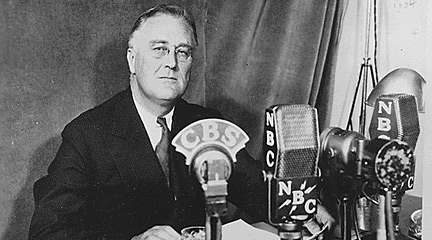
FDR's Fireside Chats
Transcript
Joe Jelen: I wanted them to sort of grapple with the context of the Fireside Chat and really think about what was happening then and how that was influencing what FDR was going to talk about, and think about the uncertainty that surrounded 1935. And so what I had students do was actually to visualize that and to draw what that looked like to them, during their warm-up contextualization exercise.
They—I feel that students too often think of FDR as a savior and think of the New Deal as without critics. And I think that too often people believe that everyone was onboard with the New Deal, when the reality was that people had their doubts and people still had their nagging concerns about whether the New Deal plan would work.
They’ve read in the textbook about FDR at this point. They know about the Fireside Chats; they know a lot about the Great Depression. This is getting towards the end of the unit on FDR, looking at how FDR is trying to convince the people that his plan is going to change the course of the country and bring the country out of the deep, deep recession that it was in.
Joe Jelen, in classroom: Listen for his tone. Listen for how he’s saying these words and think about how’s that important to understanding the context of 1935 here.
FDR, voiceover: The overwhelming majority of people in this country know how to sift the wheat from the chaff in what they hear and what they read. They know that the process of the constructive rebuilding of America cannot be done in a day or a year.
Joe Jelen: It was nice to have students listen to FDR’s voice and give kids a good sense of the year 1935, thinking about what listening to a radio would have been like and think about how FDR used his voice and used tone and used his reassuring metaphors to really capture his audience.
The next step was to have students then draw or label some of the uncertainties or what they were concerned about in the year of 1935.
Joe Jelen, in classroom: Imagine that you’re listening to one of FDR’s Fireside Chats for a moment and draw a picture of what that looks like. What does that look like to you? Stick figures, fine.
Joe Jelen: And this one student draws a picture of a family listening to the radio. He’s worried about money, this family is worried about unemployment, family, poverty, jobs, death, homelessness, food. So they’re really—they are getting the context and they were really thinking about what it would have been like to listen to the radio at the time.
I did notice that one student who had, he had drawn a homeless family that was pressed up against a shop window. Listening to the radio at a shop, instead of listening to this at home, which of course is again really capturing some of the contexts of the time, and I was excited to see him draw that.
Joe Jelen: There was a ‘during’ listening activity where they were to answer three questions. Looking at—the questions were designed to have students look at the tone and look more specifically at FDR’s text of what he was saying.
We went into sort of a group discussion about how the speech captured, and how FDR used metaphors to capture America’s attention and how that was important to getting his New Deal programs through.
Joe Jelen, in classroom: How does FDR’s voice strike you? Casey?
Casey: Slow and sort of reassuring. Slow, reassuring, it has an upbeat sort of tone to it. Francis?
Francis: He kind of, uh explained it in an easy way to understand.
Joe Jelen: He’s going to explain things in an easy way to understand. For example, Francis. From the, from the speech.
Francis: Kind of like when he was talking about building our ship and relating that to the making of governmental policies.
Joe Jelen, in classroom: Awesome. Why did he give the address? Andrew.
Andrew: To tell Americans that things are being done in Washington, and they’re trying to make policies and all that to help get them out.
Joe Jelen, in classroom: He’s telling Americans that there is something being done.
Student: Building up, like, his argument against the Republicans by, you know, saying, oh, things are happening, we’re working it out, even though some people might not see it, it’s getting worked on.
Joe Jelen, in classroom: He’s saying to bear with it. It’s a big plan, it’s a big picture. And before you can set the ship out to sea you need to build it up, you need to build the structure—you need to make the structure strong before it can go off into the ocean.
Joe Jelen: And I was pointing out to students that it was important that none of FDR’s New Deal legislation could have been passed without Congress’s support and their voting for his legislation. And so how now he’s using the people of the United States to influence their Congress people, tell them to push through FDR’s legislation.
Following our warm-up activity, we then launched into looking at some of the criticisms of FDR.
And each student was assigned a particular critic of the New Deal. They were first asked to read about that critic, read the biography of the critic and look at, on the back, look at the primary source that was associated with this critic and the New Deal.
Joe Jelen, in classroom: How would your critic criticize that piece of the speech?
So you’re thinking where was criticism coming from? You said, the Republicans on one side, but also?
Student: Socialists.
Joe Jelen: Okay. So that—
Student: He seems like a really liberal socialist.
Joe Jelen: Okay. Still, imagine. Imagine what he would argue. So you’re, you’re section one, obviously dealing with the big picture, so how is Mr. Shouse going to attack the big picture?
Student: It costs too much money and he has not enough whiskey [?].
Joe Jelen: And FDR is becoming this powerful executive.
Student: Yeah, and he doesn’t like that.
*Joe Jelen:*And what is he, what’s Schouse and the American Liberty League scared of?
Student: [Unintelligible] He’s becoming too powerful.
Joe Jelen: Yeah. Exactly.
Joe Jelen: And I really wanted students to focus, to imagine themselves as this critic, get inside that person’s head and really look closely at FDR’s text.
And I didn’t want them to see the bigger picture but, rather dissecting FDR’s Fireside Chat into these four segments,
Joe Jelen: Students were asked to end up writing a paragraph about their criticism of FDR’s speech and their particular section. Finally, as a group, they presented that to the class. While the class meanwhile was taking notes on a capture sheet where they were to detail which arguments each of the critics were standing up and making.
A lot of the students write about FDR not doing enough. This student took the role of Norman Thomas writes, “What progress is this legislation making?”
Student: There are still people on the streets and workers are working too hard and not making nearly enough money. The money we’ll spend on this New Deal program, Mr. President, is money that won’t be going to the American people. Mr. President, you would do good to be more like Robin Hood, to steal from the rich and give to the poor. Maybe the reason that nothing is happening in this country is because you’re constantly out of the office and out in your woods.
Joe Jelen: And of course he is going to spend time in Hyde Park or at Warm Springs. Interesting that students alluded to that.
Student: The relief needed for exceeds that which is being provided. FDR needs to nationalize industry and work hard to break down all of the reamining monopolies. The federal government must work with the state and local governments to do this, and then they need to take the wealth and share it equally with all workers.
Joe Jelen: Again, great. I am happy that the student is seeing what Norman Thomas is interested in. And that idea of nationalizing industry that Norman Thomas has, and trying to get rid of any monopolies.
Student: While the New Deal is moving in the right direction, we must go further to ensure that the depression is lifted. Despite government action, the crisis persists. It’s clear that to truly aid the people, FDR must do far more. The gap between rich and poor has expanded in the recent decades and this has caused many of our problems. To fix the crisis, the government must act for the common man and punish the rich for their actions. Our president must refuse to bow to Republican influence and expand the power of government so that all people, not just the rich, can prosper.
Joe Jelen: Charles Coughlin, of course, uses a lot of charged language in his rhetoric and the student, too, is capturing some of that.
And finally, for homework, students were asked to write an essay response dealing with the New Deal criticisms and dealing with the supports that FDR is giving in his speech. I was really hoping that students took away some knowledge of the criticisms that FDR was receiving. They knew that Republicans were largely against New Deal legislation, but they weren’t as familiar with some of the more left-wing criticism, the socialist criticism, the communist criticism, the American Liberty League criticism of FDR.
It’s nice to try to turn over student learning to them and allow them to run with things. I think that one of the things that I really liked about the lesson was that students were asked to be creative and to play the role of a critic and get up on stage in front of the class and pretend to be that critic. To really engage in not only, you know, thinking of history as this stagnant thing, but make it interesting and make it fun. And I think that students were able to do that through working in groups and playing the role of one of these critics.