The Assassination of Abraham Lincoln
Transcript
Bill Kendrat: Now the class that I just taught is 6th-grade American history. It’s the first part. It goes up to the Civil War. It’s the conclusion of the Civil War, and it has Abraham Lincoln being assassinated. We’re just entering the period of Reconstruction. It’s a springboard for the 7th-grade teachers to pick up next year, and I ask a series of routine questions. Usually, I have them write it down. Again, it’s another way of learning—via tactile. But simple questions like “What do you see?”
Bill Kendrat: Speak to me. What do you notice about this image up here? Anything. Aidan.
Aidan: He’s got a really good looking moustache.
Bill Kendrat: Ah. Great lookin’ moustache.
Student: Yes.
Bill Kendrat: Do we usually see a lot of moustaches like this? Not a lot today. Not a lot today. Isabelle.
Isabelle: Well, there’s like a hand showing in the picture, and you said, like, it costs more if their hand is in the picture.
Bill Kendrat: Ah, but there’s one catch when we talked about that. What’s the difference with this image compared to the images from the Revolutionary period? Libby.
Libby: Um. They invented the camera before the Civil War.
Bill Kendrat: Yes. The camera had been invented. Is this a portrait? Is this a portrait, or what is it?
Student: A photo.
Bill Kendrat: A photograph. Right. This is a photograph, so we know that it’s some time after the photograph was invented which was just before the Civil War period. What do you see? Rachel.
Rachel: He has a cane.
Bill Kendrat: He has a cane. Excellent. What else do you see? Student: He’s posed?
Bill Kendrat: He looks like he’s very stiff, maybe posed. Nice job. What else do you see?
Student: He looks like he’s wearing a nice jacket.
Bill Kendrat: Beautiful. Look at this. Look at that material. Does that look like it would be cheap in that time period? No. Not at all. What do you see?
Student: He’s, like, looking out of the window or something.
Bill Kendrat: He’s not looking directly at the camera. He’s gazing off like in thought.
Bill Kendrat: Then we’ll progress to the idea of what kind of inferences can be made.
Bill Kendrat: Laura.
Laura: Uh, he’s, like, famous.
Bill Kendrat: Why do you say—think he might be famous?
Laura: Um, because, like, they, like, they kept the picture after, like, after a lot of [Cuts off.]
Bill Kendrat: Very possible. That if they’ve kept this picture all these years, he might have been a famous person. I like your logic. [Points to student.]
Student: Uh, there might be something wrong with his legs, because he’s got a cane.
Bill Kendrat: Ooh. There could be something wrong with his leg if he’s got a cane with him. Good job, guys.
Bill Kendrat: Finally, we’ll start to bring it home to what is actually happening, and I think that that’s primarily my role.
Bill Kendrat: As a matter of fact, this guy is pretty well-to-do. This guy is pretty famous. In fact, some people would go on to say that he is the most eligible and handsome man in America for that day and age. This is a real person obviously. He is in the Civil War period, and it’s a person that is going to change history. This person is going to end up touching even our lives today. This is during the black and white photograph era, and this person is going to end up being known, not for a good thing, but for a bad thing. Does anybody want to take a guess? Anthony?
Anthony: He killed Abraham Lincoln?
Bill Kendrat: He’s the gentleman that assassinated President Lincoln. Does anybody know his name from history? Armand?
Armand: John Wilkes Booth.
Bill Kendrat: John Wilkes Booth. That’s absolutely correct.
Bill Kendrat: They—They want to know more, in this case about John Wilkes Booth; and then we will talk about Lincoln and the assassination. They want to know more. It’s a step process, a building step.
Bill Kendrat: What I’m going to do is I’m going to walk you through a game of wallpress.
Students: Yeah. [Quietly]
Bill Kendrat: I came up with this idea of wallpress as a type of means to dissect a primary document. Promethean Boards have changed our world in so many ways. Before I used to just give them a sheet of paper, and they looked at it with a partner. I still do that. I want them to see their personal copy, because sometimes the Promethean Board doesn’t give the definition or the specifics that you can see from a distance; so they have their personal copy, and they have the Promethean Board copy. Half the class is up pressing against the walls. The other half of the class is sitting in the middle. And I put all these questions around the room in all different colors, just because I think the eyes crave color, so it just sucks them in. They grab one of the questions of “who,” “what,” “when,” “where,” and “why,” and “how.” They look at the Promethean Board, and they end up forming a question that’s based on what word they’re pressing against.
Student: How did, uh, John Wilkes Booth get so close?
Bill Kendrat: Oof. Awesome question. How did John Wilkes Booth get so close to the president?
Bill Kendrat: Then, they’re going to reflect that question back upon the audience in the middle. The person that created the question can call on three people that are sitting in the middle, and they’ll try to answer the “who,” the “what,” the “when,” the “where,” the “why,” the “how” in the best means that they can using the logic from the picture.
Student: Because they’re so entertained with the, um, show that’s going on that he snuck up quiet.
Bill Kendrat: Very interesting. He is so—the people are so engaged in the show that’s being presented that he sneaks up without being noticed. Second person. Jonathan.
Laura: Next to that place in the stage, there’s a door behind it, and that’s really close, so he came in through the door.
Bill Kendrat: Ah! There had to be a back door pretty close that he could slip in through.
Megan: Well, I’m guessing that that backside, like, didn’t have, the best security, so he probably could get up there easily.
Bill Kendrat: Very interesting observation. Apparently, there wasn’t great security there, so Megan’s pointing out, because of lack of security, he could slip through. Make sure I come back to that point in the summary. That’s a great, great inference.
Bill Kendrat: After the last, the third guess, is attempted, that person chooses another person along the wall and that person gives their question.
Bill Kendrat: What do ya got? What’s your question?
Student: Um, why?
Bill Kendrat: Why. Give me a good why question.
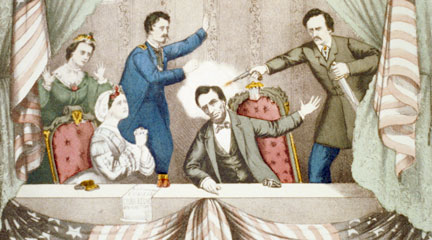
Student: Why are they surrounded by Union flags?
Bill Kendrat: Interesting. We are we surrounded by all these Union flags?
Student 2: Because the war was just finished, so they’re pretty much celebrating, and they won.
Bill Kendrat: Very interesting. The war’s finished. They’re celebrating. They’re celebrating the Union holding together.
Student 2: Maybe, um, because he’s, um, one of the most— probably one of the most famous Americans; and he’s aloft [uncertain if “aloft” is correct], so. . .
Bill Kendrat: The idea that he’s a famous American. My goodness. Very famous American, and he’s shrouded in the United States’ flag.
Student 3: Maybe it was showing that that balcony was reserved for the president, like.
Bill Kendrat: It’s a presidential balcony, and it shows the presidential suite, if you will. That this is reserved for him. Making it special. Very good.
Bill Kendrat: We do this for about five rounds, and then we switch. The we give the people that were sitting the ability to ask the questions and the people that were standing to now sit and answer the questions.
Student: Why is John Wilkes Booth assassinating Lincoln?
Bill Kendrat: Why is John Wilkes Booth assassinating Lincoln? Higher level thinking question. Good stuff. You’ve got three people.
Student 2: He was, um, he was a slaveowner.
Bill Kendrat: One. He might have been a slaveowner kind of resenting the fact that slavery is coming to an end. Good idea.
Dawn: Um, he was like from the South, and, like, he was in the Army and didn’t want to lose.
Bill Kendrat: He was in the South, and in the Army, and didn’t like the idea that the Confederate Army lost. Good one.
Libby: Um, like, kind of what Dawn said, that he was on like the Confederate side and, um, because, um, like Lincoln helps the Union to win, he like resented him.
Bill Kendrat: He resented Lincoln leading the Union to victory over his Confederate forces. Ladies and gentlemen, you’re doing an excellent job at this breakdown. You’re dissecting this portrait well.
Bill Kendrat: In doing that, we end up finding that there’s a balance where everybody knows in some way or shape or form they can participate. You know, you might not be one of them called on, but if you want to end up giving an answer, you can raise your hand. No one will be ignored; and by the way, they just get sucked right in, and they become the social scientist. They become the archaeologist. They’re digging up history.
Bill Kendrat: I bring them back together, and we talk about the story—what actually happened and why it happened.
Bill Kendrat: What play was Abraham Lincoln when—what play was he attending when he was killed?
Student: Our American Cousin.
Bill Kendrat: Our American Cousin, which, by the way, was a popular play; and it was a very, very humorous play that brought laughter. I’m going to pause here, and I’m going to let you know that Booth was an actor professionally. He was well known. He knew Ford’s Theatre. He’d performed there before. The people—the stagehands knew him. They did not perceive him as a threat. It was normal to see Booth around. The day before he was staking out the joint, and he was looking around, seeing what would be the best way to make this plan work. From your reading, you realize the conspiracy went even further. The conspiracy was not just to kill the president, but who else was an intended victim?
Student 2: The vice president.
Bill Kendrat: The vice president. And who was the third intended victim?
Student 3: William H. Seward.
Bill Kendrat: Seward. That’s right. William H. Seward. Ladies and gentlemen, this was a conspiracy and the lead man was Booth himself. Now, we’re going to try to take a look at what happens.
Bill Kendrat: There’s a couple things that I probably would just tweak. Like at the end of the lesson, what I did is an activity—an experiential exercise where I had the students dress up. I had four students. One became President Lincoln. One became the major. One became his date, Clara Harris. And the last one was Mary Todd Lincoln. And I had them actually dress up in period costumes, things I had accumulated through the years; and I played the villain, the assassin John Wilkes Booth.
Bill Kendrat: Ladies and gentlemen, I want to remind you that Ford’s Theatre had a back door. Earlier, you guys had pointed out that it looked like that the president was not very well protected. Very, very good point. He was not well protected. There was no Secret Service back then. They did have the Pinkerton Agency. That was more of a spy network than an anti-spy network or anything else.
He came up this back stairway. He slides in, very quietly up the stairway. He waits. He waits. And in a specific part of the play when a great deal of humor was going to break out and laughter, he is going to end up taking advantage and shooting the president.
[To student dressed as Lincoln] You may put the hat in your lap.
[To the class] You’re going to see Mrs. Lincoln panic. After Booth jumps off the balcony, Mrs. Lincoln really loses it, and she jumps up and she starts flapping her arms; and it is said that she looked like a bird trapped in a cage, flapping, saying, “Help! Help!” Major Rathbone is going to stand up, and he is going to try to come to the aid of the president; but when that happens, he gets stabbed with a knife.
Student: By?
Bill Kendrat: By Booth.
Student: Mr. Kendrat, I thought he had already jumped off.
Bill Kendrat: Booth had —Not yet. This is going to be just before.
Bill Kendrat: Miss Harris is going to stand up, and after Booth clears the stage, she is going to end up saying, “The President’s been shot!” at the top of her lungs. All the crowd in the meantime was clapping and laughing at the scene when all this happened, and when Booth hits the stage, he has a comment, “Sic semper tyrranis,” which means, “Thus always to tyrants.” And that ends up happening, and Booth ends up limping across the stage, because he breaks his ankle when he catches it on the bunting in front. This all transpires, and many of the people sitting in the play thought it’s part of the play—it’s part of the act.
Students: What? No!
Bill Kendrat: They thought it was a new twist to make it more interesting for them since the president was there that night. It became very interesting. Let’s take a look at it.
Bill Kendrat: He waits. He waits, and all of a sudden the crowd laughs and begins to applaud.
Students: [Laugh and applaud.]
Bill Kendrat: Bang!
Students: [Laughing and applauding continue in addition to at least one shriek.]
Bill Kendrat: Whoo. [“Stabs” Major Rathbone.]
Student as Clara Harris: The President’s been shot!
Bill Kendrat: And it was just a little five-minute thing, but I had their attention totally now for this entire lesson. Ninety minutes had gone by where we were jumping off, catching a spur on the bunting, but being able to explain it all, and them wanting to stay there even to the point of the class being over to hear how it’d end up, how it’d turn out. Again sucking the kids in.
Bill Kendrat: He will go on a fleeing spree. He thought people would rally behind the cause, but they did just the opposite. They were tired of war. They were disgusted. Much like Robert E. Lee said, “Go home. We fought a valiant fight. It’s over.” But not in his mind. All the other conspirators that were caught, and they were all caught, were hanged. All the guilty parties were put to death, including Mary Surratt, the first woman ever killed for treason—hanged for treason.
It would eventually finish in a barn, where he would be killed. A man that killed him was a very religious man who believed that God was leading him. He was a religious man that was a soldier for the Union. There are several other stories out there about Booth, but the most reliable story is he was shot fleeing from a burning barn.
Ladies and gentlemen, please give a hand to our actors and actresses. They did a fine job.
Students: [Applaud.]
Bill Kendrat: It’s an amazing way to get the kids, again, active as learners, and if you get them active as learners, you’re going to end up having active learning.
How do you draw students in to the study of history, while not skimping on the facts? Bill Kendrat of Belmont Ridge Middle School, VA, leads his students into a lesson on the assassination of Abraham Lincoln. Using a combination of primary sources, presentation, and roleplaying, he awakens students’ curiosity, informs them of known facts, and involves them in visualizing the people and events.