Central Question: How did Revolutionary War contain multiple "wars" of independence?
Textbook Silences
In many U.S. history textbooks, Black Americans are largely written out of the story of the American Revolution. Individual figures such as Crispus Attucks — a real person considered to be the first colonist killed during the Boston Massacre — appear, but beyond such brief mentions textbook narratives tend to offer little sustained attention to the roles Black Americans played during the Revolutionary era.
In many textbooks, Black Americans reenter the narrative only at the end of the story, in discussions of emancipation in the northern states or the long-term consequences of the Revolution for slavery. While these are important developments, this framing reinforces the idea that Black Americans were peripheral to the Revolution itself and rather than active participants throughout the unfolding of the crisis.
This silence on Black roles during the Revolution reflects the same structural pressures that shape textbook narratives more broadly. With the competing interests of limited space and expansive coverage, textbooks often present the Revolution as a relatively straightforward story about liberty, individual rights, and the emergence of a new nation. Complexity is often minimized. As a result, Black Americans, if included at all, are frequently treated as exceptions to the narrative rather than as integral to it.
Historians Focus on Agency
Yet historical scholarship tells a very different story: Black Americans played significant and varied roles throughout the Revolutionary era. Thousands of Black Americans fought on both sides of the conflict. Many thousands of others decided to remain neutral. Each of these individuals made strategic decisions oftentimes in pursuit of their own freedom and thus shaped the meaning and consequences of the Revolution itself. Far from being marginal figures, they were central actors in a deeply contested struggle over liberty.
Historians have long worked to recover and interpret these experiences. In 1961, historian Benjamin Quarles offered a powerful reframing of Black participation in the Revolution. “[Black Americans]role in the Revolution,” wrote Quarles,” can best be understood by realizing that his major loyalty was not to a place nor to a people but to a principle. Insofar as he had freedom of choice, he was likely to join the side that made him the quickest and best offer in terms of those ‘inalienable rights’ of which Mr. Jefferson had spoken.”
This emphasis on choice highlights a key concept in historical thinking: agency. Black Americans were not passive recipients of the Revolution’s outcomes; they actively shaped their own paths within the constraints they faced. For many, the war presented both risks and opportunities—a chance, however uncertain, to move closer to freedom.
Later historians have further complicated this picture. Gary Nash, for example, describes Black Americans as fighting “a revolution within the Revolution.”
Nash writes:
In the centuries-long history of Africans in America, the struggle to gain freedom and wrest equality from a resistant white society has been the consuming desire that has kept harrowed bodies and weary souls going. In this struggle to cross the river from bondage to freedom, the American Revolution had enormous importance. It marked the first mass slave rebellion in American history, initiated the first civil rights movement, spawned the first large-scale constructions of free black life, brought forth the first written testimonies from African Americans who wanted the world to hear of their strivings and freedom claims, involved the first emergence of what W.E.B. Du Bois called the ‘talented tenth,’ and had international repercussions.
One of the most striking aspects of Black participation in the Revolutionary War is the extent to which it disrupted later assumptions about race and military service. As Nash points out, the Revolutionary War was the last American conflict until the mid-twentieth century to feature integrated fighting units. In the North, Black soldiers served alongside white soldiers, often at higher rates relative to their population and on average for longer enlistments. In the decades that followed the American Revolution, Black abolitionists would frequently cite their Revolutionary military service as evidence that they were deserving of freedom and citizenship.
While over 5,000 Black Americans joined the Patriot cause both as soldiers and as camp followers (which included many women), a significant number of Black men and women chose a different path: they joined the British. This decision was likely not rooted in loyalty to the Crown, but in a desire to seek their own liberty. In 1775, Lord Dunmore, colonial governor of Virginia, issued a proclamation promising freedom to enslaved people who escaped from rebel enslavers and joined British forces. The response was immediate and substantial. Thousands of enslaved men, women, and children fled to British lines, seeking to secure their emancipation through military service.
Importantly, historians have shown that this movement toward British forces was not simply a reaction to Dunmore’s proclamation. Even before it was issued, enslaved people were already escaping and attempting to negotiate their freedom. The proclamation formalized and expanded an existing pattern of resistance, underscoring once again the agency of Black Americans in shaping their own destinies.
Complexity in the Classroom
For teachers, incorporating these perspectives into the classroom requires allowing students the time and space to wrestle with competing narratives and conflicting evidence. One effective approach is to foreground primary sources that reveal the presence and participation of Black Americans during the Revolution. The Declaration of Independence itself offers an entry point. Among its grievances against the British Crown is the accusation that the king incited “domestic insurrections”—a reference, in part, to efforts to encourage enslaved people to seek their freedom. This language can open up nuanced discussions about how the Revolution connected to themes of liberty and independence in different ways to different groups.
Individual stories can also be powerful teaching tools. Figures such as Primus Hall—a Black soldier who later petitioned for rights and recognition—provide concrete examples of how Black Americans participated in the war and continued to advocate for freedom afterward. Women such as Belinda Sutton also directly advocated for their own freedom by petitioning the government in this period and these petitions can be effectively used in the classroom. Pension records, petitions, and military documents can help students trace these experiences and understand the contributions that are often left out of textbook narratives.
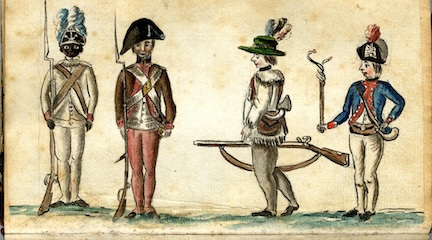
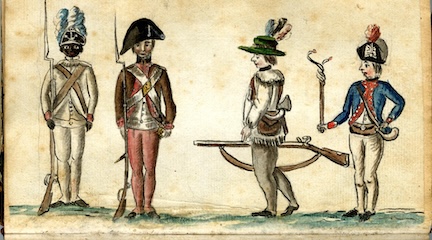
Visual sources, such as a print of Black soldiers from the 1st Rhode Island Regiment, can further reinforce the crucial participation of Black Americans. These sources invite students to ask deeper questions about why certain stories have been emphasized while others have been marginalized.
Another valuable strategy is to engage students in historical interpretation. For example, teachers can have students examine such sources as Dunmore’s Proclamation and learn about the thousands of enslaved people who joined the Loyalists and British to fight for their own freedom. From there students might be tasked with coming up with a title for an exhibit or textbook chapter about the American Revolution that encompasses a more inclusive range of historical perspectives. Activities such as these push students beyond simple answers and into the kind of complex reasoning that defines historical thinking.
Introducing Dunmore’s Proclamation to students also provides an excellent opportunity to discuss the role of women and children who also took the opportunities to escape to British lines during the Revolution. As this post from Colonial Williamsburg makes clear, Black women like Nanny, Eve, Aggy, and Lucy also made strategic decisions about freedom. Taking advantage of the proximity of British forces in Tidewater Virginia in 1781 these four enslaved women fled the estate of Peyton Randolph.
Using sources like those above to support student inquiry aligns with what education scholar Brenda Santos describes as the distinction between “figuring out” and “finding out” questions. Rather than treating history as a set of fixed facts to be memorized, it encourages students to grapple with ambiguity, weigh evidence, and construct interpretations. In this context, the American Revolution becomes not a single, unified story, but a collection of overlapping and sometimes conflicting narratives.
Teachers can take this a step further by asking students to revise textbook accounts themselves. What would it look like to write a history of the Revolution that fully incorporates Black Americans’ experiences? How can multiple perspectives be included without collapsing into confusion? These are challenging questions, but they invite students to engage directly with the process of historical construction.
Ultimately, the goal is not simply to add more content, but to rethink the framework of the narrative itself. Students should be encouraged to ask: what part of the story is missing and where can we find it? The American Revolution was not driven solely by a unified group of colonial leaders, nor did it produce a single, shared outcome. It was a complex and contested process in which many different groups—including Black Americans—pursued their own visions of freedom.
By bringing these perspectives into the classroom, teachers can offer students a richer and more accurate understanding of the past. Just as importantly, they can model a form of historical inquiry that values complexity, acknowledges multiple viewpoints, and recognizes the agency of all participants. In doing so, we move closer to a history that reflects not only what happened, but how it was experienced by the many people who lived it.
Primary Sources
"Lord Dunmore's Proclamation" (1775)
By his Excellency the Right Honourable John Earl of Dunmore, his Majesty’s Lieutenant and Governor-General of the Colony and Dominion of Virginia, and Vice-admiral of the same.
A PROCLAMATION.
As I have ever entertained hopes that an accommodation might have taken place between Great-Britain and this colony, without being compelled, by my duty, to this most disagreeable, but now absolutely necessary step, rendered so by a body of armed men, unlawfully assembled, firing on his Majesty’s tenders, and the formation of an army, and that army now on their march to attack his Majesty’s troops, and destroy the well disposed subjects of this colony: To defeat such treasonable purposes, and that all such traitors, and their abetters, may be brought to justice, and that the peace and good order of this colony may be again restored, which the ordinary course of the civil law is unable to effect, I have thought fit to issue this my proclamation, hereby declaring, that until the aforesaid good purposes can be obtained, I do, in virtue of the power and authority to me given, by his Majesty, determine to execute martial law, and cause the same to be executed throughout this colony; and to the end that peace and good order may the sooner be restored, I do require every person capable of bearing arms to resort to his Majesty’s STANDARD, or be looked upon as traitors to his Majesty’s crown and government, and thereby become liable to the penalty the law inflicts upon such offences, such as forfeiture of life, confiscation of lands, &c. &c. And I do hereby farther declare all indented servants, Negroes, or others (appertaining to rebels) free, that are able and willing to bear arms, they joining his Majesty’s troops, as soon as may be, for the more speedily reducing this Colony to a proper sense of their duty, to his Majesty’s crown and dignity. I do father order, and require all his Majesty’s liege subjects to retain their quitrents, or any other taxes due, or that may become due, in their own custody, till such time as peace may be again restored to this at present most unhappy country, or demanded of them for their former salutary purposes, by officers properly authorized to receive the same.
Given on board the ship William, off Norfolk, the 7th of Nov.
LORD DUNMORE
God Save the King
Citation
"Excerpt from the Declaration of Independence" (1776)

Citation
1st Rhode Island Regiment. Soldiers in Uniform. c. 1781.
Citation
"Primus Hall, alias Trask. Petition to Congress" (January 4, 1838)
**PRIMUS HALL,**ALIAS TRASK.
[To accompany bill **H.**R. No. 318.]
JANUARY 4, 1838.
MR. EWING, from the Committee on Revolutionary Pensions, made the following
REPORT:
‘The Committee on Revolutionary Pensions, to which the petition of Primus Hall, alias Trask, was referred, report :
That the same committee, at the second session of the 24th Congress, investigated this case, and made a favorable report thereon; that the petition and evidence have been again examined with care, and entirely concurring in the sufficiency thereof, a bill is herewith reported; that the state of facts to which reference is made, and upon which this bill is predicated, are as follows:
The petitioner is a man of color, and asks that a pension be granted to him for revolutionary services. He states, in his application to the WarDepartment, that, in the month of February, 1776, he enlisted at Cambridge, in the State of Massachusetts, as a private soldier in the company commanded by Captain Joseph Butler, of the fifth Massachusetts regiment, to serve for the term of one year; that the whole of this term he was engaged at his post. He was at Winter hill, near Boston, while that city was besieged by General Washington, until its evacuation by the British. From thence he marched with the army to New York, where be remained until the enemy took possession of the city. He was in all the skirmishes from that period until the battle of White Plains, where he bore a part; thence his regiment, crossing the Hudson, marched into New Jersey, and was attached to the command of General Lee, when that officer was surprised and made prisoner, near Basking Ridge. The petitioner was after-wards in the battles of Trenton and Princeton, and having served out the entire period of bis enlistment, was honorably discharged at Morristown. Hefurther states, that, in 1777, he again enlisted for the term of three months, in a company of militia commanded by Captain Samuel Flint, of Danvers, Massachusetts, in the regiment of Colonel Johnson, and marched to Saratoga, where his regiment joined the army under General Gates; that he was in the second engagement with the British, under Burgoyne, when his captain (Flint) and his lieutenant (Herrick) were killed. The
Thomas Allen, print
2 _[ Rep. No. 275. ]
petitioner claims to have faithfully served his whole tour of duty, and was discharged at East Chester.
He claims further, that he served three months, in 1778, in the company commanded by Captain Woodbury, during which time he was in Rhode Island, assisting in the erection of fortifications, and performing the duty of a guard. That, in 1781-82, he served twenty-two months as steward to Colonel Timothy Pickering. And was finally discharged at Newburg, New York, in 1782, in the month of December.
While in Virginia, attached to the army, in 1782, at Dumfries, his pocket-book, the petitioner states, was stolen from him, which contained his several discharges for his three first tours of duty; and his last discharge is also lost.
The petitioner further states, that he did not apply for a pension under the law of 1818, in consequence of the amount of his property. He is now nearly eighty-one year$ of age, and needs the aid of his country. The evidence to sustain the petitioner’s claim is-
1st. The affidavit of Thomas Thorpe, who is eighty years of age. This witness enlisted at the same time with the petitioner, in Captain Butler’s. company, and served out the whole period, as the petitioner in his application has stated, which exceeded twelve months; and his testimony corroborates the petitioner’s in all the details of that service: the witness is apensioner himself, and has been, since 1818, in part, for the same service.
2d. The affidavit of Elijah Flint, the son of Captain Samuel Flint, who was killed at Saratoga. He states that he knew the petitioner was a soldier in his father’s company, and served as he has stated. Also, the affidavit of John Brown, who belonged to the same company, and served with him for the whole term for which he was enlisted.
The committee are satisfied that the petitioner has fully sustained, by dear and unimpeached testimony, the material statements in his memorial, and that he is justly entitled to a pension for a faithful service of eighteen months as a revolutionary soldier, not merely in camp duty, or the ordinary performance of military obligations, but in the field of battle, where his bravery and good conduct a1·e proved to have been such as would have done honor to any man.
The Commissioner of Pensions has refused, from time to time, to allow apension to this free colored man on different grounds; for a detail of which the committee refer to the papers marked 1, 2, 3, and 4, which they make a part of their report. The reasons given by the Commissioner, is sufficient in themselves at any time, have all been obviated, as the committee believe, by the testimony which has been produced.
Citation
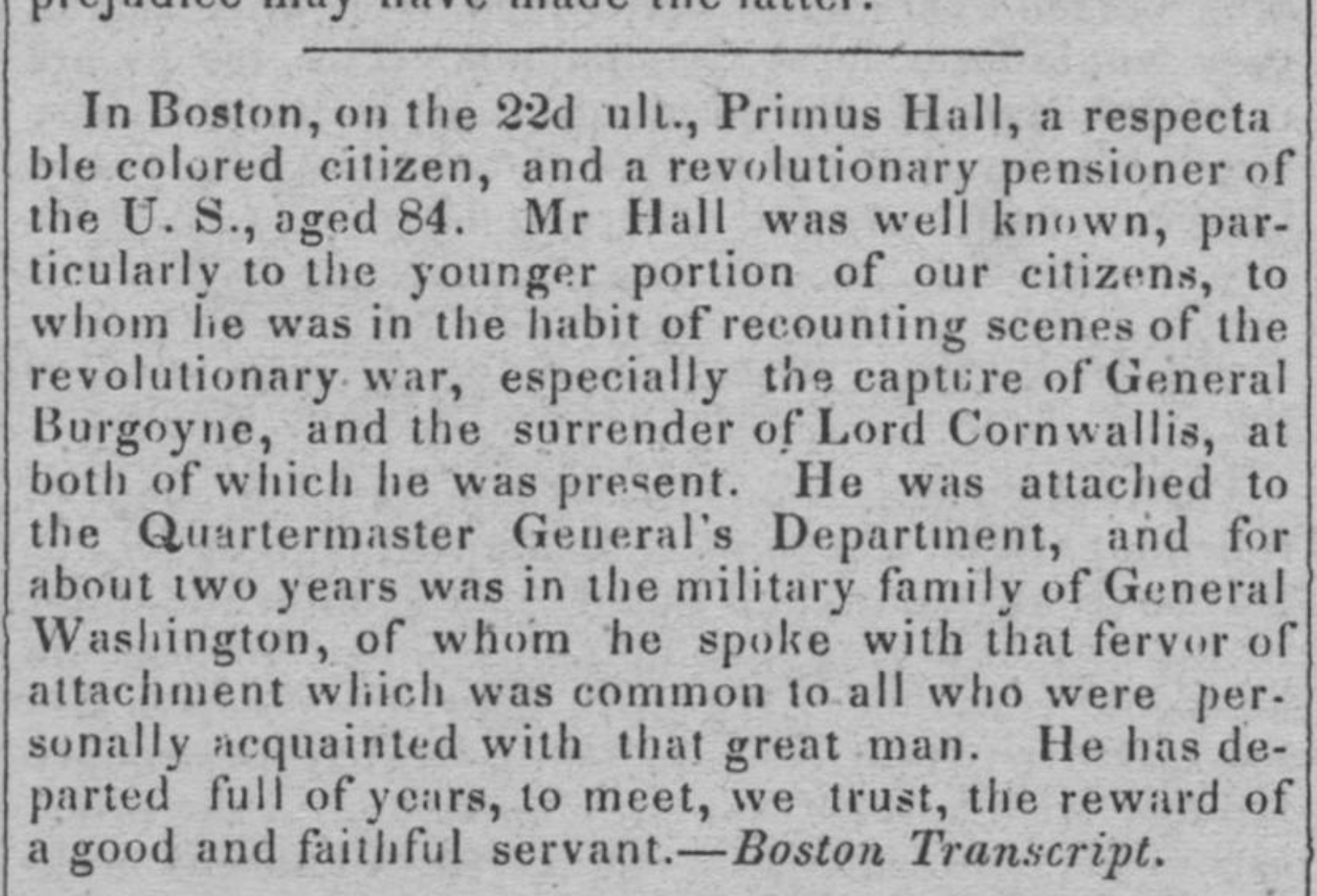
"Primus Hall Death Notice" The Liberator (April 8, 1842)
Citation
Annotated Bibliography
Primary Sources
This exhibit from the Library of Congress brings together three extraordinary collections — George Washington’s papers from the Library of Congress, George III’s scientific instruments from the Science Museum Group in London, and George III’s papers from the Royal Collection and Royal Archives. They reveal their shared interests in science and agriculture and illuminate how they approached the challenges of their time, including war, slavery, politics, and the pressures of public life. Included in this collection is Lord Dunmore’s 1775 proclamation that promised freedom to all indentured servants and enslaved to those in rebellion against Great Britain.
Secondary Sources
Danielle Allen, “A Forgotten Black Founding Father: Why I’ve Made It My Mission to Teach Others about Prince Hall”, Atlantic (March 2021). https://www.theatlantic.com/magazine/archive/2021/03/prince-hall-forgotten-founder/617791/
Karen Cook Bell, Running From Bondage: Enslaved Women and Their Remarkable Fight For Freedom in Revolutionary America (2021)
Kathleen DuVal, Independence Lost: Lives on the Edge of the American Revolution (2016)
Sylvia Frey, Water from the Rock: Black Resistance in a Revolutionary Age (1991)
Ronald Angelo Johnson, Entangled Alliances: Racialized Freedom and Atlantic Diplomacy During the American Revolution (2025).
Adam McNeil, “Norfolk to Nova Scotia Judith Jackson’s Crooked Road to Freedom,” Colonial Williamsburg, https://www.colonialwilliamsburg.org/discover/18th-century-people/stories-of-black-life/judith-jacksons/
Warren Eugene Milteer, North Carolina’s Free People of Color, 1715–1885 (2020)
Gary B. Nash “The African Americans’ Revolution,” in Oxford Handbook of the American Revolution (2012) edited by Edward G. Gray and Jane Kamensky pp. 250–70.
Gary B.Nash, The Forgotten Fifth: African Americans in the Age of Revolution (2006).
U.S. National Park Service, Primus Hall: A Revolutionary Life of Service https://www.nps.gov/articles/000/primus-hall-story-map.htm
U.S. National Park Service, The Women Present at Valley Forge https://www.nps.gov/vafo/learn/historyculture/valleyforgewomen.htm
Cassandra Pybus, Epic Journeys of Freedom: Runaway Slaves of the American Revolution and Their Global Quest for Liberty (2006)