Decoding U.S. Foreign Policy: The Iran-Contra Affair
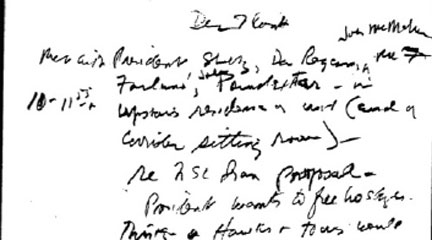
This lesson, part of the HERB collection at the American Social History Project, allows students to examine a series of primary source documents related to the Iran-Contra Affair and discuss the central issues surrounding these events. In addition to great background information for the teacher, there is a useful timeline and graphic organizer that help students access the content.
One of the strongest components of this lesson is the unique documents it uses. In addition to a document entitled “The C.I.A. Advises Nicaraguans How to Sabotage the Sandinista Government,” there are handwritten diary entries by Secretary of Defense Casper Weinburger and internal communications within the CIA . With the aid of the document analysis form, students discover the differences between internal official documents and personal accounts thus allowing them to see how audience and purpose affect a document’s contents. This document analysis form also asks students to consider what each document reveals about the unfolding of the Iran-Contra Affair and U.S. foreign policy during the Cold War. Given that the creators have identified the approximate reading difficulty of each document, teachers can use this information to purposefully group students.
This is already a flexible lesson and we suggest teachers consider adding a summative assessment task that requires student writing. As is, the lesson includes a final discussion and guiding questions but no student product requiring that individual students show their understanding. This lesson could also serve as a great scaffold for a document-based essay on motivating factors in U.S. foreign policy during the Cold War.
Notes
Teachinghistory.org Lesson Plan Rubric
| Field | Criteria | Comments |
|---|---|---|
| Historical Content | Is historically accurate? | Yes |
| Historical Content | Includes historical background? | Yes |
| Historical Content | Requires students to read and write? | Yes. Students examine documents and complete analysis forms but lack a final written product. |
| Analytic Thinking | Requires analysis/construction of interpretations using evidence? | Yes. Students examine primary sources including journal entries and internal memos. |
| Analytic Thinking | Requires close reading and attention to source information? | Yes. Document analysis form supports this skill development. |
| Scaffolding | Appropriate for stated audience? | Yes. Includes reading level indicators and repeated graphic organizers. |
| Scaffolding | Includes scaffolding materials and strategies? | Yes. Graphic organizers and modeling strategies. |
| Lesson Structure | Includes assessment criteria focused on historical understanding? | Yes. Discussion of essential questions included; written assessment could be added. |
| Lesson Structure | Defines clear learning goals and progresses logically? | Yes |
| Lesson Structure | Includes clear directions; realistic for classrooms? | Yes. May require tailoring for specific student populations. |
Related Topics
Theodore Roosevelt and the 1912 Election
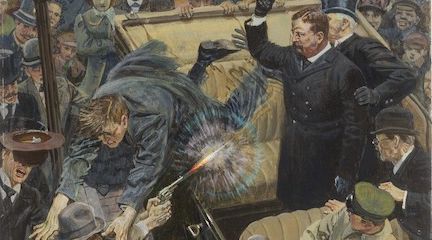
Students learn more about the larger than life figure of Theodore Roosevelt through sources related to the presidential …
John F. Kennedy and Service
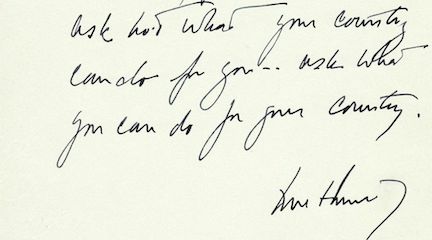
Students learn about John F. Kennedy and his ideas about service as a prompt to explore what service means in their …