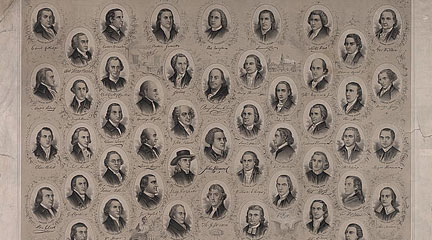
During this one-week workshop, workshop fellows will walk the streets and alleys that Benjamin Franklin walked, step through the doorways that he knew, sit in the churches where he worshiped, and stroll around the houses and public buildings where he helped to found the United States. Fellows will also explore the many rooms of Benjamin Franklin's mind: writer, printer, civic leader, politician, diplomat, scientist, revolutionary, founder. They will read Franklin's words—published and personal—and those of other men and women who lived in the era. They will examine the key aspects of gender, of race, of social class, and diverse other topics.
Two types of credit will be available to each educator participating: Institute staff will assist educators in receiving continuing education credit (similar to Pennsylvania's Act-48 requirements). In addition, participants may register for graduate-level credit through the Pennsylvania State University, which will require both participation in all programs of the week-long workshop and additional readings and assignments.
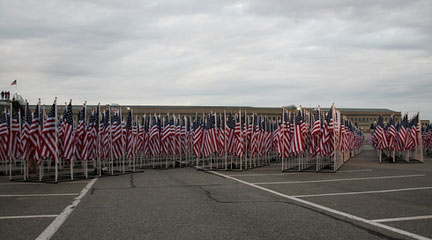
This workshop will provide the larger historical and cultural context for understanding the Pearl Harbor attacks by illuminating one of the most important (if at times antagonistic) bilateral relationships in the 20th century—that between the United States and Japan—and the impact of that relationship on both nations' international affairs. Importantly, it will explore the multiple histories that converge at Pearl Harbor—including not only American and Japanese but also Hawaiian and diverse American experiences, especially those of Americans of Japanese ancestry—reminding participants that despite the mythic status of the Pearl Harbor story in American culture, there are in fact a number of "Pearl Harbors," with different impacts and memories for diverse Americans and for people throughout the world. During the workshop, participants will visit the Arizona Memorial and related attack sites in order to gain a sense of the time and place represented by these historic resources. Since the history of Pearl Harbor is still a living history, participants will also have the unique opportunity to meet with Pearl Harbor survivors, World War II generation residents of Hawaii, and Japanese Americans who spent the wartime years in internment camps, and to experience history "come alive" through their oral histories. Importantly, the workshop will model ways to teach collaboratively. Participants will engage in rigorous conversations with leading U.S. and Japanese scholars about the historical significance and meanings of the events surrounding the attacks and important cultural and historical issues that continue to shape national perceptions of Pearl Harbor. Through hands-on sessions, participants will work closely with the scholars as well as with a group of teachers from Japan and with one another as they explore issues of content and pedagogy in teaching Pearl Harbor and develop plans for collaborative projects and lesson plans that integrate materials from the workshop. In this way, the workshop will serve as a catalyst for creating a network of educators dedicated to ongoing scholarship, professional development, and collaboration.
Participants in this workshop will travel throughout the Delta as they visit sites where significant events occurred. They will discuss and learn about issues involving civil rights and political leadership, immigrants' experiences in the Delta, the Blues, the great migration, agriculture, and the Mississippi River, among other things. They will sample Delta foods, visit local museums, and listen to the Blues. Field trips will roam as far as Greenville, Greenwood, and Memphis, with stops in between.
This one-week workshop provides teachers with fresh perspectives on the complex dynamics of the American Revolution in the Southern backcountry, a place where longstanding hostilities between American settlers erupted into a full-scale civil war between Loyalists and Patriots. This program will make use of the rich historical resources in upstate South Carolina. Participants will visit Walnut Grove Plantation and the living history museum at Historic Brattonsville in order to better understand day-to-day life in the backcountry at the time of the Revolution. Then they will tour the battlefields at Kings Mountain, Cowpens, and Ninety-Six to learn more about the nature of backcountry warfare. They will also explore the ways that art, archaeological evidence, and material culture can help increase student engagement with the subject matter. They will examine the war's impact on the region's white women and on its free and enslaved African Americans. A veteran history teacher will serve as master teacher for the workshop, advising participants on ways they can use the content and resources they gain at the workshop in their own classrooms.
In this institute, K12 teachers, in conjunction with a group of leading scholars and public historians, will explore a neglected but crucially important aspect of early American history—the two-and-a-half-century web of connections between the rise of New England as a commercial and industrial center and the enslavement of Africans. New England's extensive and complicated relationship with slavery is a crucial part of the American story that almost never is clearly and comprehensively discussed in American history textbooks. But this is an important story, and there is no better place to explore it, and learn how to teach about it, than in Rhode Island, not only the center of the American slave and provisioning trades, but also the birthplace of the American industrial revolution. The two-week institute will include lectures by experts, tours of historic sites associated with these key developments, and guided explorations of original 18th- and 19th-century print and graphic sources that document this fascinating, often painful history. Teachers will be able to bring back to their classrooms and departments new knowledge, new primary documents and images, and fresh ideas and strategies for teaching this sensitive material, including shared lesson plans.
For Rhode Island teachers, the institute can yield Continuing Education Units (CEUs). For all other participants, the project team will provide a letter of equivalency that states the content of the two-week program and the hours spent at the institute. Participants should determine the requirements for receiving CEUs from their state departments of education and should plan to bring all necessary documentation to the institute so that staff can fill out any additional paperwork.
During this one-week workshop, workshop fellows will walk the streets and alleys that Benjamin Franklin walked, step through the doorways that he knew, sit in the churches where he worshiped, and stroll around the houses and public buildings where he helped to found the United States. Fellows will also explore the many rooms of Benjamin Franklin's mind: writer, printer, civic leader, politician, diplomat, scientist, revolutionary, founder. They will read Franklin's words—published and personal—and those of other men and women who lived in the era. They will examine the key aspects of gender, of race, of social class, and diverse other topics.
Two types of credit will be available to each educator participating: Institute staff will assist educators in receiving continuing education credit (similar to Pennsylvania's Act-48 requirements). In addition, participants may register for graduate-level credit through the Pennsylvania State University, which will require both participation in all programs of the week-long workshop and additional readings and assignments.
Between c. 1500 and c. 1800, the lands bordering the Atlantic Ocean saw the creation, destruction, and recreation of communities as a result of the movement of peoples, commodities, institutions, social practices, and cultural values. This seminar will explore the pan-Atlantic webs of association linking people, objects, and beliefs across and within the region. The best Atlantic history is interactive and crosses borders. The hope is that the seminar will enlarge participants' horizons by placing the standard early North American story in a larger framework.
Pittsburg State University (PSU) is pleased to offer graduate credit to workshop participants at a tuition fee of $199 per credit hour. Participants can receive three graduate credit hours for the duration of the week.
The transition to an industrial economy posed many problems for the United States. This course examines those problems and the responses to them that came to be known as progressivism. The course includes the study of World War I as a manifestation of progressive principles. The course emphasizes the political thought of Theodore Roosevelt, Woodrow Wilson, and their political expression of progressive principles.
Teachers may choose to receive two hours of Master's degree credit from Ashland University. This credit can be used toward the new Master of American History and Government offered by Ashland University or may be transfered to another institution. The two credits will cost $468.