Laboring to Bring Forth Child Labor Statistics
field_image
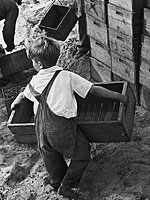
boy laborer in cranberry bog 1938
Question

How many children under 16 were employed in 1940?

Answer

The short answer is this: If you mean full-time work (with certain exceptions) ―none were employed, at least legally.

This was the result of the signing into law in 1938 (two years before) of the Fair Labor Standards Act. Wake Forest University Economics Professor Robert Whaples puts it succinctly: "the Fair Labor Standards Act of 1938 prohibited the full-time employment of those 16 and under (with a few exemptions) and enacted a national minimum wage which made employing most children uneconomical." Whaples describes the various reasons, apart from the enactment of federal, state, and local laws, why the numbers of children working in industry and on the farm had already declined dramatically over the first few decades of the 20th century before the passage of the Act.

The provision of the Fair Labor Standards Act (FLSA) that dealt with child labor stated: "No employer shall employ any oppressive child labor in commerce or in the production of goods for commerce or in any enterprise engaged in commerce or in the production of goods for commerce."

The FLSA, as further defined by statute, prohibited children under 16 from any kind of employment in certain hazardous kinds of work. The Secretary of Labor has periodically revised such categories of hazardous work. For agricultural work, for example, those under 16 should not be employed in operating a tractor of over 20 horsepower, or a hay baler, a forklift, a power post-hold digger, or a chain saw. Nor should they work in a yard or stall in which there is a bull, boar, or stud horse, a sow with suckling pigs, or a cow with newborn calf.

The FLSA also prohibits those under 18 from certain kinds of occupations altogether. These include occupations that require working with explosives or radioactive materials, operating most power-driven woodworking, baking, or meat processing machines, as well as most jobs in mining, meatpacking, logging, and brick-making.

Some Did Work

The FLSA exempts certain kinds of work, including employment of children by their parents, and church work. Boys and girls also worked (as they do today) at jobs not covered by FLSA regulations, such as office or clerical work, retail sales positions, food preparation, caring for younger children, and so on.

Given these exemptions, what was the actual number working in 1940?

Gertrude Folks Zimand, General Secretary of the National Child Labor Committee, in "The Changing Picture of Child Labor," published in 1944 in the Journal of the American Academy of Political and Social Science (pages 83-91), reported that the 1940 census showed, among 14- to 15-year-olds, a total of 4,347,665 attending school, and a total of 209,347 gainfully employed (no number was reported for children ages 7-14 who were not in school but were gainfully employed, but the number of these children attending school was 15,034,695; the numbers for 16- to 17-year-olds were 3,361,206 in school and 662,967 gainfully employed). The term "Gainfully employed" included full- and part-time work, either in industry or agriculture. There was some overlap in these numbers because some children were in school but were also working, at least part-time. But according to Zimand, 64 percent of the 14- to 15-year-olds and 83 percent of the 16- to 17-year-olds who were working were out of school and were therefore presumably working full time.

For more information

Robert Whaples. "Child Labor in the United States." EH.Net Encyclopedia, edited by Robert Whaples. October 7, 2005.

The text of the Fair Labor Standards Act of 1938, as amended.

The National Child Labor Committee website.
Child Labor Statistics at the United States Department of Labor.

Donald M. Fisk. "American Labor in the 20th Century" at the Bureau of Labor Statistics.

"Child Labor Laws and Enforcement," chapter 2 of the Report on the Youth Labor Force (revised 2000) at the Bureau of Labor Statistics. This includes a brief history of child labor in the U.S. and the legislative restrictions governing it, as well as a discussion comparing aspects of youth employment in the U.S., such as temporary or part-time teen employment, with youth employment elsewhere in the world.

The Child Labor Public Education Project's website on Child Labor in U.S. History provides links to a variety of documents on child labor.

Bibliography

Children watching a Labor Day Parade, Silverton Colorado, September 1940. Prints and Photographs Division, Library of Congress.

Detail of photo of boy laborer in cranberry bog, Burlington County, New Jersey, 1938. Prints and Photographs Division, Library of Congress.

Grant Birthplace [OH]

Description

Ulysses S. Grant was born 27 April 1822 in picturesque Point Pleasant near the mouth of Big Indian Creek at the Ohio River. This restored one-story, three-room cottage, which was built in 1817, was next to the tannery where Grant's father worked. The small cottage is furnished with period items. At one time the birthplace made an extensive tour of the United States on a railroad flatcar and was also temporarily displayed on the Ohio State fairgrounds.

The site offers tours.

Powhatan Historic State Park [AR]

Description

In the late 1800s, this busy river port on the Black River was the shipping point for a large territory. In 1888, a Victorian courthouse was built here. Restored in 1970 to the architect's original plans, the courthouse today serves as a regional archive that contains some of the oldest records in Arkansas. Visitors can tour the Powhatan Courthouse, 1873 Powhatan Jail, 1840s Ficklin-Imboden House, 1888 Telephone Exchange Building, and 1880s Powhatan Male and Female Academy, a unique two-room schoolhouse, all gracing their original foundations.

The site offers tours, exhibits, and workshops.

Parkin Archaeological State Park [AR]

Description

The Park preserves and interprets the Parkin site on the St. Francis River where a 17-acre Mississippi Period American Indian village was located from A.D. 1000 to 1550. A large platform mound on the river bank remains. There were once many archaeological sites similar to Parkin throughout this region, but they did not survive as eastern Arkansas was settled. Visitors can watch research in progress, and see firsthand the results of careful excavations and laboratory analysis. Along with including an archaeological research laboratory, the park visitor center includes an interpretive exhibit area and auditorium. The park interpretive staff offers audiovisual programs, site tours, workshops, and other educational programs and special events and activities. When archaeological excavations are underway, visitors on guided tours can observe them. Visitors experiencing Parkin Archeological State Park can also tour the circa 1910 Northern Ohio Schoolhouse. By the beginning of World War II, there were 15 one-room and two-room schoolhouses providing education for children in Parkin, a town of less than 2,000 citizens. Today, the Northern Ohio School is the only one of these early Parkin structures still standing. The stories it tells of what took place here in the early 20th century in and around the Sawdust Hill community are parts of the historic fabric of Parkin, just as is the park’s interpretation of the prehistoric village of Casqui.

The site offers exhibits, tours, workshops, and educational and recreational programs and events.

Glen Echo Park [MD]

Description

Begun in 1891 as an idealistic attempt to create a National Chautauqua Assembly "to promote liberal and practical education," the park became instead the area's premier amusement park from 1898–1968. Today, the park has come full circle, offering year-round educational activities, while two amusement-era destinations (the Spanish Ballroom and Dentzel Carousel) remain major attractions.

A second website for the park can be found here.

The park offers short films, tours, exhibits, classes, performances, educational programs, and recreational and educational events.

George Washington Birthplace National Monument [VA]

Description

Visit the house where George Washington, first President of the US and commander of the Continental Army, was born and spent his early years. The house burned in 1779 although its foundation survived. The home was rebuilt in the 1930's and now contains pieces from the Colonial era.

The site offers tours for school group as well as Virginia SOL-based educational programs (grades K-7). In addition to history education programs the site also offers environmental education programs on grounds. Outreach programs can be arranged during the winter months. Curriculum materials can be downloaded free of charge for teachers to use both before and after their visit.

Abraham Lincoln Birthplace National Historic Site [KY]

Description

The site focuses on Lincoln's life in Kentucky. The Birthplace Unit demonstrates his humble beginnings with a symbolic birth cabin enshrined within a neo-classic Memorial Building. The Boyhood Home Unit at Knob Creek Farm was home to Lincoln during his formative years. Events in Kentucky helped mold a young boy into the man who became the nation's 16th President.

The site offers a short film, exhibits, tours, educational programs, and occasional recreational and educational events (including living history events).

Tom Brokaw and Chronicling the Greatest Generation

Description

Newsanchor Tom Brokaw discusses his chronicling of the Greatest Generation in his book with the same title. The Greatest Generation tells the stories of America's citizens who came of age during the Great Depression and World War II. Brokaw also discusses his career with NBC Nightly News, where he has been the sole anchor and managing editor since 1983.

The lecture audio is available in mp3 format.