Separation of Church and State
Question
Does the constitution specifically state that there is a separation of church and state?
Answer
The United States Constitution does not state in so many words that there is a separation of church and state. The first part of the First Amendment to the Constitution states: “Congress shall make no law respecting an establishment of religion, or prohibiting the free exercise thereof.” Therefore, it is more accurate to say that the Constitution promotes freedom of religion and prohibits the federal government from inhibiting its citizens’ ability to worship as they wish.
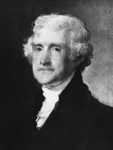
There were some colonial predecessors to this concept. For example, when Roger Williams was banned from Massachusetts Bay for his religious beliefs in 1636, he founded the colony of Rhode Island on the premise that persons of all religions were welcome. In 1649 Lord Baltimore drafted the Maryland Toleration Act, which protected Maryland colonists’ rights to worship as they pleased, and William Penn’s colony of Pennsylvania, founded in 1681, also welcomed persons of diverse religions, although only Anglicans and Quakers could hold political office. The expression “separation of church and state” can be traced to an 1802 letter that Thomas Jefferson wrote to a group of men affiliated with the Danbury Baptists Association of Connecticut. In this letter he stated that religion was “a matter which lies solely between Man & his God,” and that government should not have any influence over opinions. Therefore, he asserted: “I contemplate with sovereign reverence that act of the whole American people which declared that their legislature should ‘make no law respecting an establishment of religion, or prohibiting the free exercise thereof,’ thus building a wall of separation between Church & State.” Jefferson was a member of the Church of England throughout his life. However, while a student at William and Mary, Jefferson became a follower of Deism, an enlightenment-era religion based on reason and observation of the natural world that grew out of the Enlightenment. Deists rejected the idea of supernatural occurrences, such as miracles, and they believed that God created the universe, but did not interfere in its workings. Jefferson introduced the Virginia Statute of Religious Freedom in 1779, which became law in 1786. It separated Virginia government from any established church and asserted that the religious opinions of men were not the business of the government.
For more information
Constitution Day 2010 Holmes, David. The Faiths of the Founding Fathers. Oxford: Oxford University Press, 2006. Mapp, Alf. Faiths of Our Fathers: What our Founding Fathers Really Believed. Lanham, Md: Rowman & Littlefield, 2003. Munoz, Vincent P. God and the Founders: Madison, Washington, and Jefferson. Cambridge: Cambridge University Press, 2009.
Bibliography
Constitution of the United States The National Archives.
Thomas Jefferson to Nehemiah Dodge, Ephraim Robbins and Stephen S. Nelson. A committee of the Danbury Baptist association in the State of Connecticut, January 1, 1802, Library of Congress Information Bulletin.
About the Author
