Spotlight on Elementary Education

Oral histories and interviews are a unique form of historical documentation. This guide by Linda Shopes offers an overview of the various ways oral history can be integrated into classroom discussions. Though some of the techniques will have to be adapted for elementary students, the ideas Shopes presents are extremely useful. FIND OUT MORE »

Example of Historical Thinking

Scholars, students, and teachers model historical thinking
Frederick Douglass's Autobiographies

Use autobiographies to deconstruct views of slavery and historical heroes. [...] »

World War II Memorial

What meanings does the World War II Memorial in Washington, DC, have? [...] »

Two Blues Songs

Written primary sources only tell you so much. To learn about history that [...] »

Japanese American Internment: Executive Order 9066

How did the World War II internment of Japanese Americans happen? Historian [...] »

Women's Rights: Sarah Bagley Letters

What do these letters from a women's rights activist reveal about social [...] »

Teaching in Action

Teachers demonstrate promising teaching practices
Teaching Strategies for Museums: Graphic Organizers
Detail, KWL graphic organizer

Eighth-grade teacher Amy Trenkle keeps students on-task before, during, and [...] »

How to Introduce Students to Primary Sources

Introducing your students to primary sources for the first time? Watch [...] »

Using Primary Sources

Strategies for analyzing primary sources
Teaching with Museum Collections
Photo, Toy Cradleboard, Nez Perce National Historical Park, NEPE 1629

National Park Service lesson plans, teaching materials, and vibrant images [...] »

Making Sense of Documentary Photography
Photo, "Street Arabs in Sleeping...," Jacob A. Riis, c. 1880s, History Matters.

Textbook illustrations are often overlooked as historical evidence.

[...] »

Teaching with Textbooks

Techniques for promoting historical inquiry
Using Historiography to Analyze the Mexican-American War
Print, "Bombardment of Vera Cruz," 1893-1896, J. Andre Castaigne, NYPL

Allow students to see that history as we know it is interpretation, [...] »

The Grammar of History Textbooks Part II: Questioning the Text
Marginalia, CHNM

Turn your textbook into a conversation by scanning its language for biases [...] »

The Grammar of History Textbooks, Part I: Language Analysis
Marginalia, CHNM

The language of history textbooks challenges English language learners and [...] »
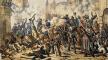
Building a Conversation between Textbooks, Students, and Teachers

Class discussion and personal inquiry builds an interactive relationship [...] »

Learning Menus: Textbooks a la Carte

Turn your students into 'master chefs' by using learning menus that allow [...] »