Free Speech Teaching Guide 3: The Problem of National Security Secrets

Article Body
This Teaching Guide is part of a series. Each of the four total teaching guides speaks to one aspect of the history of free speech. Although they work together to tell different parts of this history, it is not necessary to teach all of the guides or to teach them in a certain order. Each guide is a self-contained lesson.
(A PDF version of this teaching guide is also available for download-see left) 

Other guides in the series:
Free Speech Teaching Guide 1: The Birth of the Modern First Amendment: How Oliver Wendell Holmes Changed His Mind
Free Speech
Teaching Guide 2: Brandenburg v. Ohio (1969): Defining and Arguing Hate Speech 
Free Speech Teaching Guide 4: Mandel v. Kleindienst (1972): Censorship via Visa
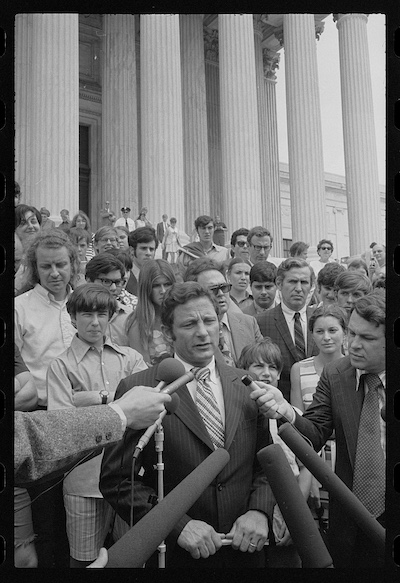
Supreme Court announces decision on pentagon papers suit
Senator Birch Bayh outside the Supreme Court after the Pentagon Papers case is decided, Library of Congress


Recommended for:

  • 11th Grade US History
  • 12th Grade Government
  • Undergraduate History

Table of Contents

Guide Introduction:
This introductory essay provides historical context on the First Amendment, government secrecy, and the rights of leakers and the press. Drawing attention first to more recent examples of these issues, the essay then introduces the 1971 Pentagon Papers leak which segues into a teaching activity on the topic.

Classroom Activities:
Exercise 1: Ellsberg's Memoir. A guided reading of an excerpt from Daniel Ellsberg’s memoir and an introduction to the Supreme Court case. Guiding Question: What’s the line between the government’s national security interest and the right of the public to know what the government is doing?
Exercise 2: Classifying Government Secrets. Small group, then whole classroom activity to help students understand the government classification process.
Exercise 3: Debating the Ellsberg Outcome. A discussion with students about the impact of the Pentagon Papers including the still unresolved legal questions around national security and free speech. Guiding Question: How does democracy operate amongst ambiguity and competing priorities?

Appendix:
Image of Pentagon Papers Cover
Excerpt of Ellsberg Memoir


Guide Introduction

        In the first and second guides in the Free Speech Teaching Guides series, we explored how speech that might cause a crime became increasingly protected under the First Amendment because it became harder to prove that speech, on its own, was harmful. But what if someone leaks a national security secret to the press? Is that sufficiently harmful or sufficiently criminal to allow censorship to protect the secret? This legal issue is inseparable from the question of how information gets classified as a “secret” in the first place. This guide explores the relationship between secrecy and the First Amendment by exploring two interrelated legal problems: the rights of leakers and the press to publish secret information; and the bureaucratic process by which information is classified as secret in the first place.
       These issues are at the heart of recent conflicts about whistleblowers and classified information – individuals like Chelsea Manning and Edward Snowden have faced jail time for sharing secrets with the public. The need to protect national security secrets has become a frontline of free speech debates. Introducing students to these topics can seem daunting because the law is complicated and confusing – one Supreme Court justice famously noted that the relevant sections of the Espionage Act are “singularly opaque.” (These are different sections of the same WW1-era law that we looked at in Free Speech Teaching Guide 1 and they remain on the books today.)
       My approach to teaching this subject at the introductory level is to focus less on the intricacies of the law than on the political and moral issues raised by the place of secrecy in a democracy. Can the government keep secrets to keep us safe? Or does the public have a right to know what its government is doing? Who gets to decide? The Pentagon Papers case provides an excellent case study to get students debating these questions.


Classroom Exercise 1: Ellsberg's Memoir

Contents:
Overview
Memoir Excerpt, Questions, and Takeaways
Visual Aids
Concluding Concepts

Overview:
The Pentagon Papers were a 7,000 page, 47-volume history of America’s policy in Vietnam that had been prepared, in secret, by the U.S. government in the late 1960s. Included in this history were the many ways that the U.S. government had lied to the American public about the origins and conduct of the Vietnam War. They were stamped “Top Secret” and very few people had access to them. One of the people who had access to the document was Daniel Ellsberg, a former marine with a Harvard PhD, who had worked in the highest levels of the U.S. government. At first, he was a believer in the American war in Vietnam. In the included excerpt of Ellsberg’s memoir, he wrote powerfully about the ways that access to secret information was intoxicating.
This excerpt can be assigned for pre-class or homework reading or can be done as an in-class exercise. Regardless of modality, the set of questions included in this exercise will help students engage with the source. Finally, the Concluding Context will explain how this case quickly became central to national decisions regarding the rights to free speech and public knowledge.

Exercise Steps:

  1. Read the Framing Essay and Overview of this exercise yourself and use both to introduce students to this topic.
  2. Have students read the excerpt of Ellsberg’s memoir either as homework or in class.
  3. Based on the reading, ask questions and guide conversation.
  4. Draw on the provided Concluding Context to explain how the Pentagon Papers incident played out politically and legally as far as rights of the press.

Memoir Excerpt, Questions, and Takeaways:
This source can be either a pre-class reading assignment or an in-class exercise. In either case, here are three questions to ask students:

  1. Why does Ellsberg think that there are relatively few leaks of secret information in the U.S.?
  2. How does Ellsberg describe the way that having access to secrets made him feel?
  3. Is this attitude toward state secrets democratic? Explain your reasoning.

The key takeaways for students are:

  1. That while secrets do leak, it’s surprisingly rare.
  2. That these leaks are rare largely because there is a glamour to having access to inside material, it makes you feel more important and knowledgeable than outsiders, and thus less likely to leak. Elsewhere in Ellsberg’s memoir, he writes that “the incredible pace and the inside dope made you feel important, fully engaged, on an adrenaline high much of the time. Clearly it was addictive.”
  3. That members of the intelligence community also take seriously their need to protect the national security.
  4. Ellsberg thinks this attitude is paternalistic and undemocratic — an opinion that students can debate and discuss.

[See Appendix for Image of Pentagon Papers Cover and Excerpt of Ellsberg's Memoir]

Visual Aids:
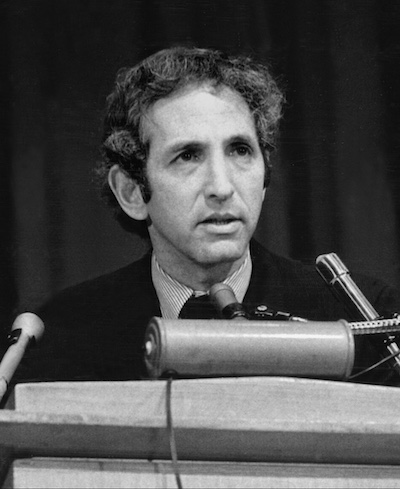
By the late 1960s, Ellsberg had become disillusioned about the war. He had seen too much on tours in Vietnam; he had become inspired by the anti-war movement. In class, I show some images of Ellsberg to show his political evolution: 
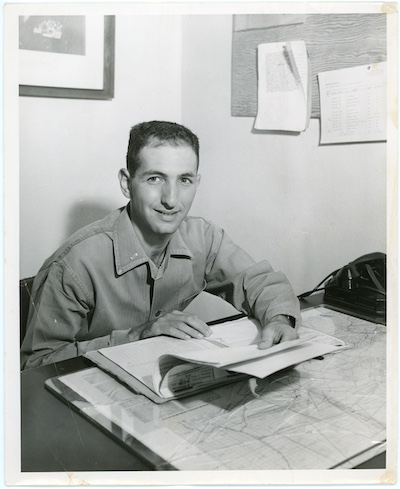
Ellsberg in the Marines in the 1950s. Sitting at a desk looking over papers
Daniel Ellsberg seated at desk, May 8, 1956. Daniel Ellsberg Papers (MS 1093). Special Collections and University Archives, University of Massachusetts Amherst Libraries
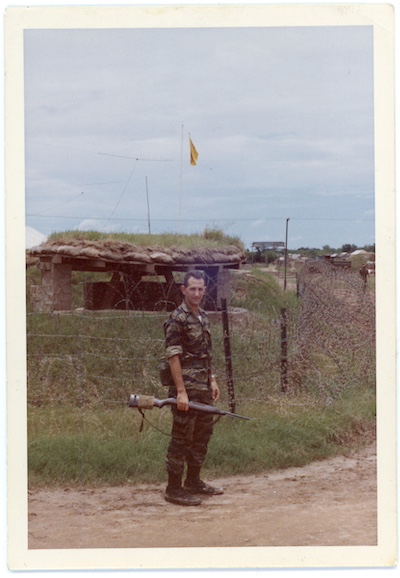
In Vietnam in the 1960s. He stands on a dirt road in his marine uniform with a rifle in hand
Daniel Ellsberg holding a rifle in front of bunker, ca. 1965. Daniel Ellsberg Papers (MS 1093). Special Collections and University Archives, University of Massachusetts Amherst Libraries
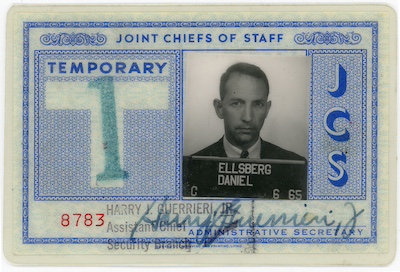
Ellsberg's Joint Chiefs of Staff ID card
United States. Joint Chiefs of Staff. Daniel Ellsberg Joint Chiefs of Staff temporary identification card, July 1, 1965. Daniel Ellsberg Papers (MS 1093). Special Collections and University Archives, University of Massachusetts Amherst Libraries

Ellsberg at the time of the Pentagon Papers case sitting in front of 3 microphones
Wikimedia Commons


Concluding Context:
In 1969, Ellsberg decided that the public had a right to know the secret history he had read in the Pentagon Papers — he hoped disclosing that history would help end the war. In secret, he began smuggling the papers out of the office every night to photocopy them. In 1971, he gave a copy to the New York Times and then to the Washington Post. After vigorous internal debates about whether it was legal to publish these stolen and secret documents, both newspapers began running stories in June.


The Washington’s Post internal deliberations about whether to run the story are dramatized in the 2017 movie, The Post – Showing the movie to students would be a way to expand this guide to discuss the ethical obligations of journalists when it comes to publishing secret documents.


The Nixon administration’s response was extreme. They went to court to try to prevent the newspapers from publishing any more stories from the Pentagon Papers, claiming that every disclosure risked harming America’s national security. But blocking a newspaper from publishing is a heavy-handed form of censorship, known as prior restraint. And so the newspapers understandably argued that their First Amendment rights were being threatened. These questions were so fundamental, the stakes so urgent, that the case was heard by the Supreme Court less than two weeks after the first publications from the Pentagon Papers.
The rushed process produced a confusing decision. Rather than one clear majority decision, each of the justices issued their own opinion. Taken together, the court had ruled, six votes to three, that prior restraint of the Pentagon Papers was unconstitutional. Only in very particular cases, when the information published was likely to “inevitably, directly, and immediately cause” serious harm to the national security – something like “imperiling the safety of a [troop] transport already at sea” – could one justify prior restraint. The government could not show this level of harm in the Pentagon Papers case, and so the press could publish. (In fact, this bar is so high that it has never been met.) But the array of opinions left open some important questions, such as whether the newspapers could be punished for publishing state secrets after the fact, even if they could not be blocked from publishing them in the first place.  
       And because the decision was about the right of the newspapers to publish state secrets, it said nothing about whether Ellsberg had a right to give the Pentagon Papers to the newspapers in the first place. He was also on trial, facing 115 years in jail for giving secret information to unauthorized persons (a violation of a section of the Espionage Act). In response, he claimed a right to inform the public about government misconduct, arguing that just because a document was stamped secret didn’t mean that its disclosure would actually harm the nation’s security. In fact, he had not turned over every section of the Pentagon Papers to the press – he had only turned over those sections he believed to be wrongly classified.
The trial of Ellsberg should have been an important case, one that clarified whether government employees could claim a First Amendment right to disclose classified information to the public. Did the simple fact that a document was stamped secret mean that its disclosure posed an actual threat to national security?
To grapple with this question, students need to know how secrecy works. How does a government document become a secret? In the U.S. the process of defining secrets is guided by the classification system, which is established by Presidential order.
The first such order was passed by Harry Truman in 1951; at the time of the Pentagon Papers, the classification rules in place where those established by President Eisenhower in 1953 (seen in Exercise 2).


Exercise 2: Classifying Government Secrets

Contents:
Overview & Exercise Steps
Executive Order 10501, Annotated
Hypothetical, Alternative Executive Order
Scenarios
Debate & Conclusions


Overview & Exercise Steps:

  • To explore how different classification standards can shape the practice of classification, divide the class into small groups.
  • Each group will be given one of two sets of classification orders:
    • One half of the groups will be given the actual classification instructions in use at the time of the Pentagon Papers case (Executive Order 10501).
    • The other half of the groups will be given a fictional, revised set of instructions which ask the classifier to pay more attention to the public’s right to know.
      • Note: While reformers have called for these sorts of changes over the years, no classification order has ever looked like this.
  • The purpose of this exercise is to allow students to see how seemingly small changes in classification orders could change the process of stamping secrets – and so we are using a hypothetical set of orders to illustrate the point.
  • Give the groups scenarios with which to test their classification instructions.
  • End by encouraging students to debate the issue of classification and lead a concluding discussion.

Executive Order 10501, Annotated:
Link to Executive Order 10501

       “WHEREAS it is essential that the citizens of the United States be informed concerning the activities of their government; and
       WHEREAS the interests of national defense require the preservation of the ability of the United States to protect and defend itself against all hostile or destructive action by covert or overt means, including espionage as well as military action; and
         WHEREAS it is essential that certain official information affecting the national defense be protected uniformly against unauthorized disclosure:
         NOW, THEREFORE, by virtue of the authority vested in me by the Constitution and statutes, and as President of the United States, and deeming such action necessary in the best interests of the national security, it is hereby ordered as follows:
       Section 1. Classification Categories: Official information which requires protection in the interests of national defense shall be limited to three categories of classification, which in descending order of importance shall carry one of the following designations: Top Secret, Secret, or Confidential. No other designation shall be used to classify defense information, including military information, as requiring protection in the interests of national defense, except as expressly provided by statute. These categories are defined as follows: ...

  • The previous order under Truman had a fourth category - "restricted" - which this order abolished.  It seems to have made little difference - classifiers simply made more use of the "confidential" stamp.
    In reality, as the above photo from 1957 reveals, many different secrecy stamps and designations were adopted in the 1950s

        (a)  Top Secret: Except as may be expressly provided by statute, the use of the classification Top Secret shall be authorized, by appropriate authority, only for defense information or material which requires the highest degree of protection.  The Top Secret classification shall be applied only to that information or material the defense aspect of which is paramount, and the unauthorized disclosure of which could result in exceptionally grave damage to the Nation such as leading to a definite break in diplomatic relations affecting the defense of the United States, an armed attack against the United States or its allies, a war, or the compromise of military or defense plans, or intelligence operations, or scientific or technological developments vital to the national defense.
       (b)  Secret: Except as may be expressly provided by statute, the use of the classification Secret shall be authorized, by appropriate authority, only for defense information or material the unauthorized disclosure of which could result in serious damage to the Nation, such as by jeopardizing the international relations of the United States, endangering the effectiveness of a program or policy of vital importance to the national defense, or compromising important military or defense plans, scientific or technological developments important to national defense, or information revealing important intelligence operations. ...

  • My goal in teaching students how these orders work is to emphasize the subjective quality of these tests.
  • The difference between the levels is vague, despite the effort to bring clarity by examples. What is a disclosure that would cause "serious damage to the Nation" as opposed to "exceptionally grave damage"? How much does it help to say that the former would "jeopardize the international relations of the US" whereas the latter would lead to a "definitive break in diplomatic relations"?
  • For teachers who have also taught Free Speech Teaching Guides 1 and 2, you can note here that we are back in the world of predicting tendencies - trying to assess the likely outcome of information disclosures.

        (c)  Confidential: Except as may be expressly provided by statute, the use of the classification Confidential shall be authorized, by appropriate authority, only for defense information or material the unauthorized disclosure of which could be prejudicial to the defense interests of the nation.
       Section 2. Limitation of Authority to Classify: The authority to classify defense information or material under this order shall be limited in the departments and agencies of the executive branch as hereinafter specified….
       Section 3. Classification: Persons designated to have authority for original classification of information or material which 
requires protection in the interests of national defense under this order shall be held responsible for its proper classification in accordance with the definitions of the three categories in section 1, hereof. Unnecessary
classification and over-classification shall be scrupulously avoided.”

  • Note here the warning against over-classification. Even in the early 1950s, it was widely understood that over-classification was a major problem. One Defense Department study concluded that 90% of classified documents had been classified unnecessarily.
  • But such warnings have not been effective in reducing over-classification. Nixon's defense secretary later conceded that 95% of the Pentagon Papers, all of which were classified Top Secret, did not need to be classified at all.
  • The problem is that this warning has no enforcement mechanism.  Classifiers are not instructed to actively weigh the public right to know in making a classification decision - when deciding they are instructed to think only about potential harms.


Hypothetical, Alternative Executive Order:

In determining whether to classify information, you must weigh the public’s right to know about its government’s policy – if the secrecy poses a greater risk to American democracy than the risk to national security posed by disclosure, then the material should not be classified. Wherever possible, to maximize the amount of information available to the public, only the most specific level of information should be segregated and classified secret. Illegal acts should never be classified. These categories are defined as follows:
              (a) Top Secret: Except as may be expressly provided by statute, the use of the classification Top Secret shall be authorized, by appropriate authority, only for defense information or material which requires the highest degree of protection. The Top Secret classification shall be applied only to that information or material the defense aspect of which is paramount, and the unauthorized disclosure of which could result in exceptionally grave damage to the Nation such as leading to a definite break in diplomatic relations affecting the defense of the United States, an armed attack against the United States or its allies, a war, or the compromise of military or defense plans, or intelligence operations, or scientific or technological developments vital to the national defense.
            (b)  Secret:  Except as may be expressly provided by statute, the use of the classification Secret shall be authorized, by appropriate authority, only for defense information or material the unauthorized disclosure of which could result in serious damage to the Nation, such as by jeopardizing the international relations of the United States, endangering the effectiveness of a program or policy of vital importance to the national defense, or compromising important military or defense plans, scientific or technological developments important to national defense, or information revealing important intelligence operations.

              (b)  Secret:  Except as may be expressly provided by statute, the use of the classification Secret shall be authorized, by appropriate authority, only for defense information or material the unauthorized disclosure of which could result in serious damage to the Nation, such as by jeopardizing the international relations of the United States, endangering the effectiveness of a program or policy of vital importance to the national defense, or compromising important military or defense plans, scientific or technological developments important to national defense, or information revealing important intelligence operations.

              (c)  Confidential: Except as may be expressly provided by statute, the use of the classification Confidential shall be authorized, by appropriate authority, only for defense information or material the unauthorized disclosure of which could be prejudicial to the defense interests of the nation.

         Section 2. Limitation of Authority to Classify: The authority to classify defense information or material under this order shall be limited in the departments and agencies of the executive branch as hereinafter specified….
         Section 3. Classification: Persons designated to have authority for original classification of information or material which  requires protection in the interests of national defense under this order shall be held responsible for its proper classification in accordance with the definitions of the three categories in Section 1, hereof. Unnecessary
classification and over-classification are as serious a threat to American democracy as under-classification. Classification decisions will be audited, and over-classifiers will face disciplinary proceedings.

Scenarios:
Give each group three scenarios and ask whether they would classify them based on their instructions. Here are three that I use; you can develop others, of course: 

  1. The government is secretly providing weapons to an ally that is using them to fight a regional war against a nation hostile to the US. The government credibly believes that the ally would lose the war without the weapons; that the public would not support the use of US weapons in the war; and that disclosure would therefore threaten the ally’s standing and the balance of power in the region. Should the existence of the weapons program be classified?
  2. The government has a program to monitor social media for threats of terrorism. It believes the disclosure of the program would impair the effectiveness of the program. Should the existence of the program be classified?
  3. The government has a program of placing undercover operatives in a number of foreign nations. It wants to classify the existence of the program, as well as the names of the agents and the particular countries in which they will be placed. What should be classified?

Conclusions:

        Students should see that applying the standards of the Eisenhower order makes it very easy to justify classification; the fictional version of the orders introduces many more questions.  For instance, in scenario three, I would think that the groups using the fictional second set of orders would be tempted to only classify the names of the officers and perhaps some of the operational details; groups using the Eisenhower order would want to classify the entire program.
        I often pause here to let students debate whether it is better to be extra-cautious and deferential to national security concerns – the government does have an obligation to protect its citizens, after all – or whether transparency is more important.
       To wrap up the discussion, I suggest that this is an important debate for all citizens to have an opinion about; but the point of this lesson is simply that the classification orders can have a big impact on how classification decisions are made.
       And that is leaving to one-side the institutional pressures that Daniel Ellsberg discussed in his memoir. If you add those pressures to the bias created by the classification standards, students can see how easy it is to over-classify. Imagine working late in the afternoon on a stressful, difficult national security matter – would you prefer to take the risk that disclosing information poses no potential risks? Or would it be easier to stamp it classified, better safe-than-sorry?


Exercise 3: Debating the Outcome of the Ellsberg Case

Contents:
Exercise Steps
Questions & Debate
Conclusion

Exercise Steps:

  1.  Review the Overview & Context below for yourself.  
  2. Provide students with Overview & Context.
  3. Either all together or in groups, have students respond to questions and debate this topic.
  4. Connect this topic to the present with the Conclusion and any further discussion.

Context:
        Part of what the Ellsberg case could have done was clarify whether it is illegal to disclose all classified information to the public, or only properly classified information. This is a difficult debate – because you don’t necessarily want any one government employee to decide they know what should and shouldn’t be classified. But it also seems extreme to say that once a document is classified, the public has no right to it, even if it wouldn’t actually pose a harm to national security.
        In the end, the Pentagon Papers case shed no new light on these issues because it was thrown out of court. Richard Nixon had formed a small group in the White House to deal with the problem of “leaks” like Ellsberg’s. One of them told his mother-in-law that he was fixing leaks in the White House, and she said it was nice to have a plumber in the family – the group took the name “the Plumbers” as an in-joke. In an effort to discredit Ellsberg in the press, the Plumbers broke into the office of Ellsberg’s psychiatrist. Later, after the Plumbers had broken into the Watergate hotel during the 1972 election, and the whole Watergate scandal became a national fixation, the break-in at Ellsberg’s psychiatrist also came to light. The judge threw Ellsberg’s prosecution out of court for government misconduct. Ellsberg went free, but the laws of secrecy and leaking were not put to the test.
        The result is that the basic classification scheme continues to operate in much the same fashion as it did in the 1960s. Subsequent presidents have tinkered with these orders – Presidents Carter, Clinton and Obama, for instance, instructed classifiers to err in the direction of under-classification when in doubt; President Reagan urged over-classification when in doubt – but none have required proactive consideration of the public’s right to know.
        Was this a satisfying outcome to the Pentagon Papers affair?  Richard Nixon didn’t think so: “the son-of-a-bitching thief [Ellsberg] is made a national hero and is going to get off on a mistrial. And the New York Times gets a Pulitzer Prize for stealing documents…. what in the name of god have we come to?” [I often put this quote on an overhead].
        Others thought the outcome reflected a balancing act – the government retained some ability to punish leakers, and thus to keep information secret in the interests of national security. But the press had the right to publish, and thus to inform the public. Alexander Bickel, a law professor who represented the New York Times in the Pentagon Papers case, described this as a “game theory” of the First Amendment – a contest between the press and the government over who got to control what information the public learned.
        One problem with this balancing act is that it requires a leaker to risk punishment to inform the press in the first place. Can we trust that people will be motivated to speak out in face of such threats? In 1971, Ellsberg was asked how he felt about facing 115 years in jail for leaking government secrets. “Wouldn’t you go to jail to help end the war?” was his famous response.

Questions & Debate:
Ask students to debate whether this is a healthy state of affairs for a democracy. The following questions could be built out to include more hypotheticals:

  1. Would students be willing to face jail to inform the public?
    1. For what sort of crimes?  To end a war, to stop an abuse of power, to reveal corruption?
    2. Is the risk worth the reward?
      1. What if the paper chooses not to publish?
      2. Do they believe that releasing government documents actually would change public opinion? Or do they think people are so committed to their beliefs that new information wouldn’t change their mind?
  2. Do they trust the judgement of an individual government employee to make the decision about which secrets can be revealed? What if that employee thinks the public has a right to know, but they get this wrong, or inadvertently reveal a vital secret?
    1. Ask students how many Americans they think have security clearances?
      1. In reality, it is more than 4 million. Should each and all of them have the right to make decisions about what should be disclosed?
    2. Does it matter if Ellsberg wasn’t acting alone? In reality, he was working with a group of antiwar activists, who helped him smuggle the documents to the press, and who helped him go underground to avoid arrest. They represented a much broader antiwar movement which was very opposed to the war; Ellsberg was, in many ways, taking his moral cues from this broader social movement. Does that change how you think about his act of moral conscience?
    3. Is it enough that the source takes the secret to a journalist, and asks the journalist to decide if the information is safe to disclose?
      Is that better than simply putting information online?

Conclusion:
During the War on Terror, a number of government insiders have, like Ellsberg, released secret information to the public. Chelsea Manning, Edward Snowden, Terry Albury, Daniel Hale and others have faced Espionage Act charges and have not been able to claim either that the material they released was improperly classified, or that the public had a right to know. Many of them served jail time for their disclosures. The newspapers that published their leaks, meanwhile, did not face any effort to bar them from publication, or to criminally prosecute them. The balancing act created by the Pentagon Papers case lives on.


Appendix

(Both items are also available in the pdf download of this teaching guide- see left)

Image of the Pentagon Papers Cover:
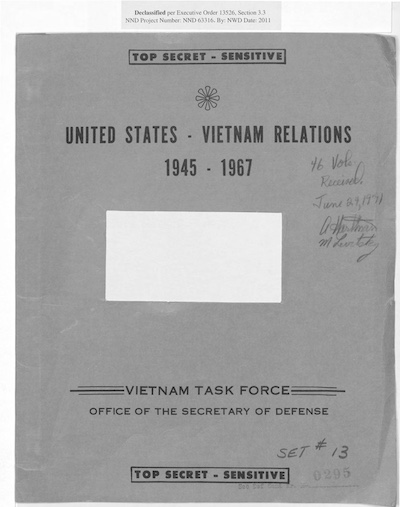
Cover of the Pentagon Papers. Reads: Top Secret-Sensitive. United States-Vietnam Relations 1945-1967. Vietnam Task Force. Office of the Secretary of Defense.

Excerpt of Ellsberg Memoir:

        “Even within the executive branch, self-discipline in sharing information—lack of a ”need to tell”—and a capability for dissimilation in the interests of discretion were fundamental requirements for a great many jobs. There was an abundance of people who, like John and me, could and did meet those requirements adequately. The result was an apparatus of secrecy, built on effective procedures, practices, and career incentives, that permitted the president to arrive at and execute a secret foreign policy, to a degree that went far beyond what even relatively informed outsiders, including journalists and members of Congress, could imagine.
       It is a commonplace that “you can’t keep secrets in Washington” or “in a democracy,” that “no matter how sensitive the secret, you’re likely to read it the next day in the New York Times.” These truisms are flatly false. They are in fact cover stories, ways of flattering and misleading journalists and their readers, part of the process of keeping secrets well. Of course eventually many secrets do get out that wouldn’t in a fully totalitarian society. Bureaucratic rivalries, especially over budget shares, lead to leaks. Moreover, to a certain extent the ability to keep a secret for a given amount of time diminishes with the number of people who know it. As secret keepers like to say, “Three people. can keep a secret if two of them are dead.” But the fact is that the overwhelming majority of secrets do not leak to the American public. ...

        This is true even when the information withheld is well known to an enemy and when it is clearly essential to the functioning of the congressional war power and to any democratic control of foreign policy. The reality unknown to the public and to most members of Congress and the press is that secrets that would be of the greatest import to many of them can be kept from them reliably for decades by the executive branch, even though they are known to thousands of insiders.
       As one of those insiders I had no particular objection to this. I shared the universal ethos of the executive branch, at least of my part of it: that for the Congress, the press, and the public to know much about what the president was doing for them, with our help, was at best unnecessary and irrelevant. At worst, it was an encouragement to uninformed (uncleared), short-sighted, and parochial individuals and institutions to intervene in matters that were too complicated for them to understand, and to muck them up. This sounds paternalistic to the point of being antidemocratic, and so it was. (And is: I doubt that this has ever changed.) But we’re talking foreign policy here, and national security matters, in which we didn’t see that people without clearances had any really useful role to play in the nuclear cold war era. It was in the national interest, as we saw it, simply to tell them whatever would best serve to free the president from their interference. ...
        Even when I regarded the administration’s policy as inadequate or misguided, as I often did on nuclear matters, I saw little hope for improvement by Congress, with its committees generally headed by conservative southerners. Once I was inside the government, my awareness of how easily and pervasively Congress, the public, and journalists were fooled and misled contributed to a lack of respect for them and their potential contribution to better policy. That in turn made it easier to accept, to participate in, to keep quiet about practices of secrecy and deception that fooled them further and kept them ignorant of the real issues that were occupying and dividing inside policy makers. Their resulting ignorance made it all the more obvious that they must leave these problems to us.
       There was one more feature of our environment within the executive branch that contributed to a disregard of the opinions or criticisms of outsiders, that made it hard to listen to or learn from them. Perhaps the most startling discovery on entering the government at this level form having been a consultant was the unrelenting pace of the work. I’ve already described the almost inconceivable amount of information and demands for information pressing on you.”
Free Speech Teaching Guide 1: The Birth of the Modern First Amendment and How Oliver Wendell Holmes Changed His Mind

Article Body
This Teaching Guide is part of a series. Each of the four total teaching guides speaks to one aspect of the history of free speech. Although they work together to tell different parts of this history, it is not necessary to teach all of the guides or to teach them in a certain order. Each guide is a self-contained lesson.
(A PDF version of this teaching guide is also available for download-see left) 

Other guides in the series:
Free Speech Teaching Guide 2: Brandenburg v. Ohio (1969): Defining and Arguing Hate Speech
Free Speech Teaching Guide 3: The Problem of National Security Secrets
Free Speech Teaching Guide 4: Mandel v. Kleindienst (1972): Censorship via Visa


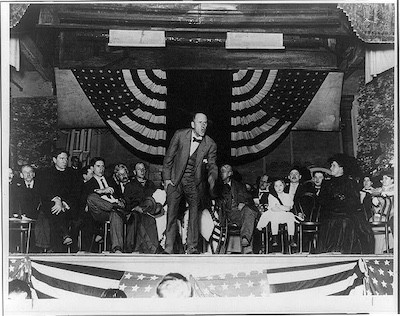
Eugene V. Debs making a speech on stage with two American flags and a group of people seated behind him

"Eugene V. Debs Making a Speech," c.1912-1918, Library of Congress

Recommended for:

  • 11th Grade US History
  • 12th Grade Government
  • Undergraduate History

Table of Contents

Framing Essay:
This essay provides historical background on modern ideas about free speech and the First Amendment through analysis of two 1919 Supreme Court cases:

  • Selection: Schenck v. United States 249 U.S. 47 (1919)
  • Selection: Abrams and others v. United States 250 U.S. 616 (1919)


Classroom Activities
Exercise 1: What does Freedom of Speech Mean? A guided reading of the Holmes opinion in Schenck v. United States 249 U.S. 47 (1919). Why did the Supreme Court decide it was acceptable to limit certain forms of speech?
Exercise 2: What Kinds of Speech are Protected? A full class group activity on the white board. What makes certain forms of speech so harmful that they fall outside First Amendment protection?
Exercise 3: Holmes Reconsiders. A detailed reading of Abrams and others v. United States 250 U.S. 616 (1919) and a comparison to Schenk. How might judges apply or avoid precedent?

Annotated Primary Sources
A section of Justice Oliver Wendell Holmes Jr. majority opinion in the Schenck case.
A section of Justice Oliver Wendell Holmes Jr. dissenting opinion in the Abrams case.

Homework Activity

Framing Essay

When I teach students the history of the First Amendment, the most basic thing I want them to learn is that the First Amendment has a history. Free speech seems like an enduring American value. After all, it is protected in the First Amendment to the constitution. But the idea that we should protect the "marketplace of ideas," that all sorts of speech should be protected from punishment, is barely more than a century old. In fact, its emergence can be traced to one year: 1919.

This guide focuses on the history of free speech in one crucial year (1919), exploring how one influential Supreme Court justice changed his mind about the value of antiwar speech and in the process wrote opinions that have shaped our attitudes to free speech ever since. It provides students an opportunity to see the First Amendment evolve at a crucial hinge in its history, and it also provides them an opportunity to think about how far the rights to free speech should extend during wartime.

During World War I, the US government sent critics of the war to jail. The Espionage Act of 1917 made it illegal to interfere with the draft, and government prosecutors successfully claimed that criticism of the war was a form of interference with the draft – if drafted soldiers thought the US should not be fighting the war, wouldn’t they be less likely to comply with the draft? On this theory, more than a thousand Americans were imprisoned for speech crimes. The most famous of them was Eugene Debs, the labor organizer and perennial Socialist presidential candidate, who was convicted for a Socialist stump speech in an Ohio park in the summer of 1918.

Find the text of the First Amendment Here


Eugene V. Debs making a speech on stage with two American flags and a group of people seated behind him
"Eugene V. Debs Making a Speech," c.1912-1918, Library of Congress
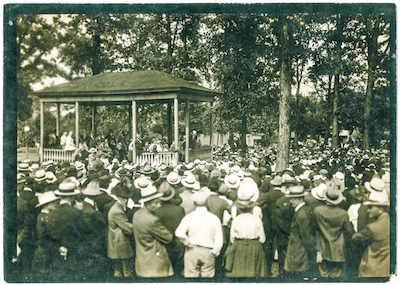
Large crowd gathers around a gazebo to listen to Eugene Debs
Eugene Debs Speaking in Canton, Ohio, c.1918, National Archives

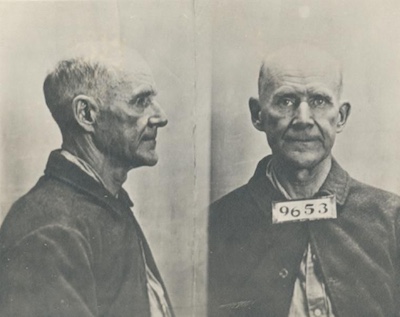
Mug shot of Eugene Debs. His number reads 9653.

"Eugene Debs Mug Shot," c.1912-1929, New York Public Library

During class, I project the above images of Eugene Debs to force students to think about the human character at the center of this story. Debs was a noted orator, but we have no videos of him speaking.

We have to rely instead on photographs and the words of his audience, who described him as a captivating, moving speaker, who had the ability to make everyone in the crowd feel like he was addressing them directly.

Look Closer:
One technique Debs used was to lean out over the crowd – as you can see in the photo of his speech in Canton, Ohio.
You can find a transcript of Debs’ Canton Speech here: Eugene V. Debs' Canton Speech, 1918, Internet Archive

After the end of the war, in the Spring of 1919, the Supreme Court heard appeals from a number of the socialists prosecuted under the Espionage Act. The socialists claimed that the First Amendment protected their right to criticize the war. In unanimous decisions, the Supreme Court rejected their claims. During war time, Justice Oliver Wendell Holmes Jr. wrote for the court, it was perfectly acceptable for the government to criminalize speech that could interfere with the draft. The first classroom exercise will explore Holmes’s decision in this case: Schenck v. United States 249 U.S. 47.
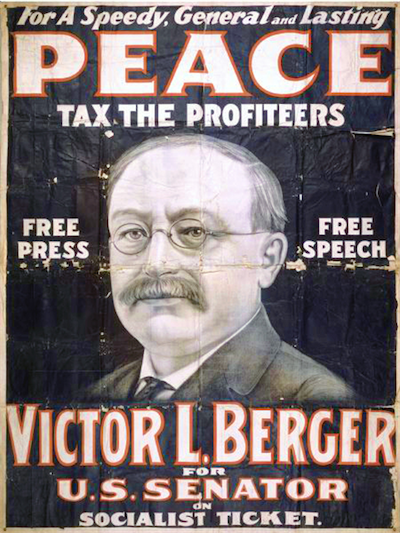
Poster with Victor Berger's picture on it. It reads "For a Speedy, General, and Lasting Peace, Tax the Profiteers. Free Press. Free Speech. Victor L. Berger for U.S. Senator on Socialist Ticket." 
Victor L. Burger Campaign Poster, 1918, Wisconsin Historical Society

This campaign poster for Victor Berger reveals the centrality of free speech to the Socialist party and the connection between the right to free speech and opposition to the war.

Berger himself was prosecuted for speech crimes — a fascinating history that is well documented Wisconsin Historical Society site linked below.

Victor L. Berger Campaign Poster, 1918, Wisconsin Historical Society


Classroom Exercise I: What does Freedom of Speech Mean?

Contents:
Overview
Schenck WWI Anti-Draft Pamphlet, 1917
Excerpt of Schenck v. U.S.(1919)
Annotated excerpt of Schenck v. U.S. (1919)
Conclusion and Takeaways: What does free speech really mean?

Overview:
Holmes’ understanding of free speech was explained most clearly in the Schenck v. U.S. (1919) case, which concerned a pamphlet (pictured below) sent to drafted soldiers which encouraged them to protest the draft by writing to their congressional representatives.

It is useful to walk students through this excerpt from Holmes’ decision closely in class explaining the relevant steps of the logic. I do so by:

  1. Have students read the dense legal text of the Holmes’ decision out loud.
  2. Paraphrase and explain each sentence. My annotations provide the context and explanation I use. The following pages provide an annotated exploration of an excerpt of the Schenck decision.

Charles Schenck, WWI Anti-Draft Pamphlet, 1917, National Archives

Primary Source: Schenck v. U.S.​ (1919):

“It well may be that the prohibition of laws abridging the freedom of speech is not confined to previous restraints, although to prevent them may have been the main purpose, as intimated in Patterson v. Colorado, 205 U. S. 454, 462. We admit that in many places and in ordinary times the defendants in saying all that was said in the circular would have been within their constitutional rights. But the character of every act depends upon the circumstances in which it is done. Aikens v. Wisconsin, 195 U.S. 194, 205, 206. The most stringent protection of free speech would not protect a man in falsely shouting fire in a theatre and causing panic. It does not even protect a man from an injunction against uttering words that may have all the effect of force. Gompers v. Buck’s Stove & Range Co., 221 U. S. 418, 439. The question in every case is whether the words used are used in such circumstances and are of such a nature as to create a clear and present danger that they will bring about the substantive evils that Congress has a right to prevent. It is a question of proximity and degree. When a nation is at war many things that might be said in time of peace are such a hindrance to its effort that their utterance will not be endured so long as men fight and that no Court could regard them as protected by any constitutional right. It seems to be admitted that if an actual obstruction of the recruiting service were proved, liability for words that produced that effect might be enforced. The statute of 1917 in § 4 punishes conspiracies to obstruct as well as actual obstruction. If the act, (speaking or circulating a paper,) its tendency and the intent with which it is done are the same, we perceive no ground for saying that success alone warrants making the act a crime. Goldman v. United States, 245 U. S. 474, 477.”
For the Full Decision see: U.S. Reports: Schenck v.US 249 U.S. 47 (1919) Library of Congress.


Annotated excerpt of Schenck v. U.S.:

"It well may be that the prohibition of laws abridging the freedom of speech is not confined to previous restraints, although to prevent them may have been the main purpose, as intimated in Patterson v. Colorado, 205 U. S. 454, 462."

Previous or Prior Restraint:

  • A particularly dangerous form of censorship because it prevents one from speaking at all without approval.
  • In the 19th century, it was well understood that the First Amendment prevented this kind of licensing system - Holmes sees this as the "main purpose" of the First Amendment.

Patterson v. Colorado was a 1907 Supreme Court case in which a newspaper was punished for criticizing a court in Colorado. The newspaper claimed that the First Amendment protected their right to criticize the judiciary, but the Supreme Court ruled that it was acceptable to punish speech if it would interfere with the "course of justice." Holmes wrote the opinion for the court; two judges dissented.

Holmes cites this decision for two purposes:

  1. FIRST: in the sentence prior to the citation, he says that the main purpose of the First Amendment is to prevent the establishment of a censorship board that can approve or deny the right to speak or publish before one has spoken.
    1. The question at stake was whether the First Amendment also protected you from punishment after you have spoken.
    2. Holmes here begins by conceding that the First Amendment might offer some protections to post-speech punishment - it is not only limited to a ban on prior restraint.
  2. SECOND: the implication is that the First Amendment offers fewer protections against post-speech punishment than it does against prior restraint.

“We admit that in many places and in ordinary times the defendants ... circumstances in which it is done. Aikens v. Wisconsin, 195 U.S. 194, 205–206 (Volume, Publication Name, Page Numbers)...

This is an opportunity to explain to students how to read Supreme Court decisions. The citation of cases, followed by the numbers, is placed in the text which will be new to many students.
The citation is the equivalent of a footnote or parenthetical reference. If you just want to read the substance of the opinion, students can jump over the citation, which will make the opinion easier to follow. I often explain to students, familiar with finding material online, how bound volumes of cases look on library shelves, and why such a reference system is helpful.

Holmes cites an opinion from a 1904 case about unfair trade practices. The Aikens case established that the decision to sign or not sign a business contract might be protected in some cases, but not if it is part of a criminal conspiracy to harm a competitor.

The details are not directly relevant to the speech context; he is citing the case to support the abstract proposition that acts which can be constitutionally protected in some cases may not be constitutionally protected in different contexts.

In Schenck - the right to say what was said in the pamphlet might be protected in some contexts, but that doesn't resolve the question of whether it is in this case.

"The most stringent protection of free speech would not protect a man in falsely shouting fire in a theatre and causing panic.”

  • This is a famous metaphor. But how does it work in this case?
  • Holmes is arguing that you do not have a right to falsely shout fire in a theater - this will cause a panic, a harm which societies would reasonably want to prevent.
  • But it matters that he assumes that the shout of "fire" is false - if there actually was a fire in the theater, you definitely want someone to yell!
  • The metaphor seems to have been introduced into case history by the federal lawyer prosecuting Eugene Debs. When Debs's lawyers claimed a right to free speech, the prosecutor said that this was the same thing as claiming the right to "go into a crowded theater...and yell 'fire' when there was no fire and people [would be] trampled to death."
  • It seems likely that the prosecutor was thinking of a recent incident in Calumet, Michigan, where striking copper workers had organized a children's Christmas party on the second floor of a hall in 1913. During the party, someone yelled fire, and there was a stampede which killed 73 people. It made the front-page of the New York Times and entered the political culture. Woody Guthrie's 1939 ballad  “1913 Massacre" is about the event - and captures the assumption by left-wing Americans that the false shout of fire had come from an anti-union vigilante.
  • If this is the origin of Holmes' metaphor, it is deeply ironic that the socialists in these World War I cases were being accused of a "false shout of fire."

Questions for Students:
Is it fair to compare Schenck’s pamphlet to a false shout of fire?
Is the harm of the pamphlet as immediate as a stampede?
Is the pamphlet ‘false’ in the same way as the shout in the theater?
If the alarmist shout about the draft is the equivalent of a true fire, might there be benefit in hearing it?
What might the merits be of debating the pamphlet, even if it is difficult to establish whether or not it is true?
Why might Holmes have chosen this metaphor?
Why do courts use analogy, metaphors, and comparisons in their decisions?

Find the song here: Woody Guthrie, “1913 Massacre,” Smithsonian Folkways Recordings.

“It does not even protect a man from an injunction against uttering words that may have all the effect of force. Gompers v. Buck’s Stove & Range Co., 221 U. S. 418, 439. The question in every case is whether the words used are used in such circumstances and are of such a nature as to create a clear and present danger that they will bring about the substantive evils that Congress has a right to prevent. It is a question of proximity and degree. When a nation is at war many things that might be said in time of peace are such a hindrance to its effort that their utterance will not be endured so long as men fight and that no Court could regard them as protected by any constitutional right. It seems to be admitted that if an actual obstruction of the recruiting service were proved, liability for words that produced that effect might be enforced.”

  • Samuel Gompers was a union leader organizing a consumer boycott of Buck’s Stove, an anti-union company. A court ruled that this kind of boycott was an illegal interference with commerce, and Gompers claimed that the ban violated his rights to free speech.
  • In 1911, the Supreme Court rejected the claim, saying Gompers’ speech was a "verbal act...exceeding any possible right of speech which a single individual might have."
  • Here, Holmes is saying that it is possible to consider Schenck's pamphlet in the same way - as a verbal act which has such effects in the world that they should be treated as acts, not as part of freedom of speech.
  • Holmes here assumes that constitutional rights during wartime are different, and this is crucial to his decision. This is a useful place to discuss with students whether they agree.

Questions for Students:

  1. What constitutes a “war”?
    1. US fought the Vietnam War, for instance, without a formal declaration of war.
  2. If the right to free speech should be limited during wartime, how do we define a war?
  3. Does a national security emergency count, or only when congress formally declares war?
    1. For a useful discussion of the ambiguities of the legal term "wartime," see Mary L. Dudziak, Wartime: An Idea, Its History, Its Consequences. (Oxford, 2012).

“The statute of 1917 in § 4 punishes conspiracies to obstruct as well as actual obstruction. If the act, (speaking or circulating a paper,) its tendency and the intent with which it is done are the same, we perceive no ground for saying that success, alone warrants making the act a crime. Goldman v. United States, 245 U. S. 474, 477.” 

  • Goldman was a case from 1918 about a conspiracy to interfere with the draft - it cited "settled doctrine" that conspiring to do an illegal act is a crime whether or not it is successful.
  • This is another citation similar to Aikens. Students don't need to know the details of the case to grasp the general point: for certain crimes we punish attempts as well as successes. Attempted murder is the most obvious example.
  • In some of his earlier writings on the law, Holmes had explained that we punish attempts as well as successes because we want to prevent certain dangerous outcomes - "the danger becomes so great that the law steps in" See G. Edward White, Justice Oliver Wendell Holmes: Law and the Inner Self, 261-262.

Conclusion and Takeaways:

  • To modern eyes, the decision seems to make a mockery of the First Amendment.
  • If you can be jailed for telling people to write to their congressional representatives, what does freedom of speech even mean?
  • But Holmes’ decision reflected prevailing understandings of the First Amendment. Throughout the nineteenth century, it was understood that freedom of speech had limits – that there were some sorts of speech acts – such as obscenity, or certain forms of criticism of public officials – that fell outside the protection of the First Amendment.
  • In his influential 1833 treatise on Constitutional law, the Supreme Court Justice Joseph Story put it like this: “that this amendment was intended to secure to every citizen an absolute right to speak, or write, or print, whatever he might please, without any responsibility, public or private therefore, is a supposition too wild to be indulged by any rational man.” “Freedom of speech” didn’t mean you could say anything at all, with no consequences. Speakers could be held responsible—could be punished—for speech acts that went beyond the pale.
    • The amendment being referred to here is the First.
  • Even today, in fact, we still criminalize some sorts of speech which we believe to be outside of the “freedom of speech”: no-one can claim First Amendment rights to insider trading, to conspiring to commit a crime, to blackmail, to breaching patient or client confidentiality.


Classroom Exercise 2: What Types of Speech are Protected?

Contents
Overview
Group Activity Directions
Group Activity Example

Overview:
To help students grasp the nuances of free speech, I often do a classroom exercise exploring the differences between speech-acts which are considered protected parts of freedom of speech and which are considered verbal acts not warranting protection. After completing the exercises below, students should be able to better grasp the following ideas:

  • In the spring of 1919, Holmes was simply saying that war criticism was a sort of speech that fell outside the meaning of “freedom of speech” under the First Amendment.
  • Speech that created a “clear and present” danger to the war effort could be regulated – and criticism of the war effort created such a danger.
  • Eugene Debs' appeal was denied along with that of Schenck He ran for president in the 1920 election from jail, where he received 913,000 votes.
  • But the legal meaning of free speech did not end with Schenck and Debs. As we will see in the final exercise (and additional teaching guides in this series), classifications of free speech would continue to be debated throughout the rest of the twentieth century.

Group Activity Directions:

  • Step 1:
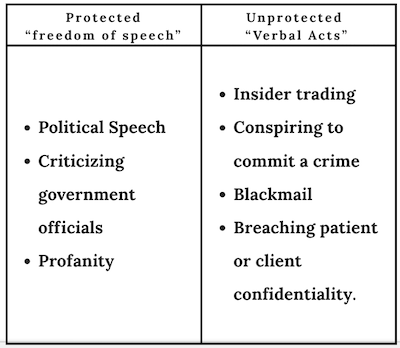
    • Use the language from the Gompers decision to create two categories on the board: speech protected by “freedom of speech” and “verbal acts” that are unprotected. It might be helpful to explain that this means that simply because words are used is not enough to make it “Speech” that is protected under the First Amendment.
  • Step 2:
    • Ask students to name some sorts of speech that are protected by the First Amendment. Depending on their level of awareness, it is normally not too hard to generate a few examples: political speech; criticizing a government official; profanity; and so forth. This should only take a minute – you just want a few examples.
  • Step 3:
    • Ask students what types of verbal acts can they think of that are not protected by free speech? They often struggle for a while, naming hard cases but ones implicated by free speech rights – for instance, pornography. You can put these in the middle of the two categories, as you can for anything you are not sure of. But some sorts of speech are clearly just verbal acts that raise no First Amendment concerns- insider trading, conspiring to commit a crime, blackmail, breaching patient or client confidentiality. If students are struggling, I give them one (insider trading) and see if they can come up with others. It normally only takes about 5 minutes or so, but it usually produces a fairly animated discussion, and helps clarify the conceptual issue by having students practice applying it.
  • Step 4:
    • After outlining the two categories, ask the students where Holmes was putting Schenck’s pamphlet. This one has a correct answer: He was saying it wasn’t like a piece of political speech; it was an act of interfering with the draft – one that just happened to be verbal, to take the form of speech – that could be regulated.

two column chart. The first column is titled "Protected "freedom of speech"" and in that column is listed 1) political speech, 2) criticizing government officials, 3) profanity. The second column is titled "Unprotected "Verbal Acts"" and below it is listed 1) insider trading, 2) conspiring to commit a crime, 3) blackmail, 4) breaching patient or client confidentiality

Classroom Exercise 3: Holmes Reconsiders

Content:
Overview & Primary Source: Abrams Pamphlet
Context
Holmes' Dissent Annotated
Group Questions
Conclusions and Key Takeaways

Overview:
If desired, you could assign the Abrams Pamphlet or the case dissent as homework reading. First, review the Context for yourself, then break students into groups for the activity.

  1. Have students read the Abrams dissent if they have not already.
  2. Have groups discuss the questions listed in the annotation.
  3. Provide students with information in the Context and Conclusion 

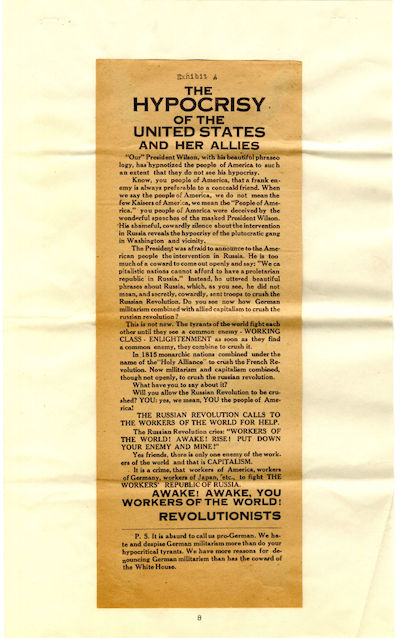
Jacob Abrams Pamphlet and Transcript

image of Jacob Abrams Pamphlet
“The Hypocrisy of the United States and her Allies,” August 1918, National Archives.

"THE HYPOCRISY OF THE UNITED STATES AND HER ALLIES

“Our” President Wilson, with his beautiful phraseology, has hypnotized the people of America to such an extent that they do not see his hypocrisy.
Know, you people of America, that a frank enemy is always preferable to a concealed friend. When we say the people of America, we do not mean the few Kaisers of America, we mean the “People of America.” You people of America were deceived by the wonderful speeches of the masked President Wilson. His shameful, cowardly silence about the intervention in Russia reveals the hypocrisy of the plutocratic gang in Washington and vicinity.
The President was afraid to announce to the American people the intervention in Russia. He is too much of a coward to come out openly and say: “We capitalistic nations cannot afford to have a proletarian republic in Russia.” Instead, he uttered beautiful phrases about Russia, which, as you see, he did not mean, and secretly, cowardly, sent troops to crush the Russian Revolution. Do you see now how German militarism combined with allied capitalism to crush the Russian revolution?
This is not new. The tyrants of the world fight each other until they see a common enemy — WORKING CLASS — ENLIGHTENMENT as soon as they find a common enemy, they combine to crush it.
In 1815 monarchic nations combined under the name of the “Holy Alliance” to crush the French Revolution. Now militarism and capitalism combined, though not openly, to crush the Russian revolution. What have you to say about it?
Will you allow the Russian Revolution to be crushed? YOU: yes, we mean, YOU the people of America!
THE RUSSIAN REVOLUTION CALLS TO THE WORKERS OF THE WORLD FOR HELP.
The Russian Revolution cries: “WORKERS OF THE WORLD! AWAKE! RISE! PUT DOWN YOUR ENEMY AND MINE!”
Yes friends, there is only one enemy of the workers of the world and that is CAPITALISM.
It is a crime, that workers of America, workers of Germany, workers of Japan, etc., to fight THE WORKERS’ REPUBLIC OF RUSSIA.
AWAKE! AWAKE, YOU WORKERS OF THE WORLD! REVOLUTIONISTS
P.S. It is absurd to call us pro-German. We hate and despise German militarism more than do your hypocritical tyrants. We have more reasons for denouncing German militarism than has the coward of the White House."

“The Hypocrisy of the United States and her Allies,” August 1918, National Archives


Context

  • In the fall of 1919, six months after the Schenck decision, another group of radicals appealed their conviction for wartime dissent. This time, the case concerned anarchists who had distributed a pamphlet calling for a general strike in New York City in an effort to prevent the production of war materials. They had been charged under a different section of the Espionage Act, one which made it illegal to interfere with wartime production.
  • In the Abrams case, seven of the justices simply applied the Schenck precedent from the spring and dismissed their appeal. As your class discussion might reveal, that seems sensible enough—if it had been illegal to advocate writing to a congressman, then calling for a general strike seemed even more of a “clear and present danger.”
  • But then Holmes did a surprising thing. Rather than applying his own precedent from only six months prior, he dissented – arguing that the anarchists had a First Amendment right to call for a general strike. What had happened?
  • Over the summer, Holmes’ decisions in the Schenck and Debs cases had been criticized by a newly emerging group of free speech advocates – intellectuals, lawyers and journalists that Holmes respected, and who were often friends. In particular, Harold Laski, a British-born academic teaching at Harvard and a close confidant of Holmes, waged a subtle influence campaign: sending Holmes reading material on the history and philosophy of free speech; arranging for Holmes to meet with a Harvard Law professor who had criticized the Debs decision. At the same time, Laski and other friends of Holmes at Harvard faced their own free speech crisis – they had spoken out in support of a strike of Boston police in 1919, and many were calling for them to be fired from the university.
  • These experiences changed Holmes’ mind about the value of free speech, and his dissent in Abrams reflected this new understanding. 


Holmes' Dissent Annotated:
Abrams v. U.S.​ Dissent
Persecution for the expressions of opinions seems to me perfectly logical. If you have no doubt of your premises or your power and want a certain result with all your heart you naturally express your wishes in law and sweep away all opposition. To allow opposition by speech seems to indicate that you think the speech impotent, as when a man says that he has squared the circle, or that you do not care whole-heartedly for the result, or that you doubt either your power or your premises. But when men have realized that time has upset many faiths, they may come to believe even more than they believe the very foundations of their own conduct that the ultimate good desired is better reached by free trade in ideas-that the best test of truth is the power of the thought to get itself accepted in the competition of the market, and that truth is the only ground upon which their wishes safely can be carried out. That at any rate is the theory of our Constitution. It is an experiment, as all life is an experiment. Every year if not every day we have to wager our salvation upon some prophecy based upon imperfect knowledge. While that experiment is part of our system I think that we should be eternally vigilant against attempts to check the expression of opinions that we loathe and believe to be fraught with death, unless they so imminently threaten immediate interference with the lawful and pressing purposes of the law that an immediate check is required to save the country."

  • The first thing to point to in this passage is that Holmes is not citing any cases. This is a sign that he is thinking more philosophically about what free speech should mean; and also that he is venturing into new territory, not covered by previous cases.
  • Classroom Discussion (Advanced Classes):
    • Does the role of judges only apply to already-existing law when deciding cases?
    • Or are judges creating law when they judge particular cases?
  • "If you have no doubt of your premises or your power and want a certain result with all your heart you naturally express your wishes in law and sweep away all opposition."
    • This sentence more or less sums up the approach Holmes took in the Schenck case six months prior - if you want to stop interference with the draft, why not ban speech that seeks to interfere with the draft?
  • "...ultimate good desired is better reached by free trade in ideas-..."
    • This is a crucial passage in the history of the First Amendment, where Holmes introduces the idea that there is a "Free trade in ideas" and that the best test of truth is whether it succeeds in the "competition of the market." While he doesn't use the exact phrase, this would come to be known as the "marketplace of ideas" - and the idea is closely related to his relativistic theory of truth: there are no guarantees that you can realize absolute truths, but the best method is to let all ideas be expressed, and see which becomes the most popular.
    • It is ironic that this defense of the free speech rights of radical socialists and anarchists is expressed in the language of the free market - for they were critics of the market. But Holmes had translated their calls for free speech into his own language, influenced by his reading of 19th century liberal philosophy.
  • "That at any rate is the theory of our Constitution..."
    • Holmes here warns us that there is no promise that truth will emerge from the competition of the market - you can't be sure that the best or most correct ideas will catch on.
    • But what it means to live in the American democracy, he says, is that you have to believe in that process of experimentation and trial and error, and that public opinion - even if based on imperfect knowledge - should be the guide to determining what is correct.
  • If it is true that the democratic experiment relies on the free formation of public opinion, Holmes suggests, then it is a dangerous thing to let governments block any expressions of opinion, even those we hate.


Compare Frameworks: Schenck & Abrams

Schenck:

  • Holmes says it is legitimate to police speech that might cause something you believe to be an evil.

Abrams:

  • Holmes warns against such censorship.
  • Censorship should be allowed only when it threatens "imminent" and "immediate" interference with a "pressing purpose."

Find the Abrams dissent here: Abrams v. United States (1919), National Constitution Center 


Group Questions:

  1.  Is the harm to the war effort here more or less severe than that in Schenck?
    1. In Schenck, the pamphlet asked people to write to their congresspeople to protest the draft; here the pamphlet calls for a general strike. Students should be able to see that a general strike would interfere with production more directly than a criticism of the war would interfere with the draft.
  2. Is the danger more "clear and present" in Abrams ​ or Schenck?
    1. Arguably, throwing leaflets out to workers is more direct than mailing them to soldiers or speaking to a picnic – you are directly addressing the audience you want to act, and asking them to act soon.

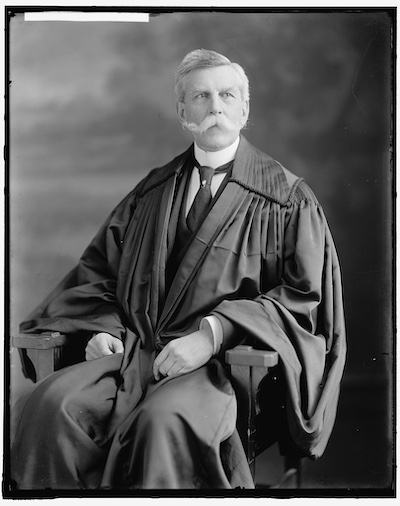
Portrait of Oliver W. Holmes in his judge robes. He has a large white handlebar mustache and is sitting in a chair.
“Holmes, Oliver W. Justice,” c. 1905-1945, Library of Congress 


Conclusions and Key Takeaways:

  • Holmes was not a radical, and he had no sympathy for the anarchists at the heart of the case – he thought they were advocating a “creed of ignorance and immaturity.” But he had come to believe that it was important to democracy to protect their rights to speech.
  • In the short-term, of course, that didn’t matter to the defendants in Abrams. A dissent doesn’t have any impact on the outcome of the case, which is determined by the majority decision – the anarchists were sent to jail, and later deported, for their pamphlet. But a dissenting opinion in a Supreme Court case also creates a record of the fact that some Justices disagreed with the opinion of the majority – and Holmes’s dissent in Abrams would become so famous and influential that it would end up becoming the legal consensus.
  • Over the twentieth century, Holmes’ dissent would guide the development of First Amendment law and philosophy, playing a crucial role in the rise of our contemporary right to free speech. Following from Holmes’ Abrams dissent, Americans today tend to speak of a “marketplace of ideas,” in which there is value to hearing from a diverse range of voices, even if you disagree with them, even if you think they might cause some harm you would prefer to avoid. But it wasn’t inevitable that this would be the way Americans came to think about the First Amendment.
  • It came out of a particular moment of history – the clashes between socialists and the government in World War I, the police strike at Harvard, and the influence of a small group of civil libertarians seeking to change the mind of one Supreme Court justice.


Optional Classroom or Homework Exercise:

  1. Ask students to identify a sort of speech today that they believe could be treated as a “verbal act” outside of the protection of the First Amendment.
  2. Ask them to make two arguments, one on either side of the question:
    1. If they had to make the case that it creates a “clear and present danger,” how would they do so?
    2. What are the benefits of protecting that speech as part of the marketplace of ideas? 

Remember: The goal here is not for students to necessarily decide on a complicated question, nor to correctly understand the current state of First Amendment law on these issues, but to practice applying the two different visions of free speech implicit in the Schenck decision and the Abrams dissent – one which focuses on regulating harms, the other on the democratic value of hearing all speech.

Free Speech Teaching Guide 4: Mandel v. Kleindienst (1972): Censorship via Visa

Article Body
This Teaching Guide is part of a series. Each of the four total teaching guides speaks to one aspect of the history of free speech. Although they work together to tell different parts of this history, it is not necessary to teach all of the guides or to teach them in a certain order. Each guide is a self-contained lesson.
(A PDF version of this teaching guide is also available for download-see left) 

Other guides in the series:
Free Speech Teaching Guide 1: The Birth of the Modern First Amendment: How Oliver Wendell Holmes Changed His Mind
Free Speech Teaching Guide 2: Brandenburg v. Ohio (1969): Defining and Arguing Hate Speech 
Free Speech Teaching Guide 3: The Problem of National Security Secrets

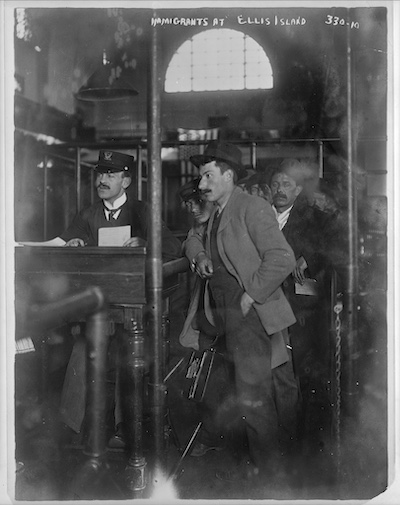
"Male Immigrants at Ellis Island." A man stands in line waiting while another man who works at Ellis Island handles his paperwork.

"Male Immigrants at Ellis Island," Library of Congress


Recommended for:

  • 11th Grade US History
  • 12th Grade US History
  • Undergraduate History

Table of Contents

Guide Introduction:
This introduction briefly previews the topics included in this guide that spans the twentieth century and ends with a 1972 Supreme Court Case.

Classroom Activities
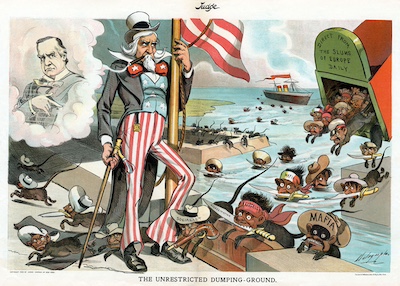
Exercise 1: "The unrestricted dumping-ground" (1903). A guided analysis of a 1903 political cartoon with annotations and questions. Why was immigration a heated debate in the early twentieth century?
Exercise 2: Who gets a Visa? A close reading of an excerpted 1984 article with guiding questions, notes, and class discussion options. Why deny visas?
Optional Exercise: Visa Waivers. Ask students to consider the more complicated reality of the visa law. How did waivers work and did they undermine political exclusion?

Framing Essay
Scholarly Context: How do visa laws and the First Amendment connect? An introduction to the Mandel Supreme Court case.
Annotated Decision: Notes on the Mandel SCOTUS decision for context or to help guide a close reading.
Key Takeaways: Concluding connections between immigration law and free speech law and prompts for class discussion.


Guide Introduction

        Throughout the 20th century, the U.S. government has denied visas to individuals because of their politics: anarchists in the early 20th century, communists in the Cold War, those it deemed advocates of terrorism in the 1990s and early 2000s. In the first half of 2025, the Second Trump Administration began seeking to deny visas to students and others engaged in pro-Palestinian advocacy during the war in Gaza.
        To be denied a visa means either that you can’t enter the country, or that you can be deported. Governments claim that this use of the visa regulations is simply a part of their control over immigration policy – they have a right to determine who can enter the country. Critics and civil liberties activists argue that it is a form of censorship, one that should be barred by the First Amendment. The relationship between visa laws and free speech was most closely examined in a 1972 case Mandel v. Kleindeinst. The case is also significant because it focused on a neglected aspect of the right to free speech – not the rights of the speakers to say what they want, but the rights of listeners and audiences to hear what they want.
        This guide traces the history of ideological visa denial to explore the intersection between immigration law and the right to free speech. It includes:

  1.  An overview of the history of visa denial in early 20th century, which allows students to assess historical fears of radical immigrants through the close reading of a political cartoon.
  2. A discussion of the denial of visas to communists and alleged radicals in the Cold War, through a classroom exercise and discussion of an excerpted newspaper article.
  3. An assessment of the role of the First Amendment in challenging visa restrictions through a close reading of a Supreme Court decision in 1972.


Classroom Exercise I: "the unrestricted dumping-ground" (1903)

Contents:
Overview
Annotated Cartoon
Questions for Students & Extended Context

Overview:
       The first efforts to exclude radicals from the United States came in 1903, when Congress passed a law barring anarchists from entering the country. This was a response to the assassination of President McKinley in 1901, which played into widespread anxieties that radical ideologies and crime were being brought to the country by immigrants. This 1903 cartoon captures the mood. The following pages include my annotations, as well as questions I use.

  1. Have students examine the cartoon individually or in groups.
  2. Invite students to share what they notice and ask more specific questions to guide conversation. This should mimic a close reading.
Political cartoon of uncle sam standing at a dock watching a shipping container dumping out immigrants who are depicted as animalistic. The ghost of president mckinley looks down on them

For the Printable Image See: linked source

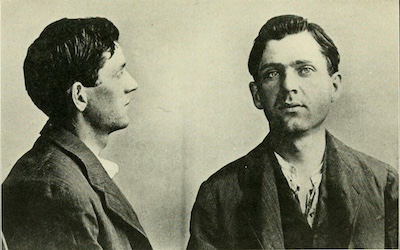
Leon Czolgosz mugshot

Image Source Here

Annotations:

  • McKinley assassination
    • McKinley (or McKinley’s ghost) is depicted in the top-left.
    • Leon Czolgosz, the gunman, was born in Detroit, but was the child of immigrants.
    • The cartoon, however, suggests the threat of anarchism is coming from immigrants, a widespread assumption at the time. “There is no such thing as an American anarchist,” said one newspaper column.
  • Both the container label “direct from the slums of Europe daily” and the title of the cartoon advocate for immigration restriction.
  • Depiction of Immigrants
    • McKinley and Uncle Sam are depicted as white, compared to the darker-skinned immigrants. At the time, most concern was about immigration from the south and east of Europe – groups that would later be considered white, but which were then treated as distinct races.
    • Immigrants are drawn to be animalistic, communicating an idea that they were less human and more threatening than white Americans.
  • Politics & crime:
    • Three migrants at the bottom are labeled “socialist,” “anarchist,” and “mafia,” associating socialists and anarchists with crime. The socialist carries a gun labelled “murder;” the anarchist a knife labelled “assassination,” further associating these political ideologies with violence.
    • There were radical leftists committed to political violence at the time. One wing of the anarchist movement, for instance, engaged in what it called “propaganda by the deed” – symbolic acts of political violence. Between 1880 and 1910, anarchists assassinated heads of state in Austria, Italy, Greece, France, Spain, Russia (twice), and Portugal – as well as McKinley in the U.S.
    • While many radical leftists rejected political violence, this cartoon suggests they were all criminals.

By the early Cold War, the bar on anarchists entering the country remained, and had been expanded to include Communists and advocates of communist revolution. The visa had also become a more powerful bureaucratic instrument. During World War I, for the first time the U.S. began requiring all visitors to the U.S. to receive a visa, which allowed a new degree of oversight and examination of applicants. A new Visa Division was created in the State Department to do this work.

Questions for Students:

  1. How are immigrants depicted?
  2. What is this cartoon arguing?
  3. Would immigration restriction be a useful remedy to the problems revealed by McKinley’s Assassination? What would have to be true for it to be effective for this purpose? What other remedies might be available?


Classroom Exercise II: Who gets a Visa?

Contents:
Overview
Excerpted Newspaper Article
Guiding Questions, Notes, & Class Discussion

Overview:
       A close reading of a later news article brings the topic of immigration and citizenship closer to the modern day for students. This exercise is centered around an excerpted 1984 newspaper article that discusses some individuals who were denied visas as well as efforts to reform the law. The article, like the cartoon in exercise 1, thus reveals some of the political dynamics involved.
        The next page includes some reading questions (as well as additional notes I might add), followed by a question for in-class discussion.

Excerpted Newspaper Article:
Kristin Helmore, “Would William Shakespeare get a Visa?” Christian Science Monitor, May 30, 1984.
       WALK into any bookstore in the United States and the works of Nobel Prize-winners Gabriel Garcia Marquez of Colombia and Pablo Neruda of Chile will be easily available. Anyone who wants to can buy Mexican novelist Carlos Fuentes's works or those of Italian writers Alberto Moravia and Dario Fo. And the titles of books by English novelist Graham Greene are almost household words in this country. Yet each of these acclaimed writers, and many others as well, has on at least one occasion been denied an entry visa to visit the United States.
        The law responsible for this policy is a section of the McCarran-Walter Immigration and Nationality Act of 1952, which some people would like to change. A bill has been introduced in Congress to do just that.
        ''Section 28,'' as it is called, empowers consular officials to refuse non-immigrant visas to foreigners who are or have been members of ''communist'' or ''anarchist'' organizations, as well as those who merely ''write, publish . . . circulate, display, or distribute . . . any written or printed matter advocating or teaching opposition to all organized government.'...
       The exclusion of writers from the US on ideological grounds can take place for a number of specific reasons. According to data collected by PEN, an international association of writers with offices in 55 countries, Gabriel Garcia Marquez was denied entry to the US from 1963 to '71 because of his affiliation with the leftist news agency La Prensa. Since that time, he has been granted entry only on presentation of a formal letter inviting him to a specific event. Last month, Mr. Garcia Marquez was denied entry into the US to speak at a meeting in New York on US policies in Latin America. Finally, in late April, he was granted a multiple-entry visa for one year.
        Pablo Neruda, the late Chilean poet and diplomat, was denied entry on the basis of his membership in the Chilean Communist Party. This ruling was waived on two occasions, in 1966 and '72, as a result of petitions put forward by PEN. ...
       Since 1961, Carlos Fuentes, the Mexican author and politician (who virtually grew up in Washington where his father was Mexican ambassador), has either been denied a visa to the US or issued restricted visas, even though he has been invited on numerous occasions to make public appearances under the auspices of respected institutions. He has received an honorary degree from Harvard University and was recently a visiting scholar at Princeton University. ...
        ''It's a scandal and a hateful thing for a democracy to perpetuate this kind of exclusionary policy,'' [novelist William] Styron said. ''It allows the United States to be branded as a bigoted nation filled with hysteria about communism.'
        Both Arthur Miller and John Irving raised the specter of McCarthyism. ''I doubt strongly that this law could have been passed before 1952, the wildest time of McCarthyism . . . but it's hung on the books because most people aren't aware of it,'' Mr. Miller said.
        ''I hope it's clear that we would improve our national character by ridding ourselves of these vestiges of McCarthyism which shame us today,'' Mr. Irving said.
        Carolyn Forche remarked, ''I am puzzled as to why my government is afraid of a free exchange of ideas. I would hope that my country and its institutions are strong enough to endure freedom of expression.' ...
        Support for the existing law was recently expressed on ABC's ''Nightline'' by Roy Cohn, counsel in the early 1950s to the Senate's Permanent Investigations Subcommittee headed by the late Joseph R. McCarthy: ''This law is aimed at people who present a threat to national security. Under various circumstances they should not be let in. They have access to courts where their visa denial can be overruled.' ….
        Opposition to Section 28 of the McCarran-Walter Act has a long history. In 1952, President Harry S. Truman vetoed the act, remarking, ''Seldom has a bill exhibited the distrust evidenced here for aliens and citizens alike.'
        Congress overrode Mr. Truman's veto."

Guiding Questions, Notes & Class Discussion:

  1. Who are some individuals who have been denied visas?
    1. Besides those named in the article, some famous individuals (though perhaps not famous to students today) include Charlie Chaplin, Pablo Picasso, Dorris Lessing, Nazim Hikmet, Czeslaw Milosz, C.L.R. James.
  2. What law was used to deny their visas?
    1. The 1952 Immigration and Nationality Act consolidated all previous immigration laws – including the Anarchist Exclusion Act of 1903 and an Internal Security Act of 1950.
    2. It was passed over Truman’s veto – a place to discuss the veto power with students if you think appropriate.
  3. Why do civil liberties groups want to reform the law?
    1. Beyond discussions of the impact of the law on the individuals involved, I make sure to draw student attention to William Styron’s argument that the law makes America look bigoted and intolerant.
  4. Why does Roy Cohn say we need such a law?
    1. How does this perspective complicate or affirm students’ thoughts on this debate?


Class Discussion:

  • Do students think denying visas under this law is a good or a bad thing?
  • Do they agree that there are national security grounds under which someone should be denied entry to the country? Do those grounds extend to political beliefs?
    • If you have used the other Free Speech Teaching Guides that cover Schenk v. US and Brandenburg v. Ohio, this is an opportunity to discuss what "harm" the law is intended to prevent.


Optional Exercise: Visa Waivers

        The visa law had a waiver process. If you were denied a visa because you were a member of a communist party, the Attorney-General could issue a “waiver” – letting you into the country just this time.

If students are opposed to the law, you can ask them if this waiver process is enough to satisfy them?

        There was some dispute over how frequently this process was delayed, and how many waivers were granted. But many were granted waivers. However, an additional concern was that the Attorney-General could attach conditions to the waiver – saying visitors could not travel to certain areas, or engage in certain types of activities. (we will see an example of these conditions in the Mandel case).


Framing Essay

Scholarly Context:
       How did these visa laws intersect with the First Amendment? They are clearly a form of punishment for political speech. As early as 1903, an anarchist being deported under the anarchist exclusion law claimed that his First Amendment rights were being violated. The Supreme Court ruled that foreigners could not claim First Amendment rights to stay in the country. As we discussed in the guide, Schenk v. U.S. (1919): The Birth of the Modern First Amendment, this was typical of the narrow way that the Supreme Court protected First Amendment rights before the mid-twentieth century. And in 1945, in a case concerning an attempt to deport an Australian labor leader, the Supreme Court said that noncitizens in the U.S. have the same First Amendment rights as citizens. Of course, in the early 1950s, American citizens didn’t have the right to advocate for Communism, and so many communists were deported in the McCarthy period, just as many Americans citizens were jailed. Today, the standards would be different.

Find the text of the First Amendment Here

       But what about the rights of the foreigner to enter the country? Here, courts have rejected the notion that foreigners can claim a First Amendment right to come into the U.S. if the U.S. has a law that would exclude them. The Supreme Court has ruled that the right to determine who can and can’t enter the country is what it calls the “Plenary Power” – part of what it means to be a government of a nation-state is the right to choose who can enter the country, and no court can interfere with those decisions.
        That has meant that foreigners can’t claim a First Amendment right to enter the country (they can claim such a right if they are being deported after entering, though the law is complex in this area.) But in the late 1960s, a group of university professors tried a different strategy to challenge the visa laws. They had invited Ernest Mandel, a Belgian Marxist theorist, to come to their campuses to give talks and engage in debates. Mandel was denied a visa because he advocated world communism.

Note (if you discussed the waiver program earlier):
       Mandel had been given waivers to enter the country in 1962 and 1968. But in 1969 he was denied a waiver. This was because 1) in 1968 he spoke at more universities than his waiver granted, and 2) after one of these talks, students auctioned posters to send money to French protestors – which violated a condition attached to Mandel’s waiver that he not speak at events where funds were raised for political causes. Mandel had not been told that these conditions were attached to his waiver. This can be a place to return to your discussion of the waiver program, to see if these details change or reinforce students’ earlier attitudes.

Annotated Decision:
       Mandel, as a foreigner, couldn’t claim his First Amendment rights were violated by his exclusion from the country. But the university professors argued that their rights were violated by his exclusion from the country – they wanted to listen to him, to talk to him, to meet with him. A lower court agreed with them, ruling that Mandel’s exclusion violated the First Amendment. The government appealed to the Supreme Court, which ruled 6-3 that Mandel’s exclusion was constitutional. Here’s what the Supreme Court said, along with some notes I use to teach the decision:

The decision text:
"The case…comes down to the narrow issue whether the First Amendment confers upon the appellee professors, because they wish to hear, speak, and debate with Mandel in person, the ability to determine that Mandel should be permitted to enter the country or, in other words, to compel the Attorney General to allow Mandel's admission. ….
The Government also suggests that the First Amendment is inapplicable because appellees have free access to Mandel's ideas through his books and speeches, and because 'technological developments,' such as tapes or telephone hook-ups, readily supplant his physical presence. This argument overlooks what may be particular qualities inherent in sustained, face-to-face debate, discussion and questioning. While alternative means of access to Mandel's ideas might be a relevant factor were we called upon to balance First Amendment rights against governmental regulatory interests—a balance we find unnecessary here in light of the discussion that follows in Part V—we are loath to hold on this record that existence of other alternatives extinguishes altogether any constitutional interest on the part of the appellees in this particular form of access."
Recognition that First Amendment rights are implicated, however, is not dispositive of our inquiry here. In accord with ancient principles of the international law of nation-states, the Court in The Chinese Exclusion Case 1889, and in Fong Yue Ting v. United States (1893), held broadly…that the power to exclude aliens is 'inherent in sovereignty, necessary for maintaining normal international relations and defending the country against foreign encroachments and dangers—a power to be exercised exclusively by the political branches of government.' ...

In summary, plenary congressional power to make policies and rules for exclusion of aliens has long been firmly established. In the case of an alien excludable under § 212(a)(28), Congress has delegated conditional exercise of this power to the Executive. We hold that when the Executive exercises this power negatively on the basis of a facially legitimate and bona fide reason, the courts will neither look behind the exercise of that discretion, nor test it by balancing its justification against the First Amendment interests of those who seek personal communication with the applicant. What First Amendment or other grounds may be available for attacking exercise of discretion for which no justification whatsoever is advanced is a question we neither address or decide in this case.

Annotations:

  • ["This argument overlooks what may be particular qualities inherent in sustained, face-to-face debate, discussion and questioning."]
    • The Government was claiming that the professors could speak to Mandel just as easily by telephone, and so his presence was not necessary. The court is skeptical of this claim.
      • In the era of zoom, do students think there is any benefit to in-person conversation? or is online discussion good enough?
  • ["Recognition that First Amendment rights are implicated..."]
    • The Supreme Court concedes here that there is a First Amendment right to hear Mandel. There are a number of other cases in the period which emphasize that the right to speak matters not for the speaker, but for the audience - that the First Amendment is important for its role in preserving a broader culture of debate and exchange.
    • Many students will think only about the rights of the speaker, so this is an important place to slow down and demonstrate how many more rights are involved.
  • ["The Chinese Exclusion Case 1889, and in Fong Yue Ting v. United States (1893)..."]
    • These are important late nineteenth century cases which established the Plenary Power. Congress passed the Chinese Exclusion Act in 1882, barring Chinese entry to the country. In these legal cases, courts said that they could not overrule political decisions made by Congress as to who could enter the country.
  • ["facially legitimate and bona fide reason..."]
    • This is a very deferential standard. In other first amendment cases, the Supreme Court has carefully scrutinized the government's rationale for a law, to make sure it isn't a cover for political discrimination. But here, the court says explicitly that if the government offers a justification that seems reasonable, the courts will not look any closer, or consider the First Amendment.
    • In dissent, Justice Marshall was very critical of this approach:
      • "I do not understand the source of this unusual standard. Merely 'legitimate' governmental interests cannot override constitutional rights. Moreover, the majority demands only 'facial' legitimacy and good faith, by which it means that this Court will never 'look behind' any reason the Attorney General gives. No citation is given for this kind of unprecedented deference to the Executive nor can I imagine (nor am I told) the slightest justification for such a rule."
  • ["What First Amendment or other grounds may be available for attacking exercise of..."]
    • This is an ambiguous final sentence, which can be used to help students understand the difficulty in working out how much precedent a given case is setting.
    • This sentence seems to leave open the possibility that there are some instances of visa denial which would raise First Amendment concerns - those in "which no justification whatsoever is advanced." But under what circumstances would a justification fail to be "facially legitimate and bona fide"?
    • The Court has never revisited the visa denial process, so the meaning of these sentences remains unresolved.

Key Takeaways:

  • Visa denial is at the crossroads of two discrete fields of the law: immigration law and free speech law.
    • In immigration law, courts have been very deferential to the power of the government to decide who can enter the country; in free speech law, courts have been very skeptical of government claims that it needs to regulate debate and discussion.

Do students think cases like Mandel’s – or more recent cases, if there have been some in the news – are better treated as First Amendment or immigration cases? Or do they think that these two areas of the law should be combined?

  • This can be an interesting place to leave the class discussion – asking students both to consider their own values in this complex area, and also to show them how the answers to legal questions are often shaped by the ways that courts and lawyers sort them into different doctrinal domains.

Housing and Houselessness: A Guide for Pre-Service Teachers

Image
Article Body

What is it?

Housing disparity is still a challenge many people, including students, face today. This guide provides historical context and primary sources so that students can better understand housing issues in the present-day U.S. 

Key points:

  • This activity will take one 90-minute period or two 45-minute periods. It is appropriate for a high school U.S. history classroom, but the sources can also inform a government class looking at the policy issue of housing.
  • Students will analyze, interpret, and evaluate primary sources related to housing. 
  • Students will gain a better understanding of the defining characteristics of housing and the historical actors and policies that determine these factors 
  • Guiding Question: How has housing been provided for people in the U.S. and how has that changed over time? 

Introduction

The McKinney-Vento Homeless Assistance Act, initially enacted in 1987 but reauthorized in 2015, ensures that youth facing homelessness can still access quality education and provides resources and assistance for students facing homelessness to succeed in their education. While there is a consensus that education is a fundamental right, housing is still an issue under debate. The purpose of this lesson is to indicate that the concept of housing as a basic right has changed over time. Students should take away that access to housing has not been solely based on individual actions or motives. It is based on various people, laws, ideas, and institutions.

This lesson aims to provide students with an understanding of the defining characteristics of housing and the historical actors and policies that determine these factors. The students should begin formulating the lesson's introduction about the foundations of a home. Have students think about what made those individuals’ houses homes. Another critical objective that teachers should have students think about is the interrelatedness of housing and houselessness. As the lesson will illustrate, housing development is usually coupled with the displacement of groups of people. This should prompt students to think about what happens to individuals when they are removed from places. To explore this interdependency of housing and houselessness, it is best to look at housing reform, which was emphasized during the New Deal. Educators should briefly reference the Great Depression and economic crisis to provide students with a starting point on how housing reform and public housing shifted into the present. The New Deal era demonstrates that concerns surrounding housing and the response to those concerns are displayed through policy and legislation. The reaction to those policies and legislation is through activism and lobbying. By the end of the lesson, students should be able to comprehend this cycle of development and reform, along with its various actors. 

Background/Context

While housing has been an issue throughout history, the first federal action to address housing came as a response to the Great Depression in the 1930s. The Great Depression brought about a massive housing crisis and high unemployment rates across the United States. Progressive reformers, as a response, initiated housing reform. The U.S. Housing Act of 1937 provided government funding to build regulated public housing, creating affordable living arrangements for low-income citizens. These new housing structures had racial segregation embedded in their design and coupled with urban renewal initiatives, the deterioration of public housing initiatives would begin after World War II. The Great Migration brought many African Americans to urban areas in the Northeast, West, and Midwest, searching for new opportunities. Due to the increasing number of African Americans in the urban centers and changes in legislation such as Brown v. Board in 1954 and the soon-to-come Civil Rights Act of 1964, housing authorities could no longer preserve the separatist vision of their progressive architects. Policymakers and white residents began to use de facto methods to maintain segregation. Leaving public housing areas in droves as a response, creating a need for more suburban neighborhoods designed to maintain segregation. Additionally, federal subsidies could no longer support the costs of maintaining these public housing buildings. As a result of tenant rent adjustments, housing authorities could no longer sustain quality conditions for tenants, and these buildings often became neglected. 

The 1970s and 1980s ushered in significant changes to housing policy in the United States. Concerns about private versus public funding for public housing and a resurgence in attention to homelessness created new policies that shifted American perspectives across racial and class lines. In the 1970s, urban renewal initiatives and policies such as the Housing and Community Development Act of 1974 shifted funding for affordable housing from federal responsibility to corporate opportunity. This act established Section 8 housing, which provided housing vouchers that allowed low-income individuals to get government subsidies to live in privately owned properties. However, because of this new shift, many public housing buildings were neglected, and many African Americans and other minority groups, like Latino communities, were still residing in them.  In the late 1970s and 1980s, there was an effort to move these residents out of public housing and into new privately owned neighborhoods. The 1986 Low-Income Housing Tax Credit (LIHTC) incentivized private developers to build new housing developments regulated by the state but relieved the federal government from fiscal responsibility. These initiatives, while alleviating the responsibility of the state and federal governments, did not lessen the ongoing poverty issues. By the 1990s, the HOPE VI program was created by Congress to demolish abandoned and neglected public housing and create new “mixed-income” housing developments. 

Throughout these efforts, the demolishing of housing and the creation of new neighborhoods always come with the displacement of people. These efforts not only created housing opportunities but also created homelessness. During the 1960s and 1970s, there were areas of placeless people, commonly known as “skid row.” These areas were filled with liquor stores, poorly managed hotels, crime, and disorder. During the 1950s and 1960s, homelessness and these areas were mainly populated by males, but as policy changed over time, there was a rise in women and children facing homelessness in the 1970s and 1980s. In 1987, the United States Interagency Council on Homelessness was created to respond to these changes in homelessness. Continuing these efforts in the 1990s and early 2000s, advocacy increased in combatting homelessness. Many non-profit organizations were forming to relieve issues concerning homelessness and federal policy, such as the Homeless Emergency Assistance Transition to Housing Act, enacted in 2009, to provide funding for homelessness prevention and re-housing. Place and placeness are interdependent. Examining housing and homelessness in the history of the United States involves examining policies, the individuals who create them, and the individuals who are affected by them. 

Activity

Bell Ringer  

To begin the lesson, students should consider the foundational elements of what constitutes a home. Using a textbook, a selection of reference materials, or even an internet search have students find examples of different homes throughout history; think of Indigenous housing structures, homes of the settlers-colonists during the Westward expansion, or the elaborate houses built by the elite class during the Gilded Age. Students should be able to express commonalities and indicators of defining “home” by the end of the discussion. 

Educators should allow students to consider whether housing structures are defined by their permanence and sustainability. Have students name the factors that could have led to temporary housing during earlier periods in U.S. history, such as migrating due to low food sources or natural disasters like fires or floods. There could also have been a lack of safety. Educators should guide students to determine that these first livable structures were built out of a necessity to survive, sheltering individuals and providing protection from elements that would compromise safety. Their permanence was yet to be determined. 

Homes began to form when people had the proper devices to ensure their structure could shield them from primary threats and cultivate sustenance. Examples are the ability to farm and raise animals. Most importantly, there was no longer a need to uproot quickly. Have students name a few activities individuals can do when they no longer must worry about these threats. Ask students what some ways these individuals could manage these threats are. 

Another significant development in creating permanent housing was property rights and land claims. People began to obtain documentation, such as deeds and titles, contracts, and leases, to represent their residences legally. Due to this, housing is now codified, but the right to housing is still in question. Federal and state governments create policies on how these laws can be enforced. Prompt students to consider the difference between a right to housing versus a right to shelter. 

After this brief discussion, this activity will allow students to begin rationalizing their definitions of what constitutes a home.  

To clarify the exercise, offer definitions for home. Here are a few definitions:  

Example: 

A home is a permanent structure used for habitation, procured through legal processes. 

Oxford Dictionary 

House 

  • (noun) A building for human habitation, typically and historically one that is the ordinary place of residence. 

Home 

  • (noun/adj.) A dwelling place is a person’s house or abode, the fixed residence of a family or household, and the seat of domestic life and interests. 

There are many definitions of house and home. Michael Allen Fox’s chapter “The Many Faces of Home” in Home: A Very Short Introduction suggests that the definition of home depends on linguistics, region, and cultural norms. Fox concludes that the definition of home is flexible and dependent on circumstance. Educators that would like additional information on how to define home should reference Fox’s chapter. 

For additional resources on defining home, Habitat for Humanity’s “What Does Home Mean to You” voices the definition of home through various perspectives. This resource can be used as a preliminary source for educators to tie in themes from the discussion.  


Step One 

First, ask the class: What do you think defines a home? 

Step Two 

As an entire class or in small groups, use the images below in the Primary Sources section and ask students what characteristics define these types of houses. These images can be printed and put on a board or provided to students. The images can also be projected on the board, or if students have their own digital devices (i.e., laptops, tablets, desktop computers), provide them the links and have them pull the images up on their devices. Students can work individually or in groups according to the teacher's preference. 

Educators can arrange these images in any order; however, they should refrain from telling the students what category they would be placed in. 

Step Three 

Create a list on a whiteboard or have students in groups write down characteristics for each image they think creates a home. For example, in Image #1, students can identify that there are curtains and other items displaying that people reside in the residence. 

Conclusion

During the activity, students have become the decision-makers on defining what constitutes a home. This is a common theme throughout the lesson: who defines housing, and who decides who gets to have housing? Historically, actors have been policymakers, activists, and legal apparatuses. 

Housing and homelessness are determined by permanence, which is determined by legislation. Legislation establishes ownership and protects residents, enforcing codes and policies to ensure the structure is livable. The policies determine housing rights. Throughout the lesson, students should continue to inquire about how these rights change over time. 

Ask students: Who decides what constitutes a home?  

Primary Sources: Housing Examples

  1. Typical Housing in Greenbelt, Maryland- https://www.loc.gov/item/2018699737/ 

Outdoor view of two houses side by side. The house on the left is blue, and the house on the right is white. Both houses have flat roofs, two stories, and five windows. Grass and trees border the houses.

Annotation: These houses should be categorized as homes. Students should be able to identify residency in both homes by examining them. A satellite dish, curtains, and other identifiers provide proof of occupancy. The individual in this home is either the owner or renter, and the structure has gone through a legal process to become a permanent structure. Housing communities in the Greenbelt District were developed during the New Deal Era in 1935 under the United States Resettlement Administration. This administration was designed to resettle farmers and migrant workers affected by the Dust Bowl.  


  1. One of Many Small Ponds Surrounded By Housing Developments in Gilbert, Arizona, a Southern Suburb of Phoenix, Arizona- https://www.loc.gov/pictures/item/2018702325/ 

A large pond takes up most of the photo, and it is lined with palm trees, which are reflected in the pond. Toward the back of the photo are houses overlooking the pond.

Annotation: The homes in this picture are recently built. This picture was taken in 2018. Students should recognize that these are permanent structures and think about what these homes do to the environment and homes of other organisms. This picture shows a pond and clear signs of human manipulation of this environment. Teachers should guide students to conclude that homes that are this way permanently displace other living things and their habitats while creating new ones for others. 


  1. Housing Development Around a Private Lake in the Northern Reaches of Indianapolis, Indiana-   https://www.loc.gov/pictures/item/2016631680/ 

Outside aerial view of a private lake and the housing development that surrounds it. The sky is clear, and an interstate sits in front of the private community.

Annotation: This image is an aerial view of housing development. Have students notice the exclusiveness of this property. It is essential to identify this lake as private. Some indicators show that there are very few entry points into this neighborhood. This is designed for the safety of the community. Students should reference the previous discussion that safety and community building are critical to creating permanence. Also, the concept of privatizing property, such as the lake, relates to the debate on property rights. This lesson will discuss the conversations between policymakers and citizens on whether housing initiatives should depend on government subsidies or become a private corporate venture. Students should begin to acknowledge the differences and outcomes between the two.  


  1. Abandoned Public-Housing Units in the Liberty City Neighborhood of Miami, Florida- https://www.loc.gov/resource/highsm.62362/ 

One full housing unit is in view, which is light blue, two stories, and has twelve windows and two doors. Two other housing units are partially visible, and a paved concrete path leads to the units. A telephone pole stands in front of the unit.

Annotation: The housing units in this image were a government-subsidized public housing project built in the 1930s. The housing units, while no longer in use, are the physical representation of the changes in housing reform. These units were once heavily populated during the early stages of housing reform. However, they are vacant over time due to many policy changes.


Primary Source Analysis Activity: Housing Policy 

To analyze these sources, divide students into groups and create a station for each primary source, a total of four stations that students will rotate. Students should spend 10 to 15 minutes at each station examining the sources, answering associated questions, and recording them on paper. Each group should have one document to share their answers at the end of this activity. The questions are designed to have students not only think about the material from a historical perspective but also prompt students to think about historical actors involved in creating housing policy changes and homeless assistance reforms. These sources are in chronological order to aid students in analyzing how housing changes over time. During this activity, ensure that students contemplate the relationship of each source and whether it adds to the continuity or change in housing policies and public sentiments. At the end of the activity, reassemble the class and discuss each group’s answers. 

A computer or tablet will be needed for this activity. 

Step One 

To begin this activity, additional information should be provided to frame the required con, specifically with Sources #3 and #4, due to the nature of the sources. As the entire class, educators should review each source, provide background information, and review the specific questions on each source.


Step Two 

Divide students into groups, set a timer for 10 minutes, and begin the timer at the start of each rotation. Each station should have instructions for the students, including how to use the source and the associated questions. Students should write a 3-5 sentence answer for each station’s question. 

Step Three

After all student groups have completed the activity, the class should reconvene, review each question, and have students share their answers. Educators should revisit the information provided at the start of the activity as needed. 


Station One 

Educators should print out the Library of Congress’s Public Improvement map and use a computer or tablet to display Mapping Segregation DC’s “Restricted Housing and Racial Change, 1940-1970” map for students to interact. 

Source #1 

Program objectives diagram 1: 1967-1985 public improvement program priorities (partial accounting) : [District of Columbia]. - https://www.loc.gov/resource/g3851g.ct010988/?r=-0.279,0.116,1.856,0.957,0 

Map of Washington, DC. Shaded areas correspond to urban renewal projects

This city-planning map displays urban renewal plans in Washington, D.C., created in 1967 to illustrate development plans from 1967-1985. This map shows where new schools will be built, transit systems, parks, and other infrastructure for public improvement. Have students pay attention to where these activities are located. In tandem with this source, have students examine Mapping Segregation DC’s, Restricted Housing and Racial Change, 1940-1970 map, and have students identify who lives in the neighborhoods that will be affected. Choose the layers of the map that coordinate with the time of this development plan. ‘

Questions 

  1. What does “public improvement” mean according to this map? 
  2. What places are being added to the neighborhood? 
  3. What neighborhoods and residents are being affected based on both maps? 


Station Two

Educators can print out this source or display it digitally. 

Source #2

The Housing Struggle in Crisis, National Tenant Organization Poster, 1973- https://www.loc.gov/item/2016649888/ 

Poster featuring a crumbling building. The text reads The Housing Struggle in Crisis. The 1973 National Tenants Organization, National convention Aug. 30 thru Sept. 3 Pick-Congress Hotel Chicago, IL

This source is a poster for the National Tenant Organization’s National Convention in 1973, held in Chicago, Illinois. The poster shows an apartment building being demolished. The National Tenant Organization was formed in 1969 to help with tenants' rights issues. The National Tenants Organization vs. HUD (U.S. Department of Housing and Urban Development) determined that HUD’s restriction in deductions to secondary wage earners resulted in overcharging those tenants. The courts determined that this was a violation and that HUD must carry out the deductions. Students examining this source should contemplate the types and levels of advocacy during housing reform. 

Questions 

  1. How does this poster depict issues surrounding housing during the 1970s? 


Station 3 

Educators should print or display digitally the first page of this source and highlight the excerpt or print out the excerpt of the source placed below. 

Source #3

U.S. Reports: Hills, Secretary of Housing and Urban Development v. Gautreaux et al., 425 U.S. 284 (1976). - https://www.loc.gov/item/usrep425284/ 
 

Hills vs. Gautreaux was a defining moment in housing reform. This case shows that racial discrimination remained active after the 1964 Civil Rights Act. It prompted housing authorities to create new non-discriminatory housing programs, including Section 8 and integrating Black and White residents. Students should use the excerpt below, and educators should prompt a discussion about the magnitude of why the integration of residence was essential to Americans. This case is twelve years after the Civil Rights Act and in Chicago, which is often not associated with racism as in the American South. Students should identify that racism was nationwide and that the Civil Rights Act, a federal law, did not solve the problem of segregation. While segregation was now illegal, de facto segregation was still prevalent. 

Excerpt: 

“Respondents, Negro tenants in or applicants for public housing in Chicago, brought separate class actions against the Chicago Housing Authority (CHA) and the Department of Housing and Urban Development (HUD), alleging that CHA had deliberately selected family public housing sites in Chicago to ‘avoid the placement of Negro families in white neighborhoods’ in violation of federal statutes and the Fourteenth Amendment, and that HUD had assisted in that policy by providing financial assistance and other support for CHA's discriminatory housing projects. The District Court on the basis of the evidence entered summary judgment against CHA, which was ordered to take remedial action. The court then granted a motion to dismiss the HUD action, which meanwhile had been held in abeyance. The Court of Appeals reversed, having found that HUD had committed constitutional and statutory violations by sanctioning and assisting CHA's discriminatory program.”

Questions

  1. What does this case say about race in public housing during the 1970s? 
     

Station 4 

This station should center on the preservation of communities. Educators should be permanently present at this station to guide conversations and answer questions. 

Source #4

Bulletin board at Johnson Houses, E. 115th St. at Lexington Ave., Harlem, 1989 digital file from original- https://www.loc.gov/resource/vrg.07713/ 

Bulletin board under an analog clock with various posters, pamphlets, and photographs pinned to it.

This is a bulletin board in a public housing project in Harlem, NY. It is filled with advertisements about drug prevention and bulletins that encourage Black success. There is also a sign in Spanish. This primary source shows what some public housing communities faced during this time in these housing projects. This source also shows the dichotomy of the needs of Black and Brown community members. It shows the upliftment and success of the Black and Brown communities while protecting their communities from crime. 

During the 1980s, many members of the public believed minority communities were responsible for crime and poor living conditions. The most crucial portion of this source is that it shows an effort of community members to preserve their communities so that they won’t be subjected to urban renewal initiatives. It is also essential for students to note that there wasn’t much improvement in housing between the 1960s and 1980s. Have students identify why that is. 

Questions 

  1. How do the posters on this bulletin board speak to the preservation of public housing in the 1980s? 


Wrap Up 

To conclude this lesson, have students reflect on the difficulty of decision-making and consider who determines housing and houselessness. 

Revisit the question in the Bellringer exercise and discuss how answers may have changed or have stayed consistent. 

Question: What defines housing? Who decides these defining attributes? 

General Tips for Teaching Controversial Subjects

  • Center activities on primary sources. Primary sources are tangible evidence that allow students to engage directly with history. These primary sources in particular were preserved and digitized by the Library of Congress because they were deemed important to the history of the United States.
  • Discussion and analysis of these sources can be wide ranging, but within each class those discussions can always be turned back to the source itself.
  • The sources are also, by definition, only pieces of a puzzle. They bring us closer to understanding the past but there is always room for doubt and uncertainty.  
  • Questions, Observations, and Reflections should come from students. These are primarily student-directed learning activities. It is the instructor's role to create a space for inquiry and empower students to drive the inquiry.
  • It may help to remind students at the outset that it is normal for different individuals to come to different conclusions, even when we are looking at the same sources. Further, it would be strange if we all agreed completely on our interpretations. This can normalize the strong reactions that can come up and enables educators to discuss the goal of historical research, which is to hopefully go beyond the realm of individual  perspective to access a fuller understanding of the past that takes multiple perspectives into account.
  • Teaching historical topics that involve violence and other trauma can be traumatic for some students as well. Providing students with previews of what content will be covered and space to process their emotions can be helpful. The following video series from the University of Minnesota contains further tips for teaching potentially traumatic topics: https://extension.umn.edu/trauma-and-healing/historical-trauma-and-cultural-healing.


For more information


Bibliography

Eide, Stephen. Homelessness in America: The History and Tragedy of an Intractable Social Problem. London: Rowman and Littlefield Publishing, 2022. 

Fox, Michael Allen, 'The many faces of home', Home: A Very Short Introduction, Very Short Introductions (Oxford, 2016; online edn, Oxford Academic, 15 Dec. 2016), https://doi-org.mutex.gmu.edu/10.1093/actrade/9780198747239.003.0001,

Hunt, D. Bradford. "Public Housing in Urban America." Oxford Research Encyclopedia of American History. 20 Dec. 2018; Accessed 11 Jul. 2024. https://oxfordre.com/americanhistory/view/10.1093/acrefore/9780199329175.001.0001/acrefore-9780199329175-e-61.

U.S. Department of Housing and Urban Development Timeline 

Theodore Roosevelt and the 1912 Election

Teaser

Students learn more about the larger than life figure of Theodore Roosevelt through sources related to the presidential election of 1912. 

lesson_image
Description

Students learn about Theodore Roosevelt the man and his 1912 third party campaign for president.

Article Body

In this teaching module from the Shapell Manuscript Foundation in collaboration with the Roy Rosenzweig Center for History and New Mediastudents learn how to examine engaging primary sources that surround the dramatic 1912 presidential campaign in which Roosevelt ran as a third party candidate after having served as president from 1901 to 1909. During the campaign Roosevelt was the victim of an assassination attempt while speaking in Milwaukee and several of the documents relate to this event and how it affected Roosevelt and the campaign.

Students work in small groups to analyze sources to better understand Theodore Roosevelt, the person, and the issues that most concerned Americans during the 1912 campaign. Primary sources include letters from Roosevelt providing an account of his assassination and an update on his recovery. Other sources relate to the campaign itself and the Bull Moose or Progressive Party that Roosevelt ran under. Students are also encouraged to think through how Roosevelt's personality made him an attractive candidate.

After analyzing these primary sources students work in groups to create their own campaign materials for Roosevelt. Teachers have the option of having students create physical posters or pamphlets or to have students use digital tools to create their promotional materials. The modules also contain guidance on differentiation for diverse learners and connections to standards.  

Topic
Theodore Roosevelt and the 1912 presidential campain
Time Estimate
90 minutes
flexibility_scale
2
Rubric_Content_Accurate_Scholarship

Yes

Rubric_Content_Historical_Background

Yes

Rubric_Content_Read_Write

Yes

Rubric_Analytical_Construct_Interpretations

Yes

Rubric_Analytical_Close_Reading_Sourcing

Yes

Rubric_Scaffolding_Appropriate

Yes

Rubric_Scaffolding_Supports_Historical_Thinking

Yes

Rubric_Structure_Assessment

Yes

Rubric_Structure_Realistic

Yes

Rubric_Structure_Learning_Goals

Yes

John F. Kennedy and Service

Teaser

Students learn about John F. Kennedy and his ideas about service as a prompt to explore what service means in their communities.  

lesson_image
Description

What does it mean to "ask not what your country can do for you but what you can for your country"? Students learn the context of JFK's phrase and craft their own "Ask Not" messages.

Article Body

In this teaching module from the Shapell Manuscript Foundation in collaboration with the Roy Rosenzweig Center for History and New Mediastudents explore rare and historically significant manuscripts from Shapell collection. These include handwritten documents by President John F. Kennedy including notes recording his well known call to service "Ask not what your country can do for you, but what you can do for your country." Students use documents to learn more about what President Kennedy meant by service and then develop their own ideas about how what service means in their community.

Students work in small groups to analyze these documents and think through the kinds of service Kennedy engaged in. Kennedy's service include his military service in the navy during World War II that he volunteered for despite the fact that his medical issues excused him from the draft. Students also learn about Kennedy's policies such as the Peace Corps which promoted the idea that young people could serve the world in a variety of ways.

After analyzing these primary sources students work in groups to create their "Ask Not" video to encourage young people to engage in service to their communities. As a possible extension, teachers can invite community leaders into the classroom to view the video presentations and offer feedback on what local service opportunities exist for young people.

Topic
John F Kennedy and Service
Time Estimate
90 minutes
flexibility_scale
2
Rubric_Content_Accurate_Scholarship

Yes

Rubric_Content_Historical_Background

Yes

Rubric_Content_Read_Write

Yes

Rubric_Analytical_Construct_Interpretations

Yes

Rubric_Analytical_Close_Reading_Sourcing

Yes

Rubric_Scaffolding_Appropriate

Yes

Rubric_Scaffolding_Supports_Historical_Thinking

Yes

Rubric_Structure_Assessment

Yes

Rubric_Structure_Realistic

Yes

Rubric_Structure_Learning_Goals

Yes

Ford's Theatre: Lincoln's Second Inaugural Address

Video Overview

Ford's Theatre Society's Sarah Jencks leads a group of TAH teachers through analysis of Abraham Lincoln's Second Inaugural Address. After taking a close look at Lincoln's techniques in the speech, the teachers engage in a roleplaying activity, suggesting the reactions of a selection of historical characters to the speech and to Lincoln's assassination.

Video Clip Name
Fords1.mov
Fords2.mov
Fords3.mov
Fords4.mov
Video Clip Title
Analyzing the Second Inaugural: Part One
Analyzing the Second Inaugural: Part Two
POV Activity: Part One
POV Activity: Part Two
Video Clip Duration
7:03
7:58
7:05
7:27
Transcript Text

Sarah Jencks: First take: What are some of the things you notice, both about the content, what he’s saying, and also about the way he goes about saying it? Just a quick phrase or what words or phrases stick out to you here? Teacher: Well, there’s some old Biblical references. Sarah Jencks: Yeah, he calls on the Bible a lot, absolutely Teacher: That’s strange for us in the 21st century Sarah Jencks: And he also, it’s clear he assumes people know that those quotes are from the Bible, right, because he doesn’t say these are Bible quotes, he just does it. What else? Teacher: He brings sort of a why he said some things in the first inaugural address and how this is going to be different, lays out and prepares for what he’s going to say. Sarah Jencks: He definitely starts off by saying this is a new day, this is a different time. Absolutely. What else? What other things do you notice in here? Yeah. Teacher: Malice towards none is sort of the start of the Reconstruction. Sarah Jencks: So yeah. So at the very end of the speech, he’s definitely moving forward and he’s setting a tone for what his expectations are. Absolutely. What else? Teacher: I think he reaffirms the notion that we’ve seen since the Emancipation Proclamation, that originally the war was about preserving the Union, but now he’s very clear that it was about ending slavery. Sarah Jencks: Absolutely. Yeah, he really states it. He even goes further than that. We’ll talk a little bit more about that. What else? What else do you notice? Anything about the structure? Teacher: I’m just struck by the rather severe comment that God wills the retribution. Sarah Jencks: Yeah, there’s nothing light or casual about this middle paragraph. Anything else? Okay, let’s try to take a second pass at this, and as we’re doing it, I want you to think about those things, about the references, the Biblical references, and let’s also—we’ll pay attention to these different paragraphs. He starts by saying it’s a new day, then he goes into talking about what it was like in the country at the beginning of the Civil War in the next paragraph, and then he goes into this really intense paragraph about slavery and about why this war—he’s got an idea why this war happened. And then moving us towards post-war times. And just quickly I want to remind you, do you all know what the day was that Abraham Lincoln was assassinated? Do you remember? [Murmuring answers] Sarah Jencks: April 14th. He was assassinated on the 14th, he died on the 15th. And what is this date right here? March 4th. So it’s how much earlier? Yeah, just like a month and a half. It’s not much. He hardly had a second term. Teachers reading: Fellow-Countrymen: At this second appearing to take the oath of the Presidential office there is less occasion for an extended address than there was at the first. Then a statement somewhat in detail of a course to be pursued seemed fitting and proper. Now, at the expiration of four years, during which public declarations have been constantly called forth on every point and phase of the great contest which still absorbs the attention and engrosses the energies of the nation, little that is new could be presented. The progress of our arms, upon which all else chiefly depends, is as well known to the public as to myself, and it is, I trust, reasonably satisfactory and encouraging to all. With high hope for the future, no prediction in regard to it is ventured. Sarah Jencks: Okay, let’s stop for a second and talk about some of the things he’s doing in this first paragraph. It’s funny, I’ve been doing this for three years, and I just noticed a new thing, so what, what are some of the—he’s very skilled in the way he’s structuring this. What are some of the things that he’s doing in this first paragraph. How is he—what is he trying to do as he introduces this speech? What do you see? Teacher: Well, ’high hope for the future, no prediction in regard to it is ventured.’ Like, he has a plan, he’s not quite sure how it’s going to go and how it’s going to be accepted. Sarah Jencks: Yeah, and, you know, that’s the part that I just noticed something for the first time. He doesn’t ever say in this speech, and the Union is going to win, which was clear by then. It was clear by March 4th that the Union was going to win. Why wouldn’t he say that? Why might he choose not to say that in this speech? Given what else he knows? Teacher: He feels he’s a president of all the states. Sarah Jencks: He doesn’t want to stick it to the South. He’s specifically saying no prediction is ventured, I’m not going to go there. It’s an interesting way for him to start this. Teacher: So he’s already thinking about healing. Sarah Jencks: Exactly, exactly. Yeah, yeah, we’re not going to start this speech by saying we’re winning, we’re doing it. Teacher: Well, he even has sense before, ’reasonably satisfactory,’ he doesn’t go jump and say that we’ve won, pretty much, it’s very— Sarah Jencks: I just heard, I’m sorry, I don’t know—yes. Yeah. And very measured. He’s very careful how he does that. Teachers reading: On the occasion corresponding to this four years ago all thoughts were anxiously directed to an impending civil war. All dreaded it, all sought to avert it. While the inaugural address was being delivered from this place, devoted altogether to saving the Union without war, insurgent agents were in the city seeking to destroy it without war—seeking to dissolve the Union and divide effects by negotiation. Both parties deprecated war, but one of them would make war rather than let the nation survive, and the other would accept war rather than let it perish, and the war came. Sarah Jencks: Okay, let’s stop again. Um, he’s still talking about the previous inauguration and the beginning of the war here, and he does a lot of this ’then and now.’ If you notice, in the first paragraph, he says ’then the statement seemed fitting and proper, now, we don’t need it anymore.’ So, what do you notice about this paragraph, what are some of the things you notice about what he’s saying at this paragraph? I’m going to say one—are there any hands back there that I’m missing? Yes. Teacher: I was just going to say he’s very balanced. He’s not placing blame. And, you know, in these last few sentences, he states what one party did, then what the other party did, and then response one party did, and the other party did. He’s very—it gives a very balanced perspective. Sarah Jencks: And what’s the—this is just a little grammar thing that I sometimes do with kids when I’m looking at this. In that very last clause of the paragraph, who’s taking the action? Teacher: The war itself. Sarah Jencks: Yeah. Isn’t that interesting? It’s not a person on either side. It’s the war is the subject. Teacher: And he also does a similar thing by saying that insurgent agents, he’s not saying the whole South, the government, you know, or the leaders of the South, like agents, like I know it’s not everyone, it’s just these few. Sarah Jencks: And he also says in that second sentence, notice the way he says all dreaded it, all sought to avert it. Nobody wanted war. Teacher: I think he does nail, though, who he feels started it. Sarah Jencks: Yeah, yeah. It’s true. Teacher: Makes it clear. Sarah Jencks: It’s true. He says one of them would make war rather than let the nation survive. And the other would accept it. No, you’re absolutely right, you’re absolutely right. I mean, he’s not saying nobody’s responsible here, but he is really being careful about the way he phrases it. Um. We’re ready to keep going. Teacher: Okay. Sarah Jencks: Okay. Teachers reading: One-eighth of the whole population were colored slaves, not distributed generally over the Union, but localized in the southern part of it. These slaves constituted a peculiar and powerful interest. All knew that this interest was somehow the cause of the war. To strengthen, perpetuate, and extend this interest was the object for which the insurgents would rend the Union even by war, while the Government claimed no right to do more than to restrict the territorial enlargement of it. Sarah Jencks: Okay, I’m going to stop us here, because this is a really long paragraph. What’s he doing here? He’s moving on from talking about what happened at the beginning and who was responsible. He’s going a little deeper here. What’s he doing? Teacher: He’s kind of always said that the cause of the war was to save the Union, but here he’s saying that even though we always said it was to save the Union, we knew that this was slavery and this institute had something to do with it. Sarah Jencks: And who knew? According to him? Teacher: Everybody. Sarah Jencks: Everybody. He does it again. All dreaded it, all sought to avert it. All knew that this interest was somehow the cause of war. He’s not letting anyone off the hook here. What else? Do you recognize any language here, from other studies of slavery or anything? Teacher: A peculiar institution. Sarah Jencks: Exactly. A peculiar and powerful interest. Absolutely. And I think it’s really interesting the way he says to strengthen, perpetuate, and extend this interest was the object to which the insurgents would rend the Union even by war. I love that image, his use of that word, to rend the Union, because I always think of sort of tearing fabric or something. Teacher: He’s also in the next part of that sentence talking about, you know, I didn’t say that I was going to abolish slavery at the beginning, I was not—I was going to let the states deal with it, the territory. He says, hey, you know. Sarah Jencks: Other "than to restrict the territorial enlargement." Part of what I like about this speech also is that it sort of like gives you like, the whole history of, you know, the early part of the 19th century. He addresses so many issues that you can then make connections to. Okay, let’s keep going. Teachers reading: Neither party expected for the war the magnitude or the duration which it has already attained. Neither anticipated that the cause of the conflict might cease with or even before the conflict itself should cease. Sarah Jencks: Okay, stop for just a second. What is he saying here? He’s addressing something that happened in January 1865 here. The cause of the conflict should cease before the conflict itself should cease. Does anybody know? Do you remember from down— Teachers: The Emancipation Proclamation. Sarah Jencks: The Emancipation Proclamation, yes, that was in 1863. January 1865, the Congress passed the 13th Amendment. And so it hadn’t been ratified yet, it wasn’t ratified until December 1865, but it had been passed by Congress. And so he lived to see that happen, and that was yet another sign that it was—we were in the endgame.

Teachers reading: Each looked for an easier triumph, and a result less fundamental and astounding. Sarah Jencks: I love that sentence because the kids often, they think, they’re not used to these words being used in such a powerful way. A result less fundamental and astounding. Just changing the whole country. Keep going. Teachers reading: It may seem strange that any men should dare to ask a just God’s assistance in wringing their bread from the sweat of other men’s faces, but let us judge not, that we be not judged. The prayers of both could not be answered. That of neither has been answered fully. The Almighty has His own purposes. Sarah Jencks: Okay, let’s stop again. So he’s making a transition here from determining what the cause of the war was to what? What’s going on here? Teacher: It’s in God’s hands. Sarah Jencks: It’s in God’s hands. Where do you see that? Teacher: It’s just the [unintelligible] that I’m getting from the actual—the whole Bible and everything else, it’s just kinda like this is fate now. Sarah Jencks: He’s doing something more here with that. The way he was using 'all' before, he’s using—do you see he’s using that here as well? What words does he use here to bring people together? Teacher: Neither. Sarah Jencks: Neither and also—does anybody see anything else? Both. Yep, neither and both. He’s bringing everybody—he’s saying, we may not be seeing this from the same perspective, but we’re all seeing it together. Teacher: And I take that both sides here have lost. Neither side is jumping for joy. Sarah Jencks: Yeah. Yeah, absolutely. Absolutely. And he really is bringing everybody together. Let’s talk about that dig for a second. What’s his dig here? Teacher: That the prayers of both could not be answered. Sarah Jencks: The prayers of both could not be answered. That of neither has been answered fully. They could—we can’t—we’re not—we’re not going to be satisfied. What’s he—his previous sentence, though, may seem strange. Teacher: Yeah. Sarah Jencks: What’s going on in that sentence? Anybody want to read it aloud again? Somebody just go ahead. Go ahead. Teacher: Uh, okay. ’It may seem strange that any men should dare to ask a just God’s assistance in wringing their bread from the sweat of other men’s faces, but let us judge not, that we be not judged.’ Teacher: Is that a dig against slavery, then? Teacher: Yeah. Sarah Jencks: What’s he—how do you take that? Teacher: You’re making money from someone else’s work. Sarah Jencks: Yeah. But who do you think he’s talking to there? Teacher: I think to the South. Sarah Jencks: You think he’s talking—okay, tell me more about that. Teacher: Slaveowners. Sarah Jencks: Slaveowners. Okay. And the workforce. Think about the Northerner here, for a second. Why might that sentence—and I’m just thinking of this right now, so don’t think I’m so far ahead of you here. Why might that sentence be addressed to a Northern audience? Teacher: He’s critical in that the Northerners really didn’t maybe speak up more loudly against it, that they even have labor issues themselves. Sarah Jencks: Remember he quotes the Bible here, though. He says it may seem strange that slavery exists, but, let us judge not, that we be not judged. So yeah, he’s bringing up issues of labor in the North, and he’s saying hey, you Northerners, you abolitionists, you may think those Southerners are pieces of white trash, but let us judge not so that we be not judged. You’re not God. It’s interesting because he’s got many many audiences here, and we’re going to be playing with that in the minute. Teacher: I was thinking similar to the reference that he used, let he who casts the first stone be without sin, so, you know, it seems like another Biblical reference or reference to that part of the Bible. Sarah Jencks: Yeah, absolutely. Let’s keep going. Let’s go. Teacher: Woe— Sarah Jencks: My apologies for cutting you off. Teacher: It’s okay. ’Woe unto the world because of offenses; for it must needs be that offenses come, but woe to that man by whom the offense cometh.’ Sarah Jencks: What does this mean? What does this Biblical quote mean? Let’s break it down, because it’s not an easy one. ’Woe unto the world because of offenses; for it must needs be that offenses come, but woe to that man by whom the offense cometh.’ Teacher: I mean, to go back to the Biblical language, he’s saying something along the line of it’s a shame that we have to live in a world of sin, this is a sinful world, so we should feel sorry for ourselves, and this is a place where sin is going to happen, but God help the sucker who commits the sin. Teacher: Yeah. Teacher: Bad things happen, but this could have been avoided. Sarah Jencks: Right, and also you’d better not be the one who’s actually doing it. Yeah, absolutely, and what he’s doing, it almost looks here like he’s setting up the South, but then let’s see what comes next. Teacher: You wonder if there’s a little confusion in the speech. He starts out saying it’s about saving the Union, then he ends up saying, well, this is really about retribution for slavery. Which is it? Sarah Jencks: It’s the big question of the Civil War, isn’t it? Teacher: It strikes me, realistically, you can’t have it both ways, even though he wants it that way. Teacher: Couldn’t you read it, though, as more of a superficial understanding— Teacher: Superficial is my middle name. Teacher: No, no, I mean, the whole thing about preserving the Union, that sort of, you know, the reading of it, initially, but then, you know, we spent the whole week studying Lincoln and how he agonized over this stuff in his summer retreat and then at a deeper level, he’s looking for a more meaningful way to frame the whole thing, so that it’s not necessarily contradictory, but just deeper readings of the same situation. Sarah Jencks: I would throw out to you also that Abraham Lincoln was the consummate politician. He was a great leader. That’s separate from his having been a great politician. And that he was very conscious of the laws of the land and the way that he handled this war in the first half of the war. And in the second half, he started to become much—he was looking for a deeper meaning. For himself, with the death of his son and the death of all of these soldiers, whom he was mourning. And he really started drawing on—looking for a deeper meaning in a different way. So that doesn’t answer your question. Teacher: Back in the 19th century, didn’t most Americans, or at least, you know, the elites believe that democracy was a divine act? I mean, Reagan wasn’t the first person to say that United States was a city on the hill. You know, you’ve got Melville[?] and all these other guys referring to it that way, so for Abraham Lincoln, couldn’t that also be the case. That to preserve the Union was to keep God’s purposes, God’s will going on Earth, because as long as democracy was there, justice could be done. Sarah Jencks: That’s really interesting. Yeah, and that was, it was Winthrop, it was that early on, the city on the hill concept started. Teacher: Remember that, yesterday, talking about how the Declaration of Independence was the apple, yeah, the Constitution is the rain. Goes right back to that. Teachers reading: With malice toward none, with charity for all, with firmness in the right as God gives us to see the right, let us strive on to finish the work we are in, to bind up the nation’s wounds, to care for him who shall have borne the battle and for his widow and his orphan, to do all which may achieve and cherish a just and lasting peace among ourselves and with all nations. Teacher: I mean, this is what brings the whole thing full circle. From the introduction, what Mike said about it started out trying to preserve the Union. Yes, slavery was a major part of it, but, I think, you know, events change people. You’ll have a belief when you’re a younger person and then as you get older and as experiences start to mold and shape you, you start to—especially having a child or something else—it makes you think differently. And this war, with the loss of his own child and the loss of all these mother’s children, changed him. So he needed to get back to a place that brings us back together. Sarah Jencks: I see also that he’s using this whole Biblical kind of exegesis almost to set up what he says in the last paragraph. Because if none of us are responsible, then we have to move forward, we have to strive on with malice towards none and charity for all. We can’t hold it against anyone. Teacher: Especially when he said back a few sentences before that both sides have committed sins during the course of this war. Teacher: Yet does he really say that nobody’s responsible, or does he say that we’re all responsible. I sort of get the sense he’s saying that we’re all responsible. Sarah Jencks: Yes, I agree with you. I totally agree with you. We are all responsible. Teacher: But he still names the insurgents. Sarah Jencks: Yes. Teacher: We’re still pointing the finger somewhere. Teacher: I still wonder, to what degree does Lincoln himself take personal responsibility for all this tremendous loss. I mean, in the first inaugural, I lot of you are remembering, he said, I’ve taken an oath to preserve the Union. So I’m this passive agent, essentially, and I must follow my oath. But of course he didn’t have to follow his oath exactly as he saw it. He had other choices. Teacher: And I think— Teacher: What do you think? Teacher: He wasn’t passive. You know, he used the Constitution to his benefit and that other times he expanded powers in it and stretched things and kind of toyed with it in order to achieve a goal. And you’re saying he’s a master politician, he wasn’t just—he wasn’t, in my opinion, this ’I’m a moral person that’s just following my oath,’ he was very deliberate in what he did, he was very calculated in what he did, and the way things that he followed in the Constitution, things that he chose to kind of stretch a little bit, it was all for his kind of for his goal to win the war. Teacher: Very Machiavellian. Ends justify means. Sarah Jencks: One of the phrases that I find really powerful from—I don’t know if you all are ever trying to make these connections, I can’t imagine you’re not, but I’m always looking for those threads that sort of go through the 19th century or follow from the Declaration, you know, the different political threads, through to the Civil War and beyond, and Lincoln was a great follower of Daniel Webster, the Whig politician. And one of Webster’s phrases, or his sayings, which is actually on the wall of the National Constitution Center if you ever get to go up there in Philadelphia, it’s ’one country, one Constitution, one destiny.’ And they were struggling with these same issues in, you know, the middle and the early part of the 19th century, too. It didn’t just happen. Teacher: [Unintelligible]—time we were a country— Sarah Jencks: Yeah. You’re absolutely right. And so Webster said that. Well, if you go down to the coat in the lobby, Lincoln had those words, ’one country, one destiny,’ embroidered in his overcoat. Literally, an eagle of the Union, with the words ’one country, one destiny,’ embroidered in his overcoat.

Sarah Jencks: So what I’d like to do is to start off by looking at some of the things, specific things that might have been, you know, when we hear presidential speeches and other speeches today, commentators and even regular people can see things, and then you think, oh my gosh, I see they said that, that’s going to be—that’s a buzzword or there’s that kernel of an idea, it’s going to keep going forward, I know it’s going to be an issue. And so the idea here is to partner up and to look for, to try to articulate, we’ve talked a lot about these, but the theory, the sort of proposition about the war that Lincoln makes, and then, secondly, what the policy is that he’s proposing. He makes a statement of a proposition of what the war was all about, and then he proposes a policy. Teacher: These two people get along fantastically—this person didn’t want to fight the war at all. This person didn’t want a war that would disrupt the institution of cotton and slave [uncertain], because his livelihood would be Teacher: Right— Teacher: But he could always turn a blind eye to how the cotton was being produced. Teacher: Alright, so the theory we’re going with is that there’s blame to go around, right? Teacher: Right, and the South is not going to be punished. And I guess that’s what she was getting to, in order to understand what happens next, why Lincoln’s assassination was a tragedy is because we know that Reconstruction went in a million different directions. Teacher: The war is God punishing us for slavery. Teacher: No, all parties are [unintelligible]. Teacher: Right. Because, I mean, he’s really not talking a lot here about the war to preserve the Union, to preserve states’ rights, he’s really focusing on the slavery issues a lot more. Sarah Jencks: I call these the POV cards, your point-of-view cards. I want to first ask you, does anybody feel particularly good about what you wrote, not to show off, but you feel like you could—you’d be willing to share with us either your theory or your policy and/or did it bring up any questions that anyone wants to raise with the— Teacher: We kind of felt that people of the North who really felt that they were sort of fighting to fight would see this as controversial. What do you mean we shared the blame, you know, we don’t have slavery, we’re trying to preserve the Union, and now you’re telling us that we’re partly to blame. I think maybe that’s where some of the controversy lies. Sarah Jencks: Interesting. Okay. Yes. Teacher: We also felt that neither the North, kind of going on what Nancy said, that neither the North nor South is going to be happy with his plan of no blame and that, you know, he wanted to move quickly, like the South now is going to be forced to join the Union, which they’re going to be upset about, and the North is going to be angry that they’re not, you know, held as this victorious winner, that he’s really got enemies on both sides now. Teacher: Northerners don’t want to accept Southerners, Southerners don’t want to accept Northerners, and that 10% loyalty cutoff[?] of which 90% of the population in that Confederate state doesn’t want to be there. Sarah Jencks: Did any—I don’t know how much you all got to talk about or you read about in the basement museum the election of 1864. What were Lincoln’s chances? What happened? Can anybody sort of revisit that? Teacher: I think it depended on victory. Teacher: Yeah. Sarah Jencks: I’m sorry, say it again? Teacher: Well, it depended on victory. Sarah Jencks: Yeah, military victory. So, how was he doing before Sherman started succeeding in the fall? Yeah, it was not looking good. It was all over. And there are amazing images, again, of what happened on the Library of Congress website and on other places, in Atlanta and Savannah. And at the same time just remember, you know, if he hadn’t done that, where would we be? It’s a conundrum. It’s a little bit like the conundrum, when you investigated, of should we have dropped the atomic bomb on Hiroshima? Teacher: Well, Grant as well. I mean Mike was talking about should Lincoln take the responsibility of the death toll, where if you look at a Sherman or a Grant, their strategy was attrition and just keep throwing bodies at the problem until they run out of bullets. Sarah Jencks: Yeah, I mean, there’s a lot of controversy over what the best military practice is here. We do a play called The Road from Appomattox and it’s a meeting between Grant and Lee the day after the surrender, which we know took place. We don’t know what happened in it, but we know it took place. Or at least in their memoirs they both say it took place. And one of the things that Lee says is this is the last war that will ever be fought according to conventional rules of war as we know them. And I think that was true in many ways. So. Sarah Jencks: What else? What else is coming through here, in terms of the controversy of his theory, his controversial theory, or what his proposal was. What is the policy that he’s beginning to articulate here? Maybe we can move on to the policy. Yes. Teacher: The whole ’malice towards none, charity for all’ is remarkable. Sarah Jencks: So what’s he saying there? If you were thinking of it from policy terms? Teacher: Well, it’s directed towards the South. We’re not going to hang the leadership like many wanted to do up north, and after four years of hell, that’s pretty remarkable, that he would keep that focus, on reuniting the country. Sarah Jencks: Just to repeat myself, is it just directed towards the South, do you think? I mean, what about those Northerners? Teacher: Stop looking for revenge. Sarah Jencks: And the border states, it was a really big issue. As you begin to look at Andrew Johnson, one of the issues that we come up against with Andrew Johnson is that he was from a border state. He had been holding out for four years, as a member of the Union, as a legislator and a senator from a state that, essentially, had seceded. But he was maintaining his presence, which was why he was named vice president in the 1864 election. From a state that essentially had seceded from the Union, Tennessee. He was full of vengeance. He couldn’t have been more the opposite of Lincoln.

Sarah Jencks: So having thought about these two, having articulated this theory and then the resulting policy he’s proposing, I want you to take a look at these different Americans—almost all of them are Americans, one is not an American—that you have in front of you on these POV cards. And by the way, I have one more—if anybody needs one, I have one more. And take a moment to think both about how they would have responded to the speech and then, as a follow-up, how they would have responded to the assassination. Abraham Lincoln’s family was from Kentucky, originally, and they—his parents left their Baptist church because it was pro-slavery and they were not. So these are—and even if you can’t make a clear decision, start to think of what the questions are, you know. Okay, in his very last speech before he was assassinated, Lincoln proposed that what he described as ’very intelligent Negroes’ and those who had fought for the Union should be eligible for the vote. Teacher: Okay. Sarah Jencks: So. . . . Teacher: That would give hope, but— Teacher: Yeah. Teacher: But this is after the assassination, right? Sarah Jencks: What happened in South Carolina afterwards actually was that it became the state with the most black legislators during Reconstruction. Teacher: Right. Sarah Jencks: Right, so. . . . Teacher: And that only lasts about 10 years. Sarah Jencks: Right. Not even. Alright, so. Good questions you guys are bringing up, though. I’m not going to ask you to tell—to go around and say what your person would have thought. But instead, if you want to reflect on some of the questions that you were struggling with or that came up or some of the issues that you had to ask— Teacher: How about if we know what the person would have thought? Sarah Jencks: If you know? If you feel certain, then I think you should say what were some of the things that made you know. Okay? Alright. Go ahead. Whoever wants to start, raise your hand or just shout out. Anybody? Okay. Teacher: Well, we got Andrew Johnson the [unintelligible] legislator from Tennessee, so we already know that he was a little angry and wanted revenge, but was politically-minded enough to go with Lincoln until, you know, his time came. But then because I mouthed off, she gave me another one. And this one was a white merchant in San Francisco, formerly of Delaware. Apparently Delaware was a very small, slaveholding state— Sarah Jencks: Yeah, but border state. Teacher: —and this gentleman moved to San Francisco, obviously probably during the Gold Rush, so our idea was we really don’t think this guy cares. He’s in San Francisco, he’s trading, he’s involved with all sorts of ethnic groups and nationalities and he’s there just to make money. So I really don’t think his political opinions are going to be very strong, since he moved from a very small state to a state with more people where there could be more opportunity. Sarah Jencks: But California came—was strongly in which camp during— Teacher: In the free state category— Sarah Jencks: In the free state category. Teacher: —since the Compromise of 1850. Sarah Jencks: Okay. Excellent. Good thoughts. What else? Who else? What did you—what were you thinking about as you were going through this process? Teacher: Right. We were a white Georgetown DC dockworker. We’re wondering why we were unable to fight, but— Sarah Jencks: Maybe you had like a leg that had a—you broke your leg when you were little. Teacher:: You have to build your character. Teacher: Our options are really limited, so we’re really worried now with the freeing of slaves, because all this cheap black labor is going to be coming up from the South and if this—if what you’re saying is basically our case, we have very few options economically to turn to. So if we lose this job. . . . Sarah Jencks: Not to mention that the Potomac River is about to silt up and there isn’t going to be a dock in Georgetown in 10 years, but you don’t know that. Teacher: Man. Sarah Jencks: What else? Teacher: I just thought it was interesting how you guys think about their reaction to the speech and then to the assassination, and the role that we had was a Massachusetts writer with strong abolitionist ties. And we have very different reactions to the speech and the assassination, that, you know, they’re disillusioned by the speech, and this is not enough. You know, you’ve soft-pedaled down, you’ve taken more of a centrist stance. But the assassination still devastates them because this is, you know, your revered leader who did speak out. Sarah Jencks: Interesting. Teacher: We also struggled as an abolitionist with the idea of, you know, having a religious sort of approach to this whole thing, would we have been insulted that, okay, now we’re being lumped in with the sinners who perpetrated this horrible institution, and how dare you try to make us be with them. And then maybe we become more zealous once Lincoln was assassinated—see, now you didn’t want to punish them, now they killed the president on top of it, just sin upon sin on the South, and I’m not part of that. You know, even more stronger regional identity of not wanting to be seen as part of that bigger— Sarah Jencks: Yeah. Very interesting. Teacher: And one of our controversies was, just because you’re an abolitionist didn’t mean you believed in equal rights. Sarah Jencks: So true. That’s so true. Absolutely. There were a lot of Northerners who did not—we sort of tend to say that the Northerners were oh, they were antislavery. Not so much, you know. That was unusual. Absolutely. So the last thing I want to ask you all is if you were to take this into your classrooms, what kinds of things might you want to do to enhance your ability to assess students and/or to develop this into something that would actually work for you. And I know this is really fast, but let’s just quick do some popcorn ideas about this. And the last piece is if you were to use this, is there anything that you feel like you would need to do to scaffold it differently? Yeah. Teacher: I mean, I teach global, so we were thinking of ideas, possibly doing this with, like, the French Revolution and giving out different characters, or Caesar or any revolution for that matter, and really, you know, coming up with different types of characters and seeing what the kids do. Sarah Jencks: It does require some research, though. Because as you noticed as I was going—it can be your research or the kids’, you can decide, sort of. You can use it as an assessment tool, or you can give it to them and then say you need to go find out more about these people. Teacher: We had an Illinois regimental soldier, [unintelligible] Taylor, and we were trying to think what battles that soldier would have fought in. So that would be a springboard to do a little more research about that regiment, get background on— Sarah Jencks: One thing that has occurred to me just while we’ve been doing this here is that you could potentially do this in part as a Google map activity. You could use Google maps to actually pin where each of the different people were from, and to upload, you know, something so that you’re creating a class project as a result that might allow you to—everybody can make use of it as a tool, ultimately.

Visiting the George Mason Memorial

Video Overview

How can you encourage teachers to view monuments and memorials as primary and secondary sources, ripe for analysis? Historians Christopher Hamner and Michael O'Malley introduced Teaching American History (TAH) grant project teachers to the George Mason Memorial in Washington, DC.

Video Clip Name
georgemasonmem.mov
Video Clip Title
George Mason Memorial
Video Clip Duration
1:16
Transcript Text

Christopher Hamner: We had, I thought, the beginning of a very good conversation there with the teachers about choices. It could have been a different pose, it could have been different books. The quotes had obviously been selected very carefully that flank his statue. Michael O’Malley: You can problematize it really easily, you know, and it's so situated in this specific politics, so I thought that worked well. Christopher Hamner: And just kind of getting them open to this idea of monuments as texts, as sources, as something that you can ask questions about and you can approach it not just—this is not just or even foremost a monument to George Mason, the 18th-century Virginia thinker, but also to the moment in time in which the statue and the monument was designed, commissioned, erected, and opened. I thought that was also a great place to start because it kind of jolted them out of the tourist mode and into— Michael O’Malley: Into the inquirer mode. Cause you’re not at the—there’s the thing everybody is looking at, Jefferson. Instead you’re looking at this odd guy on this bench. So I would probably use that again. I thought that worked pretty well.

National Portrait Gallery: Teaching with 19th-Century Portraits

Video Overview

Briana Zavadil White of the National Portrait Gallery introduces TAH teachers to portraits of inventors and presidents from the 19th century, inviting teachers to ask questions and form hypotheses.

Video Clip Name
portraitgallery1.mov
portraitgallery2.mov
portraitgallery3.mov
portraitgallery4.mov
Video Clip Title
Piecing Art Together
Christian Schussele's "Men of Progress" (1862)
Ole Peter Hansen Balling's "U.S. Grant" (1864)
Portraits of Abraham Lincoln
Video Clip Duration
5:12
5:26
3:33
9:02
Transcript Text

Briana Zavadil White: So, within the education department what we do is we use the portrait as a springboard into a conversation about history and biography, because the Portrait Gallery considers itself to be a biography, history, and art museum. So the art, the portrait, is always our focus, yet we're using that to get into a much deeper conversation.

The activity that we like to do is called a puzzle activity. You will need to share, and some of you will get your own. All right, this is what I would like you to do. In your pairs, or individually—depending on if you have a pair or you're working individually—just look at your puzzle piece, and try to identify what it is that you see. You're not trying to put the puzzle together yet, because we will get to that point; don't share with another group what it is that you have, just identify what it is that you're looking at. Okay? And then we'll go through in just a second.

[One group converses]

Speaker 1: [Unintelligible]

Speaker 2: It makes him seem really easy and relaxed.

Speaker 1: And interested in what he's saying. The other person over there, it's like he's not party to that conversation.

Speaker 2: Right, like he's focused on something else over here.

Speaker 1: Doesn't that look like he's looking at—maybe the city—

Briana Zavadil White: Just identify to the group what it is that you saw, but not showing anybody else your puzzle piece. Okay? Okay?

Speaker 1: Levers, wheels, some type of transportation tool? Lots of wood, and lots of levels—platforms—made of wood.

Speaker 2: We had a rug, a couple shoes—with feet and pant legs. And a map, or sketch of a building unrolled on the floor.

Speaker 3: I had what looks to be a blueprint sitting on an end table with a red rug on the floor.

Speaker 4: We have a meeting; there are many men involved. Two men are having an aside—one is turned to the other listening. There's something strange on the table, a metallic device, it looks like it's got tape through it; so we were wondering if it’s a telegraph receiver or something.

Briana Zavadil White: What do we know for certain about this portrait?

Speaker 5: That it's a formal affair.

Speaker 6: The signing of the Declaration of Independence or something?

Speaker 7: There's no women.

Briana Zavadil White: So it's a meeting, there's no women, it’s a formal affair, the signing of perhaps the Declaration.

Speaker 8: They look like prominent, powerful men; they have authoritative dress.

Briana Zavadil White: Okay, so their clothing is telling us that—again, this idea of formality—but also that they are prominent gentlemen.

Speaker 9: Movers and shakers.

Briana Zavadil White: We talked about the rug, there's some red drapery, right? And the marble pillars.

Speaker 10: There's the Franklin portrait.

Briana Zavadil White: There's the Franklin portrait.

Speaker 10: Which would mean that it's not the Declaration of Independence signing, but maybe it's inventors or industrialists.

Speaker 11: Maybe the period of Enlightenment, invention, science.

Briana Zavadil White: And you had said mid-19th century. Why did you say that?

Speaker 12: The clothing.

Speaker 13: No powdered wigs.

Speaker 12: The dark black coats that seemed to have been popular around that time.

Briana Zavadil White: Okay, okay. What do you want to do with it?

Speaker 13: Put it together?

Briana Zavadil White: Why don't we do it right there, in that open space?

[Attendees assemble puzzle]

Briana Zavadil White: What's the big "so what?" of a puzzle activity?

Speaker 14: If you did it with a class, they'd be questioning where things go, where things are placed, what's the significance of observing.

Briana Zavadil White: Okay, so observation [and] visual thinking. What else?

Speaker 15: Spatial awareness of where something's located within something larger.

Briana Zavadil White: Okay, and making inferences. Anything else?

Speaker 16: Working collaboratively.

Briana Zavadil White: The puzzle activity works really well when you choose a portrait that has a lot going on in it, like this piece does. It allows the opportunity to get into the individual pieces, because no one piece doesn't have a lot going on. Even the piece in the corner that sort of looks like a lot of just dark space, I mean, it's still an important piece of the puzzle.

Briana Zavadil White: What do all of these men have in common? Speaker 1: They've got to be inventors. Speaker 2: They're trying to make a decision. Briana Zavadil White: They have to be inventors, they're trying to make a decision. What visually in this portrait is leading you to believe "inventors" and, again, this idea of a meeting and trying to make a decision about something? Speaker 3: Blueprints, models. Speaker 4: Different things, like the gun could be a Colt; just all the different little contraptions, definitely the blueprints, and Franklin again, I think that's— Speaker 5: He's symbolic. Speaker 6: You've got the gentleman pointing at whatever it is, and it looks like the three of them together in the center are pointing at it. They may agree on something and the guy turning across the table to talk to the gentleman behind him…maybe there's two different ideas about what's going on. Speaker 7: I'm wondering though about the men on the left. The lighting is on them so they're significant somehow, but they seem on the fringe of what's going on. So I'm wondering why are they there and what impact do they have? Speaker 8: Or are they just the investors. Briana Zavadil White: Okay, okay. So this is interesting right? You're thinking that perhaps some of these individuals are investors. So again I guess the question would be, what do they allhave in common? Speaker 9: They don't look happy. Briana Zavadil White: Okay. Speaker 10: Well, they're all white males. Briana Zavadil White: What does that tell us? Speaker 10: They are leaders of some industry, because white, and they probably are property owners because they're making a decision and at this timeframe you had to own property to have any kind of power or authority. Briana Zavadil White: What does it say that Ben Franklin is in this portrait, but as a portrait within the portrait? Not physically among them. Speaker 11: It's past his time, but he's influenced the thinking or whatever is going on. Speaker 12: He's pretty much the "Great Inventor." He represents the spirit of inventing. Briana Zavadil White: Okay, so, it's past his time—which is starting to help us date this portrait a little bit; we know we're past 1795. He is above them, again as the Father of Science and Invention—the patron saint. Okay. What else? Speaker 13: This guy in the center is probably one of the lead authority figures in this group because his body is facing toward us, and his body scale is a little larger, seemingly, than some of the other ones—just the width of him. Briana Zavadil White: He's spread out, right? The way that the artist has positioned him we actually see his whole body, not profile. All inventors, right? So, we've got Franklin as the Father of Science and Invention watching over all of these men, okay? One of the reasons why we know that they're all inventors is because—this is when it all fits so nicely together for you as educators—because these men are placed in this portrait with their inventions, with models of their inventions. You've got the Colt Revolver; you've got McCormick's mechanical reaper; you have Goodyear's rubber soled shoes right here. I have had so many conversations—I was just having a conversation this morning with two of the Portrait Gallery's historians, and for the life of us, we just don't know what this is! This is the telegraph. We think that this is a model for a printing press. This is a sewing machine. And the carpet loom. And one of the reasons that we know that we're smack dab in the Civil War for this portrait is the facial hair. Think about it, Abraham Lincoln—with the facial hair—I mean, we're very much in that style. So, you've all been very curious about the individuals, and the lighting, and the way that they're faced, so here's my question to all of you: You are the preeminent inventors of the era; are you all going to have time to come together and have time to sit for your portrait to be painted? Group: No. Briana Zavadil White: No, absolutely not. So what the artist, Christian Schussele, has done in this portrait—just like he did with Washington Irving and his friends at Sunnyside right there—is he sketched them individually from life, so the connection between the artist and the sitter, and then brought them together in his imagination. Okay? So this is why we've got a little bit of strange lighting right here. It's also why most of these men don't necessarily seem to be looking at each other. I mean, they're looking in the same general direction, but it's not as if it's a straight-on conversation.

Speaker 1: It's like a memoir. Like it's telling about his history, not just that moment in time. Speaker 2: Somebody made it to show honor or respect to him. Was he president at the time? When was it painted, like right then or after? Briana Zavadil White: So even though we're seeing "Grant, 1863," the question is: Is this 1863 or not? Is it later? Speaker 3: I think it's later. Briana Zavadil White: It is later, it's 1865. Alright? So when you know that this is Grant at Vicksburg and it's 1865, what does that tell us? Speaker 4: Well, I mean, he was a failure. He was considered a failure in so many different ways. And looking at him, you know, Vicksburg was a big deal; it effectively split the South in two. So it was a big deal. You look at this and Hey, look, I am a— Speaker 5: But I think he looks sad. I don't think he looks like "I am—"; I think he looks sad. Speaker 4: He brought—he pulled himself back up. Speaker 6: The frame is black, and I find that odd—I don't think I've ever seen a frame at all like that. I mean, black is usually mourning. Speaker 7: Black and gold. Briana Zavadil White: My sense is that it's probably meant to contrast with the gold. We've got the acorns referencing oak leaves, and oak leaves are a symbol of strength, right? So it could be it's meant for the battles and for the acorns to stand out. Speaker 8: It's like somebody wants us to know that he's not a guy who just sits around and signs things, he is a man of action and taking charge of whatever. It's all done and now he's in the midst of this mess, not sitting in a tent waiting to hear how it turned out. Speaker 9: And I think his face—I do, I just see this poignancy in his eyes like glory has pain. That's that look in his eye. Speaker 10: The frame and his positioning in the picture makes it seem like he's trying to promote an agenda. Briana Zavadil White: I don’t necessarily know if the portrait was created for him. What I can tell you though is that the artist who created it, Ole Peter Hansen Balling—he was a Norwegian, I believe—he also created the portrait of John Brown that you took a look at out there. He also created Grant and His Generals, I saw some of you looking at it; it's that huge 10 by 16 portrait. This was an artist who did portraits on the side of the Union, right, and so he was commemorating. Especially with that portrait of Brown, that painting was created in 1872, long after Brown had been hung. In a way, I guess the question is: Are these portraits acting as propaganda? Speaker 11: With an agenda? Briana Zavadil White: Maybe a little bit. Right? Right?

Speaker 1: He's leaning forward like he's engaged, he's not passive. Briana Zavadil White: Okay, what else? Speaker 1: Because, you know, sitting is a passive act. Speaker 2: Also, even though he's in a suit, it's ruffled and it has the wrinkles in it. So that whole, common man, rail-splitter platform that he won the election with. Speaker 1: Even the cuff of his pants is caught up in his boot. Speaker 2: And that jacket being so crumpled in his chair. Speaker 1: His boots look a little worn, they don't look new. Speaker 3: There's a neat line that I thought of when I read—when I saw this picture; he said—they were talking to his law partner—"he had a slow but tenacious quality of his mind," [he] noted that Lincoln's "intellect worked not quickly nor brilliantly, but exhaustively. He not only went to the root of the question, but dug up the root, separated and analyzed every fiber of the root before he would come to a decision." Briana Zavadil White: I wonder what could you do—how could you make the connection with your students between that quote and this portrait. What could you have them do? Speaker 2: Pose it in a way that would represent them. Speaker 1: Make cartoon balloons of what he's thinking at that moment in time, because that would go with that thought process. Speaker 3: Yeah, he's certainly not thinking about what to eat for lunch. Speaker 4: I don't know, I think—some of the things that I read, like, at the Ford's Theatre talked about how these people were petitioning for places on his cabinet, and that he would listen to them, and that he's seen Sojourner Truth—it just seems like he was a listener. And that to me looks like he's almost listening to somebody talk attentively, he didn't brush people off—is what I kind of got the impression. Briana Zavadil White: So you're getting this feeling of him listening to somebody telling him something. Okay, interesting. Speaker 1: There's no accoutrements, there's no symbolism, there's no draped background, there's no mini log cabin on the floor. It's just him and the chair and the room. Briana Zavadil White: It lacks the objects, right? We know that there's a setting; it's most likely some sort of studio type of setting, right? But, again, like Sherman, we're forced to focus on Lincoln himself. So this particular piece—people always flock to it. It always strikes them for some reason, and maybe it's the pose, maybe it is that there isn't a lot of the extra stuff in it, but this particular image—which is by the artist George P. A. Healy—is actually a replica. Everybody knows the difference between a copy and a replica, right? A replica is a piece created by the same artist who completed the original, and a copy is a piece created by somebody entirely different. So here's the sneaky detail about this portrait, Lincoln had already died when Healey painted The Peacemakers. So he had to use a model, and then he used, mostly likely, photographs of Lincoln to create this likeness. Isn't that interesting? So, similar to the Brown downstairs—that portrait, like I said, is 1872—the artist had to use photographs from the trial to create the likeness. Alright, be in a position where you can see this portrait. Tell me about Lincoln's expression here. Speaker 2: At peace. Briana Zavadil White: At peace, what makes you say that? Speaker 2: He has somewhat of a smile on his face. Speaker 5: Relaxed. Briana Zavadil White: Okay. Does everybody agree that he has somewhat of a smile on his face. Speaker 4: He looks tired to me. Speaker 1: I don't think he looks peaceful. Briana Zavadil White: You don't think he looks peaceful. What's giving you the impression of him looking tired? Speaker 6: The eyes. Speaker 4: Yeah, I was going to say the eyes. And the shoulders are kind of slouched a little bit. He just looks tired. Speaker 1: His hair is just sort of ruffled around his ears. Briana Zavadil White: Kind of a bit unkempt, Lincoln is known for that certainly. Speaker 1: The big bags under his eyes. Briana Zavadil White: Okay. So we've got these bags, right, under his eyes here. And tell me about his cheeks. Multiple Speakers: Sunken. Briana Zavadil White: They're sunken in. What else? Speaker 1: His bowtie is askew. Briana Zavadil White: His bowtie is askew, isn't it? And it's always so interesting because this is a formal photograph, right? And yet, here we have Lincoln with his bowtie askew and his hair sort of a little disheveled, okay? It really is a true likeness of Lincoln because that's how he often was portrayed. Speaker 2: He looks like a common man. Briana Zavadil White: So, this is a photograph; where is the focus? Because we all can see a focal point, we also can see a blurred piece of the portrait. So what becomes the focus? Speaker 8: His face. Briana Zavadil White: Okay. Right really in the middle of his face, right? And then everything else gets blurred out from there. Speaker 3: The crack of the glass plate negative is a focal point though, too. Briana Zavadil White: Okay, and everybody sees that? Speaker 3: That wasn't intentional though. Briana Zavadil White: No, it absolutely wasn't. It absolutely wasn't. So is this—we certainly know, think about the plaster cast on the other side. You can tell that this is Lincoln, right, at the end of the war. This is February 5, 1865. This is one of the last formal sittings that Lincoln sat for. And this wasn't the only portrait of him that was created on that day in Alexander Gardner's studio, but the reason why this particular image was saved is because of that slight smile. Speaker 2: He did accomplish what he set out to do: he kept the Union together. And that was the goal. Briana Zavadil White: I want you to think about all of the photographs of Lincoln that you've seen. Do you ever see that expression? Multiple Speakers: No. Briana Zavadil White: No. The crack has taken on so much importance in contemporary times. But the reason why, again, the portrait was kept then, was because of the expression on his face. People talk now about how the crack is a foreshadowing of his assassination, and how it's separating North from South—but that's all contemporary ideas. Absolutely. I would urge you—and I saw that you have the Lincoln Smithsonian in your classroom, right? Did you get that? So the Portrait Gallery partnered up with the Center for Education and Museum Studies to create that issue. So in that issue you will have this piece, along with the life masks, as well as the Cooper Union carte-de-visite that I was telling you about downstairs. It really does provide a nice comparison between Lincoln at the beginning of the Civil War and Lincoln at the end of the Civil War. The other thing that you're going to get as well—and I think it's either on the CD or in your folder—is a lesson about the chronology of Lincoln. So I'm giving you about 20 different images of Lincoln spanning from I think 1857 to 1865 for your students to be able to consider that chronology and place—really place the portraits in order and to do it visually.

A Close Look at the FDR Memorial

Video Overview

Historian Christopher Hamner introduces educators to the original Franklin D. Roosevelt Memorial in Washington, DC—a simple engraved block of marble. Hamner asks how this memorial, dedicated in 1965, contrasts with the 1997 memorial on the Tidal Basin. What different purposes do the two memorials serve?

Video Clip Name
fdr1.mov
fdr2.mov
Video Clip Title
Comparing FDR Memorials
Different Purposes
Video Clip Duration
4:51
3:00
Transcript Text

Christopher Hamner: Somebody who's been to the FDR Memorial describe that one.

Teacher 1: An experience.

Christopher Hamner: Okay. What does it look like? How big is it.

Teacher 1: It's huge.

Teacher 2: It's larger than life.

Teacher 3: It's the different acts or time periods in his life.

Christopher Hamner: So how much—it covers a fairly large spread of ground. It covers different phases of his life. The centerpiece is. . . ?

Teacher 4: Him in his wheelchair.

Christopher Hamner: Yeah, exactly. He's in his wheelchair, I think he's got his dog Fala—which is always a crossword puzzle answer—F A L A, if that comes up. Why is this here if we have a perfectly good memorial over by the Tidal Basin?

Teacher 5: The money? They had extra money.

Teacher 6: This one was earlier.

Christopher Hamner: Yeah, this one's first. That's a good question, but this one is actually first. And this is the one that FDR suggested during his lifetime. He had been elected president four times; it seems more likely than not that he might someday get a memorial. When asked what would be an appropriate way to commemorate his life as a public servant, I believe he was in the Oval Office, and he said a block of marble the size of this desktop with my name and my birth date and placed at the National Archives. He thought that—which I think is very understated, he picked the location, he picked the design, and that's exactly what you've got. The FDR Memorial at the Tidal Basin is totally different—in so much as he told us exactly what he wanted, it kind of flies in the face of his wishes and his explicit instructions.

There's a further twist there and if you remember back to the second week when Michael O'Malley came in and talked about political theater. The centerpiece of the memorial at the Tidal Basin is FDR in his wheelchair. For a president who went to such enormous lengths over the course of his entire political career to never be photographed in his wheelchair. Remember Professor O'Malley talking about how he would set up rails so he could appear to walk to the podium, so that he could carry himself to the podium, he had a car outfitted with hand controls. This is not just someone who did not make a big deal about the fact that he was in a wheelchair; this is someone who went to great lengths to disguise that fact.

Christopher Hamner: That’s a great point to talk about: Who is this memorial for? Is it for the person; is it for the generation for whom he was such a central figure? There's a whole generation of Americans and he guided them through the Depression and the Second World War, is the memorial for them? Is it for us, for contemporary generations who are trying to place him in a historical context? Those are really useful questions and they're transportable. You can ask these questions about any monument in any place.

Christopher Hamner: Why do we do that?

Teacher 5: We've got to teach now. The other memorial is supposed to be a teaching memorial. This I think was probably done fairly close after his death—

Christopher Hamner: I would imagine.

Teacher 5: It's not designed to teach.

Teacher 7: I know! There's a little marker right there that explains. It was put in by his friends of his to commemorate the 20th anniversary of his death in 1965.

Christopher Hamner: Is that the right thing to do? To go…when somebody says this is how I want to be commemorated and you go and say yeah, alright, we're going to do something different.

Teacher 7: It depends on who it's for. If you're doing it for that person, yes. The other memorial is not for him.

Christopher Hamner: So who is it for?

Teacher 8: Everybody else.

Christopher Hamner: Yeah, that could be a glib but accurate answer.

Teacher 5: But it's for people who didn't experience New Deal programs. At this point—I had the reality check that I am now wholly in a totally different generation than my students this year. Their great-grandparents fought in World War II versus my grandparents. And that their grandfathers fought in Vietnam whereas my father fought in Vietnam. So you've got so many people that are so far removed at this point that this isn't going to teach them about who Franklin Roosevelt was.

Christopher Hamner: Is that what a memorial is supposed to do?

Teacher 5: That's I think what the goal of the other memorial is.

Christopher Hamner: This is where you get into the sort of interesting, undefined territory of what do we want to use this space for?

Teacher 1: There's a contrast. I think that FDR was rather shortsighted when he said I want to be remembered this way. Because I do believe that there is a teaching technique, the teacher in me comes out, but those are memories. If I wasn't an American, if I was not a history teacher, if I was just walking down the road, this just looks like a gigantic tombstone for some schmoe. Therefore, there is no memory being projected and I think that you have to honor him. I love that idea—that "I was a simple man"—but I think he was being shortsighted because we will not remember him without knowing the great things that came with him.

Christopher Hamner: I think part of the power of this is exactly how understated it is. Particularly in a city where there's Logan Circle, there are huge statues, 15-foot-tall statues, of Civil War figures that people have totally forgotten. Here is someone whose place in 20th-century history is immense and there is a kind of disconnect between the immensity of his contributions and the really plain nature of this. To that extent I think it does have some power because there's so many statues around here that are so overly grandiose and kind of hit you in the face with the importance of what they're celebrating and you think, not that important, not that significant in the long run. Whereas this, if anything I think Roosevelt's reputation has been burnished by historians over the years and this is incredibly plain and understated.

Teacher 2: How would we not remember him? That's the other component of it.

Teacher 1: Time. Time kills it.

Christopher Hamner: I think about the Martin Luther King Memorial. He talked during his life a lot about how he was a part of something, that he was not the Civil Rights Movement, but that he was a part of a larger wave. I think that that was an important statement in part because it indicates his humility but also because it underlines the rightness of the Civil Rights Movement. It wasn't one person saying okay, now the country's going in this direction but a large segment of the country saying this injustice has to be corrected. I'm not sure how comfortable King would have been to be singled out with a statue of him covered with his quotes.

On the other hand, to not do something is sometimes sending as powerful a message as to do something. To have the National Mall, which celebrates Lincoln and Washington and Grant and a lot of white elite political figures, and to not have part of the Civil Rights Movement and the African American leaders who helped push it through, that's a conspicuous absence. To not put anything is kind of an interesting—that makes an interesting comment, too.