Pictures of World War II

Image
Annotation

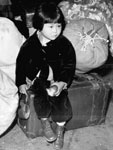
This National Archives and Records Administration online archive offers selected photographs depicting Americans' activities during World War II. The 202 photographs, drawn from the Still Picture Branch of the National Archives, primarily came from the records of the Army Signal Corps, Department of the Navy, Coast Guard, Marine Corps, and the Office of War Information. They represent all aspects of wartime preparation, from military training to combat and support services, as well as the homefront activities of civilians and war agencies. They are grouped into 22 subjects, including eight regions of Europe and the Pacific in which Americans fought, and other topical categories such as: the Homefront; Rest and Recreation; Prisoners; The Holocaust; Death and Destruction; and Victory and Peace.

Images include leaders like Franklin D. Roosevelt, General Dwight Eisenhower, and Adolph Hitler, as well as posters from homefront rationing and war bond campaigns, Rosie the Riveter posters, combat photographs of invasions and scouting missions, and images of entertainers like Danny Kaye and Bing Crosby visiting the troops. Each photograph is accompanied by a 15-25 word caption with the title, photographer, location, and date the photograph was taken. This site is ideal for those interested in illustrating reports or lectures on Americans' contributions to World War II.

The Star-Spangled Banner

Image
Annotation

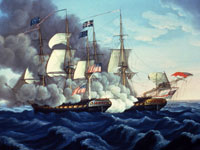
This exhibit tells the story of "the flag that inspired the National Anthem" through more than 50 images and short texts (50–200 words) explaining their significance. Also presents images from Smithsonian collections to illustrate sections on expressing patriotism, fostering national memory, and how "common cultural symbols, such as the American flag, patriotic songs, presidential images, and monuments, serve to coalesce a common identity among Americans." Elucidates challenges the Smithsonian faces to preserve the flag that flew over Fort McHenry during the Battle of Baltimore in 1814 and inspired Francis Scott Key's poem.

Provides a teacher's manual in three sections for grades K–2, 3–5, and 6–8 and suggestions for using the site in the classroom. Includes a 10-title reading list, links to 14 related sites, and games designed to stimulate students to use primary sources to investigate "mysteries surrounding this famous flag." A well-conceived site, though modest in size, that will prove useful for K–8 classes.

Immigration

Teaser

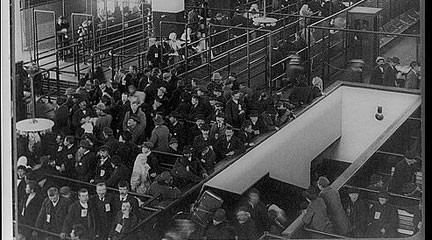
Very few of us have ancestors who were not immigrants. Bring the topic of immigration to life.

lesson_image
Description

Primary sources and questions for a unit on immigration to the United States during the late 19th and early 20th centuries.

Article Body

Primary source documents and statistical tables about immigration in the late 19th and early 20th centuries anchor this lesson. Analytical questions about the documents and the tables require students to draw conclusions from the data, as well as evaluate opinions regarding immigration as expressed in the primary sources.

These materials are supplemented by Digital History’s larger Immigration Learning Module which provides many hyperlinks to additional primary sources including a timeline and documents. (NOTE: To access these documents, paste the title of the document into the search field when you arrive at the Library of Congress Learning Page.)

Links to primary source sets from the Library of Congress and other features of the Ethnic America section of the Digital History site are also provided.

Overall we feel that the basic lesson plan provides an excellent set of teaching materials, but we encourage you to explore the interrelated hyperlinks of the Learning Module to find additional materials that will inspire you and your students.

Topic
Immigration; early 20th century
Time Estimate
undefined
flexibility_scale
1
thumbnail
Rubric_Content_Accurate_Scholarship

Yes

Rubric_Content_Historical_Background

Yes
Much information is available on the website. In addition, Digital History’s online textbook provides detailed background information on the topic.

Rubric_Content_Read_Write

Yes

Rubric_Analytical_Construct_Interpretations

Yes
In the basic lesson students are asked to draw conclusions from immigration data. Other documents that you may decide to use from Digital History’s online textbook may elicit student analysis and interpretation as well.

Rubric_Analytical_Close_Reading_Sourcing

Yes

Rubric_Scaffolding_Appropriate

Yes
While no specific audience is stated, we feel the basic lesson and accompanying questions are suitable for middle school. Other materials on the site may be useful for all grade levels.

Rubric_Scaffolding_Supports_Historical_Thinking

No
Teachers will want to provide some scaffolds of their own to help students understand and interpret texts and data tables.

Rubric_Structure_Assessment

No
No assessment criteria are included. As teachers define their goals for this lesson they will have to determine how to assess student learning.

Rubric_Structure_Realistic

Yes
The basic lesson is unstructured, but the questions and activities are clearly presented. It would be easy to use these materials to teach about immigration in normal classroom settings.

Rubric_Structure_Learning_Goals
No
Teachers must provide structure and goals for this lesson.

The Boston Massacre: Fact, Fiction, or Bad Memory

Teaser

Help students think about where evidence for history comes from.

lesson_image
Description

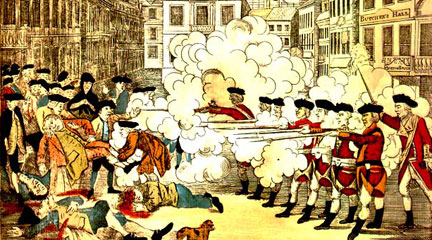
Students attempt to assign responsibility for the Boston Massacre through careful reading of primary and secondary sources and consideration of such issues as who produced the evidence, when it was produced and why was it produced.

Article Body

With iconic historical events such as the Boston Massacre it can be difficult to separate historical fact from myth. This lesson acquaints students with some of the subtleties of constructing historical accounts. It allows them to see firsthand the role of point of view, motive for writing, and historical context in doing history. The lesson opens with an anticipatory activity that helps illustrate to students how unreliable memory can be, and how accounts of the past change over time. Students then analyze a set of three different accounts of the Boston Massacre: a first-hand recollection recorded 64 years after the fact, an account written by an historian in 1877, and an engraving made by Paul Revere shortly after the event. We especially like the fact that with the first document, the teacher models the cognitive process of analyzing the source information by engaging in a “think aloud” with the document. This provides a great opportunity to uncover for students the kinds of thoughts and questions with which an historian approaches an historical source. The primary source reading is challenging, and students will likely require significant additional scaffolding to understand the meaning of the texts. Teachers may want to consider pre-teaching some of the difficult vocabulary, excerpting or modifying the text, or perhaps reading the text dramatically together as a whole class.

Topic
Revolutionary War; Boston Massacre
Time Estimate
1 class period
flexibility_scale
4
thumbnail
Rubric_Content_Accurate_Scholarship

Yes

Rubric_Content_Historical_Background

Yes
The image linked in the “materials” section offers valuable supplemental information for teachers. But minimal background information is provided for students.

Rubric_Content_Read_Write

Yes
Teachers will have to plan carefully to help students read the challenging texts. In addition, teachers may want to augment the writing portion of the lesson; the extension activity provides a great opportunity for this.

Rubric_Analytical_Construct_Interpretations

Yes
Teacher models a “think aloud” with the first document. Students replicate the process first in groups, and then individually.

Rubric_Analytical_Close_Reading_Sourcing

Yes
Identifying and evaluating source information is a key element of this lesson.

Rubric_Scaffolding_Appropriate

Yes
While appropriate for elementary school students, it could easily be adapted for middle school.

Rubric_Scaffolding_Supports_Historical_Thinking

No
Very limited vocabulary support is provided. Teachers will have to read aloud or otherwise provide additional scaffolding to assist students in understanding the documents.

Rubric_Structure_Assessment

Yes
The assessment activity provided is not thorough, and no criteria for evaluation are provided. However the extension activity provides a splendid opportunity for teachers to assess how well students have acquired the skills taught in the lesson, as well as an opportunity for students to see that these skills may be used in other situations and contexts.

Rubric_Structure_Realistic

Yes

Rubric_Structure_Learning_Goals
Yes

Historical Agency in History Book Sets (HBS)

Image
Article Body
What Is It?

A strategy that combines fiction and nonfiction texts to guide students in analyzing historical agency.

Rationale

Authors of historical fiction for children and adolescents often anchor their narratives in powerful stories about individuals. Emphasis on single actors, however, can frustrate students’ attempts to understand how collective and institutional agency affects opportunities to change various historical conditions. History Book Sets (HBS) that focus on experiences of separation or segregation take advantage of the power of narratives of individual agency to motivate inquiry into how collective and institutional agency supported or constrained individuals’ power to act.

Description

History Book Sets combine a central piece of historical fiction with related non-fiction. By framing a historical issue or controversy in a compelling narrative, historical fiction generates discussion regarding the courses of action open not only to book characters, but to real historical actors. Carefully chosen non-fictional narratives contextualize the possibilities and constraints for individual action by calling attention to collective and institutional conditions and actions.

Teacher Preparation
  1. Select a piece of well-crafted historical fiction that focuses on a historical experience of separation or segregation (NCSS Notable Books is a good    place to start). The example focuses on Cynthia Kadohata’s (2006)  Weedflower—a story that contrasts a young Japanese-American internee’s    relocation experience with a young Mohave Indian’s reservation experience.
  2. Select two pieces of related non-fiction that provide context for the historical fiction. Non-fiction should include courses of action taken by    groups and institutions, as well as individuals. This example uses Joanne Oppenheim’s (2007) “Dear Miss Breed”: True Stories of the Japanese    American Incarceration During World War II and a Librarian Who Made a Difference and Herman Viola’s (1990) After Columbus.
  3. Select photographs that visually locate the events in the literature. Duplicate two contrasting sets of photographs.
  4. Reproduce templates for poem (Template A) and recognizing agency chart (Template B). The recognizing agency chart works best if students begin    with an 8½x11 chart and then transfer their work to larger chart paper.
  5. The time you need will depend on whether you assign the historical fiction for students to read or use it as a read-aloud. Reading a book aloud    generates conversation, ensures that everyone has this experience in common, and lessens concerns about readability. If students read the    book independently, plan on three class periods.
In the Classroom
  1. Recognizing Changing Perspectives. In making sense of historical agency, it helps if students recognize that different people experience historical    events differently. For instance, the main fictional characters in the example have quite distinct views of relocation camps. The packets of    photographs help children interpret changing perspectives, and the biographical poem provides a literary structure for expressing their    interpretations.
      • Organize the students in pairs. Give half the pairs Packet A (Japanese Experiences); half Packet B (Indian Experiences). Students write captions for the pictures explaining how the experiences pictured influence characters’ view of the relocation camp.
      • Drawing on their discussion and readings, each pair of students writes a biographical poem (see Template A) representing how their character’s ideas and attitudes change over the course of the story.
      • Display captioned pictures and poems where students can refer to them during the next activity.
  2. Recognizing Agency: What Can be Done?
      • Distribute Recognizing Agency chart (Template B). Work through the chart using a secondary character in the historical fiction as an example.
      • Assign pairs of students to a fictional or historical participant. For example, students might investigate the fictional main character or a family member or friend or students could investigate a historical participant.
      • Display charts. Discuss:
        1. Why do some people, groups and institutions seem to have more power than others?
        2. How can people work most effectively for change?
        3. Can you identify strategies used to alter other historical experiences of separation or segregation?
  3. Agency Today. After considering the kinds of agency expressed by people    during the past, students might write an argument for or against    contemporary issues that surround the topic. For instance in the example,    students investigate efforts to restore the relocation camp.
Common Pitfalls
Example
  1. Book selection presents the most common pitfall in developing and using    an HBS. Historical fiction presents a two-pronged challenge: If the    narrative in the historical fiction does not hold up, good historical    information can’t save it. On the other hand, a powerful narrative can    convince students of the “rightness” of very bad history. Never use books    you have not read! With that in mind:
      • Make sure you check out reviews of historical fiction and non-fiction (i.e.    Hornbook, Booklinks, Notable Books) or more topic-specific reviews such    as those provided by Oyate, an organization interested in accurate    portrayals of American Indian histories.
      • Choose non-fiction emphasizing collective and institutional agency that    contextualizes actions in the novel.
  2. Because students’ identification with literary characters can be quite    powerful, use caution in identifying one historical group or another as    “we.” Implying connections between historical actors and students    positions students to react defensively rather than analytically. None of    your students, for instance, placed people in relocation camps or on    reservations, but referring to past actions by the U.S. government as    something “we” did can confuse the issue. Students are not responsible    for the past, but as its legatees they are responsible for understanding    what happened well enough to engage in informed deliberation about the    consequences of past actions.
  3. Historical Book Sets are designed to work against tendencies to    overgeneralize about group behavior (i.e. assuming all European    Americans supported internment). In response to overgeneralization, ask    for (or point out if necessary) counter-examples from the book set.    Occasional prompting encourages students to test their generalizations    against available evidence and to think about within-group as well as    between-group differences.
  4. Historical Agency: Internment and Reservation at Poston. Background for the teacher: Groups and individuals exercise power differently, depending on the social, cultural, economic, and political forces shaping the world in which they are acting. In the case of the internment and reservation systems, for example, the power of Japanese-Americans to resist internment was quite different from the power of the War Relocation Authority to enforce relocation. Or, consider that the options available to Japanese men were quite different from those available to women or to the Native American residents of the Poston reservation. Introducing the concept of historical agency—what action was possible given the historical moment—can be a powerful tool for making sense of past behaviors. Power is a familiar concept to students who, with relatively little prompting, understand not only that larger forces may limit or expand opportunities for action, but that individuals may not all respond in the same way to those opportunities. Beginning by recognizing different perspectives on an event prepares students to consider why people might take different action, and comparing responses to action prepares students to consider available options for expressing agency. This, in turn, reinforces an important historical understanding: nothing happens in a vacuum. By placing so much attention on individual agency (often some hero or heroine), history instruction too often ignores persistent patterns of collective and institutional agency. This is not to dismiss narratives of individual agency. This HBS begins with Sumiko’s and Frank’s story because individual agency captures students’ interest and engenders a level of care that motivates further investigation of the differential agency expressed by the individuals, groups, and institutions that framed Sumiko’s and Frank’s historical choices. * Agency refers to the power of individuals, groups, and institutions to resist, blunt, or alter historical conditions. Differential agency refers to differences in potential for and expression of power within and between individuals, groups, and institutions.
Bibliography

Bamford, Rosemary A. and Janice V. Kristos, eds. Making Facts Come Alive: Choosing Quality Nonfiction Literature K-8, 2nd ed. City: Christopher-Gordon Publishers, 2003.

Levstik, Linda S. and Keith C. Barton. Doing History: Investigating with Children in Elementary and Middle Schools. London: Routledge (2005).

Online U.S. History Textbooks

Image
Question

Do you know of any good online US history textbooks?

Answer

Online textbook options are convenient, inexpensive, and environmentally friendly. The key is finding one that is reliable, meets the needs of your students, and complies with district standards—so you will want to explore some to find one that fits your needs. We know of a few online textbooks that will help you get started in your search. Digital History, a project hosted by the University of Houston, offers an easy-to-use, high-quality textbook. Digital History is also a good resource for supplementary classroom materials including primary sources, e-lectures, and lesson plans. USHistory.org, created and hosted by the non-profit Independence Hall Association, also offers a complete illustrated U.S. history text that is clearly organized by topic and easy for students to use. A third option is the Outline of U.S. History, which is produced and maintained by the U.S. State Department. The Outline is a fairly comprehensive textbook, and is accompanied by useful supplementary resources, including historian essays and a briefer version of the textbook. Finally, Wikibooks offers a U.S. history textbook that is fairly comprehensive and easy to use. On a cautionary note, Wikibooks is an open source site (like Wikipedia), so teachers will want to carefully monitor the content of the site to be certain that the material is accurate and useful.

Foundations of American History: John Brown Song

Image
Article Body

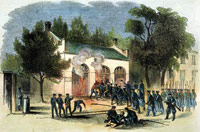
Foundations of U.S. History, Virginia History as U.S. History features 4th graders learning about John Brown's raid on Harpers Ferry through analyzing the song "John Brown's Body." Video clips of classroom instruction accompany short videos of a scholar analyzing the song and the teacher reflecting on the lesson. The John Brown song is one of eight documents found on the Source Analysis feature of the Teaching American History grant website in Loudoun County, Virginia. In the classroom practice section for John Brown's Body we see students analyzing the song to understand how northerners viewed John Brown shortly after his raid on Harpers Ferry. This video provides examples of two promising practices:

  • Close analysis of a song as a primary source
  • Consideration of whether views expressed in that source represent all perspectives.
The Lesson in Action

The lesson starts with the teacher playing the song "John Brown's Body." In this warm-up activity, the teacher instructs students to draw a picture of "what you see in your mind." After students share their drawings, the teacher provides them with a worksheet to help students analyze the musical composition. Next, students analyze the lyrics to an adapted version of the song written in 1861. The teacher works with individual students to help them use prior knowledge to make sense of the song and generate questions about the song. This progression from open-ended student task to close historical analysis engages and challenges students.

Students see that while primary documents are valuable evidence, they should not assume that an individual source speaks for all people.

Towards the end of the lesson, the teacher facilitates a whole-class review of the Guiding Question worksheet. After students share that they think the song portrayed John Brown as a hero, the teacher refers back to a prior lesson asking, "Do you think this song represents how everybody in the North feels?" Students respond that it does not. The teacher uses this conversation as an opportunity to review that many people in the North did not support John Brown's tactics. Students see that while primary documents are valuable evidence, they should not assume that an individual source speaks for all people. This lesson also draws on multiple classroom resources and incorporates a variety of historical thinking skills. Students use their textbook to help them make sense of the song: they consider the song's historical context and audience. Additionally, you can find a comprehensive lesson plan, complete with additional primary sources, background information, and classroom worksheets, on the site.

Evaluating the Validity of Information

Teaser

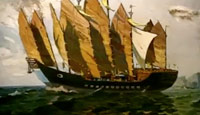
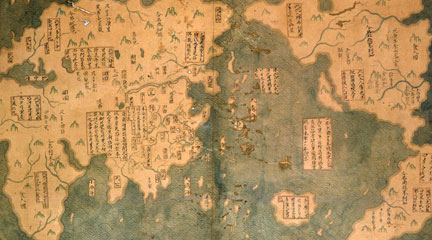
Did the Chinese discover America before Columbus? How would or does this impact our understanding of European explorers and exploration?

lesson_image
Description

Students learn to assess the validity of a historical argument as they evaluate the implausible theory that the Chinese discovered America in 1421.

Article Body

TV presents a great deal of historical information these days, but not all of it is valid or trustworthy. Unfortunately, many students lack the tools needed to assess historical information they see on television. This skill-building lesson presents students with some of the tools needed to assess the validity of an argument made through a persuasive, high-quality visual medium. In this two-day lesson, students assess the validity of a claim integral to the argument that the Chinese discovered America in 1421. Retired submarine commander Gavin Menzies presents this argument and the evidence to students in two short video clips highlighting the resources available to ancient Chinese sailors to make seven epic ocean voyages during the Ming dynasty. The lesson is clearly structured and guides students through steps they should take to evaluate historical claims. Helpfully, it includes a student handout that clearly explains the criteria for assessing the evidence of a historical argument. For example students are prompted to look at the qualifications of the person making a claim and to evaluate the persuasive techniques being used. A second handout has a worksheet to help students use the criteria to evaluate specific aspects of Menzies's argument. Student learning is assessed both through classroom discussion and a culminating essay that prompts students to provide a reasoned evaluation of the claim that the Chinese had the naval capacity to travel to America in the 15th century. The lesson includes a detailed rubric to assist your evaluation of these essays.

Topic
Exploration; Evaluating Historical Evidence
Time Estimate
2 class periods
flexibility_scale
4
Rubric_Content_Accurate_Scholarship

Yes The process of examining historical evidence is presented accurately. However, other websites present additional information and arguments disputing Menzies' thesis.

Rubric_Content_Historical_Background

No The lesson provides clear criteria for assessing historical accuracy but provides little historical background about the specific time period under investigation.

Rubric_Content_Read_Write

Yes Students write a final essay, but the lesson does not require significant reading.

Rubric_Analytical_Construct_Interpretations

Yes Lesson requires students to analyze the evidence.

Rubric_Analytical_Close_Reading_Sourcing

Yes Requires close attention to the arguments made in a historical video. Attention to the source of a historical argument is an integral part of the lesson.

Rubric_Scaffolding_Appropriate

Yes Appropriate for grades 6-8. Could easily be adapted for grades 9-12.

Rubric_Scaffolding_Supports_Historical_Thinking

Yes Provides a well-written student handout of criteria for assessing the validity of a historical argument. A table to help students apply these criteria to Menzies's theory is also provided.

Rubric_Structure_Assessment

Yes The lesson provides a solid essay prompt and a clear rubric for assessing the essay.

Rubric_Structure_Realistic

Yes Directions are clear and procedures are realistic in most settings.

Rubric_Structure_Learning_Goals

Yes The lesson progresses logically toward the goal of making students think about historical evidence.

Twitter

Image
What is it?

What is it?

Twitter is a social networking tool for almost-instant communication through the exchange of quick, frequent messages. People write short updates, often called 'tweets' of 280 characters or fewer. Tweets are available to the general public or communicated more specifically as users join groups—as followers or followed by others in networked communication. Twitter users continue to expand its diversity and application. For teachers, Twitter can offer professional support, instant communication with students, and creative approaches to disseminating course content.

Getting Started

Twitter's own forum, Frequently Asked Questions, gives a concise, comprehensive view of what it is and how to use it. To establish a Twitter account, simply follow the sign up icon to the Registration page where you're asked to enter your name, a username, and password and to agree to the terms of service. Multiple accounts are possible if you choose to separate business, family, and friends.

Examples
Twitter is what you make it. . . . It can be a business tool, a teenage time-killer, a research assistant, a news source.

But does Twitter have value as an educational tool, or is it another cog in the wheel of communication overload?  Quick Start Tips Information includes methods to use Twitter tools and software to enhance Twitter's application. The conclusion: "Twitter is an incredibly powerful tool for your personal learning, connecting with others and complements your blogging." The Power of Educational Technology blog offers Advice for Teachers New to Twitter—including links to other twittering teachers with comments, problems, and suggestions. These tips stress the value of Twitter as a professional communication and development tool. The Twitter4Teachers Wiki helps educators link with others in their specific discipline or field such as social studies teachers, geography teachers, retired teachers, school principals, and more.

Twitter can help direct students' attention to good things . . . Twitter brings great minds together.

Among the reasons Twitter may be more useful for professional networking and professional development than as a classroom tool is cost and accessibility.

As The Wired Campus in the Chronicle of Higher Education points out: Twitter costs money—while it works with internet access, the immediacy of the text messaging facility of mobile phones maximizes its use.

For more information

For some educators, however, Twitter has become a useful classroom tool. Can We Use Twitter for Educational Activities?, a paper presented at the Fourth International Scientific Conference, eLearning and Education (Bucharest, April 2008), focused on arguments for and against the microblogging platform in education. Twitter is about learning, according to authors Gabriela Grosseck and Carmen Holotescu, but they are clear that guidelines and parameters are critical to successful educational application—as they are with any learning tool. The article looks at examples of Twitter in the classroom and concludes with an extensive bibliography of online resources about educational uses of Twitter. For older students, Twitter is another tool that can encourage enthusiasm through communication and promote collaborative learning—as well as provide another opportunity to stress responsible use of networking tools. 

Twitter may be more useful for professional networking and professional development than as a classroom tool.

In Twitter in the Classroom, a Vimeo posting, Christine Morris discusses issues related to uses of Twitter and initial problems with the interface and application—and how these software and training problems were solved. While educators frequently ask about the use of Twitter in the K–8 classroom, examples are few and its value, inconclusive. K-3 Teacher Resources offers an enthusiastic step-by-step guide—including a description of the learning curve and tips on Twitter etiquette. Twitter in the Classroom is a series of educational screencasts on YouTube discussing among other points, the use of hashtags and backchannels.