FDR's Second Inaugural Address

Video Overview

David Kennedy questions Franklin D. Roosevelt's second inaugural address. What, he asks, were FDR's intentions in making his speech? What are the key lines that reveal his intentions? What changes did he make to U.S. politics and society, and were they in keeping with the ideas in this speech?

Video Clip Name
Kennedy1.mov
Kennedy2.mov
Kennedy3.mov
Video Clip Title
The Document
What is FDR doing?
FDR as Visionary
Video Clip Duration
4:06
2:29
3:30
Transcript Text

Well, the document that I have here in front of me is a copy of Franklin Roosevelt’s second inaugural address—delivered in January 1937; and it happens to be the first presidential inauguration that took place in January. Since George Washington’s time down to the '30s inaugurations happened in March and that was changed to January, so that’s a kind of historical factoid that gives this a little bit of interest. But this document, as much as any single document can, reminds us of what the New Deal was all about, what its relationship to the Great Depression of the 1930s was, and what its implications were for this society going forward. And I think as much as any single document can reveal, it shows us what Franklin Roosevelt’s deepest intentions were, what his highest priorities were, what his agenda was in the period of the 1930s.

So this is 1937. He’d come to power—come to the presidency three years earlier in 1933, when the unemployment rate was 25%—the most god-awful economic crisis that ever struck this society. Here he is being re-inaugurated for a second term four years later. Quite obviously and not surprisingly, as any president would do under the circumstances, he's bragging a bit about the things he accomplished during his first term; drawing the contrast between how bad things were when he took office and how much better they are now. He goes through a little bit of a list of the specific things that are better: unemployment is down and gross national product is up and so on and so forth. Then he says, kind of summarily, he said, “Our progress out of the Depression is obvious.” That’s the kind of summary statement of what he’s talking about. And he says again, further on the same note, he says, “We have come far from the days of stagnation and despair.”

Now so far this is standard presidential boilerplate on any situation, who wouldn’t—under the circumstances—pat himself on the back for the things he’s accomplished in the preceding four years. But then he says something absolutely extraordinary in the annals of presidential addresses, especially inaugural addresses. It’s a sentence that when I first read it just leapt off the page at me for its surprising quality and for its explanatory quality. After having just gone through this little recital of how things are better now than they were, he says, “Such symptoms of prosperity may become portents of disaster.” Now wait a minute, what’s he saying? Prosperity’s returning, we’re better off, the Depression is lifting, we’re going ahead on a much more confident basis than we were; but this—these “symptoms of prosperity may become portents of disaster.” The sentence doesn’t explain itself, you really have to know what the context was and know something about Roosevelt’s ultimate intentions, and ultimately the consequences of what he tried to accomplish and did accomplish in the 1930s.

That single sentence—"such symptoms of prosperity may become portents of disaster"—is such a shock and such a surprise. If you read it all carefully you realize, why would he say that at the moment of his own greatest self-congratulation upon being reelected/reinaugurated? So I think if you can get students to focus on that sentence: Why would a president in that moment in that particular circumstance say such a thing? What could be on his mind that he would so apparently undercut his own agenda on this occasion? I think what explains it—where the answer lies is in that immediately subsequent passage about the third of the nation. So there’s a way to connect something that’s quite surprising about "prosperity is a portent of disaster" with something that is maybe a little bit familiar, which is the "I see one third of the nation ill-housed, ill-clad, and ill-nourished." So you can put those two together and I think it’s a very effective teaching combination.

When I teach this document, I usually asking the class—before I’ve asked them to read the whole document—I ask them if they’ve heard the phrase “I see one third of the nation ill-housed, ill-clad, and ill-nourished.” As time goes by, I suppose, fewer students have ever heard it at all, but most of them usually have had—it’s got some echo in their brains someplace, they’ve heard it or a version of it someplace or other.

So then I explain this is a speech that Roosevelt gave in the midst of the Great Depression, what do you think he was talking about? Again, not without reason, most students will say, “Well, he’s talking about all those people who are unemployed and having such hard times during the Depression.” And I say, “Well, fair enough, but now let's read the rest of the speech and see what he’s really talking about.” Then when they hit that sentence, if I give them the space and if I tee them up properly, that when they get to that sentence—“Such symptoms of prosperity may become portents of disaster”—that does bring them up short. They say, “Wait, what’s he talking about here? How could any president undercut his own self-congratulation for the return of prosperity?” I make the point that what follows this is this lyrical litany about the one third of the nation, and that’s his real objective. This goes to a deeper point, it seems to me, and it goes to the point of putting to rest that idea that the New Deal was just whatever Roosevelt threw at the wall, whatever stuck became the New Deal.

I believe, and I think this document goes along way to making the case, that Roosevelt had a vision, and it’s proper to call him a visionary. In fact, in my reading of the evidence he had this vision before the Depression ever happened. You can see this in his private correspondence in the 1920s [and] in his prior political career, that the major thing he wanted to accomplish if he ever got the chance was to make American society more secure, less risky, and more inclusive. To bring more people into the mainstream of American life and to reduce elements of risk that perpetually over the previous century had brought people into the mainstream and then ejected them from it again. Life was unstable for so many people, for millions of people. That’s what he wanted to change, and the New Deal put in place a series of structural reforms that accomplished a lot of that objective.

[The New Deal put in place a series of structural reforms that accomplished a lot of that objective.] The Federal Deposit Insurance Corporation—which gave federal guarantees to bank deposits—at a stroke ended the century-old or more practice of panicked runs on banks when times got tough. Banks failed—between 1931 and 1933, over 5,000 banks failed in this country. Between 1933 and the end of the 20th century, probably fewer than 500 banks failed, I don’t know the exact number but in that order of magnitude. Why? Because the FDIC imparted a measure of stability, predictability, risk reduction to banking. Glass-Steagall Act, which is actually where the FDIC legislation is embedded as well, separated investment from commercial banking. It made the day-to-day operations that the average citizen dealt with a different beast from the big investment banking houses like Goldman Sachs and Lehmans Brothers and so on and so on. Which for a long time, until the opening years of the 20th [21st] century, protected the core banking system from the speculative and risky activities that go on in the investment banking business.

The Home-Owners Loan Corporation, which became the Federal Housing Authority, created a system of private insurance overseen by the federal government that stabilized mortgage lending and made that a lot less risky. Its that structural reform which actually built suburbia and built the Sun Belt in the decades after World War II because mortgage money was so much more available than it had been earlier. It [also] changed the terms on which people could buy homes—it changed them drastically. So we went from a society in which only about 40% of citizens owned their own homes as the Great Depression opened, to a society in which about 60% of Americans owned their own homes by 1960. So it didn’t take, it took about a generation for this to work its effects.

The Securities and Exchange Commission is another New Deal era reform that brought a measure of transparency and open information/accessible information into stock market trading. Again, that did a lot to dampen—not eliminate entirely—but to dampen a lot of the speculative fevers that had driven Wall Street up and down and sidewise over the preceding century. So its no accident, it’s absolutely no accident, that in the 70 years or so after the New Deal this society saw no economic crisis even remotely approaching the scale, volatility, and explosive character of the Great Depression of the '30s.

The Great Depression of the '30s is a unique event, and it’s a singular event in its severity, but it’s in a family of events that go back into the 1830s; there’s centuries worth of these kinds of severe economic shocks to the system. The New Deal put a very substantial end to that for the remainder of the 20th century at least. That was not an accident, that was part of a conscious design on Roosevelt’s part to remake the society, bring new institutions into being, reduce risk, bring elements of security into the lives of millions of citizens and institutions and economic sectors like banking, investing, and so on. That didn’t just happen; it was part of a conscious political program. And it seems to me this speech, this second inaugural address, is about as succinct and pointed a piece of documentary evidence that you can find that makes that case.

All of these things were part of a very coherent, unified program to make life less risky. It was—it became less risky for millions upon millions of people in the two or three generations following the 1930s. So we see here a glimpse, you might say, into Roosevelt’s deepest ideological agenda when he tells us prosperity might be a portent of disaster because his reform agenda is not yet accomplished.

The U.S. House of Representatives Remembers September 11

Image
Annotation

“Due to the Circumstances of Today”: The U.S. House of Representatives Remembers September 11, 2001 brings together a series of interviews conducted by the Office of the House Historian to commemorate the 10th anniversary of the September 11, 2001 terrorist attacks. A project of the U.S. House of Representatives Oral History Program, it features the recollections of former Representatives, House officials and employees, and select eyewitnesses to the event.

The great strength of the website is its extensive collection of video and audio sources. Sources are divided into four sections that explore the events of September 11, American reaction and response, efforts to improve security and safety, and the lingering impact of the attacks. Such materials, extensive as they are, would make for an excellent set of sources for a research project.

The site also features a seven and a half minute long video narrative that draws on clips from oral history resources, as well as a dozen images and artifacts. Finally, the site offers a link to a series of historical highlights on the website of the Office of the Clerk of the U.S. House of Representatives. Each highlight is accompanied by a brief synopsis and a “teaching tip.”

The Election of 1932: Photographs of FDR

Bibliography
Image Credits
  • Library of Congress
  • National Archives and Records Administration
  • Franklin D. Roosevelt Presidential Library and Museum
Video Overview

What can a photograph of Franklin D. Roosevelt in 1932 reveal? Donald A. Ritchie looks at the people captured in this photograph, including FDR, his son James, Eleanor Roosevelt, and later Secretary of the Senate Mark Trice, and considers the significance of how Roosevelt stands and presents himself.

Video Clip Name
Ritchie5.mov
Ritchie6.mov
Ritchie7.mov
Ritchie8.mov
Video Clip Title
The Photograph and Its Context
Mark Trice and the Photograph
Reading the Photograph
Polio and Roosevelt
Video Clip Duration
4:49
2:18
3:38
1:57
Transcript Text

In my book I use this picture of Franklin Roosevelt arriving at the capital in 1932. Now we have a picture before that of Roosevelt riding with Herbert Hoover from the White House to the capital. These are two men who had been friends since 1917, they had worked together in the Woodrow Wilson administration, they had considered running as a Hoover/Roosevelt ticket for the Democrats in 1920, except that Hoover decided that he was really a Republican and went for them and Roosevelt went for vice president that year on the Democratic ticket. Then they sort of drifted apart, and in 1928 Roosevelt became governor of New York, Hoover became president and then they became rivals in 1932. Their relationship became more and more bitter to the point when they rode from the White House to the capital they practically didn't speak to each other.

At this point they've arrived at the Capital, Hoover is nowhere to be seen, but Roosevelt is out standing with his family. Roosevelt had been stricken with polio in 1921 and he had lost the use of his legs. This was going to be an issue in the election of 1932—would we elect a president who was paralyzed? Hoover knew about Roosevelt's condition and he speculated that the nation would not elect a "half-man" and that Roosevelt might collapse in office. I think Hoover thought that Roosevelt would not be an effective campaigner that he would probably be too weak to carry on a campaign. Roosevelt, in fact, is an enormously vigorous campaigner, [he] spends the time traveling back and forth across the country, being photographed constantly. Hoover, who has been working seven days a week late into the night over the problems of the Depression, has aged terribly in his four years—the photographs of him make him look 82 years old. So Roosevelt looks much healthier and more vigorous than Hoover does.

Roosevelt goes to great lengths to disguise his illness. People wrote stories about it, saying that he had been stricken [with polio] and people knew he had polio, that had been front-page stories in 1921. But, he did not appear in public in a wheelchair, he had leg braces, he had his pants tailored to cover the braces, he walked with a cane, and he always walked with a strong-armed person next to him. During much of the campaign his son James—who is standing here in the bowler hat—was the one who stood next to him. Especially in the back of the trains, when they would step out, the Roosevelt family would be all around him.

Roosevelt had a nice little way of introducing his family to audiences so that you were all part of the family essentially. He would always end with "and my little boy Jimmy," because Jimmy was two or three inches taller than he was and everybody would laugh at that point, but that would diffuse the issue that he was hanging on to Jimmy's arm really to keep himself standing.

So here is Roosevelt dressed for the inauguration, in his top hat, striped pants, the cane, holding on to Jimmy's arm. Standing next to them is Eleanor Roosevelt, who does not look like she's really happy to be there. Eleanor Roosevelt was a very independent-minded person; she and her husband had really developed independent lives, especially in the 1820s. She was very politically active and she really did not look forward to him being President of the United States. She did not campaign very much with him, she hated being on smoke-filled trains—which went very slowly, because of Roosevelt's condition he didn't like the train to speed because he was in a wheelchair in the train. So it went relatively slowly across the country. Then you would stop in these little towns; everybody got out the back [to] say pretty much the same things to the same types of crowds. The wife was supposed to stand pleasantly on the side, receive a bouquet of flowers, not say anything. Eleanor was just beside herself. She actually left the campaign trail in mid-October to go back to New York to teach in the school—the private school—where she was teaching American history at the time.

She—I'm not even sure she voted for Franklin Roosevelt in 1932, she may have voted for Norman Thomas. She really did not want him to be President of the United States and you can just see this in her body language and the way she's looking at this point. She had great anxiety over what this was going to do to [him]. The irony is that she became a great first lady. She realized this gave her an opportunity to promote all the issues she was interested in, to travel and to do things. But she didn't know that on March 4, 1933, this was all coming in the future.

Now the reason I have this photograph is because of the young man standing on the edge of the picture, looking very nervous, in striped pants and a cut-away: his name is Mark Trice. Mark Trice came to the U.S. capital during World War I as a pageboy and then he stayed; that was not uncommon in those days, people were just drawn to politics. He stayed and he worked for the Sergeant at Arms and he was the Deputy Sergeant at Arms in 1933. He was a Republican appointee.

In February of 1933 the U.S. Senate fired the Sergeant at Arms. He knew that he was losing his job because his party had lost the majority. He was an old newspaper reporter and he wrote a story about what he really thought about Congress to be published in the March edition of a magazine, not realizing that the March edition came out in February. When it came out—and when his critical comments about Congress were in there—the Senate called him forward to demand to know what he had in mind, and then fired him. That made Mark Trice the acting Sergeant at Arms for Franklin Roosevelt's inauguration. He was very young, he was very scared, he was also very Republican, which is interesting that he was in charge of this Democratic president's inauguration.

When I came to work for the Senate in 1976, Mark Trice was still around—he had been a variety of functions, he had been the Republican secretary, he'd been the Secretary of the Senate. He was retired at this point but he couldn't keep away from the capital. He'd come to the Senate Historical Office and tell us stories—just sit there and tell wonderful stories. He gave us this photograph and other photographs of the time. We tried desperate to do an oral history interview with him; I really wanted to record what he had to say. But he felt that he had kept the confidences of these politicians for so long that he could not record it. And he literally one day ran out of the office when we tried to tape-record his stories that he was telling us. But this photograph from him, I think, is a great keepsake of that moment [and] it tells you a lot about those people and about the way that they're presenting themselves to the world.

Photographs are part of the documentary evidence, they're not exclusive, you can't—unless you've done the research to find out what's really going on here—you can look at this picture and not really realize how Roosevelt is presenting himself. But if you look closely you can notice that there's just something that's a little odd about the cuffs of his pants, the way they've been cut, and they're there to cover these very heavy steel braces that Roosevelt used. There's actually a small piece of the brace that goes underneath the heel that you can see there. When he's sitting down sometimes you can see a little bit more of it.

Franklin Roosevelt only mentioned his braces once in public. That was in January or February of 1945 when he had just come back from Yalta. He went to speak in the House chamber and instead of standing, he sat at a table—it was the only time he ever sat for a major speech like that. He apologized to the Congress, but he said, "With 10 pounds of heavy steal around my legs, it's easier for me to sit down." That was the sole reference he ever made to those braces. You can actually see the braces in other pictures where he's sitting down. But there's just a slight awkwardness to the pose.

He walked by pushing his legs forward. Actually, when he became ill, he developed his upper body so he had very powerful arms and shoulders. And getting on and off of trains they actually built parallel bars and he swung his way down. So he gave the illusion of walking, but he was never able to walk again after he was stricken with polio in 1921.

There's a misconception that Roosevelt hid his polio. The fact of the matter is every year on his birthday children used to send dimes to the March of Dimes in his honor. They would have pieces on newsreels in the movie theaters; they would actually raise money at movie theaters. Roosevelt became a poster person for polio victims, and eventually of course, when he dies, they put his face on the dime because of the March of Dimes. His illness actually contributes to the final solution to coming up with a cure for polio or prevention for polio. But what he was really trying to show was that he was not limited by polio. That he could go around, he could get anywhere, he could do anything, even though he couldn't walk well.

Some of the people thought he was just lame. Of course the editorial cartoonists used to draw pictures of Roosevelt running, jumping, jumping out of an airplane in a parachute, chasing a bull with a pitchfork, doing the types of things that editorial cartoonists like to do. Which people had the sense that Roosevelt could move. People could see Roosevelt standing up in the newsreels and all the rest. Now if you were in a crowd who had come to see Roosevelt, you would see that he was in some cases physically lifted out of a car, you could see that he was not able to walk smoothly, but he was able to get from point A to point B. They would often put potted plants and other things in front of him so you didn't see him from the waist down. But it was clear that he wasn't walking easily and freely at that point.

His favorite recreation was sailing, which of course you sit down while you're sailing. And again, he looked very outdoorsy, very healthy, in that respect. He had been a very agile, healthy person before that—one of the better golfers, for instance, who became president. He actually had a small golf course made for himself that he could golf in in his wheel chair for a while. But he projected an image of being able to move around, not being limited. I think that was the main issue.

I think he's disguising his disability; he made a great effort not to draw attention to it. His press secretary, whenever he was asked about it, would just say it's not a story. The Democrats had actually prepared a pamphlet in defense of Roosevelt about his health conditions to put out if it became a public issue [but] they never released it during the campaign. The Republicans and just his general opponents—and that included Democrats who ran against him for the nomination—they conducted a whispering campaign about Roosevelt. A lot of the whispering campaign was, "Well, it's not really polio, it's really syphilis!" or "it’s a mental illness," or "it’s a stroke," like Woodrow Wilson. They had terrible scenarios that were spread around and there were lots of rumors. So one reason why Roosevelt was out being vigorous in his campaign was to dispel those rumors.

Again, the fact is, anybody who was aware what the—had been reading the newspapers at all in the 1920s and 1930s was not surprised about the news that Roosevelt had polio or that he didn't walk easily. But Roosevelt went to great lengths to minimize that; for instance, at his inauguration there was a viewing stand and they created a chair for him—which was a long pole with a seat—so that he could appear to be standing up for hours while watching this, [but] he was actually sitting down. That was part of the image that he was projecting.

People pose for photographs, this is a posed photograph: Roosevelt is looking "presidential," Eleanor is looking in despair, poor Jimmy is looking a little nervous in the process, and Mark Trice is scared to death. You can just sort of see there all four of them in that image there.

The Election of 1932: Clifford Berryman Cartoon

Bibliography
Image Credits
  • Library of Congress
  • National Archives and Records Administration
  • Franklin D. Roosevelt Presidential Library and Museum
Video Overview

As the 1932 campaign began, no one could know Franklin D. Roosevelt would win. Donald A. Ritchie looks at how political cartoons can capture a moment of change, analyzing Clifford Berryman's cartoon reacting to the results of the September 1932 elections in Maine.

Video Clip Name
Ritchie1.mov
Ritchie2.mov
Ritchie3.mov
Ritchie4.mov
Video Clip Title
Introducing Clifford Berryman's Cartoons
Explaining the Context
Examining the Conventions
How Cartoons Have Changed
Video Clip Duration
5:16
5:06
4:52
3:45
Transcript Text

My project was to write a history of the election of 1932, which is an election that everybody figured they all knew, it was a forgone conclusion that because of the Great Depression, Franklin Roosevelt was going to be elected president. In fact, many accounts reduced the election of 1932 to a single sentence, "The Depression elected Franklin Roosevelt president." So the question is, how do you write a book about something everyone else can write off in a single sentence? I came to the conclusion that people read backwards into history, we know how history ends and we have 20/20 hindsight and we make assumptions from the end. But those who lived through it didn't see the end first, they started at the beginning and they worked their way to the end, much of which was very problematic.

The thing that surprised me when I read the sources was that Herbert Hoover thought he was going to win reelection in 1932, and there were a lot of very good, very competent political commentators who thought he had a very good chance of doing that. Actually, statistically if you look at what was happening in early 1932 there was an upswing in the economy. About a million people went back to work, and business was beginning to move again. Hoover thought that if that continued until November of 1932 he would be reelected; it was not a bad assumption in a lot of ways. He thought he could run the traditional 'rose garden' campaign the presidents did in those days. Which [meant] they stayed in the White House and they made official proclamations and they let their cabinet go out and campaign for them. Calvin Coolidge did that in 1924, and it was seen to be unseemly for presidents to get in a train and go around the country and pitch for themselves. So Hoover played a very low-keyed campaign from the time of his nomination in June throughout the summer.

A couple of things happened to change all of his expectations. One was the reason why the economy was coming back was because the Federal Reserve had loosened up on credit in early 1932. And the reason they did that was because Congress, which was in panic over the Depression, was pushing for inflationary solutions—lots of government spending, let's get money into circulation, let's get people back, let's hire people to work and there were all sorts of federal emergency relief programs that were being proposed in Congress. So the Federal Reserve to steer Congress out of that loosened up credit and things were going fine.

Well, in the summer of 1932, Congress adjourned—they went home—which they did, they usually worked for six months of the year and then they were gone for six months a year. The Federal Reserve sort of breathed a great sigh of relief and tightened back up on credit, under the old orthodox financial system they were trying to balance the budget. One way to do this is to tighten up on credit. Well, the economy went into a tailspin, the million people who had gone back to work at the beginning of the year had all lost their jobs, plus more by the end of the year. In fact, the economy went into a total tailspin, even after the election until March of 1933 when Roosevelt was finally inaugurated.

This is happening in the summer and the fall and it takes a while for Hoover to recognize what the public mood really is. The turning point is the main elections in September, and that's what this cartoon by Clifford Berryman—which ran in the Washington Star—depicts. Clifford Berryman was a cartoonist most famous for creating the teddy bear. When Theodore Roosevelt was president he—Theodore Roosevelt—refused to shoot a small bear on a hunting trip and so Berryman created a cartoon about this and the small teddy bear became very popular as a children's toy and that became Berryman's symbol for the rest of his career. He was still drawing cartoons when Franklin Roosevelt and Harry Truman and I think Eisenhower were president; his son then took over drawing the cartoons and continued to draw them until Nixon was president. All of those cartoons have been given to the National Archives and they're in the Center for Legislative Archives.

So as I was getting ready to write my book, I contacted the National Archives and I said, "What Berryman cartoons are available for the election of 1932?" One thing you're looking for, of course, are sources that you can use that are not copyrighted, and the Berryman cartoons are all public domain. So, the Archives gave me about a half a dozen cartoons from that election; I wound up using two in the book. This one I used because I thought it captured the moment when the Republicans knew they were in trouble and when Hoover realized that he was in trouble.

Now Maine, because of the weather, always held its state elections in September before the snows came. That was considered to be a barometer of what public opinion was. There was an old slogan, going back to the Civil War, "As Maine goes, so goes the Union." Maine tended to vote Republican—actually since the end of the Civil War—the Republicans were the majority party; so therefore, whatever Maine voted did tend to reflect what was going on. Also, in those days the Republican Party's base really was in New England and in the Midwest. So a Republican president candidate was probably never going to get an electoral vote in the South, not as many in the West—it's up for grabs, the West was a contested area. But Republicans from McKinley on counted that they were going to carry the Midwest and they were going to carry New England and the Northeastern states.

Hoover figured that, even though he had done fairly well in the South in 1928, he probably was not going to do very well there in 1932. The reason he did so well in 1928 was that he was running against the first Catholic candidate, there was huge anti-Catholic sentiment in the South—Al Smith did very poorly in the South, Hoover did very well. But that was not an issue in 1932. Then he thought that the West was sort of radical and he probably wouldn't carry much of the West, but that he would carry New England and Northeastern states.

So when Maine went Democratic in September of 1932, when they elected a Democratic governor and Democratic members of the House of Representatives everybody was shocked. When Franklin Roosevelt was campaigning—the news came as he was campaigning—and everybody in the stands yelled, "As Maine goes so goes the Union!" meaning you're going to do this, Maine has already voted Democratic. In fact, John Nance Garner, who was the vice presidential candidate for Roosevelt told the crowd, "Maine's already voted Democratic, you might as well make it unanimous." So that became a slogan, it boosted Roosevelt's spirits and added to his crowds that he was getting.

It shocked Hoover, and Berryman captured this perfectly, I thought, in this cartoon. The Republican elephant—and the elephant was the symbol of the Republican party going back to the days of Thomas Nast and the Civil War era—is obviously ill, in a terrible funk with a cloud over its head.

It has several nurses; one of the nurses is Vice President Curtis. Charles Curtis had been majority leader of the Senate, he was vice president but he was not Hoover's choice for vice president, he was sort of thrust on Hoover by the Republican convention. Hoover referred to him always as the "Old Gentleman," had very little to do with him; in fact, during Hoover's presidency there was a George Gershwin play called Of Thee We Sing, and there's a vice president in the play who's modeled after Curtis who can only get into the White House on public tours. So this is Charles Curtis, well, Curtis is this solicitous nurse taking care of the elephant.

Also Everett Sanders, who's the chairman of the Republican National Committee, is the other nurse fretting over this. And "Doctor" Hoover is saying, well, we're going to have to do something to—you know, give some new medication, we've got to get this patient back on his feet because this is the first omen of tough times coming up in this election.

In fact, one of the sources that I used most heavily for this project was the diary of Hoover's press secretary, a man named Ted Joslin. Joslin wrote a little page everyday while he was Press Secretary and in his book—in his little notes—Hoover says, "This is a disaster for us" when he gets the results. "We are going to have to change our tactics, we're going to have to campaign vigorously." Hoover realizes the rose garden campaign is out, he's got to raise a lot of money, and he's got to get out on the campaign hustings and he's got to campaign. From that point on, Hoover changes course and does become a very active candidate in October. It's almost too late for him at that stage.

But this cartoon captures that moment. And I think in that sense, for students coming to the project, it personalizes it a little bit, it shows them the urgency and it's also a humorous account of the period. That’s one of the great things about editorial cartoons in general, that visual depiction with a bit of humor. And in the case of Berryman of course the faces are all very close to what the people actually look like, it's just that the bodies have been twisted around to make them a little bit funnier and [he's] dressed them up as nurses and doctors at that point.

One of the things that editorial cartoonists like to do is put people into funny costumes. It's very common in the late 19th, early 20th century for them to dress men as women. For instance presidential candidates are all going to Cinderella's ball, which one is going to be—who are the ugly stepsisters and who's going to be the "Cinderella" at the ball. Of course these were bearded men dressed up in frilly frocks and all the rest of it to make it a little bit funnier and to bring them all down to size a bit. In this case Curtis and Sanders were not particularly dynamic figures so it's sort of making fun of them to turn them into nurses.

Women were not major political players, they were just getting into it because starting in 1920 women got the right to vote. A lot of women didn't use the right to vote actually at that period; there were a few women who were elected to office, not many. In 1932 there was a women candidate for the Senate in Illinois and she's defeated. Really it takes a while for women candidates to take over. So politics is still "men's business," but the cartoonists still turn the men into female figures.

Now, "Doctor" Hoover is dressed as a man. Hoover ran his administration, he was in charge, nobody would have put Hoover in a nurse's costume. He was the doctor. He had been seen actually before this as the nation's physician. Before he became president he had been Secretary of Commerce during a major flood that took place in the Mississippi River. He was sent in to help [with] emergency relief. Before that during World War I he had provided emergency relief for the Belgians and others in Europe. So Doctor Hoover was the man who came in when you were sick and in trouble. That was the great irony of his presidency—the nation was in trouble and Doctor Hoover failed and people had expected him to play the role he had played before he had become president. For a lot of ideological reasons Hoover refused to do that. But again, an editorial cartoonist would have never gotten away with putting Herbert Hoover in a skirt in any of these cartoons.

One of the cartoonists who's very influential at this period is a man named Rollin Kirby. Kirby reported for—or drew cartoons for—the New York World, which was a liberal, Democratic newspaper; which did not survive the Depression, it went out of business in 1931, it was folded into [a] very conservative newspaper in New York. It dispersed all of its editorial writers, people like Walter Lippmann and others—and also the cartoonists—so Kirby began drawing for national syndicate, or rather having a single newspaper. His cartoons were syndicated all over the country.

When Roosevelt, Franklin Roosevelt, went to the Chicago convention, he flew to the Chicago convention, to accept the nomination in 1932, this broke all precedent. Kirby was impressed by this and caught up with that. In the midst of Roosevelt's speech—which reporters had not gotten an advanced copy of the speech, because Roosevelt was actually putting it together as he spoke. He was taking a draft from one set of advisors and a draft by another advisor and mixing the two, as he tended to do during the campaign. There's a line in there [in which] Roosevelt promises a "New Deal" for the American people. His speechwriter had lifted this from a series of articles that was appearing in the New Republic at the time, it was a nice applause line, and it sort of reflected back to his cousin Theodore Roosevelt's Square Deal.

But Roosevelt really didn't see this as the defining description of his upcoming administration. In fact, he doesn't use the phrase for the next several speeches. It's only because Rollin Kirby, the cartoonist, drew this cartoon of a plane flying over with the words "New Deal" on it and a farmer in the field looking up at this plane going by as the symbol of "change is in the air." Newspaper editorial writers, and headline writers, and others began to realize that the New Deal was a nice little catchphrase to describe this sort of disparate notion of the types of things that Franklin Roosevelt was proposing. So Roosevelt himself later embraced the idea of the New Deal, but the editorial cartoonists were actually ahead of him in this case. That's the idea, you want to get it down to the nub, get the idea in the point it can be visual, everybody understands what it's about, makes the point, and they—in some cases—get a chuckle out of it and then they turn the page and go on to the sports.

Because the editorial cartoonists are aiming at a general public—they're not aiming at a highly educated people—they're aiming at a "man on the street" image. They want to make sure that everyone knows exactly what this is, which is the reason why they put lots of labels on to everything that they're doing so you don't make any mistakes about it. The really clever cartoonists don't need a lot of labels—the picture tells the story—but usually there's a very strong visual sense with an editorial cartoon. There are stacks and stacks of these cartoons—Berryman's at the National Archives, the Library of Congress has the Herblock cartoons from the Washington Post. It’s a huge collection, and Herblock was doing cartoons from the 1930s to up through George W. Bush's presidency.

These are terrific teaching tools; we can go back to the 19th century and use Thomas Nast cartoons. Earlier than that if you deal with the American Revolution, they have cartoons but they're so complicated and they have so many layers in labels that in many ways they overwhelm the student. But visually the cartoons become more pointed the further on you go, and certainly at least from the 1860s on they are just absolutely terrific teaching tools.

I think cartoons have changed with audiences and audience expectations. How much time people had to spend to look at these things. You know, looking at Tom Jones is a novel and the convoluted nature of those things, people enjoyed that and they could relate to that. Of course you're also talking about a much smaller reading class of people who would have looked at a magazine or a newspaper that would have carried a cartoon like this. For mass consumption, cartoons are much simpler. So for instance Benjamin Franklin draws the snake that's divided and it says "unite or die" and that's something that anybody—even the mob—will recognize and see. For the genteel drawing-room class, then you have lots of pictures that draw on religious allegories and others. You can see this change over time.

I think the late 19th century is one of the great periods for editorial cartoons. Part of this was printing needs, the artist would sketch but then it would have to be copied over by engravers. Well you have to make it a little less complicated to do that, to make the transfer. Then you had the Germans coming in, and it was a very strong German press in the United States in the late 1880s, 1890s, and on. Pulitzer and other people coming out of it, getting experience there. Hiring editorial cartoonists—people like Keppler and others—drawing originally for the German-speaking population of the United States, then translating it into English. They brought in all sorts of fanciful, fairytale, Brothers Grimm type of images into the cartoons.

They began to settle on certain very recognizable images. Nast uses the elephant for the Republicans, he's got a donkey for the Democrats—but sometimes a rooster for the Democrats, sometimes the Tammany tiger for the Democrats—but it begins to develop a lot along those lines. Uncle Sam becomes a familiar figure. Santa Claus actually was a cartoon figure that appears in the same period by the same cartoonists. So by the 1900s, the average person who picks up a newspaper can tell right away if this is a cartoon about the Republicans or the Democrats and the pictures are getting simpler and simpler.

Living New Deal Project

Image
Annotation

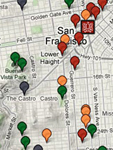
The Living New Deal project essentially creates a Google map of projects completed within the United States as part of the economic and social revival measure, the New Deal. These maps can be sorted by the type of project you are interested in locating, such as education, parks, art, or flood erosion measures. You can also find the portion of the nation of interest to you, and use the maps to locate nearby New Deal examples. Time for a field trip, perhaps?

In addition to providing the name, address, and website link for each location, the Living New Deal project also includes numerous other resources—such as detailed project descriptions, names of contributors and/or artists, project dates, photographs, and many other helpful and informative tid bits of information. The site also offers a plethora of other resources, so be sure to search around for teaching resources centered on the New Deal, news updates about existing New Deal projects, and coverage of the current economic crisis.

Although the website asks for contributions on the main page, users are under no financial obligations whatsoever. Contributions of information (to be verified by UC Berkeley) are also welcome, and likely more professionally appropriate.

Mission US: For Crown or Colony

Image
What is it?

New York Public Television developed Mission US: For Crown or Colony as the first in a series of free, online adventure games focused on various periods in U.S. history. In For Crown or Colony the player takes the role of 14-year-old Nat Wheeler, a printer’s apprentice in 1770s Boston. While completing errands for his master, Nat witnesses acts of violence between colonists and soldiers and discusses British colonial policies with Boston residents. Ultimately, Nat must decide whether his loyalties lie with the colonists or the crown.

The game is designed to teach players about the debates over British policies, the roles of various colonial groups (women, apprentices, slaves, etc.) in protesting those policies, and the forms such protests could take. Nat’s adventures in Boston are divided into a six-part story, each of which can be played in 15 to 20 minutes. In the course of fulfilling his duties, Nat learns more about the growing tensions between the colonists and the British troops stationed in the city. He meets various historical people (Phillis Wheatley, Paul Revere, and John Adams among others) and hears three basic responses to the tensions with the British: loyalty to the crown, support for the Patriot movement, and neutrality. characters 

In addition to conversing with these and other characters, Nat will witness several important historical events culminating in the Boston Massacre. He ultimately must testify at an inquest on the shootings. After the inquest, Nat must decide to support the Patriots, side with the Loyalists, or stay out of the conflict. The effects of his choices are revealed at the end. Finally, an animated epilogue narrates the events after the Boston Massacre that led to the outbreak of war and the Declaration of Independence.

Getting Started

Gameplay Consistent with the adventure game genre, the player experiences the game by visiting various locations in Boston rendered as fixed illustrations. The player can interact with objects and people in each location that are highlighted in yellow when the mouse hovers over them. Clicking on highlighted objects provide more information about them. For example, Mr. Edes’s print shop has a variety of objects the player can click on, ranging from the press itself to the paper supplies and type trays. Teachers may want to instruct players explicitly to investigate carefully as they play and follow up with discussions about the items in the game and what they suggest about Boston in the period.

Interacting With Characters Clicking on a highlighted character initiates a conversation with that character, the great strength of the game. The player sees and hears the animated character speak; the dialogue is also captioned in text. Choosing different responses for Nat will lead the dialogue in different directions. Much of the dialogue concerns how different characters perceive the events around them and whether Nate agrees with those perceptions. So, for example, if Nat sells a newspaper advertisement to Constance, the niece of loyalist Theophilus Lillie, Patriot Mr. Edes refuses to print the ad. His rationale: “She is the niece of Theophilus Lillie. He is breaking the non-importation agreement and all good patriots must oppose him.” The player has a variety of choices for Nat’s response ranging from inquiries, to arguments, to simple acceptance. Through the dialogues, Nat can try out different points of view, gain the approval and disapproval of various characters, and encounter many perspectives on British rule in colonial Boston. There are a variety of interesting characters, and the dialogues are well designed to achieve the learning goals of the game—namely, leading players to analyze the tensions in late colonial Boston and the main responses to British colonial policies.

Also included in the dialogues is the SmartWords vocabulary system. Certain conversations with characters bring up highlighted yellow terms representing key vocabulary—terms like apprentice, Sons of Liberty, and Townshend Acts. Clicking on highlighted terms adds them to the player’s SmartWords collection and shows the player a definition. As with the clickable background items, there is no guarantee a student will be motivated to have the types of conversations that will reveal these words. Turning the search for vocabulary into a side game, however, is not an unreasonable approach to the problem of presenting key vocabulary in a game.

Examples

The game’s great strength is its focus on making choices. The course of past events is so regularly, and mistakenly, perceived as inevitable. This game, on the other hand, reminds players people in the past made choices that had consequences. Nat can buy imports or local goods, side with Constance or Royce in disputes, and make friends with Loyalists or Patriots, among many other decisions. These decisions affect how the dialogues unfold and, to a lesser extent, the options Nat has for completing his tasks.

Best of all, the trend of Nat’s choices throughout the game changes the way he perceives the climactic events of the Boston Massacre.

When Nat finally must elect to side with Solomon, Royce, or Constance, he muses, “With the freedom to choose my own way, I knew that my future lay down one of three paths.” But choosing one of these three paths does not end the game immediately. Instead the player is invited to make a few more decisions about Nat’s adult life after 1770 that are woven into a short narrative. This final adventure, in addition to reinforcing the idea that the past was not predetermined, also helps make a potentially important point that the Revolution was not the only thing that mattered for people at the time.

Uses in the Classroom One of the great challenges for using a simulation game in class is incorporating the game into a coherent and well-designed lesson and unit structure. Mission U.S. has, laudably, completely removed this obstacle. The support materials provided are, quite simply, outstanding. The designers conceived of For Crown or Colony as an integral part of a rich and comprehensive unit on the road to Revolution. Accordingly, each section from the game is accompanied by a summary of the game, well-organized lesson plans, reflection prompts, discussion suggestions, and all manner of resources. Best of all, 20 relevant primary sources are included, each with a brief source note to aid in analysis and comprehension. Between the materials provided and the links to additional materials off-site, Mission U.S. provides more high quality resources and guidelines than could possibly be employed by any single teacher in a single unit.

The game, plans, and resources are tailored for a middle school audience, grades five to eight. Each section of the game takes approximately 15 minutes to play, and the game can be saved so play can spread Example characterover a number of sessions. If possible, playing through the game several times and adopting different stances each time can contribute to students’ abilities to analyze the variety of viewpoints and options colonists had—subsequent playthroughs take considerably less time. Alternating between gameplay, discussion, and use of the additional resources could easily fill a week or more with rich lessons on the road to Revolution. 

Mission US also features other storylines for students, such as early 20th century immigration and the Great Depression.

For more information

Mission US also offers other interactive, decision-based missions that explore United States' history. From the Revolutionary War through the Civil War and the Great Depression, each mission features a different character facing obstacles and different decisions of their time.

Looking for more online games appropriate for the U.S. history classroom? Jeremiah McCall introduces Do I Have a Right?, a game that teaches constitutional rights, in Tech for Teachers.

Google Forms

Image
What is it?

The Google suite of tools holds a number of free educational goldmines. In my classroom practice, Google Forms has become an indispensible tool for curricular application, classroom management, and work flow assistance. A form can be created, customized, and shared with students quickly and easily.

Getting Started

If you do not have an account with Google, you will need to register to set up a free account.

  1. Once you are logged into Google, click on “Docs.”
  2. Click on “Create New → Form”
  3. Enter the questions you would like to have answered. You can choose to collect information in multiple formats: text, paragraph text, multiple choice, checkboxes, select from a list, scale, or grid.
  4. For each new item, click “Add Item” at the top left.
  5. In addition, you can select a theme from a plethora of options.
  6. When you have finished the form, copy and paste the link found at the bottom of the page.

The responses will populate a corresponding spreadsheet in your Google Docs list and can then be sorted by question. A form can be used to simplify and coordinate basically any function where you need to collect student responses or information. The customizable backgrounds and range of question types allow for personalization of the forms. I am discovering new and interesting ways to use forms all the time in my classroom, and it has become a tool that I implement frequently.

Examples

At the beginning of the school year I use a Google Form to collect contact information for the students, including book numbers, email addresses, and parent names. The answers are then always accessible online whether I am at home or at school. We even created a contact form for the staff.

A second instance where I use Google Forms in the classroom is for self-assessment. During American Government, we completed a project called Story of a Bill. At the end of the project, I needed to find a quick way to collect the student assessment of their work. The form proved to be a quick and efficient manner of completing that goal.

For an advanced challenge, many teachers are using Google Forms to set up self-grading quizzes. Although I do not use this function in my classroom practice, there are a number of teachers who are finding it quite useful. For good resources and templates for the quiz function, visit Kern Kelly’s page from the Google Teacher Academy. Scroll down to the screencast and then the section on Form Templates.

For more information

If Google Forms isn't enough for you, check out our entry on Survey Monkey, another online tool for creating and administering forms and surveys.
10 minute video of how Google Apps work for the K-12 classroom.

Learner Response Systems (Clickers)

Image
What is it?

Learner Response Systems are handheld remote controls that allow students to respond instantly to classroom activities or learning. The Learner Remote Systems, commonly referred to as clickers, put the power to immediately answer questions into the hands of students. This tool allows teachers to provide formal and informal assessments to any number of students. Student responses can then be recorded in a number of different formats allowing the teacher flexibility when assessing responses and organizing data.

Learner Response Systems can be an incredible tool. Students love technology and, by putting the clickers in their hands, they feel a sense of importance in the classroom. They can be active participants without raising their hands and risking the awkwardness of a wrong answer in front of their peers. And they can share their ideas and answers without fear or hesitation.

Getting Started

There are several types of clickers. Teachers can evaluate how clickers will be used in class and determine budgetary constraints and the depth of response desired as they range in price and features. Almost all Learner Response Systems are compatible with PCs and Macs. The cost of the product is determined by the manufacturer and often is adjusted based on the quantity ordered.

The Learner Response Systems work using 2.4 GHz wireless technology that plugs directly into any USB port. Accompanying software allows the teacher to do a couple of important things. The first is importing questions they already have into the program. Second is the ability to export student responses into an Excel file format for faster analysis of results. Finally, most software programs have the ability to interact with other programs such as Word and Web browsers.

Although some clickers support open-ended questions and short answers, the most well-known types allow students to reply to multiple-choice questions, using a series of buttons on the remote that correspond to the possible answers.

Examples

There are countless opportunities to incorporate Learner Response Systems into a social studies classroom to increase student engagement, allow for rapid feedback, and assist teachers in planning lessons and activities. Pre-Testing One great way to use the clickers is through pre-testing. Before a teacher begins a unit, topic, or era, a short multiple-choice survey can be created using the key ideas that will be covered. Using the software provided by the manufacturer, the teacher can go through the survey and, after students have input their answers, the class responses can be shown on the screen beside the question. Set up the survey with four to six answers to a question and allow the students 45 seconds to a minute to complete each question. The survey should be no longer than 10 questions and the entire pretest can be completed in 15 – 20 minutes if students are already familiar with the Learner Response System. For this activity, it is not necessary to show individual responses because the relevant information is how the class performed as a whole. This will allow the teacher and the students to see how much prior knowledge they already possess. Once the teacher has an idea which key ideas the students are, and are not, already familiar with, the coming unit can be altered to maximize student learning. If a majority of the students already know the key information, a teacher can then spend more time in the areas where the class struggled. Formal Assessment Another great use for the Learner Response System is for formal assessment. To use this as a quiz or exam, the test is developed similarly to the pretest mentioned above. The first major change is that the students must register the remote with their name or student identification number so that the individual responses are recorded for that student. The second major change is that the questions should be timed. The teacher will set a predetermined time for each question, for example 45 seconds, and after the set time the questions automatically rotate to the next question in the exam. The final major change is that the teacher does not want to show any student responses. Instead, the teacher should allow the students to complete the exam and then all answers are stored within the software program provided by the company. After the completion of the quiz, the scores can then be converted into an Excel file for easier assessment.

From a teacher’s perspective, there is no grading to be done and the results are instant...

Most Learner Response Systems allow for the teacher to look at how each student, and the class, did on each individual question and on the exam in its entirety. If the teacher has broken down the exam into key ideas from the unit, it is quick and easy to evaluate where individual students or the class struggled or excelled, which can be crucial in planning revision and reteaching of some subject matter or skills. To expand on the exam, teachers could include pictures, maps, and graphs to test social studies skills as well as content knowledge. From a teacher’s perspective, there is no grading to be done and the results are instant which allows for quick turnaround on lesson planning and evaluation of student performance. Thought-Provoking Analysis The clickers can also be used to provide thought-provoking analysis for the students. This is done by posing a critical thinking question to the class and then allowing them two – three minutes to respond to the question. After all the responses are in, the total responses for each possible answer can be shown to the class in either raw numbers or in a graph. The students can then work with a partner using think, pair, share to discuss why one answer received the most responses (i.e. why it’s right) and why others received fewer responses (i.e. why it’s wrong). This is a great activity for getting a class to start thinking about what makes answers right or wrong and can be used to answer and provide discussion at all levels of Bloom’s Taxonomy. A fourth simple classroom activity for the social studies classroom is using the Learner Response Systems to make predictions about what is about to happen. An example of this could be the Treaty of Versailles. Allow students to review what each of the Big 3 wanted out of the Paris Peace Conference, then allow the students to use the clickers to choose a prediction from a list of possibilities. This can be done as a great small group activity by having 3-4 students discuss what the best prediction is and why it is the best. After the groups have discussed and registered a response, show them the correct answer with the raw numbers or graph of how they responded. Have the students discuss as a class what factors influenced their decision and, if they were incorrect, what caused them to be wrong. Seeing the responses and then discussion will lead to better understanding, better dialogue between students, and higher-level thinking. Other Uses There are also several ways to use the clickers in a non-assessment format as well. One example is that the clickers can simply be used to take attendance every day. If the students are well versed in using the Learner Response Systems, they will be able to come in, activate their clicker, which signals they are present in the classroom.

For more information

Vanderbilt University's Center for Teaching looks at teaching with clickers.

Research study "Waking the Dead: Using Interactive Technology to Engage Passive Listeners in the Classroom" tests student perceptions of clickers.

Another study, "Learning by Remote Control," suggests that clickers can help move classrooms away from lectures towards greater interactivity.

Popplet

Image
What is it?

Popplet is a tool that allows users to visualize ideas. Teachers and students can create graphic organizers, timelines, and many other forms of visual organization. Popplet's strength as a collaborative brainstorming tool, however, should not lead teachers to overlook its usefulness as an effective presentation tool.

Getting Started

Registering with Popplet takes only a few minutes and includes a tutorial that guides new users in understanding the basic features. Once registered, users can begin developing their first projects by creating a popple: a balloon or textbox. By double-clicking on the Popplet canvas, text can be added, aligned, and resized in each new popple. Likewise, videos and images can be imported via Facebook, Flickr, or YouTube, or from any file saved on the computer. Users can also use the drawing tool to freely write notes or sketch a diagram. A comment function allows other users to leave feedback on individual popples. Finally, users can take advantage of color coding to group and organize their Popplet canvases. In addition to these simple features, other tools offer added flexibility—which can be accessed by clicking on the wheel in the top menu. Users can edit entries and organize popples in a variety of way: either horizontally and vertically. Aside from Flickr, Facebook, and YouTube, Popplet also allows users to directly embed from Google Maps and Amazon. One helpful feature for teachers is found in the labs functions, where a "timewarp" displays a sliding timeline of the popplet's creation process. Finished popplets can be exported as JPG and PDF files, as well as saved and printed. A new feature is a desktop application that can be downloaded and allows popplets to be saved for offline presentations. 

Examples

Popplet is a new tool whose database of user samples is small but growing. However, a few examples demonstrate Popplet's ability to enhance the history classroom. A short history of Coke bottles is a good example of how visual displays can show change over time, or diversity, within a specific subject matter. Similarly, another example on the Popplet site focuses on Napoleon's career, mixing images with textual information.

...educators can develop Popplet displays that model historical timelines, hierarchal social systems, and other forms of organization that historians often rely on for their work.

Like another collaborative brainstorming tool, Wallwisher, Popplet is a useful tool for either teacher-directed or student-initiated projects. Teachers can use Popplet to create a variety of templates for student use of graphic organizers, timelines, or storyboards. For formal presentations, educators can develop Popplet displays that model historical timelines, hierarchal social systems, and other forms of organization that historians often rely on for their work. Popplet is also a valuable tool for collaborative planning among history faculty through its comments feature and multiple-user interface. Students will also find Popplet as a useful tool for initiating ideas for history projects or for displaying research, similar to other display tools like Glogster.

Massive Resistance Political Cartoons

Video Overview

Historian J. Douglas Smith contextualizes and analyzes two political cartoons commenting on Virginia government's reactions to Brown vs. Board of Education and the call for desegregation.

Video Clip Name
MassRes1.mov
MassRes2.mov
MassRes3.mov
MassRes4.mov
Video Clip Title
Cartoons and Newspapers
Segregation
Looking at the Cartoons
Teaching Massive Resistance
Video Clip Duration
5:05
6:15
5:23
4:33
Transcript Text

These are political cartoons, which typically do appear on the editorial page and are a comment on the major political events of the day. The first cartoon from May of 1954 entitled "Now What," was drawn and published in the immediate aftermath of the Supreme Court’s Brown decision.

Typically, the editorial cartoonists will reflect the editorial position of the newspaper. Certainly in the Richmond Times-Dispatch in the 1950s, the cartoonists would’ve more or less reflected the editorial position of the newspaper. By the time you get to the ’50s, you cannot avoid talking about massive resistance, you can’t avoid commenting on the Brown decision, you can’t avoid commenting on the imminent closing of the public schools. These are single images that convey a quite bit of information. Once you really begin to look deeply at this, you start to understand and to see where Virginia has gone in the four years from the Brown decision.

Virginius Dabney was the editor of the Times-Dispatch from the ’30s until late 1960s. And he recognized that massive resistance itself was not going to lead to anything productive, but the publisher of the paper, the Bryan family, were firm supporters of massive resistance, and so the bargain that essentially was worked out is that Dabney just didn’t say much about massive resistance. He certainly didn’t editorialize against it.

This is actually, I think, quite typical of the elites in Virginia, He was certainly amongst those, but Virginius Dabney once famously described massive resistance as an aberration from Virginia’s heritage of sound leadership and forward-looking thought. So, he was able to sort of dismiss this four- or five-year period as a blip on an otherwise excellent record when, in fact in many, many ways, massive resistance is the logical culmination of a particular type of race relations that people like Virginius Dabney did support.

Dabney is a complicated figure in this in that he was somebody who always editorialized for the better treatment of African Americans in Virginia. But within this paternalistic vein that had developed in Virginia; at one point in time he was seen as a liberal in the '30s because he was advocating better treatment of blacks and anti-lynching. By the '40s he’s more moderate, by the late '50s and '60s he’s actually seen as quite conservative.

Richmond had two papers. There was the Times-Dispatch which was the morning paper and then the News Leader which is the afternoon paper. The editor of the News Leader was James Kilpatrick who was one of the real leaders of massive resistance in many ways. In Norfolk, you have the Norfolk Virginian-Pilot, the other major paper in the state and it was the only one of the white papers that opposed massive resistance. Not that they embraced and desired integration, but that they recognized that the Supreme Court was the law of the land, that the Justice[s] had spoken and it was a responsibility to adhere to those decisions.

The Norfolk Journal & Guide and the Richmond Afro-American were black papers of the time. They were weeklies, and they had a relatively small readership. I think that most African Americans felt they had the Supreme Court ruling on their side and that ultimately that would have to prevail, but getting there wasn’t easy. Richmond was the capital, the power center, and so the Richmond paper certainly was the most important in the state and then the Norfolk paper after that in terms of overall readership.

The 13th Amendment simply abolished slavery towards the end of the Civil War. The 14th Amendment said that no citizen of the United States can be denied the equal protection of the laws. What was so important about the 14th Amendment was that it basically said that any citizen of the United States is first and foremost a citizen of the United States and secondarily, a citizen of their individual state and therefore it meant that no state could deny any individual any of the guarantees that were made by the federal government.

The 15th Amendment said that no person could be denied the right to vote based on race or previous condition of servitude. It doesn’t say that you can’t be denied the right to vote for other reasons, so what you end up with is the implementation of Jim Crow. Because of the 15th Amendment, no state could pass a law which said blacks can’t vote, but what they did instead was come up with all sorts of other methods for achieving essentially the same purpose.

Understanding clauses were educational tests where it was up to individual registrars to decide who passed certain tests. One of the problems with the literacy tests and understanding clauses is that there were in fact many uneducated whites who might have failed those tests. This is where you get grandfather clauses in which states would pass a law which said that if your grandfather could vote, then you can vote. There was no black person whose grandfather could vote because you’re talking about the slave era.

It was under the guise of the 14th Amendment that in Brown, the Supreme Court basically says that the court in Plessy was wrong, that equal protection laws do not allow for segregation. The 14th and 15th Amendment are quite important in terms of understanding the whole edifice of white supremacy and of Jim Crow. It’s not until 1965 with the Voting Rights Act that the vestiges of the disfranchisement laws are finally put to rest.

In the late 19th century you have the implementation of series of state laws, many of them begin with railroad transportation and quickly spread to other aspects of public life. As public schools come into being, they are fully segregated. The segregation laws tend to have to do with public separation of the races in public places.

The whole notion of Plessy v. Ferguson in 1896 when the Supreme Court gives its permission for the South to maintain and build a segregated state. Homer Plessy, who was a man who was one-eighth black, wanted to test the law. The state of Louisiana had passed a law which said that the races could not sit together on railroad cars. He did so anyway. He was arrested, charged with a violation of the law.

The case went to the Supreme Court and by an eight-to-one decision, the Supreme Court said that laws that mandated segregation were okay as long as facilities for both blacks and whites were equal and so the phrase separate but equal comes out of this, talking about parks, playgrounds, schools, trolley cars, then later buses, railroad cars, any sort of place of where the public might mingle.

The standards definition of desegregation is the abolishment of racial segregation and integration, as the full equality of all races in the use of public facilities. A distinction I often find helpful especially in the context of understanding massive resistance, and even more so with what happens after massive resistance is that I think that in many respects desegregation means the end of state-sponsored segregation. Desegregation comes to mean the absolute minimum necessary to comply with the law. What really happens in the wake of massive resistance is that you end up with token integration, at least for another decade until another series of court decisions force more complete integration.

On a national level Brown v. Board of Education was the culmination of a nearly two-decade campaign led by the NAACP to attack segregated education at the professional and graduate school—the whole notion of Plessy v. Ferguson in 1896 when the Supreme Court gives its permission for the South to maintain and build a segregated state.

The NAACP began winning a series of precedents: in the Maryland courts, then Missouri, in Texas, Oklahoma. NAACP recognized that they could keep doing this forever and ever, they basically were arguing that there was nothing equal about segregation, that the states were failing to meet their constitutional mandate under Plessy. The hope was not that they’ll simply increase funding and we’ll have a separate but equal society, but that they would recognize that to do so would be so prohibitively expensive, that real meaningful change would have to take place.

The case of Brown v. Board of Education, which was five cases which all examined the question of segregation in the public schools at the pre-collegiate level—these cases worked their way through the different courts and then finally they were bundled together by the Supreme Court and we know them as Brown v. Board of Education.

In the early ’50s we know Virginia provided one of the cases that was bundled in Brown, the case out of Prince Edward County which started when a group of young students led by Barbara Johns, who was a junior at Moton High School—the facilities in Farmville are horrific and the students finally say enough. Many of their parents are scared because their parents’ jobs depend upon not causing trouble and so the students don’t tell their parents about this. One day they march down to the superintendent’s office and have a protest of their own.

It would be simply wrong to suggest that African Americans in Virginia weren’t demanding more change. Even though the Brown case comes out of Kansas, it’s every bit as much about life in Virginia. People often assume that the Brown decision dealt with segregation and all of its guises and aspects, but the Brown decision actually was limited to segregation in the schools.

Part of the problem with Brown and part of what why we end up with massive resistance is that the court they’re obviously worried about the reaction in the South. So they actually did not in 1954 issue an actual implementation ruling. They could have said all public schools in the South must be desegregated beginning in September, but they did not. They left it up to the district courts and they said they must move with quote unquote “all deliberate speed” and this provides the context for massive resistance.

The NAACP basically said look you’ve got to do this now, or else the white South is going to stall and certainly the NAACP proved to be quite right about this. So, the court decision comes down in May of 1954 and the initial response in Virginia is sort of like this cartoon suggests. The Virginia constitution guarantees every child the right to a public education. So, there were some who thought well maybe if we get rid of that guarantee then we don’t have to run public schools. There were others who thought you know that was going a bit too far. So you have this ferment in the summer or fall of 1954 who are trying to figure out what to do.

We have an ocean with no land in sight whatsoever, but a giant rock sticking up right in the middle. It says "Supreme Court Segregation Decision," in reference to the Brown decision which declared segregation of the schools unconstitutional. The ship itself is sitting on top of the rock. It’s on the point of the rock so you could imagine if the weight shifted too much one way or the other that it would fall into the ocean. The water itself is pretty still.

The ship is an old wooden vessel labeled The South. Inside the ship there is a schoolhouse. It says public schools. In the front, presumably the captain of the ship is a man that looks like a throwback from the Confederate era. He’s got the trademark long moustache and long, pointed beard. The big top hat, almost a 10-gallon hat except we’re not in Texas but otherwise similar to that. Almost the type of man that you would imagine as a model for Colonel Sanders of Kentucky Fried Chicken fame. This is an old Confederate general, the embodiment of the myth of the lost cause if you will, of the Southern confederacy, and yet here he is in 1954 at the helm of the ship The South standing at the front, but firmly inside the boat, gazing out to sea to look and see whether or not help might be coming.

The overall message is that the Supreme Court decision has put the South in a very difficult spot with regard to the public schools, but disaster is not necessarily imminent. There may yet be a way out of this. The ship is not breaking apart as far as we can see. It’s stuck but not coming apart. The title of the cartoon itself “Now What” suggests some ambivalence about where things are headed.

The Byrds would have to be considered the most prominent political family in Virginia in the 20th century. Harry Byrd, Sr., was the dominant political figure in Virginia from the early 1920s until his death in the mid 1960s. He was elected governor in 1925 as a very young man. Recognized as the head of what comes to be known as the Organization—a small tightly-knit group of important political figures that revolved around the county courthouse the county clerk and the county judge and the county sheriff. He was brilliant at maintaining contact with people, at knowing how to relate with people. People around the state loved Harry Byrd and he was as a governor in some respects progressive for the time, but certainly on issues of race and many others, quite, quite conservative. He went to the U.S. Senate, until 1965 when he became very ill and he actually resigned his seat so that the governor could appoint his son, Harry Byrd, Jr., and then Harry Byrd, Jr., occupied that Senate seat until he retired in 1982.

It’s interesting to note the ways in which the political dynamics of Virginia and the South shifted. Up until the 1960s, Virginia, like every other Southern state, was virtually all Democrats. The Democrats were the party of white supremacy, which makes sense if you think about the Republicans as the party of Lincoln and of Reconstruction. The Democrats regained control in the late 19th century, and it was very much a one-party state until the advent of the civil rights movement when the national Democratic party embraces civil rights beginning in 1948 and then accelerating in the 1960s, you begin to see many southern Democrats switching parties.

A lot of the South was watching to see what Virginia would do. In the fall, the governor appoints what’s known as the Gray Commission in November of 1955. The Gray Commission issues a report. The key provision, and the most controversial one, was a recommendation that the state begin to make available tuition grants so that any white family that objected to sending their child to a school which was integrated could get a tuition grant from the state to go to private school. In January of 1956 the state overwhelmingly voted to amend the Constitution to allow for tuition grants.

The Gray Commission would actually have allowed some integration in places. It was very clear that Arlington especially was ready to integrate its schools. Also, the mountainous parts of Virginia, there’re very few African Americans and they would’ve made financial sense to integrate the schools because running two separate school systems was costly. So the fear was that there were parts of the state that would in fact comply with the court decision and for a lot of people in the southern part of the state, that was untenable.

So, it’s in the spring/summer of 1956 that Harry Byrd and others began to try to formulate a plan and this leads to the real showdown in August and September of 1956 when the governor calls a Special Session of the legislature and what come to be known as the Massive Resistance Laws are passed. The most important components of Virginia’s Massive Resistance Laws were that the people placement was taken out of the hands of local officials and put in the hands of a state people placement board, so that meant that people in Arlington, for instance, could not automatically send to a formerly white school a handful of black students.

Secondly, the Massive Resistance Laws provided for tuition grants. Most importantly, though, what the Massive Resistance Laws did is that they empowered the governor to take control of and close down any schools which integrated as a result of court orders.

On the other side of the issue, there were various people who made very clear that they were more committed to public education than they were to segregation. I think if you had surveyed most white Virginians at the time of the Brown decision they would have preferred to maintain segregation, but that doesn’t mean they’re necessarily willing to defy the Supreme Court. If forced to choose between segregation and public education, they would prefer public education.

The portions of the state, which had the heaviest concentration of African Americans, most of whom were prevented from voting by a variety of reasons, were vastly overrepresented in the Virginia legislature. In the 1956 Special Session when the Massive Resistance Laws were implemented, the key vote in the state Senate was 21 to 17. The 17 who voted against massive resistance actually represented more Virginians than did the 21 who voted to implement the law.

The second cartoon is from late September 1958 and clearly things are quite different. The ship is still intact but somehow it has managed to get off the rock. We have huge waves. There’s massive lightning bolts which appear that they might be headed towards the ship even if they haven’t hit quite yet. The storm is clearly in full force and presumably the waves have risen high enough to pull the ship off of the rocks.

The title "Riding Out the Storm" suggests that there is a way out of this. The fact that the ship has not turned over. It’s still upright. We still have the Confederate-era gentlemen at the helm. He’s now identified specifically as Virginia as opposed to the South. He’s looking out to see what’s ahead, and the presumption is that there is a possibility of still riding out the storm, however severe it now seems to be.

This isn’t a cartoon that has an image of an integrated classroom that somehow leads to some catastrophe. But it certainly suggests that it’s important to maintain segregated schools. Integration is seen as a cause of a storm that’s going to somehow damage or change the way of life.

The character is the same person in both cartoons and yet in the first cartoon, it says "The South," certainly a sense that the South as a whole is sort of stuck looking for a way out, whereas in the second one, it doesn’t say "The South" anywhere. It does say "Virginia" and so in that case it’s more a sense of this is Virginia’s path because by 1958 much of the rest of the South is watching to see what Virginia will do. The message of the first cartoon is that the Supreme Court decision has caused some problems for the South. It’s not entirely clear what’s going to happen next, but what does that actually mean in practical terms.

By 1958, four years later, quite a lot has happened, both on the national level but especially in Virginia. Those who are most committed to keeping the schools segregated have now taken quite a different step. Instead of the ship saying "The South" on the side, it actually now says "public school closing." This is the point just a few weeks before schools actually are closed. There’s still a message here that Virginia can navigate its way through the waters. Despite the Supreme Court edicts, this is somehow a viable strategy to get through this crisis, although it’s become much more problematic.

This was a public relations disaster for the state. Histories of massive resistance are often quick to credit a group of businessmen and bankers in Richmond who quietly said you’ve got to do something to stop this, this is hurting the state’s reputation, it’s hurting business.
I think we should be very careful because these individuals said nothing for four years, so to give them credit for stepping in when they should’ve done so much earlier I think is problematic. By the end of 1958, early 1959, the NAACP and others were challenging the constitutionality of the Massive Resistance Laws in both federal and state courts. In January of 1959, both state and federal courts ruled the Virginia Massive Resistance Laws unconstitutional.

So in the spring of 1959, you have a final showdown between those who want to return to the local option, but with tuition grants, always giving white students the option of getting out of integrated schools at state expense and then those who continued to resist despite all the court decisions. What you really end up with is very token integration. The percentage of black students attending white schools is quite small until the late 1960s. In 1968, the Supreme Court finally said enough of 'all deliberate speed.' It’s been 15 years since the Brown decision.

Start with what appears to be the obvious and then draw out from that what the different components represent. What does this ship represent? What does the person at the helm represent? What is it that’s going on in the sea here? What might the cartoonist not be telling us or not sharing with us? Asking them to explain what do they see here, what do they think is likely to happen?

I think it's important to pay attention to all of the details, to really look at each particular component both on its own and also collectively. See how these pieces fit together. You could look at the cartoons without the caption at the top and it would be interesting to see whether the caption is one that you would necessarily come up with yourself based on the image. In reading any cartoon or any image it's important also to ask what’s not in the picture. And one way you might answer that question is think about how would other newspapers have portrayed the series of events. And in Virginia certainly if you looked at either of the African American newspapers you would have gotten a very different perspective.

The northern Virginian Pilot is the only major white newspaper in the state that opposed massive resistance. And certainly if you were to compare this to cartoons that they had at the time you would see a very different image. They would’ve suggested what they argued editorially, which is that it was doomed to fail. That it could not possibly pass constitutional muster. That by prolonging the inevitable, you’re simply heightening tensions.

It would be very interesting to compare the cartoons with the actual written editorials of those papers. It would be interesting to think about the different ways in which public opinion is reflected. Newspapers aren’t necessarily always accurate. Public documents, to compare what a newspaper is reporting with what the actual public statements are, whether it’s a press release of the governor or looking at the actual laws, looking at election returns. One of the things that’s quite fascinating is to look at private letters, what people are saying behind the scenes. What is the cartoon telling us about the event versus what does it tell us about the person who’s actually created the image. The more sources you can find the better because you’re going to often get conflicting points of view and then it’s important to try to understand those sources in a way that makes those seeming disparities make sense.