National Women's History Project
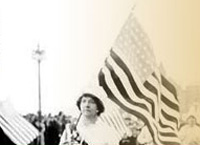
Image
Logo, National Women's History Project
Annotation

Introduces the National Women's History Project, "a non-profit organization dedicated to recognizing and celebrating the diverse and historic accomplishments of women by providing information as well as educational material and programs." Includes a 5,000-word essay on the history of the women's rights movement and a 7,000-word timeline. The site gives detailed information about the organization's activities, including efforts to bring women's history into public life, a list of curricular ideas for teachers, material concerning National Women's History Month, and a 15-question quiz on Women's History.

Perhaps most valuable, the site furnishes approximately 200 partially annotated links, arranged into 12 broad categories such as "Politics," "World History," and "Math and Science." Though lacking in primary source material, this site provides useful beginning resources for the study and practice of women's history.
Creation of the Modern City

Description

Kenneth Jackson, Jacques Barzun Professor in History and the Social Sciences at Columbia University, describes the ways in which 19th-century cities evolved from disorganized, unregulated communities into modern cities focusing on order, safety, and public health. Professor Jackson looks at the motivations behind these developments as well as implementation strategies.

North American Women's Letters and Diaries: Colonial Times to 1950

Image
Logo, North American Women's Letters and Diaries: Colonial Times to 1950
Annotation

This extensive archive offers approximately 150,000 pages of letters and diaries from colonial times to 1950, including 7,000 pages of previously unpublished manuscripts. Highlighted material includes extracts from the Journal of Mrs. Ann Manigault (1754-1781), the Life of Harriet Beecher Stowe, letters of Phyllis Wheatley, letters of Ellen Louisa Tucker to Ralph Waldo Emerson, letters of Margaret Fuller, and the memoirs and letters of Dolley Madison, wife of James Madison.

Search the database by keyword or use the advanced search to find material by such fields as author, race, religion, age, occupation, date of writing, document type, historical event, or subject. More than 80 fields have been indexed. This website is available either through one-time purchase of perpetual rights or through annual subscription (your library or institution may have a subscription). This collection is a useful archive of material for teaching about the history of women as well as for research in women's studies, social history, and cultural history.

Lincoln and Race

Description

James Oakes of City University of New York examines Abraham Lincoln's views on race and slavery, including his reaction to the Dred Scott Decision. Oakes argues that Lincoln was a racial egalitarian.

J.P. Morgan

Description

According to the Gilder Lehrman website, "Award-winning historian Jean Strouse discusses her research into the life of J.P. Morgan, America's most influential banker. She looks at the reasons for his success and delves into his inscrutable personal life. Strouse's extensive scholarship offers many insights into her subject, whose name is in the financial news headlines once again."

Harriet Tubman

Description

Harriet Tubman was born into slavery in Maryland in 1820. After her escape to the North in 1849, she returned to the South more than a dozen times to ferry other slaves along the Underground Railroad. She later helped John Brown recruit men for his Harper's Ferry raid; and during the Civil War, Tubman served as a Union spy. In this lecture, historian Catherine Clinton details not only Tubman's life but also the quest to uncover new information on Tubman.

Lincoln: A Life of Purpose and Power

Description

Richard Carwardine is Rhodes Professor of American History at Oxford University, author of Lincoln: A Life of Purpose and Power, and winner of the 2004 Lincoln Book Prize. In this lecture, he discusses different aspects of Lincoln's life. Why is Lincoln a mythic figure? How early in his career did he develop his views against slavery? What role did religion play in his life? Professor Carwardine analyzes Lincoln's greatness as well as his humility.