Free Speech Teaching Guide 1: The Birth of the Modern First Amendment and How Oliver Wendell Holmes Changed His Mind

Article Body
This Teaching Guide is part of a series. Each of the four total teaching guides speaks to one aspect of the history of free speech. Although they work together to tell different parts of this history, it is not necessary to teach all of the guides or to teach them in a certain order. Each guide is a self-contained lesson.
(A PDF version of this teaching guide is also available for download-see left) 

Other guides in the series:
Free Speech Teaching Guide 2: Brandenburg v. Ohio (1969): Defining and Arguing Hate Speech
Free Speech Teaching Guide 3: The Problem of National Security Secrets
Free Speech Teaching Guide 4: Mandel v. Kleindienst (1972): Censorship via Visa
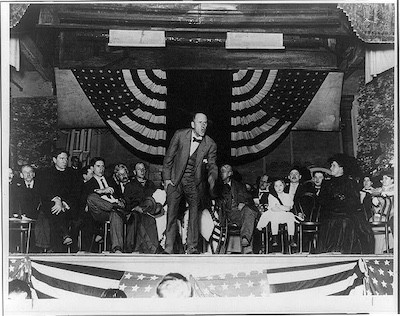
 

Eugene V. Debs making a speech on stage with two American flags and a group of people seated behind him

"Eugene V. Debs Making a Speech," c.1912-1918, Library of Congress
Recommended for:

  • 11th Grade US History
  • 12th Grade Government
  • Undergraduate History

Table of Contents

Framing Essay:
This essay provides historical background on modern ideas about free speech and the First Amendment through analysis of two 1919 Supreme Court cases:

  • Selection: Schenck v. United States 249 U.S. 47 (1919)
  • Selection: Abrams and others v. United States 250 U.S. 616 (1919)


Classroom Activities
Exercise 1: What does Freedom of Speech Mean? A guided reading of the Holmes opinion in Schenck v. United States 249 U.S. 47 (1919). Why did the Supreme Court decide it was acceptable to limit certain forms of speech?
Exercise 2: What Kinds of Speech are Protected? A full class group activity on the white board. What makes certain forms of speech so harmful that they fall outside First Amendment protection?
Exercise 3: Holmes Reconsiders. A detailed reading of Abrams and others v. United States 250 U.S. 616 (1919) and a comparison to Schenk. How might judges apply or avoid precedent?

Annotated Primary Sources
A section of Justice Oliver Wendell Holmes Jr. majority opinion in the Schenck case.
A section of Justice Oliver Wendell Holmes Jr. dissenting opinion in the Abrams case.

Homework Activity

Framing Essay

When I teach students the history of the First Amendment, the most basic thing I want them to learn is that the First Amendment has a history. Free speech seems like an enduring American value. After all, it is protected in the First Amendment to the constitution. But the idea that we should protect the "marketplace of ideas," that all sorts of speech should be protected from punishment, is barely more than a century old. In fact, its emergence can be traced to one year: 1919.

This guide focuses on the history of free speech in one crucial year (1919), exploring how one influential Supreme Court justice changed his mind about the value of antiwar speech and in the process wrote opinions that have shaped our attitudes to free speech ever since. It provides students an opportunity to see the First Amendment evolve at a crucial hinge in its history, and it also provides them an opportunity to think about how far the rights to free speech should extend during wartime.

During World War I, the US government sent critics of the war to jail. The Espionage Act of 1917 made it illegal to interfere with the draft, and government prosecutors successfully claimed that criticism of the war was a form of interference with the draft – if drafted soldiers thought the US should not be fighting the war, wouldn’t they be less likely to comply with the draft? On this theory, more than a thousand Americans were imprisoned for speech crimes. The most famous of them was Eugene Debs, the labor organizer and perennial Socialist presidential candidate, who was convicted for a Socialist stump speech in an Ohio park in the summer of 1918.

Find the text of the First Amendment Here


Eugene V. Debs making a speech on stage with two American flags and a group of people seated behind him
"Eugene V. Debs Making a Speech," c.1912-1918, Library of Congress
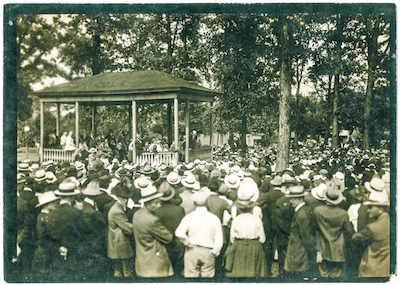
Large crowd gathers around a gazebo to listen to Eugene Debs
Eugene Debs Speaking in Canton, Ohio, c.1918, National Archives
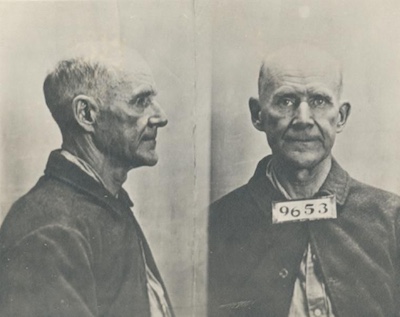
Mug shot of Eugene Debs. His number reads 9653.

"Eugene Debs Mug Shot," c.1912-1929, New York Public Library

During class, I project the above images of Eugene Debs to force students to think about the human character at the center of this story. Debs was a noted orator, but we have no videos of him speaking.

We have to rely instead on photographs and the words of his audience, who described him as a captivating, moving speaker, who had the ability to make everyone in the crowd feel like he was addressing them directly.

Look Closer:
One technique Debs used was to lean out over the crowd – as you can see in the photo of his speech in Canton, Ohio.
You can find a transcript of Debs’ Canton Speech here: Eugene V. Debs' Canton Speech, 1918, Internet Archive

After the end of the war, in the Spring of 1919, the Supreme Court heard appeals from a number of the socialists prosecuted under the Espionage Act. The socialists claimed that the First Amendment protected their right to criticize the war. In unanimous decisions, the Supreme Court rejected their claims. During war time, Justice Oliver Wendell Holmes Jr. wrote for the court, it was perfectly acceptable for the government to criminalize speech that could interfere with the draft. The first classroom exercise will explore Holmes’s decision in this case: Schenck v. United States 249 U.S. 47.
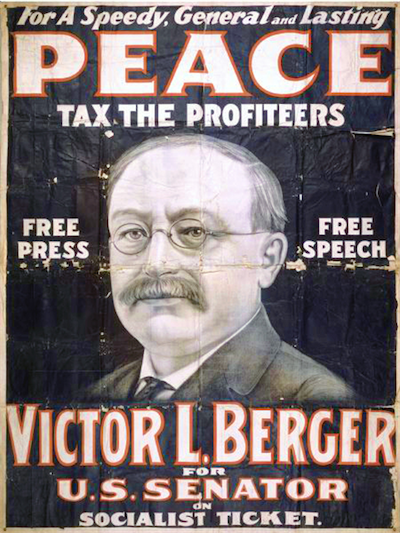
Poster with Victor Berger's picture on it. It reads "For a Speedy, General, and Lasting Peace, Tax the Profiteers. Free Press. Free Speech. Victor L. Berger for U.S. Senator on Socialist Ticket." 
Victor L. Burger Campaign Poster, 1918, Wisconsin Historical Society

This campaign poster for Victor Berger reveals the centrality of free speech to the Socialist party and the connection between the right to free speech and opposition to the war.

Berger himself was prosecuted for speech crimes — a fascinating history that is well documented Wisconsin Historical Society site linked below.

Victor L. Berger Campaign Poster, 1918, Wisconsin Historical Society


Classroom Exercise I: What does Freedom of Speech Mean?

Contents:
Overview
Schenck WWI Anti-Draft Pamphlet, 1917
Excerpt of Schenck v. U.S.(1919)
Annotated excerpt of Schenck v. U.S. (1919)
Conclusion and Takeaways: What does free speech really mean?

Overview:
Holmes’ understanding of free speech was explained most clearly in the Schenck v. U.S. (1919) case, which concerned a pamphlet (pictured below) sent to drafted soldiers which encouraged them to protest the draft by writing to their congressional representatives.

It is useful to walk students through this excerpt from Holmes’ decision closely in class explaining the relevant steps of the logic. I do so by:

  1. Have students read the dense legal text of the Holmes’ decision out loud.
  2. Paraphrase and explain each sentence. My annotations provide the context and explanation I use. The following pages provide an annotated exploration of an excerpt of the Schenck decision.

Charles Schenck, WWI Anti-Draft Pamphlet, 1917, National Archives

Primary Source: Schenck v. U.S.​ (1919):

“It well may be that the prohibition of laws abridging the freedom of speech is not confined to previous restraints, although to prevent them may have been the main purpose, as intimated in Patterson v. Colorado, 205 U. S. 454, 462. We admit that in many places and in ordinary times the defendants in saying all that was said in the circular would have been within their constitutional rights. But the character of every act depends upon the circumstances in which it is done. Aikens v. Wisconsin, 195 U.S. 194, 205, 206. The most stringent protection of free speech would not protect a man in falsely shouting fire in a theatre and causing panic. It does not even protect a man from an injunction against uttering words that may have all the effect of force. Gompers v. Buck’s Stove & Range Co., 221 U. S. 418, 439. The question in every case is whether the words used are used in such circumstances and are of such a nature as to create a clear and present danger that they will bring about the substantive evils that Congress has a right to prevent. It is a question of proximity and degree. When a nation is at war many things that might be said in time of peace are such a hindrance to its effort that their utterance will not be endured so long as men fight and that no Court could regard them as protected by any constitutional right. It seems to be admitted that if an actual obstruction of the recruiting service were proved, liability for words that produced that effect might be enforced. The statute of 1917 in § 4 punishes conspiracies to obstruct as well as actual obstruction. If the act, (speaking or circulating a paper,) its tendency and the intent with which it is done are the same, we perceive no ground for saying that success alone warrants making the act a crime. Goldman v. United States, 245 U. S. 474, 477.”
For the Full Decision see: U.S. Reports: Schenck v.US 249 U.S. 47 (1919) Library of Congress.


Annotated excerpt of Schenck v. U.S.:

"It well may be that the prohibition of laws abridging the freedom of speech is not confined to previous restraints, although to prevent them may have been the main purpose, as intimated in Patterson v. Colorado, 205 U. S. 454, 462."

Previous or Prior Restraint:

  • A particularly dangerous form of censorship because it prevents one from speaking at all without approval.
  • In the 19th century, it was well understood that the First Amendment prevented this kind of licensing system - Holmes sees this as the "main purpose" of the First Amendment.

Patterson v. Colorado was a 1907 Supreme Court case in which a newspaper was punished for criticizing a court in Colorado. The newspaper claimed that the First Amendment protected their right to criticize the judiciary, but the Supreme Court ruled that it was acceptable to punish speech if it would interfere with the "course of justice." Holmes wrote the opinion for the court; two judges dissented.

Holmes cites this decision for two purposes:

  1. FIRST: in the sentence prior to the citation, he says that the main purpose of the First Amendment is to prevent the establishment of a censorship board that can approve or deny the right to speak or publish before one has spoken.
    1. The question at stake was whether the First Amendment also protected you from punishment after you have spoken.
    2. Holmes here begins by conceding that the First Amendment might offer some protections to post-speech punishment - it is not only limited to a ban on prior restraint.
  2. SECOND: the implication is that the First Amendment offers fewer protections against post-speech punishment than it does against prior restraint.

“We admit that in many places and in ordinary times the defendants ... circumstances in which it is done. Aikens v. Wisconsin, 195 U.S. 194, 205–206 (Volume, Publication Name, Page Numbers)...

This is an opportunity to explain to students how to read Supreme Court decisions. The citation of cases, followed by the numbers, is placed in the text which will be new to many students.
The citation is the equivalent of a footnote or parenthetical reference. If you just want to read the substance of the opinion, students can jump over the citation, which will make the opinion easier to follow. I often explain to students, familiar with finding material online, how bound volumes of cases look on library shelves, and why such a reference system is helpful.

Holmes cites an opinion from a 1904 case about unfair trade practices. The Aikens case established that the decision to sign or not sign a business contract might be protected in some cases, but not if it is part of a criminal conspiracy to harm a competitor.

The details are not directly relevant to the speech context; he is citing the case to support the abstract proposition that acts which can be constitutionally protected in some cases may not be constitutionally protected in different contexts.

In Schenck - the right to say what was said in the pamphlet might be protected in some contexts, but that doesn't resolve the question of whether it is in this case.

"The most stringent protection of free speech would not protect a man in falsely shouting fire in a theatre and causing panic.”

  • This is a famous metaphor. But how does it work in this case?
  • Holmes is arguing that you do not have a right to falsely shout fire in a theater - this will cause a panic, a harm which societies would reasonably want to prevent.
  • But it matters that he assumes that the shout of "fire" is false - if there actually was a fire in the theater, you definitely want someone to yell!
  • The metaphor seems to have been introduced into case history by the federal lawyer prosecuting Eugene Debs. When Debs's lawyers claimed a right to free speech, the prosecutor said that this was the same thing as claiming the right to "go into a crowded theater...and yell 'fire' when there was no fire and people [would be] trampled to death."
  • It seems likely that the prosecutor was thinking of a recent incident in Calumet, Michigan, where striking copper workers had organized a children's Christmas party on the second floor of a hall in 1913. During the party, someone yelled fire, and there was a stampede which killed 73 people. It made the front-page of the New York Times and entered the political culture. Woody Guthrie's 1939 ballad  “1913 Massacre" is about the event - and captures the assumption by left-wing Americans that the false shout of fire had come from an anti-union vigilante.
  • If this is the origin of Holmes' metaphor, it is deeply ironic that the socialists in these World War I cases were being accused of a "false shout of fire."

Questions for Students:
Is it fair to compare Schenck’s pamphlet to a false shout of fire?
Is the harm of the pamphlet as immediate as a stampede?
Is the pamphlet ‘false’ in the same way as the shout in the theater?
If the alarmist shout about the draft is the equivalent of a true fire, might there be benefit in hearing it?
What might the merits be of debating the pamphlet, even if it is difficult to establish whether or not it is true?
Why might Holmes have chosen this metaphor?
Why do courts use analogy, metaphors, and comparisons in their decisions?

Find the song here: Woody Guthrie, “1913 Massacre,” Smithsonian Folkways Recordings.

“It does not even protect a man from an injunction against uttering words that may have all the effect of force. Gompers v. Buck’s Stove & Range Co., 221 U. S. 418, 439. The question in every case is whether the words used are used in such circumstances and are of such a nature as to create a clear and present danger that they will bring about the substantive evils that Congress has a right to prevent. It is a question of proximity and degree. When a nation is at war many things that might be said in time of peace are such a hindrance to its effort that their utterance will not be endured so long as men fight and that no Court could regard them as protected by any constitutional right. It seems to be admitted that if an actual obstruction of the recruiting service were proved, liability for words that produced that effect might be enforced.”

  • Samuel Gompers was a union leader organizing a consumer boycott of Buck’s Stove, an anti-union company. A court ruled that this kind of boycott was an illegal interference with commerce, and Gompers claimed that the ban violated his rights to free speech.
  • In 1911, the Supreme Court rejected the claim, saying Gompers’ speech was a "verbal act...exceeding any possible right of speech which a single individual might have."
  • Here, Holmes is saying that it is possible to consider Schenck's pamphlet in the same way - as a verbal act which has such effects in the world that they should be treated as acts, not as part of freedom of speech.
  • Holmes here assumes that constitutional rights during wartime are different, and this is crucial to his decision. This is a useful place to discuss with students whether they agree.

Questions for Students:

  1. What constitutes a “war”?
    1. US fought the Vietnam War, for instance, without a formal declaration of war.
  2. If the right to free speech should be limited during wartime, how do we define a war?
  3. Does a national security emergency count, or only when congress formally declares war?
    1. For a useful discussion of the ambiguities of the legal term "wartime," see Mary L. Dudziak, Wartime: An Idea, Its History, Its Consequences. (Oxford, 2012).

“The statute of 1917 in § 4 punishes conspiracies to obstruct as well as actual obstruction. If the act, (speaking or circulating a paper,) its tendency and the intent with which it is done are the same, we perceive no ground for saying that success, alone warrants making the act a crime. Goldman v. United States, 245 U. S. 474, 477.” 

  • Goldman was a case from 1918 about a conspiracy to interfere with the draft - it cited "settled doctrine" that conspiring to do an illegal act is a crime whether or not it is successful.
  • This is another citation similar to Aikens. Students don't need to know the details of the case to grasp the general point: for certain crimes we punish attempts as well as successes. Attempted murder is the most obvious example.
  • In some of his earlier writings on the law, Holmes had explained that we punish attempts as well as successes because we want to prevent certain dangerous outcomes - "the danger becomes so great that the law steps in" See G. Edward White, Justice Oliver Wendell Holmes: Law and the Inner Self, 261-262.

Conclusion and Takeaways:

  • To modern eyes, the decision seems to make a mockery of the First Amendment.
  • If you can be jailed for telling people to write to their congressional representatives, what does freedom of speech even mean?
  • But Holmes’ decision reflected prevailing understandings of the First Amendment. Throughout the nineteenth century, it was understood that freedom of speech had limits – that there were some sorts of speech acts – such as obscenity, or certain forms of criticism of public officials – that fell outside the protection of the First Amendment.
  • In his influential 1833 treatise on Constitutional law, the Supreme Court Justice Joseph Story put it like this: “that this amendment was intended to secure to every citizen an absolute right to speak, or write, or print, whatever he might please, without any responsibility, public or private therefore, is a supposition too wild to be indulged by any rational man.” “Freedom of speech” didn’t mean you could say anything at all, with no consequences. Speakers could be held responsible—could be punished—for speech acts that went beyond the pale.
    • The amendment being referred to here is the First.
  • Even today, in fact, we still criminalize some sorts of speech which we believe to be outside of the “freedom of speech”: no-one can claim First Amendment rights to insider trading, to conspiring to commit a crime, to blackmail, to breaching patient or client confidentiality.


Classroom Exercise 2: What Types of Speech are Protected?

Contents
Overview
Group Activity Directions
Group Activity Example

Overview:
To help students grasp the nuances of free speech, I often do a classroom exercise exploring the differences between speech-acts which are considered protected parts of freedom of speech and which are considered verbal acts not warranting protection. After completing the exercises below, students should be able to better grasp the following ideas:

  • In the spring of 1919, Holmes was simply saying that war criticism was a sort of speech that fell outside the meaning of “freedom of speech” under the First Amendment.
  • Speech that created a “clear and present” danger to the war effort could be regulated – and criticism of the war effort created such a danger.
  • Eugene Debs' appeal was denied along with that of Schenck He ran for president in the 1920 election from jail, where he received 913,000 votes.
  • But the legal meaning of free speech did not end with Schenck and Debs. As we will see in the final exercise (and additional teaching guides in this series), classifications of free speech would continue to be debated throughout the rest of the twentieth century.

Group Activity Directions:

  • Step 1:
    • Use the language from the Gompers decision to create two categories on the board: speech protected by “freedom of speech” and “verbal acts” that are unprotected. It might be helpful to explain that this means that simply because words are used is not enough to make it “Speech” that is protected under the First Amendment.
  • Step 2:
    • Ask students to name some sorts of speech that are protected by the First Amendment. Depending on their level of awareness, it is normally not too hard to generate a few examples: political speech; criticizing a government official; profanity; and so forth. This should only take a minute – you just want a few examples.
  • Step 3:
    • Ask students what types of verbal acts can they think of that are not protected by free speech? They often struggle for a while, naming hard cases but ones implicated by free speech rights – for instance, pornography. You can put these in the middle of the two categories, as you can for anything you are not sure of. But some sorts of speech are clearly just verbal acts that raise no First Amendment concerns- insider trading, conspiring to commit a crime, blackmail, breaching patient or client confidentiality. If students are struggling, I give them one (insider trading) and see if they can come up with others. It normally only takes about 5 minutes or so, but it usually produces a fairly animated discussion, and helps clarify the conceptual issue by having students practice applying it.
  • Step 4:
    • After outlining the two categories, ask the students where Holmes was putting Schenck’s pamphlet. This one has a correct answer: He was saying it wasn’t like a piece of political speech; it was an act of interfering with the draft – one that just happened to be verbal, to take the form of speech – that could be regulated.
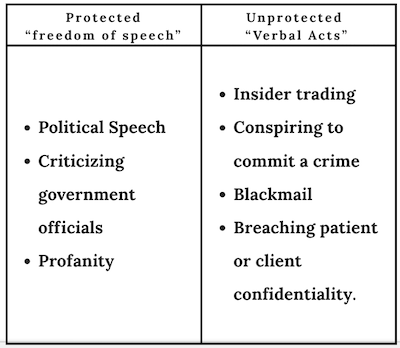
two column chart. The first column is titled "Protected "freedom of speech"" and in that column is listed 1) political speech, 2) criticizing government officials, 3) profanity. The second column is titled "Unprotected "Verbal Acts"" and below it is listed 1) insider trading, 2) conspiring to commit a crime, 3) blackmail, 4) breaching patient or client confidentiality

Classroom Exercise 3: Holmes Reconsiders

Content:
Overview & Primary Source: Abrams Pamphlet
Context
Holmes' Dissent Annotated
Group Questions
Conclusions and Key Takeaways

Overview:
If desired, you could assign the Abrams Pamphlet or the case dissent as homework reading. First, review the Context for yourself, then break students into groups for the activity.

  1. Have students read the Abrams dissent if they have not already.
  2. Have groups discuss the questions listed in the annotation.
  3. Provide students with information in the Context and Conclusion 

Jacob Abrams Pamphlet and Transcript
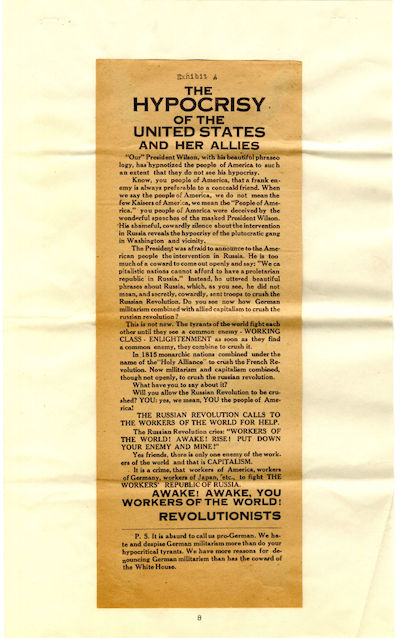
image of Jacob Abrams Pamphlet
“The Hypocrisy of the United States and her Allies,” August 1918, National Archives.

"THE HYPOCRISY OF THE UNITED STATES AND HER ALLIES

“Our” President Wilson, with his beautiful phraseology, has hypnotized the people of America to such an extent that they do not see his hypocrisy.
Know, you people of America, that a frank enemy is always preferable to a concealed friend. When we say the people of America, we do not mean the few Kaisers of America, we mean the “People of America.” You people of America were deceived by the wonderful speeches of the masked President Wilson. His shameful, cowardly silence about the intervention in Russia reveals the hypocrisy of the plutocratic gang in Washington and vicinity.
The President was afraid to announce to the American people the intervention in Russia. He is too much of a coward to come out openly and say: “We capitalistic nations cannot afford to have a proletarian republic in Russia.” Instead, he uttered beautiful phrases about Russia, which, as you see, he did not mean, and secretly, cowardly, sent troops to crush the Russian Revolution. Do you see now how German militarism combined with allied capitalism to crush the Russian revolution?
This is not new. The tyrants of the world fight each other until they see a common enemy — WORKING CLASS — ENLIGHTENMENT as soon as they find a common enemy, they combine to crush it.
In 1815 monarchic nations combined under the name of the “Holy Alliance” to crush the French Revolution. Now militarism and capitalism combined, though not openly, to crush the Russian revolution. What have you to say about it?
Will you allow the Russian Revolution to be crushed? YOU: yes, we mean, YOU the people of America!
THE RUSSIAN REVOLUTION CALLS TO THE WORKERS OF THE WORLD FOR HELP.
The Russian Revolution cries: “WORKERS OF THE WORLD! AWAKE! RISE! PUT DOWN YOUR ENEMY AND MINE!”
Yes friends, there is only one enemy of the workers of the world and that is CAPITALISM.
It is a crime, that workers of America, workers of Germany, workers of Japan, etc., to fight THE WORKERS’ REPUBLIC OF RUSSIA.
AWAKE! AWAKE, YOU WORKERS OF THE WORLD! REVOLUTIONISTS
P.S. It is absurd to call us pro-German. We hate and despise German militarism more than do your hypocritical tyrants. We have more reasons for denouncing German militarism than has the coward of the White House."

“The Hypocrisy of the United States and her Allies,” August 1918, National Archives


Context

  • In the fall of 1919, six months after the Schenck decision, another group of radicals appealed their conviction for wartime dissent. This time, the case concerned anarchists who had distributed a pamphlet calling for a general strike in New York City in an effort to prevent the production of war materials. They had been charged under a different section of the Espionage Act, one which made it illegal to interfere with wartime production.
  • In the Abrams case, seven of the justices simply applied the Schenck precedent from the spring and dismissed their appeal. As your class discussion might reveal, that seems sensible enough—if it had been illegal to advocate writing to a congressman, then calling for a general strike seemed even more of a “clear and present danger.”
  • But then Holmes did a surprising thing. Rather than applying his own precedent from only six months prior, he dissented – arguing that the anarchists had a First Amendment right to call for a general strike. What had happened?
  • Over the summer, Holmes’ decisions in the Schenck and Debs cases had been criticized by a newly emerging group of free speech advocates – intellectuals, lawyers and journalists that Holmes respected, and who were often friends. In particular, Harold Laski, a British-born academic teaching at Harvard and a close confidant of Holmes, waged a subtle influence campaign: sending Holmes reading material on the history and philosophy of free speech; arranging for Holmes to meet with a Harvard Law professor who had criticized the Debs decision. At the same time, Laski and other friends of Holmes at Harvard faced their own free speech crisis – they had spoken out in support of a strike of Boston police in 1919, and many were calling for them to be fired from the university.
  • These experiences changed Holmes’ mind about the value of free speech, and his dissent in Abrams reflected this new understanding. 


Holmes' Dissent Annotated:
Abrams v. U.S.​ Dissent
Persecution for the expressions of opinions seems to me perfectly logical. If you have no doubt of your premises or your power and want a certain result with all your heart you naturally express your wishes in law and sweep away all opposition. To allow opposition by speech seems to indicate that you think the speech impotent, as when a man says that he has squared the circle, or that you do not care whole-heartedly for the result, or that you doubt either your power or your premises. But when men have realized that time has upset many faiths, they may come to believe even more than they believe the very foundations of their own conduct that the ultimate good desired is better reached by free trade in ideas-that the best test of truth is the power of the thought to get itself accepted in the competition of the market, and that truth is the only ground upon which their wishes safely can be carried out. That at any rate is the theory of our Constitution. It is an experiment, as all life is an experiment. Every year if not every day we have to wager our salvation upon some prophecy based upon imperfect knowledge. While that experiment is part of our system I think that we should be eternally vigilant against attempts to check the expression of opinions that we loathe and believe to be fraught with death, unless they so imminently threaten immediate interference with the lawful and pressing purposes of the law that an immediate check is required to save the country."

  • The first thing to point to in this passage is that Holmes is not citing any cases. This is a sign that he is thinking more philosophically about what free speech should mean; and also that he is venturing into new territory, not covered by previous cases.
  • Classroom Discussion (Advanced Classes):
    • Does the role of judges only apply to already-existing law when deciding cases?
    • Or are judges creating law when they judge particular cases?
  • "If you have no doubt of your premises or your power and want a certain result with all your heart you naturally express your wishes in law and sweep away all opposition."
    • This sentence more or less sums up the approach Holmes took in the Schenck case six months prior - if you want to stop interference with the draft, why not ban speech that seeks to interfere with the draft?
  • "...ultimate good desired is better reached by free trade in ideas-..."
    • This is a crucial passage in the history of the First Amendment, where Holmes introduces the idea that there is a "Free trade in ideas" and that the best test of truth is whether it succeeds in the "competition of the market." While he doesn't use the exact phrase, this would come to be known as the "marketplace of ideas" - and the idea is closely related to his relativistic theory of truth: there are no guarantees that you can realize absolute truths, but the best method is to let all ideas be expressed, and see which becomes the most popular.
    • It is ironic that this defense of the free speech rights of radical socialists and anarchists is expressed in the language of the free market - for they were critics of the market. But Holmes had translated their calls for free speech into his own language, influenced by his reading of 19th century liberal philosophy.
  • "That at any rate is the theory of our Constitution..."
    • Holmes here warns us that there is no promise that truth will emerge from the competition of the market - you can't be sure that the best or most correct ideas will catch on.
    • But what it means to live in the American democracy, he says, is that you have to believe in that process of experimentation and trial and error, and that public opinion - even if based on imperfect knowledge - should be the guide to determining what is correct.
  • If it is true that the democratic experiment relies on the free formation of public opinion, Holmes suggests, then it is a dangerous thing to let governments block any expressions of opinion, even those we hate.


Compare Frameworks: Schenck & Abrams

Schenck:

  • Holmes says it is legitimate to police speech that might cause something you believe to be an evil.

Abrams:

  • Holmes warns against such censorship.
  • Censorship should be allowed only when it threatens "imminent" and "immediate" interference with a "pressing purpose."

Find the Abrams dissent here: Abrams v. United States (1919), National Constitution Center 


Group Questions:

  1.  Is the harm to the war effort here more or less severe than that in Schenck?
    1. In Schenck, the pamphlet asked people to write to their congresspeople to protest the draft; here the pamphlet calls for a general strike. Students should be able to see that a general strike would interfere with production more directly than a criticism of the war would interfere with the draft.
  2. Is the danger more "clear and present" in Abrams ​ or Schenck?
    1. Arguably, throwing leaflets out to workers is more direct than mailing them to soldiers or speaking to a picnic – you are directly addressing the audience you want to act, and asking them to act soon.
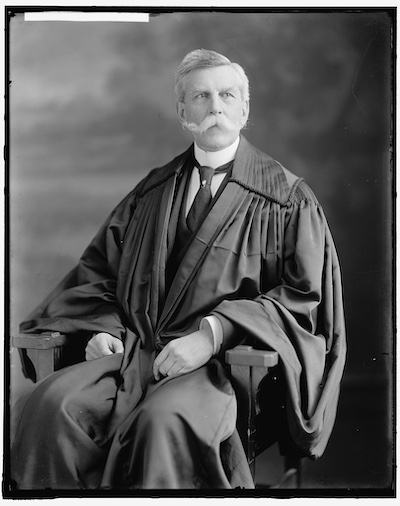
Portrait of Oliver W. Holmes in his judge robes. He has a large white handlebar mustache and is sitting in a chair.
“Holmes, Oliver W. Justice,” c. 1905-1945, Library of Congress 


Conclusions and Key Takeaways:

  • Holmes was not a radical, and he had no sympathy for the anarchists at the heart of the case – he thought they were advocating a “creed of ignorance and immaturity.” But he had come to believe that it was important to democracy to protect their rights to speech.
  • In the short-term, of course, that didn’t matter to the defendants in Abrams. A dissent doesn’t have any impact on the outcome of the case, which is determined by the majority decision – the anarchists were sent to jail, and later deported, for their pamphlet. But a dissenting opinion in a Supreme Court case also creates a record of the fact that some Justices disagreed with the opinion of the majority – and Holmes’s dissent in Abrams would become so famous and influential that it would end up becoming the legal consensus.
  • Over the twentieth century, Holmes’ dissent would guide the development of First Amendment law and philosophy, playing a crucial role in the rise of our contemporary right to free speech. Following from Holmes’ Abrams dissent, Americans today tend to speak of a “marketplace of ideas,” in which there is value to hearing from a diverse range of voices, even if you disagree with them, even if you think they might cause some harm you would prefer to avoid. But it wasn’t inevitable that this would be the way Americans came to think about the First Amendment.
  • It came out of a particular moment of history – the clashes between socialists and the government in World War I, the police strike at Harvard, and the influence of a small group of civil libertarians seeking to change the mind of one Supreme Court justice.


Optional Classroom or Homework Exercise:

  1. Ask students to identify a sort of speech today that they believe could be treated as a “verbal act” outside of the protection of the First Amendment.
  2. Ask them to make two arguments, one on either side of the question:
    1. If they had to make the case that it creates a “clear and present danger,” how would they do so?
    2. What are the benefits of protecting that speech as part of the marketplace of ideas? 

Remember: The goal here is not for students to necessarily decide on a complicated question, nor to correctly understand the current state of First Amendment law on these issues, but to practice applying the two different visions of free speech implicit in the Schenck decision and the Abrams dissent – one which focuses on regulating harms, the other on the democratic value of hearing all speech.
Free Speech Teaching Guide 4: Mandel v. Kleindienst (1972): Censorship via Visa

Article Body
This Teaching Guide is part of a series. Each of the four total teaching guides speaks to one aspect of the history of free speech. Although they work together to tell different parts of this history, it is not necessary to teach all of the guides or to teach them in a certain order. Each guide is a self-contained lesson.
(A PDF version of this teaching guide is also available for download-see left) 

Other guides in the series:
Free Speech Teaching Guide 1: The Birth of the Modern First Amendment: How Oliver Wendell Holmes Changed His Mind
Free Speech Teaching Guide 2: Brandenburg v. Ohio (1969): Defining and Arguing Hate Speech 
Free Speech Teaching Guide 3: The Problem of National Security Secrets

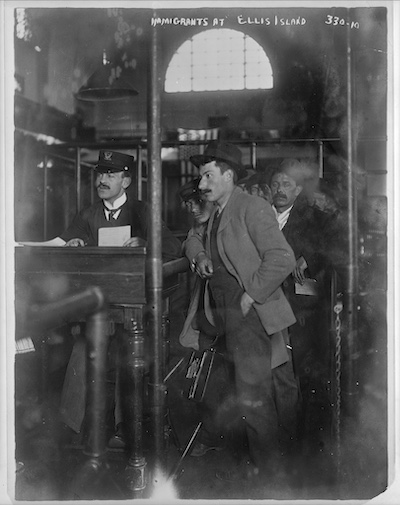
"Male Immigrants at Ellis Island." A man stands in line waiting while another man who works at Ellis Island handles his paperwork.

"Male Immigrants at Ellis Island," Library of Congress


Recommended for:

  • 11th Grade US History
  • 12th Grade US History
  • Undergraduate History

Table of Contents

Guide Introduction:
This introduction briefly previews the topics included in this guide that spans the twentieth century and ends with a 1972 Supreme Court Case.

Classroom Activities
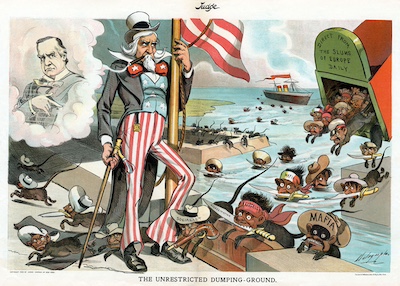
Exercise 1: "The unrestricted dumping-ground" (1903). A guided analysis of a 1903 political cartoon with annotations and questions. Why was immigration a heated debate in the early twentieth century?
Exercise 2: Who gets a Visa? A close reading of an excerpted 1984 article with guiding questions, notes, and class discussion options. Why deny visas?
Optional Exercise: Visa Waivers. Ask students to consider the more complicated reality of the visa law. How did waivers work and did they undermine political exclusion?

Framing Essay
Scholarly Context: How do visa laws and the First Amendment connect? An introduction to the Mandel Supreme Court case.
Annotated Decision: Notes on the Mandel SCOTUS decision for context or to help guide a close reading.
Key Takeaways: Concluding connections between immigration law and free speech law and prompts for class discussion.


Guide Introduction

        Throughout the 20th century, the U.S. government has denied visas to individuals because of their politics: anarchists in the early 20th century, communists in the Cold War, those it deemed advocates of terrorism in the 1990s and early 2000s. In the first half of 2025, the Second Trump Administration began seeking to deny visas to students and others engaged in pro-Palestinian advocacy during the war in Gaza.
        To be denied a visa means either that you can’t enter the country, or that you can be deported. Governments claim that this use of the visa regulations is simply a part of their control over immigration policy – they have a right to determine who can enter the country. Critics and civil liberties activists argue that it is a form of censorship, one that should be barred by the First Amendment. The relationship between visa laws and free speech was most closely examined in a 1972 case Mandel v. Kleindeinst. The case is also significant because it focused on a neglected aspect of the right to free speech – not the rights of the speakers to say what they want, but the rights of listeners and audiences to hear what they want.
        This guide traces the history of ideological visa denial to explore the intersection between immigration law and the right to free speech. It includes:

  1.  An overview of the history of visa denial in early 20th century, which allows students to assess historical fears of radical immigrants through the close reading of a political cartoon.
  2. A discussion of the denial of visas to communists and alleged radicals in the Cold War, through a classroom exercise and discussion of an excerpted newspaper article.
  3. An assessment of the role of the First Amendment in challenging visa restrictions through a close reading of a Supreme Court decision in 1972.


Classroom Exercise I: "the unrestricted dumping-ground" (1903)

Contents:
Overview
Annotated Cartoon
Questions for Students & Extended Context

Overview:
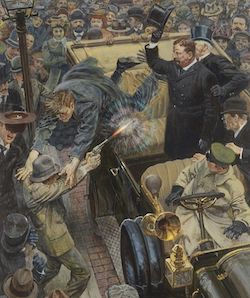
       The first efforts to exclude radicals from the United States came in 1903, when Congress passed a law barring anarchists from entering the country. This was a response to the assassination of President McKinley in 1901, which played into widespread anxieties that radical ideologies and crime were being brought to the country by immigrants. This 1903 cartoon captures the mood. The following pages include my annotations, as well as questions I use.

  1. Have students examine the cartoon individually or in groups.
  2. Invite students to share what they notice and ask more specific questions to guide conversation. This should mimic a close reading.
Political cartoon of uncle sam standing at a dock watching a shipping container dumping out immigrants who are depicted as animalistic. The ghost of president mckinley looks down on them

For the Printable Image See: linked source

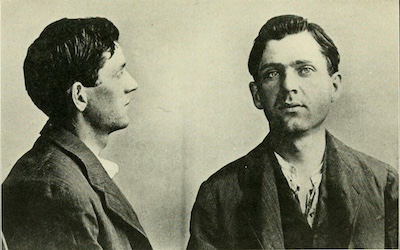
Leon Czolgosz mugshot

Image Source Here

Annotations:

  • McKinley assassination
    • McKinley (or McKinley’s ghost) is depicted in the top-left.
    • Leon Czolgosz, the gunman, was born in Detroit, but was the child of immigrants.
    • The cartoon, however, suggests the threat of anarchism is coming from immigrants, a widespread assumption at the time. “There is no such thing as an American anarchist,” said one newspaper column.
  • Both the container label “direct from the slums of Europe daily” and the title of the cartoon advocate for immigration restriction.
  • Depiction of Immigrants
    • McKinley and Uncle Sam are depicted as white, compared to the darker-skinned immigrants. At the time, most concern was about immigration from the south and east of Europe – groups that would later be considered white, but which were then treated as distinct races.
    • Immigrants are drawn to be animalistic, communicating an idea that they were less human and more threatening than white Americans.
  • Politics & crime:
    • Three migrants at the bottom are labeled “socialist,” “anarchist,” and “mafia,” associating socialists and anarchists with crime. The socialist carries a gun labelled “murder;” the anarchist a knife labelled “assassination,” further associating these political ideologies with violence.
    • There were radical leftists committed to political violence at the time. One wing of the anarchist movement, for instance, engaged in what it called “propaganda by the deed” – symbolic acts of political violence. Between 1880 and 1910, anarchists assassinated heads of state in Austria, Italy, Greece, France, Spain, Russia (twice), and Portugal – as well as McKinley in the U.S.
    • While many radical leftists rejected political violence, this cartoon suggests they were all criminals.

By the early Cold War, the bar on anarchists entering the country remained, and had been expanded to include Communists and advocates of communist revolution. The visa had also become a more powerful bureaucratic instrument. During World War I, for the first time the U.S. began requiring all visitors to the U.S. to receive a visa, which allowed a new degree of oversight and examination of applicants. A new Visa Division was created in the State Department to do this work.

Questions for Students:

  1. How are immigrants depicted?
  2. What is this cartoon arguing?
  3. Would immigration restriction be a useful remedy to the problems revealed by McKinley’s Assassination? What would have to be true for it to be effective for this purpose? What other remedies might be available?


Classroom Exercise II: Who gets a Visa?

Contents:
Overview
Excerpted Newspaper Article
Guiding Questions, Notes, & Class Discussion

Overview:
       A close reading of a later news article brings the topic of immigration and citizenship closer to the modern day for students. This exercise is centered around an excerpted 1984 newspaper article that discusses some individuals who were denied visas as well as efforts to reform the law. The article, like the cartoon in exercise 1, thus reveals some of the political dynamics involved.
        The next page includes some reading questions (as well as additional notes I might add), followed by a question for in-class discussion.

Excerpted Newspaper Article:
Kristin Helmore, “Would William Shakespeare get a Visa?” Christian Science Monitor, May 30, 1984.
       WALK into any bookstore in the United States and the works of Nobel Prize-winners Gabriel Garcia Marquez of Colombia and Pablo Neruda of Chile will be easily available. Anyone who wants to can buy Mexican novelist Carlos Fuentes's works or those of Italian writers Alberto Moravia and Dario Fo. And the titles of books by English novelist Graham Greene are almost household words in this country. Yet each of these acclaimed writers, and many others as well, has on at least one occasion been denied an entry visa to visit the United States.
        The law responsible for this policy is a section of the McCarran-Walter Immigration and Nationality Act of 1952, which some people would like to change. A bill has been introduced in Congress to do just that.
        ''Section 28,'' as it is called, empowers consular officials to refuse non-immigrant visas to foreigners who are or have been members of ''communist'' or ''anarchist'' organizations, as well as those who merely ''write, publish . . . circulate, display, or distribute . . . any written or printed matter advocating or teaching opposition to all organized government.'...
       The exclusion of writers from the US on ideological grounds can take place for a number of specific reasons. According to data collected by PEN, an international association of writers with offices in 55 countries, Gabriel Garcia Marquez was denied entry to the US from 1963 to '71 because of his affiliation with the leftist news agency La Prensa. Since that time, he has been granted entry only on presentation of a formal letter inviting him to a specific event. Last month, Mr. Garcia Marquez was denied entry into the US to speak at a meeting in New York on US policies in Latin America. Finally, in late April, he was granted a multiple-entry visa for one year.
        Pablo Neruda, the late Chilean poet and diplomat, was denied entry on the basis of his membership in the Chilean Communist Party. This ruling was waived on two occasions, in 1966 and '72, as a result of petitions put forward by PEN. ...
       Since 1961, Carlos Fuentes, the Mexican author and politician (who virtually grew up in Washington where his father was Mexican ambassador), has either been denied a visa to the US or issued restricted visas, even though he has been invited on numerous occasions to make public appearances under the auspices of respected institutions. He has received an honorary degree from Harvard University and was recently a visiting scholar at Princeton University. ...
        ''It's a scandal and a hateful thing for a democracy to perpetuate this kind of exclusionary policy,'' [novelist William] Styron said. ''It allows the United States to be branded as a bigoted nation filled with hysteria about communism.'
        Both Arthur Miller and John Irving raised the specter of McCarthyism. ''I doubt strongly that this law could have been passed before 1952, the wildest time of McCarthyism . . . but it's hung on the books because most people aren't aware of it,'' Mr. Miller said.
        ''I hope it's clear that we would improve our national character by ridding ourselves of these vestiges of McCarthyism which shame us today,'' Mr. Irving said.
        Carolyn Forche remarked, ''I am puzzled as to why my government is afraid of a free exchange of ideas. I would hope that my country and its institutions are strong enough to endure freedom of expression.' ...
        Support for the existing law was recently expressed on ABC's ''Nightline'' by Roy Cohn, counsel in the early 1950s to the Senate's Permanent Investigations Subcommittee headed by the late Joseph R. McCarthy: ''This law is aimed at people who present a threat to national security. Under various circumstances they should not be let in. They have access to courts where their visa denial can be overruled.' ….
        Opposition to Section 28 of the McCarran-Walter Act has a long history. In 1952, President Harry S. Truman vetoed the act, remarking, ''Seldom has a bill exhibited the distrust evidenced here for aliens and citizens alike.'
        Congress overrode Mr. Truman's veto."

Guiding Questions, Notes & Class Discussion:

  1. Who are some individuals who have been denied visas?
    1. Besides those named in the article, some famous individuals (though perhaps not famous to students today) include Charlie Chaplin, Pablo Picasso, Dorris Lessing, Nazim Hikmet, Czeslaw Milosz, C.L.R. James.
  2. What law was used to deny their visas?
    1. The 1952 Immigration and Nationality Act consolidated all previous immigration laws – including the Anarchist Exclusion Act of 1903 and an Internal Security Act of 1950.
    2. It was passed over Truman’s veto – a place to discuss the veto power with students if you think appropriate.
  3. Why do civil liberties groups want to reform the law?
    1. Beyond discussions of the impact of the law on the individuals involved, I make sure to draw student attention to William Styron’s argument that the law makes America look bigoted and intolerant.
  4. Why does Roy Cohn say we need such a law?
    1. How does this perspective complicate or affirm students’ thoughts on this debate?


Class Discussion:

  • Do students think denying visas under this law is a good or a bad thing?
  • Do they agree that there are national security grounds under which someone should be denied entry to the country? Do those grounds extend to political beliefs?
    • If you have used the other Free Speech Teaching Guides that cover Schenk v. US and Brandenburg v. Ohio, this is an opportunity to discuss what "harm" the law is intended to prevent.


Optional Exercise: Visa Waivers

        The visa law had a waiver process. If you were denied a visa because you were a member of a communist party, the Attorney-General could issue a “waiver” – letting you into the country just this time.

If students are opposed to the law, you can ask them if this waiver process is enough to satisfy them?

        There was some dispute over how frequently this process was delayed, and how many waivers were granted. But many were granted waivers. However, an additional concern was that the Attorney-General could attach conditions to the waiver – saying visitors could not travel to certain areas, or engage in certain types of activities. (we will see an example of these conditions in the Mandel case).


Framing Essay

Scholarly Context:
       How did these visa laws intersect with the First Amendment? They are clearly a form of punishment for political speech. As early as 1903, an anarchist being deported under the anarchist exclusion law claimed that his First Amendment rights were being violated. The Supreme Court ruled that foreigners could not claim First Amendment rights to stay in the country. As we discussed in the guide, Schenk v. U.S. (1919): The Birth of the Modern First Amendment, this was typical of the narrow way that the Supreme Court protected First Amendment rights before the mid-twentieth century. And in 1945, in a case concerning an attempt to deport an Australian labor leader, the Supreme Court said that noncitizens in the U.S. have the same First Amendment rights as citizens. Of course, in the early 1950s, American citizens didn’t have the right to advocate for Communism, and so many communists were deported in the McCarthy period, just as many Americans citizens were jailed. Today, the standards would be different.
Find the text of the First Amendment Here

       But what about the rights of the foreigner to enter the country? Here, courts have rejected the notion that foreigners can claim a First Amendment right to come into the U.S. if the U.S. has a law that would exclude them. The Supreme Court has ruled that the right to determine who can and can’t enter the country is what it calls the “Plenary Power” – part of what it means to be a government of a nation-state is the right to choose who can enter the country, and no court can interfere with those decisions.
        That has meant that foreigners can’t claim a First Amendment right to enter the country (they can claim such a right if they are being deported after entering, though the law is complex in this area.) But in the late 1960s, a group of university professors tried a different strategy to challenge the visa laws. They had invited Ernest Mandel, a Belgian Marxist theorist, to come to their campuses to give talks and engage in debates. Mandel was denied a visa because he advocated world communism.

Note (if you discussed the waiver program earlier):
       Mandel had been given waivers to enter the country in 1962 and 1968. But in 1969 he was denied a waiver. This was because 1) in 1968 he spoke at more universities than his waiver granted, and 2) after one of these talks, students auctioned posters to send money to French protestors – which violated a condition attached to Mandel’s waiver that he not speak at events where funds were raised for political causes. Mandel had not been told that these conditions were attached to his waiver. This can be a place to return to your discussion of the waiver program, to see if these details change or reinforce students’ earlier attitudes.

Annotated Decision:
       Mandel, as a foreigner, couldn’t claim his First Amendment rights were violated by his exclusion from the country. But the university professors argued that their rights were violated by his exclusion from the country – they wanted to listen to him, to talk to him, to meet with him. A lower court agreed with them, ruling that Mandel’s exclusion violated the First Amendment. The government appealed to the Supreme Court, which ruled 6-3 that Mandel’s exclusion was constitutional. Here’s what the Supreme Court said, along with some notes I use to teach the decision:

The decision text:
"The case…comes down to the narrow issue whether the First Amendment confers upon the appellee professors, because they wish to hear, speak, and debate with Mandel in person, the ability to determine that Mandel should be permitted to enter the country or, in other words, to compel the Attorney General to allow Mandel's admission. ….
The Government also suggests that the First Amendment is inapplicable because appellees have free access to Mandel's ideas through his books and speeches, and because 'technological developments,' such as tapes or telephone hook-ups, readily supplant his physical presence. This argument overlooks what may be particular qualities inherent in sustained, face-to-face debate, discussion and questioning. While alternative means of access to Mandel's ideas might be a relevant factor were we called upon to balance First Amendment rights against governmental regulatory interests—a balance we find unnecessary here in light of the discussion that follows in Part V—we are loath to hold on this record that existence of other alternatives extinguishes altogether any constitutional interest on the part of the appellees in this particular form of access."
Recognition that First Amendment rights are implicated, however, is not dispositive of our inquiry here. In accord with ancient principles of the international law of nation-states, the Court in The Chinese Exclusion Case 1889, and in Fong Yue Ting v. United States (1893), held broadly…that the power to exclude aliens is 'inherent in sovereignty, necessary for maintaining normal international relations and defending the country against foreign encroachments and dangers—a power to be exercised exclusively by the political branches of government.' ...

In summary, plenary congressional power to make policies and rules for exclusion of aliens has long been firmly established. In the case of an alien excludable under § 212(a)(28), Congress has delegated conditional exercise of this power to the Executive. We hold that when the Executive exercises this power negatively on the basis of a facially legitimate and bona fide reason, the courts will neither look behind the exercise of that discretion, nor test it by balancing its justification against the First Amendment interests of those who seek personal communication with the applicant. What First Amendment or other grounds may be available for attacking exercise of discretion for which no justification whatsoever is advanced is a question we neither address or decide in this case.

Annotations:

  • ["This argument overlooks what may be particular qualities inherent in sustained, face-to-face debate, discussion and questioning."]
    • The Government was claiming that the professors could speak to Mandel just as easily by telephone, and so his presence was not necessary. The court is skeptical of this claim.
      • In the era of zoom, do students think there is any benefit to in-person conversation? or is online discussion good enough?
  • ["Recognition that First Amendment rights are implicated..."]
    • The Supreme Court concedes here that there is a First Amendment right to hear Mandel. There are a number of other cases in the period which emphasize that the right to speak matters not for the speaker, but for the audience - that the First Amendment is important for its role in preserving a broader culture of debate and exchange.
    • Many students will think only about the rights of the speaker, so this is an important place to slow down and demonstrate how many more rights are involved.
  • ["The Chinese Exclusion Case 1889, and in Fong Yue Ting v. United States (1893)..."]
    • These are important late nineteenth century cases which established the Plenary Power. Congress passed the Chinese Exclusion Act in 1882, barring Chinese entry to the country. In these legal cases, courts said that they could not overrule political decisions made by Congress as to who could enter the country.
  • ["facially legitimate and bona fide reason..."]
    • This is a very deferential standard. In other first amendment cases, the Supreme Court has carefully scrutinized the government's rationale for a law, to make sure it isn't a cover for political discrimination. But here, the court says explicitly that if the government offers a justification that seems reasonable, the courts will not look any closer, or consider the First Amendment.
    • In dissent, Justice Marshall was very critical of this approach:
      • "I do not understand the source of this unusual standard. Merely 'legitimate' governmental interests cannot override constitutional rights. Moreover, the majority demands only 'facial' legitimacy and good faith, by which it means that this Court will never 'look behind' any reason the Attorney General gives. No citation is given for this kind of unprecedented deference to the Executive nor can I imagine (nor am I told) the slightest justification for such a rule."
  • ["What First Amendment or other grounds may be available for attacking exercise of..."]
    • This is an ambiguous final sentence, which can be used to help students understand the difficulty in working out how much precedent a given case is setting.
    • This sentence seems to leave open the possibility that there are some instances of visa denial which would raise First Amendment concerns - those in "which no justification whatsoever is advanced." But under what circumstances would a justification fail to be "facially legitimate and bona fide"?
    • The Court has never revisited the visa denial process, so the meaning of these sentences remains unresolved.

Key Takeaways:

  • Visa denial is at the crossroads of two discrete fields of the law: immigration law and free speech law.
    • In immigration law, courts have been very deferential to the power of the government to decide who can enter the country; in free speech law, courts have been very skeptical of government claims that it needs to regulate debate and discussion.

Do students think cases like Mandel’s – or more recent cases, if there have been some in the news – are better treated as First Amendment or immigration cases? Or do they think that these two areas of the law should be combined?

  • This can be an interesting place to leave the class discussion – asking students both to consider their own values in this complex area, and also to show them how the answers to legal questions are often shaped by the ways that courts and lawyers sort them into different doctrinal domains.

Incorporating 20th Century US Environmental History in the 6-12 Classroom

Article Body

Introduction: How to Use this Guide

Organization

  • Sources are sorted into four thematic sections, arranged chronologically.
  • Each section begins with an overview and index of sources.
  • Primary sources are curated alongside questions, videos, and podcasts to help contextualize each source.

Links

  • Many sources are linked to their hosting websites (external to this site).


Environmentalism in the Progressive Era & WWI (c. 1890-1920)

Overview

The primary source documents and videos in this section illustrate the growing environmental ethos evident in the early twentieth century, from the Progressive Era through Wold War I.

The Progressive Era, spanning roughly from 1890-1920, can be understood as a period of reform movements formed in response to rapid industrialization, urbanization, and commercialization. Among these reform movements were two early environmental movements known as preservationism and conservationism. Preservationists believed that natural landscapes should be left exactly as they were, and conservationists sought to maintain natural resources in order for them to be best used and enjoyed. John Muir was known as the most prominent preservationist, whereas Gifford Pinchot was known as the most prominent conservationist.

This growing environmental ethos continued into World War I, as Americans conserved and rationed resources in order to support the war effort. Through their participation in garden clubs and local victory gardens, American women and children on the home front used agricultural practices to support soldiers abroad.

The sources in this section exemplify the many perspectives among Americans fostering connections to the environment in the early twentieth century.

Sources

  • Essay: Gifford Pinchot, 1890 (Excerpt) 
    • 6-12 Video: Mira Lloyd Dock: A Beautiful Crusade
  • Legislative Summary of the Bill to Establish the National Park Service, 1916
    • 6-12 Video: Brigadier General Charles Young
  • “Everybody Plant a Garden,” Richmond Times-Dispatch, April 22, 1917
  • “Yule Exhibits in Portsmouth,” Virginian-Pilot, December 11, 1941
  • Will you have a part in Victory? 1918 Poster
  • The Gardens of Victory, Poster
    • Victory Gardens Video


Excerpt: Gifford Pincho Essay, 1890

Link: https://dp.la/primary-source-sets/environmental-preservation-in-the-progressive-era/sources/919


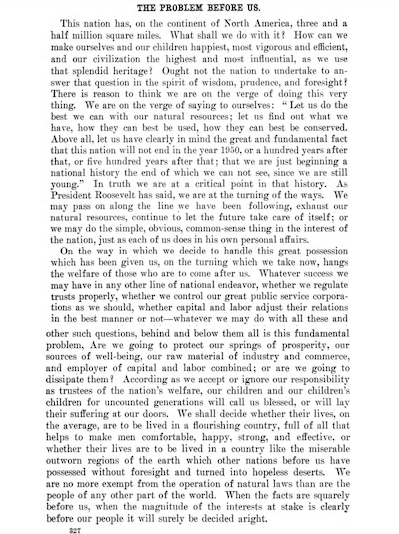
Excerpt from essay on pg 327

Background:

  • Gifford Pinchot (1865-1946) was known as the “father of American forestry.”
  • He was an influential Progressive Era conservationist who advocated for the protection of natural resources in the United States.
  • This 1908 Essay discusses issues of deforestation, the over-extraction of coal and other minerals, and the negative effects of monopolies on natural resources.
  • Pinchot calls for a “New Point of View” regarding the environment, and he appeals to doing so for future generations and the United States as a nation.

Discussion Questions: 

  • Which natural resources do you think Pinchot is referring to?
  • What might Pinchot mean by a “critical point” in history?
  • In what ways might this relate to industrialization?

Extension Video:

Mira Lloyd Dock: A Beautiful Crusade (Link to Web)

Annotation/Discussion Questions:

  • How might Dock’s experiences growing up in an industrializing city influenced her career trajectory?
  • What were some of the environmental hazards
    Harrisburg faced due to industrialization?
  • What were some of the argument Dock made for cleaning up Harrisburg? How might her trip to Europe have influenced her arguments?
  • How might public parks have helped industrializing cities?
  • How might Harrisburg’s city beautiful movement have influenced movements in other cities, as well as city parks in our own time?


1916 Congressional bill to establish the National Park Service & NPS Video

Link: https://dp.la/primary-source-sets/environmental-preservation-in-the-progressive-era/sources/913

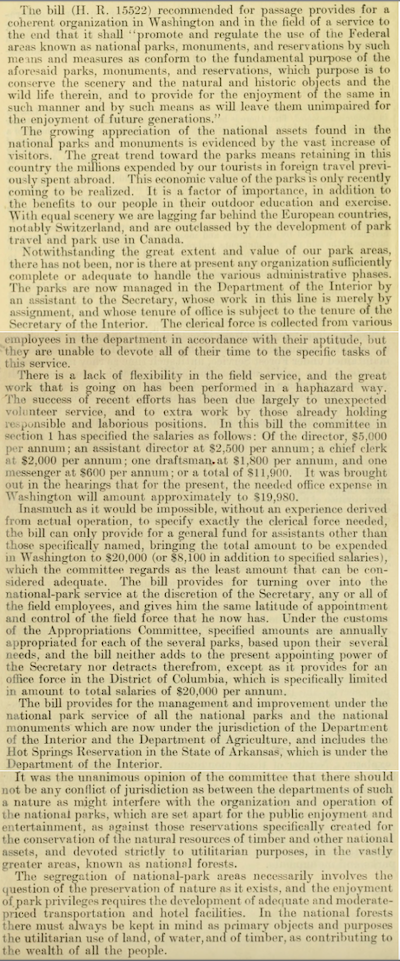
1916 Congressional bill to establish the NPS

Background:

  • President Woodrow Wilson established the NPS
    into law through the 1916 “Organic Act.”
  • Congress proposed a bill to establish the NPS in response to the growing national ethos toward conservation coming out of the Progressive Era.
  • This Congressional report summarizes the bill,
    highlighting the utility behind the creation of the
    NPS under the Secretary of the Interior.

Annotation/Discussion Questions:

  • In the first paragraph, the report summarizes the main purposes behind the foundation
    of the National Park Service. What are they?
  • Which department will manage the NPS? Why do you think Progressive Era Americans wanted the federal government to oversee parks? How might this fit into broader Progressive Era reforms?
  • How does Congress distinguish the difference between the National Parks and the National Forests?

Extension Video:

Brigadier General Charles Young Link: https://home.nps.gov/seki/learn/historyculture/young.htm

Background:

  • First Black National Park Super Intendant of Sequoia National Park
  • Prolific military career despite segregation of US armed forces

Link to Supplementary Lesson Plan, NPS: https://home.nps.gov/articles/000/-h-our-history-lesson-fit-for-service-colonel-charles-young-s-protest-ride.htm


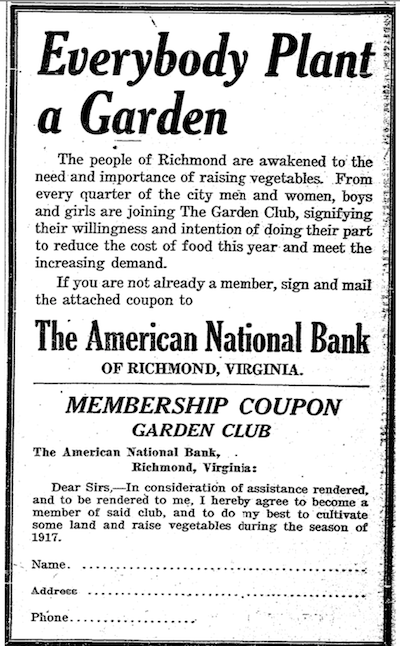
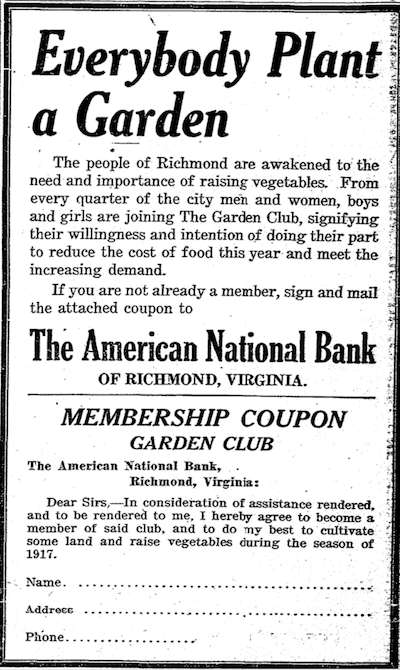
"Everybody Plant a Garden," Richmond Times-Dispatch, April 22, 1917

Everybody Plant a Garden Newspaper article


Annotation:

  • As a newspaper, this was intended for a wide audience and was published just weeks after the US declared war on Germany during WWI. Victory Gardens were encouraged as a way to help with food shortages and rations during the war. Gardening also gave people something to do and a way to participate that would ease anxieties about the war, food, and the threat of inflation.
  • While Garden Clubs were primarily run by women, men and children were also encouraged to join so the whole family could be involved.
  • War took millions of men away from their jobs which included agriculture and transportation. Imports of goods from other countries including fertilizer also slowed or stopped. With decreased home grown food and decreased imports of foreign food, shortages occurred  which caused increased prices and hoarding.
  • The bank invested in the Garden Club in support of the war effort and the local economy.

Discussion Questions:

  • Why might the Bank sponsor a Garden Club? For what reasons might the government have encouraged victory gardens?
  • What benefits do you think victory gardens provided?
  • What do you need to start a Victory Garden? Can everyone do it? (knowledge, tools)


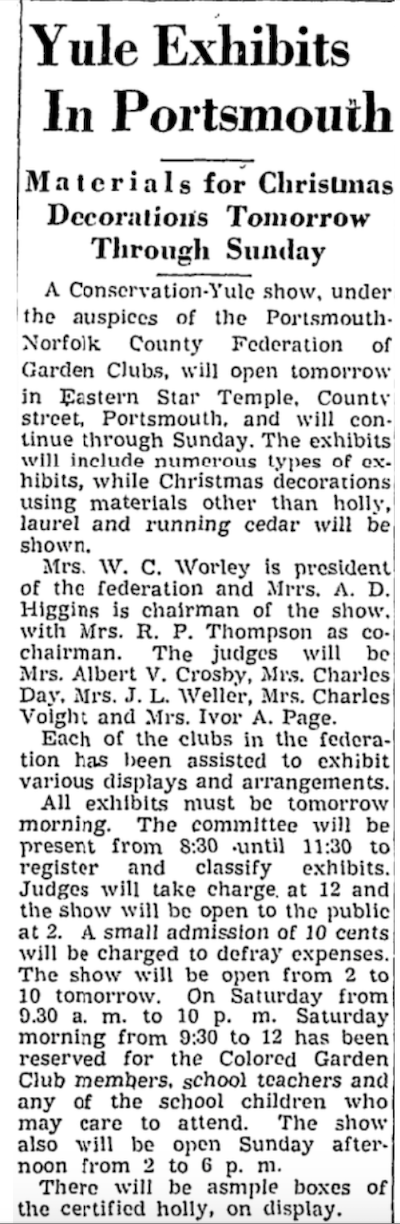
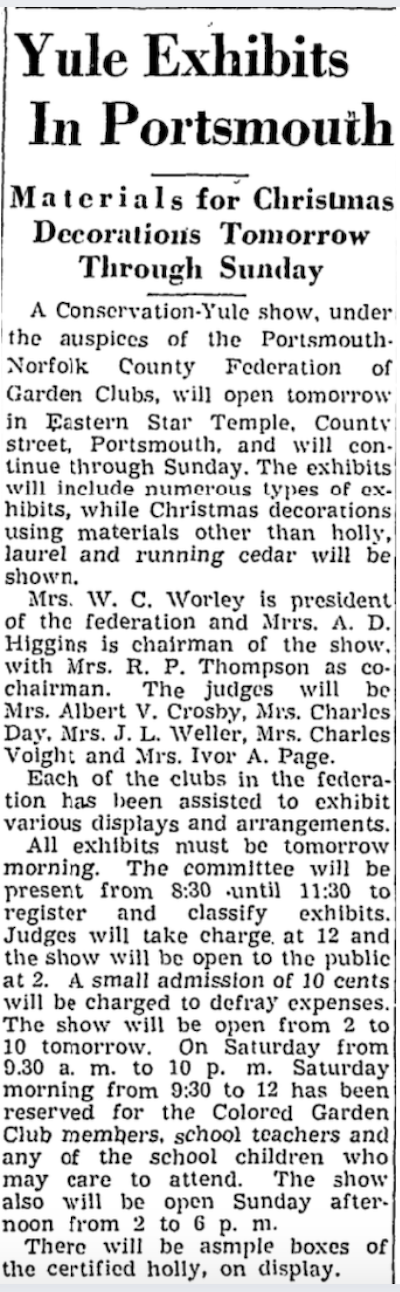
"Yule Exhibits in Portsmouth," Virginian-Pilot, December 11, 1941

Yule Exhibits in Portsmouth Newspaper Article

Annotation:

  • As a newspaper, this was intended for a wide public audience. The date reveals that this Yule Exhibit was held the weekend after the attack on Pearl Harbor.
  • A Federation of Garden Clubs through the County indicates that Garden club work was important to the government. Even on the local level, there was institutional support of the war effort.
  • This exhibit attempted to make conservation interesting
    to a wide audience by connecting it to Christmas, and
    hoped to encourage families to reduce waste and decorate using recycled materials at home. Reducing
    waste was important during war time when money and
    resources were scarce.
  • All of the club’s leaders were women which shows that
    conservation was seen as a “women’s activity.” Garden
    Clubs provided women leadership opportunities. Also note that they were all listed by their husbands’ names.
  • Garden Clubs were often made exclusive to only wealthy
    white women. This article shows that in spite of
    segregation, Black women organized their own Garden
    Clubs and advocated for conservation.

Extension Videos:

Smithsonian Gardens: https://www.youtube.com/watch?v=TtrlcLslK5w

Discussion Questions:

  • How might Garden Clubs connect to politics?
  • Why was gardening an “acceptable” way for women to become activists and professionals?
  • What were gender roles of the time? How did this work stay within or reject them?


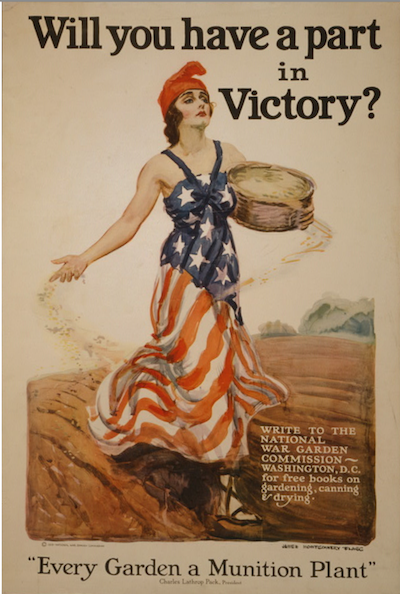
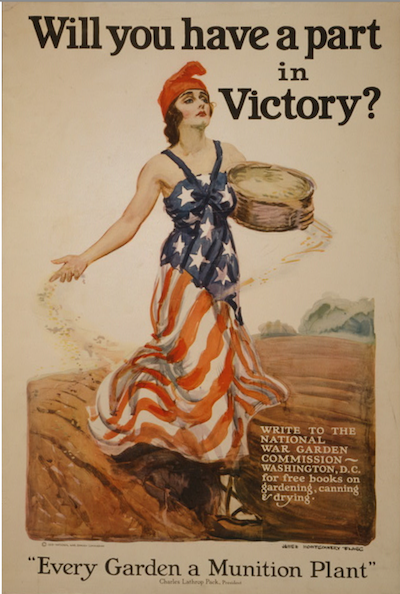
Will you have a part in Victory? 1918

Link: https://www.loc.gov/item/2002712327/

Will you have a part in victory? painting of woman dressed in american flag tossing seeds into a field.

Annotation:

  • This was published by the National War Garden Commission, a temporary department created to encourage gardening during WWI.
  • Dressed in the American flag, this woman, beautiful and innocent looking, represents the country. She appears delicate and yet powerful, but ultimately worthy of
    protection. She walks with a purpose and sows seeds that presumably will allow the nation to win the war. This imagery is often used for America or American ideals (think Statue of Liberty). The image conjures an emotional attachment to the nation, but also inspires women to join her in the garden or farm fields.
  • “Every Garden a Munition Plant” communicates that growing food is just as important as manufacturing guns and ammunition.

Discussion Questions:

  • How is this similar to or different
    from other propaganda images?
  • Why might America be depicted in
    this way? Where have we seen
    something similar?
  • Why do you think the painting/image
    was made to look this way?
  • Who is the audience for this image?


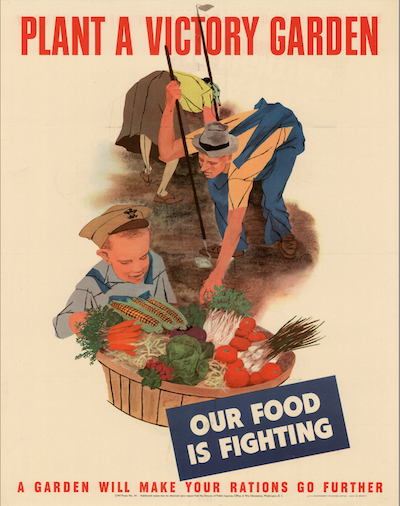
The Gardens of Victory

Gardens of Victory Video

Link: https://www.youtube.com/watch?v=uBg1ND5X3tA

poster showing a family working in a garden with a basket full of vegetables they grew

Annotation:

  • This film was made by the United States Office of Civil Defense. It shows the wartime need for vegetable gardens. It advertises that people can get instructions from the government on how to plant a successful garden. The film also says that people benefit from being in the sun and feeling involved in the war effort.
  • In both of these sources, every member of the family is shown participating in the garden. The poster is not just focused on a wife or mother, in fact she is in the back. This family also does not appear to be wealthy which suggests Victory Gardening is for everyone.
  • “Our food is fighting,” is similar to the WWI Poster that said “Every Garden, a Munitions Plant.” Food is seen as just important as military material and action.

Discussion Questions:

  • Do you think this video would have been helpful to people? Why?
  • What are some of the benefits victory gardens provided?
  • How is this poster similar to or different from other propaganda images?
  • Do you see any similarities or differences between these sources and victory garden material from WWI?


The Great Depression & The New Deal (c.1929-1945)

Overview

The sources in this section chronicle the environmental aspects of the Great Depression and the New Deal. This period can be studied for both its environmental disaster and federal initiatives toward conservation and reforestation.

In the early 1930s, as the Great Depression wreaked havoc on the economy, the Dust Bowl hit in the Great Plains and the eastern US. The Dust Bowl became known as the largest human caused environmental disaster in US history and is largely attributed to the poor use of agricultural lands as well that were intensified by a long drought in the region. The disaster would lead to mass migration from the Great Plains to Wester states, including California. Primary source photographs, an interview, and a PBS video illustrate the toll the Dust Bowl had on the environment and the people living there.

President Franklin Roosevelt’s New Deal ushered in a series of federally funded programs to alleviate financial burdens of the Great Depression, while also focusing on environmental projects. Notably, the Civilian Conservation Corps (CCC) employed young men to work on conservation initiatives and reforestation projects. Their work would benefit the National Park Service, as well as State Parks around the country.

Sources

  • The Dust Bowl & The Great Depression
    • Photo: Arthur Rothstein, “Abandoned farm in the dust bowl area, Oklahoma,” April 1936, Farm Security Administration.
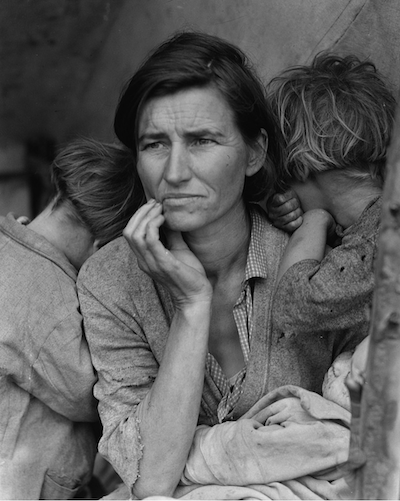
    • Photo: Dorothea Lange, “Migrant Mother: Birth of an Icon,” Nipomo, 1936.
    • Video: A Man-Made Ecological Disaster
    • Interview with Flora Robertson, 1940
  • Civilian Conservation Corps & the New Deal
    • Video: Zion National Park Ranger Minute
    • NPS, Civilian Conservation Corps Article
    • Video: Civilian Conservation Corps | Oregon Experience, Oregon Public Broadcasting


The Dust Bowl and the Great Depression

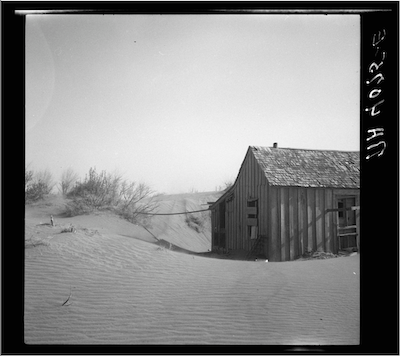
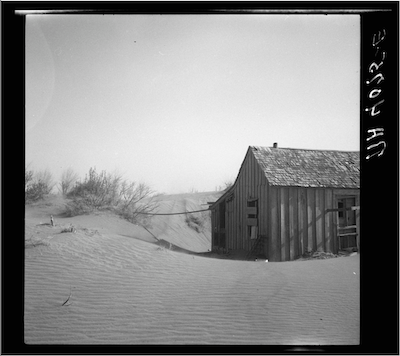
“Abandoned farm in the dust bowl area, Oklahoma. ” Photographed by Arthur Rothstein of the Farm Security Administration April 1936, Library of Congress.
“Abandoned farm in the dust bowl area, Oklahoma.”
Photographed by Arthur Rothstein of the Farm Security Administration April 1936, Library of Congress.
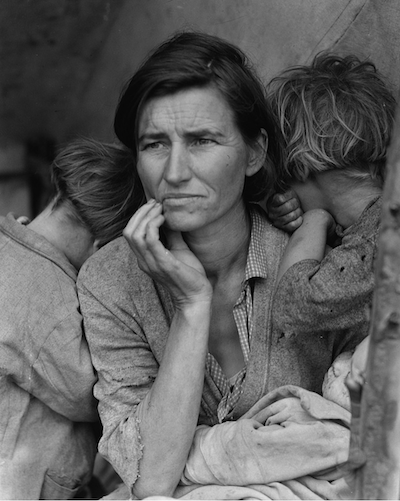
Dorothea Lange, “Migrant Mother: Birth of an Icon,” Nipomo, 1936, Oakland Museum of California.
Dorothea Lange,“Migrant Mother: Birth of an Icon,” Nipomo, 1936, Oakland Museum of California.

Background:

  • In the early 1930s, extreme drought hit the Great Plains. For decades, farmers in the region had been over-plowing and depleting the soil through a lack of crop rotation.
  • The drought, combined with high winds, caused massive
    dust storms that blew across the plains, further stripping topsoil.
  • Along with environmental damage, the Dust Bowl caused
    further economic hardship and health issues.
  • The Dust Bowl would also cause a mass migration of
    farmers out of states like Oklahoma, Texas, and Arkansas
    and to California as they searched for better opportunities.

Discussion Questions:

  • Describe what you see in the photo.
  • Read the caption:
    • Who took this photo and when?
    • Where is this located?
    • Why do you think this photo was taken?
    • Why might this photo have historical significance?
  • Taken together, how do these two photographs provide different perspectives of the Dust Bowl and the Great Depression (eg. environmental, migration, childhood)

Extension Videos:

A Man-Made Ecological Disaster

Link: https://www.pbslearningmedia.org/resource/ecological-disaster-ken-burns-dust-bowl/ken-burns-the-dust-bowl/

Interview with Flora Robertson, 1940

Link: https://history.iowa.gov/history/education/educator-resources/primary-source-sets/dust-bowl/interview-flora-robertson-about

Discussion Questions:

  • When was this interview recorded and where is Flora located?
  • How did Flora take to protect her from the dust storms?
  • Why might Flora have waited to move to California?
  • How does a personal account of the Dust Bowl add to your understanding of what happened?


Segregation and Jim Crow in the Environment

Overview

In the early twentieth century, Jim Crow segregation relegated Black Americans to separate and often unequal environmental spaces. In spite of this, Black Americans had robust relationships to the environment through recreation, and commercial or personal ownership.

The sources in this section highlight the specific ways outdoor spaces were segregated through law and social custom. The sources also reveal how Black Americans maintained connection to the outdoors despite the segregation they actively fought, creating spaces of joy and environmental connection for their communities. By exploring these not so distant stories, students will also be able to consider what effects of environmental segregation and racism are still present today.

Sources

  • Ownership and Segregation of Beaches
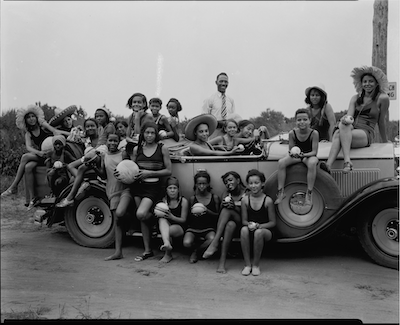
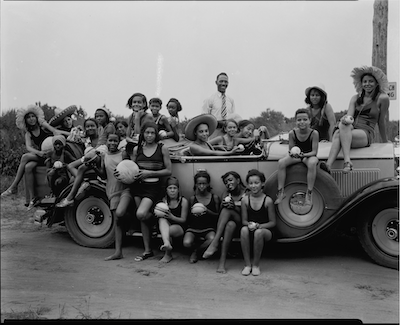
    • Photo: “YWCA camp for girls. Highland Beach, Maryland,”
      1930, Scurlock Studio Records, Box 41, Archives Center,
      Smithsonian National Museum of American History.
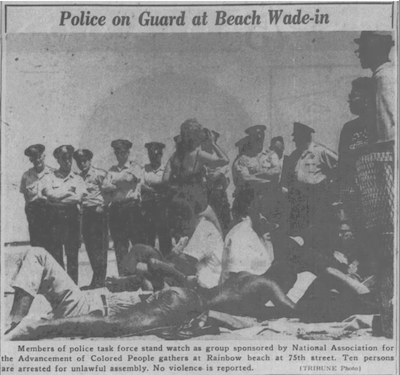
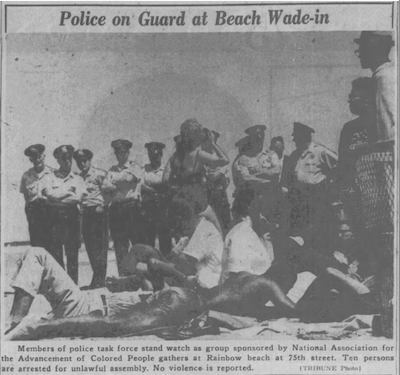
    • Newspaper: “Police on Guard at Wade-In,” Chicago Tribune, July 9, 1961
    • Video: “Five Minute Histories: Carr’s Beach,” Baltimore Heritage, August 25, 2023.
  • “African Americans and the Great Outdoors,” National Park Service, Digital Project and Map

Ownership and Segregation of Beaches

YWCA camp for girls. Highland Beach, Maryland, 1930, Smithsonian National Museum of American History.
YWCA camp for girls. Highland Beach, Maryland, 1930,
Smithsonian National Museum of American History. https://sova.si.edu/search/ark:/65665/ep80096b07bf0a64bfb9fd5ec70b4dd9cc6


Annotation:

  • Incorporated in 1922, Highland Beach was the first African American municipality in Maryland. It was also the first African American Summer Resort in the Country.
  • Many very wealthy African Americans including Mary Church Terrell and Charles Douglass.
  • In the late 1800s and early 1900s, most beaches and coastal properties were owned by Black people, particularly formerly enslaved folks and their descendants because the weather and sandy soil made the land less valuable. In the 20th century, predatory white land developers started trying to take these properties and monetize them as segregated beaches and resorts.
  • The car and clothing hint at when this was taken, and reveal the presence of Black people in outdoor spaces, specifically beaches, long before desegregation.
  • This photo is of a YWCA camp for girls. Recreation, specifically in the outdoors, was not limited to just boys.
Chicago Tribune, July 9, 1961.

Annotation:

  • Wade-ins were just like sit-in protests happening at lunch counters during the civil rights movement. Instead of sitting down in restaurants, activists were visiting the beach and swimming in the ocean.
  • Many of the beaches where wade-ins occurred, including Rainbow Beach, were not legally segregated, but were “segregated by custom,” meaning that only white people had been welcome there for many years, they were dangerous places for Black people to go.
  • Wade-ins advocated for integration. Many communities ended up getting designated Black beaches rather than equal access to all beaches.
  • The police are facing the group of protestors. This stance indicates that the protestors were seen as the threat of violence rather than the racist mob.
  • Although no violence was reported, ten people were arrested for “unlawful assembly.” This charge is meant for people who enter a space illegally or who threaten public safety. Since there was no legal segregation of Rainbow Beach, neither one of these things was the case.

Discussion Questions:

  • What or who do you see in these photos?
  • When do you think these photos were taken?
  • Why do you think the photos were taken?
  • Did anything in the photos surprise you?
  • What questions do you have for the photos?


The Environmental Movements of the 1960s and 1970s

Overview

By the 1960s, decades of industrialization, resource over-extraction, and use of harmful chemicals had taken a noticeable environmental toll. The sources in this section explore the environmental movements of the 1960s and 1970s and pieces of federal legislation passed in response to the growing popular movement to protect the environment.

By the early 1960s and 1970s, what had been a burgeoning environmental movement grew into the mainstream as activists and scholars alike noticed an intensifying environmental crisis. Some key issues included deforestation, air and water pollution, and species extinction. A few key moments in this growing environmental movement include: the fight against DDT, made popular by Rachel Carson’s Silent Spring; the first Earth Day in 1970; and the American Indian Movement’s March to Wounded Knee in 1973. Important pieces of legislation include the Wilderness Act (1964), Clean Air Act (1970), the Endangered Species Act (1973).

Sources

  • "DDT is good for me-e-e," Advertisement, Time Magazine, June 30, 1947
    • Podcast: "DDT: The Britney Spears of Chemicals"
  • Rachel Carson, Silent Spring, excerpts
    • American Experience: Rachel Carson Video
  • Earth Day and March to Wounded Knee
    • Walter Cronkite, Earth Day CBS News Broadcast, April 22, 1970
    • "World Pilgrimage: Wounded Knee," Poster, April 22, 1970
    • Podcast: Throughline, "The Force of Nature"
    • Video: PBS, "The American Indian Movement and Wounded Knee"
  • Environmental Movement: Legislation
    • Complete Text of the Wilderness Act (Teaching Version)
    • Endangered Species Act of 1973
    • Video: PBS Learning Media, "Birth of the Clean Air Act"
    • Video: US Fish and Wildlife Service, Endangered Species Act 101

"DDT is good for me-e-e," Advertisement, Time Magazine, June 30, 1947 

DDT Poster by the Penn Salt Chemicals Manufacturing Company. Poster touts the many beneficial uses of DDT.

(see https://digital.sciencehistory.org/works/1831ck18w)

Background

  • Created by the Penn Salt Chemicals company
  • Published in Time Magazine, June 1947
  • Touts the multiple uses and benefits of DDT for different audiences, including commercial farmers and in the home.
  • Dichloro-diphenyl-trichloroethane (DDT) was developed in the late nineteenth century, but became commercially available by the 1940s.
  • The US military initially used DDT to stop the spread of diseases, like malaria, that spread through insects.
  • DDT became commercially available in the 1940s as a pesticide that everyday Americans and famers could use to keep insects off of crops.
  • Rachel Carson’s Silent Spring has been credited with exposing the harms of DDT on human, animal, and plant health.
  • The movement against DDT can be seen as one of the main signifiers of the modern environmental movement, which had already started to take shape by the early 1960.

Discussion Questions

  • What kind of document is this? (Is it a newspaper article, an advertisement, a letter, etc.)
  • Who created this document?
  • Who might the intended audience be for this document?
  • Choose three of the photographs and text blurbs. What do these sections argue?
  • Taking the document as a whole, what do you think the argument of this document is?
  • Given what has been discussed about DDT, how might this document be misleading?

Extend: "DDT: The Britney Spears of Chemicals" Podcast, https://digital.sciencehistory.org/works/1831ck18w.

  • What were some of the initial uses of DDT?
  • When did the public start to question the use of DDT and why?
    • What are some of the different interpretations of when the public started doubting the use of DDT?
    • How did the Polio epidemic sway public opinion on DDT?
  • Where do we see discourses surrounding uses of chemicals and safety in today’s media?

Excerpts: Rachel Carson’s Silent Spring, 1962, Chapters 1 & 17

A Fable for Tomorrow page one. Above the text is a sketched landscape with trees and mountains

(see https://www.uky.edu/~tmute2/GEI-Web/GEI/GEI10/GEI%20past/GEI08-Global%20Env%20Issues/GEI%20lecturse/carson_silent-spring.pdf).

Background

  • Rachel Carson’s Silent Spring was published in 1962.
  • Carson’s work exposed the dangers of DDT to the public, spurring an already growing environmental movement.
  • Carson was born in Springdale, Pennsylvania (near Pittsburgh) in 1907, and died in 1964 after a battle with cancer.
  • Carson was one of the foremost nature writers of the twentieth century.
  • For more on Rachel Carson see: https://pabook.libraries.psu.edu/literary-cultural-heritage-map-pa/bios/carson__rachel_louise.

Video Source: American Experience on Rachel Carson https://www.youtube.com/watch?v=SeJNRaE11A0

Questions

  • Carson’s introduction spells out a “before” and “after.” How does she describe the natural landscape like before?
    • How does she describe the condition of nature after?
  • What is the cause of this change, according to Carson?
  • Why might Carson have called her book Silent Spring?
  • What is Carson’s call to action?
  • How does Carson appeal to broad audiences beyond the scientific profession?
  • How would you describe Carson’s philosophy behind humanity’s relationship with nature?
  • Do you think Carson’s observations and solutions are still relevant today? If so, how? 

The First Earth Day & March to Wounded Knee, 1970 & 1973

Walter Cronkite, Earth Day CBS News Broadcast, April 22, 1970, https://www.youtube.com/watch?v=WbwC281uzUs.

March to Wounded Knee: Earth Day World Pilgrimage Poster, 1973, Library of Congress, https://www.loc.gov/item/2016648085/

Poster reading March to Wounded Knee: Earth Day, April 20-22

Background

  • The growing popular movements aimed at environmental protection led to a major moment in 1970 with the first Earth Day.
  • Senator Gaylord Nelson of Wisconsin is credited with organizing the first Earth Day, wherein activists from across the country, protested the environmental degradation caused by unchecked industrial pollution.
  • The American Indian Movement (AIM) used Earth Day as a focal point of the 73-day Wounded Knee occupation in 1973.
    • AIM protested the US government’s broken promises and exploitation of American Indian land and human rights. Activists protested on the site of the 1890 Wounded Knee Massacre.

Cronkite Broadcast Questions

  • What are some of the environmental issues Earth Day might have remedied?
  • Who participated in the first Earth Day?
    • Why might Cronkite have said Earth Day “failed?”
  • What role do the media play in shaping public awareness and action on environmental issues?
  • How do you think the environmental movement has evolved since 1970?
    • In what ways do you think it has succeeded, and where do challenges remain?

March to Wounded Knee Poster Questions

  • Who created this poster, and when?
  • Why was this poster made?
  • What is on the poster, and what might these symbols represent?
  • How might the goals of Earth Day align with those of AIM?

Extension Podcast and Video

  • NPR Throughline Podcast, "The Force of Nature," https://www.npr.org/2021/04/19/988747549/earth-day-1970.
  • PBS Video: "The American Indian Movement at Wounded Knee," https://www.pbslearningmedia.org/resource/ush22-soc-aimwoundedknee/the-american-indian-movement-and-wounded-knee-we-shall-remain-wounded-knee/.

Environmental Movement: Legislation 

Background

The growing social and cultural movements throughout the 1960s and 1970s helped push both state and federal legislatures to pass a series of laws to combat air and water pollution, and curb species extinctions. Legislation including the Clean Air Act (1963, 1970), the Wilderness Act (1964), and the Endangered Species Act (1973), provided federal support for the conservation and protection natural environment. These acts, along with the creation of the Environmental Protection Agency (EPA) in 1970, formed the backbone of modern environmental policy, as the federal government began to take a more active role in environmental protection efforts. 

Sources


Incorporating 20th Century US Environmental History in the K-5 Classroom

Article Body

Introduction: How to Use this Guide

Organization

  • Sources are sorted into four thematic sections, arranged chronologically.
  • Each section begins with an overview and index of sources.
  • Primary sources are curated alongside questions, videos, and podcasts to help contextualize each source.

Links

  • Many sources are linked to their hosting websites (external to this site).


Environmentalism in the Progressive Era & WWI, c. 1890-1920

Overview

The primary source documents and videos in this section illustrate the growing environmental ethos evident in the early twentieth century, from the Progressive Era through Wold War I.

The Progressive Era, spanning roughly from 1890-1920, can be understood as a period of reform movements formed in response to rapid industrialization, urbanization, and commercialization. Among these reform movements were two early environmental movements known as preservationism and conservationism. Preservationists believed that natural landscapes should be left exactly as they were, and conservationists sought to maintain natural resources in order for them to be best used and enjoyed. John Muir was known as the most prominent preservationist, whereas Gifford Pinchot was known as the most prominent conservationist.

This growing environmental ethos continued into World War I, as Americans conserved and rationed resources in order to support the war effort. Through their participation in garden clubs and local victory gardens, American women and children on the home front used agricultural practices to support soldiers abroad.

The sources in this section exemplify the many perspectives among Americans fostering connections to the environment in the early twentieth century.

Sources

  • US Forest Service Video, "Gifford Pinchot Birthday Card"
  • National Parks Service Video, "Happy Birthday National Park Service!" 
  • National Parks Service Video, "Brigadier General Charles Young, Early Park Superintendent."  
  • "Everybody Plant a Garden," Richmond Times Dispatch, April 22, 1917.
    • Political cartoon, J.N. Darling, in the New York Tribune, 1919.
  • "Yule Exhibits in Portsmouth, Virginia Pilot, December 11, 1941.
    • Smithsonian Gardens Video.
  • "Will you have a part in Victory?" 1918, poster.
  • "The Gardens of Victory," poster.
    • Victory Gardens Video.

US Forest Service, "Gifford Pinchot Birthday Card" 

Link: https://www.youtube.com/watch?v=WgFlbQiG3j0.

Background:

  • Gifford Pinchot (1865-1946) was known as the “father of American forestry.” He was an influential Progressive Era conservationist who advocated for the protection of natural resources in the United States.

Discussion Questions:

  • The Grey Towers National Historic Site commemorates Pinchot. 
  • What does commemorate mean?
  • How might physical sites commemorate people?
  • Why might the Forest service want to tell Pinchot’s story?
  • What is scientific forestry?
  • Why might Pinchot have wanted to bring forestry to the United States?
  • What kinds of local and national political influence did Pinchot garner?

National Parks Service Video, "Happy Birthday National Park Service!" 

Link: https://www.nps.gov/media/video/view.htm?id=F4CA333A-E487-498D-BB0A-4E3D3729B9B7

Background:

  • President Woodrow Wilson established the NPS into law through the 1916 “Organic Act.”
  • Now, there are sixty-three National Parks across the country, serving millions of people each year. 

Discussion Questions 

  • What do you think of when you hear “National Parks”?
  • What is a Park Ranger?
    • Where do the Park Rangers in this video work?
  • List some of the National Parks described by these Park Rangers.
    • Do any of these places surprise you?
  • If you could make a site you know a National Park, which site would you choose? Why?

Brigadier General Charles Young, Early Park Superintendent

Link: https://home.nps.gov/seki/learn/historyculture/young.htm.

Background:


“Everybody Plant a Garden,” Richmond Times-Dispatch, April 22, 1917.

Everybody Plant a Garden newspaper article, sponsored by the American National Bank of Richmond, Virginia

Background

  • As a newspaper, this was intended for a wide audience and was published just weeks after the US declared war on Germany during WWI. Victory Gardens were encouraged as a way to help with food shortages and rations during the war. Gardening also gave people something to do and a way to participate that would ease anxieties about the war, food, and the threat of inflation.
  • While Garden Clubs were primarily run by women, men and children were also encouraged to join so the whole family could be involved.
  • War took millions of men away from their jobs which included agriculture and transportation. Imports of goods from other countries including fertilizer also slowed or stopped. With decreased home grown food and decreased imports of foreign food, shortages occurred which caused increased prices and hoarding.
  • The bank invested in the Garden Club in support of the war effort and the local economy.

Political cartoon, J.N. Darling, in the New York Tribune, 1919

Link: https://virginiahistory.org/learn/victory-gardens.

Cartoon featuring a line of vegetables with faces like people, and a soldier standing in front of them with a newspaper reading Uncle Sam Expects every war garden to do its duty.

Discussion Questions:

  • What do you see?
  • How might Cabbage Worms “enemy plotters” like our enemies in war?
  • Who do you think this cartoon is for?


“Yule Exhibits in Portsmouth,” Virginian-Pilot, December 11, 1941. 


Article about a conservation yule show in Portsmouth-Norfolk County, Virginia.

Background

  • As a newspaper, this was intended for a wide public audience. The date reveals that this Yule Exhibit was held the weekend after the attack on Pearl Harbor.
  • A Federation of Garden Clubs through the County indicates that Garden club work was important to the government. Even on the local level, there was institutional support of the war effort.
  • This exhibit attempted to make conservation interesting to a wide audience by connecting it to Christmas, and hoped to encourage families to reduce waste and decorate using recycled materials at home. Reducing waste was important during war time when money and resources were scarce.
  • All of the club’s leaders were women which shows that conservation was seen as a “women’s activity.” Garden Clubs provided women leadership opportunities. Also note that they were all listed by their husbands’ names.
  • Garden Clubs were often made exclusive to only wealthy white women. This article shows that in spite of segregation, Black women organized their own Garden Clubs and advocated for conservation.

Smithsonian Gardens Video

Link: https://www.youtube.com/watch?v=TtrlcLslK5w. 

Discussion Questions

  • Are the photos you see in this video in Black and White?
  • What might that mean?
  • What are some reasons people have gardens today?
  • What are some reason why people had gardens back then?
  • Why is gardening good?
  • Why is reducing waste good?
  • What did the women in Garden Clubs do besides garden?
  • How might Garden Clubs have benefited communities?


Will you have a part in Victory? 1918

Link: https://www.loc.gov/item/2002712327/

Image showing woman dressed in american flag walking and sprinkling seeds into a field

Background

  • This was published by the National War Garden Commission, a temporary department created to encourage gardening during WWI.
  • Dressed in the American flag, this woman, beautiful and innocent looking, represents the country. She appears delicate and yet powerful, but ultimately worthy of
    protection. She walks with a purpose and sows seeds that presumably will allow the nation to win the war. This imagery is often used for America or American ideals (think Statue of Liberty). The image conjures an emotional attachment to the nation, but also inspires women to join her in the garden or farm fields.
  • “Every Garden a Munition Plant” communicates that growing food is just as important as manufacturing guns and ammunition.

Discussion Questions:

  • What do you see? What do you wonder about this image?
  • Why is the woman dressed in an American flag?
  • Is this similar to other propaganda images?
  • Why was food important during the war?


The Gardens of Victory Video

Link: https://www.youtube.com/watch?v=uBg1ND5X3tA

Discussion Questions:

  • What do you notice about this video?
  • When do you think this video was made? Why?
  • What are some reasons why people have gardens today?
  • Why might people have had gardens back then?
  • What is a ration?
  • Do you have questions about the video?


The Great Depression and the New Deal (c. 1929-1945)

Overview

The sources in this section chronicle the environmental aspects of the Great Depression and the New Deal. This period can be studied for both its environmental disaster and federal initiatives toward conservation and reforestation.

In the early 1930s, as the Great Depression wreaked havoc on the economy, the Dust Bowl hit in the Great Plains and the eastern US. The Dust Bowl became known as the largest human caused environmental disaster in US history and is largely attributed to the poor use of agricultural lands as well that were intensified by a long drought in the region. The disaster would lead to mass migration from the Great Plains to Wester states, including California. Primary source photographs, an interview, and a PBS video illustrate the toll the Dust Bowl had on the environment and the people living there.

President Franklin Roosevelt’s New Deal ushered in a series of federally funded programs to alleviate financial burdens of the Great Depression, while also focusing on environmental projects. Notably, the Civilian Conservation Corps (CCC) employed young men to work on conservation initiatives and reforestation projects. Their work would benefit the National Park Service, as well as State Parks around the country.

Sources

  • The Dust Bowl & The Great Depression
    • Photo: Arthur Rothstein, “Abandoned farm in the dust bowl area, Oklahoma,” April 1936, Farm Security Administration.
    • Photo: Dorothea Lange, “Migrant Mother: Birth of an Icon,” Nipomo, 1936.
    • Video: A Man-Made Ecological Disaster
    • Interview with Flora Robertson, 1940
  • Civilian Conservation Corps & the New Deal
    • Video: Zion National Park Ranger Minute
    • NPS, Civilian Conservation Corps Article
    • Video: Civilian Conservation Corps | Oregon Experience, Oregon Public Broadcasting

The Dust Bowl and the Great Depression

“Abandoned farm in the dust bowl area, Oklahoma.” Photographed by Arthur Rothstein of the Farm Security Administration April 1936, Library of Congress.
“Abandoned farm in the dust bowl area, Oklahoma.”
Photographed by Arthur Rothstein of the Farm Security Administration April 1936, Library of Congress.
Dorothea Lange,“Migrant Mother: Birth of an Icon,” Nipomo, 1936, Oakland Museum of California.

Background:

  • In the early 1930s, extreme drought hit the Great Plains. For decades, farmers in the region had been over-plowing and depleting the soil through a lack of crop rotation.
  • The drought, combined with high winds, caused massive
    dust storms that blew across the plains, further stripping topsoil.
  • Along with environmental damage, the Dust Bowl caused
    further economic hardship and health issues.
  • The Dust Bowl would also cause a mass migration of
    farmers out of states like Oklahoma, Texas, and Arkansas
    and to California as they searched for better opportunities.

Discussion Questions:

  • What do you see in these photos?
  • What people and objects do you see?
  • When do you think these photos were taken?
  • Why do you think the photo was taken?
  • How might the Dust Bowl have affected women and children?
  • How might the Dust Bowl have affected the environment?

Civilian Conservation Corps & the New Deal

National Park Service Ranger Minute Link: https://www.youtube.com/watch?v=zPvnXG8qSTs

National Park Service CCC Article Link: https://www.nps.gov/articles/the-civilian-conservation-corps.htm

Oregon Public Broadcasting CCC Video (28 min) Link: https://www.youtube.com/watch?v=6ZArEDEVo4s

Analyzing Photographs & Discussion Questions:

  • What do you see in these photos?
  • What people and objects do you see?
  • When do you think these photos were taken?
  • Why do you think the photo was taken?
  • How did the Civilian Conservation Corps help people? How did it help the earth?
  • Would you join the CCC? Why or why not?


Segregation and Jim Crow in the Environment

Overview

In the early twentieth century, Jim Crow segregation relegated Black Americans to separate and often unequal environmental spaces. In spite of this, Black Americans had robust relationships to the environment through recreation, and commercial or personal ownership.

The sources in this section highlight the specific ways outdoor spaces were segregated through law and social custom. The sources also reveal how Black Americans maintained connection to the outdoors despite the segregation they actively fought, creating spaces of joy and environmental connection for their communities. By exploring these not so distant stories, students will also be able to consider what effects of environmental segregation and racism are still present today.

Sources

  • Ownership and Segregation of Beaches
    • Photo: “YWCA camp for girls. Highland Beach, Maryland,” 1930, Scurlock Studio Records, Box 41, Archives Center, Smithsonian National Museum of American History.
    • Newspaper: “Police on Guard at Wade-In,” Chicago Tribune, July 9, 1961

Ownership and Segregation of Beaches

YWCA camp for girls. Highland Beach, Maryland, 1930, Smithsonian National Museum of American History.
YWCA camp for girls. Highland Beach, Maryland, 1930,
Smithsonian National Museum of American History. https://sova.si.edu/search/ark:/65665/ep80096b07bf0a64bfb9fd5ec70b4dd9cc6

Annotation:

  • Incorporated in 1922, Highland Beach was the first African American municipality in Maryland. It was also the first African American Summer Resort in the Country.
  • Many very wealthy African Americans including Mary Church Terrell and Charles Douglass.
  • In the late 1800s and early 1900s, most beaches and coastal properties were owned by Black people, particularly formerly enslaved folks and their descendants because the weather and sandy soil made the land less valuable. In the 20th century, predatory white land developers started trying to take these properties and monetize them as segregated beaches and resorts.
  • The car and clothing hint at when this was taken, and reveal the presence of Black people in outdoor spaces, specifically beaches, long before desegregation.
  • This photo is of a YWCA camp for girls. Recreation, specifically in the outdoors, was not limited to just boys.
“Chicago Tribune, July 9, 1961. Police on Guard at Beach Wade-In police stand and look down on group of young African Americans sitting on the beach.
“Chicago Tribune, July 9, 1961.

Annotation:

  • Wade-ins were just like sit-in protests happening at lunch
    counters during the civil rights movement. Instead of sitting down in restaurants, activists were visiting the beach and swimming in the ocean.
  • Many of the beaches where wade-ins occurred, including Rainbow Beach, were not legally segregated, but were “segregated by custom,” meaning that only white people had been welcome there for many years, they were dangerous places for Black people to go.
  • Wade-ins advocated for integration. Many communities ended up getting designated Black beaches rather than equal access to all beaches.
  • The police are facing the group of protestors. This stance indicates that the protestors were seen as the threat of violence rather than the racist mob.
  • Although no violence was reported, ten people were arrested for “unlawful assembly.” This charge is meant for people who enter a space illegally or who threaten public safety. Since there was no legal segregation of Rainbow Beach, neither one of these things was the case.

Discussion Questions:

  • What or who do you see in these photos?
  • When do you think these photos were taken?
  • Why do you think the photos were taken?
  • Did anything in the photos surprise you?
  • What questions do you have for the photos?

The Environmental Movement of the 1960s and 1970s

Overview

By the 1960s, decades of industrialization, resource over-extraction, and use of harmful chemicals had taken a noticeable environmental toll. The sources in this section explore the environmental movements of the 1960s and 1970s and pieces of federal legislation passed in response to the growing popular movement to protect the environment.

By the early 1960s and 1970s, what had been a burgeoning environmental movement grew into the mainstream as activists and scholars alike noticed an intensifying environmental crisis. Some key issues included deforestation, air and water pollution, and species extinction. A few key moments in this growing environmental movement include: the fight against DDT, made popular by Rachel Carson’s Silent Spring; the first Earth Day in 1970; and the American Indian Movement’s March to Wounded Knee in 1973. Important pieces of legislation include the Wilderness Act (1964), Clean Air Act (1970), the Endangered Species Act (1973).

Sources

  • “DDT is good for me-e-e” Advertisement, Time Magazine, June 30, 1947.
  • Rachel Carson’s Silent Spring
    • Video: Rachel Carson and the Origin of Scientific Environmentalism
  • Earth Day & March to Wounded Knee
    • Walter Cronkite, Earth Day CBS News Broadcast, April 22, 1970
    • “World Pilgrimage: Wounded Knee,” Poster, April 22, 1970.
    • Video: PBS, “All About Holidays: Earth Day”
  • Environmental Movement: Legislation
    • Video: Endangered Species Act Overview, U.S. Fish and Wildlife Service


"DDT is good for me-e-e," Advertisement, Time Magazine, June 30, 1947

DDT is good for me-e-e magazine page

Link: https://digital.sciencehistory.org/works/1831ck18w


Background:

  • Dichloro-diphenyl-trichloroethane (DDT) was developed in the late nineteenth century, but became commercially available by the 1940s.
  • The US military initially used DDT to stop the spread of diseases, like malaria, that spread through insects.
  • DDT became commercially available in the 1940s as a pesticide that everyday Americans and famers could use to keep insects off of crops.
  • Rachel Carson’s Silent Spring has been credited with exposing the harms of DDT on human, animal, and plant health.
  • The movement against DDT can be seen as one of the main signifiers of the modern environmental movement, which had already started to take shape by the early 1960s.

Annotation:

  • Created by the Penn Salt Chemicals company
  • Published in Time Magazine, June 1947
  • Touts the multiple uses and benefits of DDT for different audiences, including commercial farmers and in the home.

Discussion Questions:

  • What kind of document is this? (Is it a newspaper article, an advertisement, a letter, etc.)
  • Who created this document?
  • Who might the intended audience be for this document?
  • Choose three of the photographs and text blurbs. What do these sections argue?
  • Taking the document as a whole, what do you think the argument of this document is?
  • Given what has been discussed about DDT, how might this document be misleading?


Rachel Carson's Silent Spring

Rachel Carson and the Origin of Scientific Environmentalism Video Link: https://www.youtube.com/watch?v=GCYEElzrK64

Discussion Questions:

  • What were some of Carson’s “unique talents”?
  • How did Carson communicate her findings to the public, and why might her message have been important?
  • Why might Carson’s writings appeal to us today?


The First Earth Day & March to Wounded Knee, 1970 & 1973

Background:

  • The growing popular movements aimed at environmental protection led to a major moment in 1970 with the first Earth Day.
  • Senator Gaylord Nelson of Wisconsin is credited with organizing the first Earth Day, wherein activists from across the country, protested the environmental degradation caused by unchecked industrial pollution.
  • The American Indian Movement (AIM) used Earth Day as a focal point of the 73-day Wounded Knee occupation in 1973.
    • AIM protested the US government’s broken promises and exploitation of American Indian land and human rights. Activists protested on the site of the 1890 Wounded Knee Massacre.

Walter Cronkite, Earth Day, CBS News Broadcast, April 22,1970. Video Link: https://www.youtube.com/watch?v=WbwC281uzUs

Discussion Questions:

  • What are some of the environmental issues Earth Day might have remedied?
  • Who participated in the first Earth Day?
    • Why might Kronkite have said Earth Day “failed?”
  • What role do the media play in shaping public awareness and action on environmental issues?
  • How do you think the environmental movement has evolved since 1970?
    • In what ways do you think it has succeeded, and where do challenges remain?
March to wounded knee poster
March to Wounded Knee: Earth Day World Piligramage Poster, 1973, Library of Congress. https://www.loc.gov/item/2016648085/

Discussion Questions:

  • Who created this poster, and when?
  • Why was this poster made?
  • What is on the poster, and what might these symbols represent?
  • How might the goals of Earth Day align with those of AIM?

PBS, All About Holidays: Earth Day Video Link: https://www.youtube.com/watch?v=YuhpygdNmcQ&feature=youtu.be

Video: Endangered Species Act Overview, U.S. Fish and Wildlife Service, https://www.youtube.com/watch?v=9OAIlM1EFHc.


History of Education and Indigenous Americans: A Guide for Pre-Service Teachers

Image
Article Body

What is it?
Education and learning cannot be neutral. What we decide is important for young people to know necessarily reflects our values. This guide takes a look at two topics in history education of Indigenous people in the United States. First, the Federal Indian Boarding Schools which were a deliberate attempt to separate indigenous people from their communities and their cultures. The second topic is the emergence of the American Indian Movement and specifically that movement’s efforts to defend Indigenous culture and also establish schools, called “survival schools” to teach Indigenous young people about their history and culture.

Guiding questions

What is the purpose of education?
What history should be taught in schools?


Background - History of Boarding Schools 1880-1930


As the United States settlers expanded into the American West between 1865 and 1890, the federal government increasingly confined Native peoples who lived there to reservations and denied the ability to continue their livelihood through hunting and farming. In addition to this effort to separate Native Americans from their land, the government also acted to separate Native Americans from their history and culture. Indian Boarding schools were central to this effort. Beginning in the 1880s, Native children were sent to these schools typically located hundreds of miles from their parents and community with the expressed purpose of assimilating them into what the government considered to be U.S.-American culture. In order to coerce Native communities into sending their children to boarding schools, the U.S. government made basic aid such as food and supplies contingent on the reservation’s children going off to school. At these schools, the children were forced to cut their hair and take English-sounding names. Children who were caught using their given names or speaking a Native language were harshly punished. While the curriculum at each school was different, the schools tended to emphasize training in manual labor rather than academics. History, when it was taught, centered on white U.S-Americans. The fact that Native young people were separated from their elders and community meant that they did not have the same access to stories and oral traditions that they would have had they remained with their families.

Primary Source Activity:
Show students the following video (~8min) from PBS News Hour on Indian Boarding schools: https://youtu.be/gRNcCCgnauI.
When the video is over, ask the class how the boarding schools acted to separate Native children from their history and culture.


Examining Sources:
Direct the students to the following collection of primary sources related to Indian Boarding Schools. Have students choose a source and determine if it contains evidence of how Native children were separated from their history and culture:
 
https://www.loc.gov/classroom-materials/native-american-boarding-schools/

Along with these sources, have students consider the announcement by Secretary of the Interior Deb Haaland of the Federal Indian Boarding School Initiative:
https://www.doi.gov/priorities/strengthening-indian-country/federal-indian-boarding-school-initiative


Question when examining these sources:

  • In what way are Native people advocating for a reconsideration of history of a different perspective of the past?


The American Indian Movement 1961-

From the very beginning, many Native people criticized the boarding school program and opposed the effort to assimilate Native people into U.S. culture. (See guide on Charles Eastman, Zitkála-Šá, and the Society of American Indians for more on early opposition). By the 1920s, these schools were the subject of increased scrutiny for their teaching practices, living conditions , and lack of quality medical care that led to over 500 students' deaths over the years and most were eventually closed. Beginning in the 1960s, a new movement called the American Indian Movement (AIM) began organizing for Native rights including the right for Native people to practice their culture and to emphasize history from a Native American perspective.

Timeline:

1961 - Activists Clyde Warrior (Ponca) and Mel Thom (Walker River Paiute) among others form the National Indian Youth Council. A group that would grow to 15,000 members and was one of the first Native activist groups to use direct action protest.

1968 - American Indian Movement formed in Minneapolis, Minnesota around the issue of police treatment of Native Americans.

1972 - AIM members founded two schools in Minnesota, the Little Red School House in St. Paul and Heart of the Earth Survival School in Minneapolis; Beginning in October, the Trail of Broken Treaties march ends with an occupation of Bureau of Indian Affairs headquarters in Washington, DC. AIM protestors demand that 110 million acres of land be restored to Native Americans.

1973 - At the request of Lakota elders, AIM participated in a protest against corruption within the Bureau of Indian Affairs and Tribal Council, which led to the famed 71-day occupation of Wounded Knee, South Dakota. Federal law enforcement killed two protestors and wounded 24 more.


1978 -  The Longest Walk a march on Washington that began in Alcatraz Island, California and ended on the National Mall. 30,000 individuals eventually join the march. As part of the protest, a tipi was set up and maintained on the grounds of the White House.The protest called attention to legislation that would have broken Indian treaties and threatened water rights. The legislation was defeated. Two AIM leaders, Dennis Banks and Russell Means, were indicted on charges related to the occupation, but prosecutor misconduct led to the charges being dismissed.


Primary Source Activity:
Show students this brief video about Clyde Bellecourt (Nee-gon-we-way-we-dun) and the American Indian Movement.
https://www.youtube.com/watch?v=LLh3gw0kVhQ

An excellent alternative film, if your school can access it, is the 2020 documentary, Warrior Women, about Native American women activists in the American Indian Movement. https://www.warriorwomenfilm.com/synopsis


Examining Primary sources
Have students choose a primary source from the links below. As they examine or listen to the source, ask them to pay attention to how the American Indian Movement advocated for Native American culture and history. For more background on AIM, teachers may can consult this history of the movement: http://www.aimovement.org/ggc/history.html

Russell Means Radio Interview (1992)
https://americanarchive.org/primary_source_sets/american-indian-movement/2-224-257d81km


Interview of Vernon Bellecourt, AIM Leader (1973)
https://americanarchive.org/primary_source_sets/american-indian-movement/3-28-wh2d795w2v

“Survival Schools,” WGBH Journal, 1978
https://americanarchive.org/primary_source_sets/american-indian-movement/9-15-8279d3bf

“Wounded Knee,” Sunday Forum, 1973
(Pine Ridge Reservation Residents Discuss AIM)
https://americanarchive.org/primary_source_sets/american-indian-movement/6-15-78gf28x2


“Support the American Indian Movement” | Library of Congress
https://www.loc.gov/item/2016648080/

[Tipi with sign "American Indian Movement" on the grounds of the Washington Monument, Washington, D.C., during the "Longest walk"] | Library of Congress
https://www.loc.gov/item/2011646498/

“Prevent a 2nd massacre at Wounded Knee : show your solidarity with the Indian nations” Library of Congress
https://www.loc.gov/item/2016648079/

Protesters at Columbus landing, San Francisco, California | Library of Congress
https://www.loc.gov/item/afc1989022_kl_c104/

An American Indian Movement Wounded Knee button, 1990.
https://dp.la/primary-source-sets/the-american-indian-movement-1968-1978/sources/1338

Flag of the American Indian Movement (AIM). Image by Wikimedia Commons user Tripodero,
https://commons.wikimedia.org/wiki/File:Flag_of_the_American_Indian_Movement_V2.svg

“What we did in the 1960s and early 1970s was raise the consciousness of white America that this government has a responsibility to Indian people. That there are treaties; that textbooks in every school in America have a responsibility to tell the truth. An awareness reached across America that if Native American people had to resort to arms at Wounded Knee, there must really be something wrong. And Americans realized that native people are still here, that they have a moral standing, a legal standing. From that, our own people began to sense the pride."
AIM Leader Dennis Banks, from a 1996 interview

Wrap up
Pose the following question for students:

  • What can be done today to ensure that Native culture is defended and history will be learned? This can be an end-of-class discussion or written on an exit ticket to be handed in when students leave.

Extension idea
Have students examine the resources below to learn about what’s being done to defend Native culture and spread the understanding of Native history both in the U.S. and around the world. Students could develop a project on how the education system in their state could be changed to incorporate the culture and history of Native people.


Additional resources

About Native Knowledge 360° | Native Knowledge 360° - Interactive Teaching Resources
https://americanindian.si.edu/nk360/about/native-knowledge-360

OPINION: We must support the teachers who will be in charge of expanding Native history lessons
https://hechingerreport.org/opinion-we-must-support-the-teachers-who-will-be-in-charge-of-expanding-native-history-lessons/


From United Nations Declaration on the Rights of Indigenous Peoples
https://www.un.org/development/desa/indigenouspeoples/wp-content/uploads/sites/19/2018/11/UNDRIP_E_web.pdf

Article 14
1. Indigenous peoples have the right to establishand control their educational systems and institutions providing education in their own languages, in a manner appropriate to their cultural methods of teaching and learning.

2. Indigenous individuals, particularly children,have the right to all levels and forms of education of the State without discrimination.

3. States shall, in conjunction with indigenous peoples, take effective measures, in order for indigenous individuals, particularly children, including those living outside their communities, to have access, when possible, to an education in their
own culture and provided in their own language.


General Tips for Teaching Controversial Subjects

  • Center activities on primary sources. Primary sources are tangible evidence that allow students to engage directly with history. These primary sources in particular were preserved and digitized by the Library of Congress because they were deemed important to the history of the United States.
  • Discussion and analysis of these sources can be wide ranging, but within each class those discussions can always be turned back to the source itself.
  • The sources are also, by definition, only pieces of a puzzle. They bring us closer to understanding the past but there is always room for doubt and uncertainty.  
  • Questions, Observations, and Reflections should come from students. These are primarily student-directed learning activities. It is the instructor's role to create a space for inquiry and empower students to drive the inquiry.
  • It may help to remind students at the outset that it is normal for different individuals to come to different conclusions, even when we are looking at the same sources. Further, it would be strange if we all agreed completely on our interpretations. This can normalize the strong reactions that can come up and enables educators to discuss the goal of historical research, which is to hopefully go beyond the realm of individual  perspective to access a fuller understanding of the past that takes multiple perspectives into account.
  • Teaching historical topics that involve violence and other trauma can be traumatic for some students as well. Providing students with previews of what content will be covered and space to process their emotions can be helpful. The following video series from the University of Minnesota contains further tips for teaching potentially traumatic topics: https://extension.umn.edu/trauma-and-healing/historical-trauma-and-cultural-healing.


Native Women and Suffrage - Beyond the 19th Amendment: A Guide for Pre-Service Teachers

Image
Article Body

What is it?

Women’s suffrage is a commonly-taught topic in U.S. history and the textbook narrative follows a familiar pattern: the topic often begins with Seneca Falls in 1848 and ends with the ratification of the 19th Amendment in 1920. While these were both important events, one way historians ask new questions about the past is by asking whether a topic’s generally accepted beginning and ending are actually the most useful for understanding the topic. Historians call this “periodization”. Sometimes it’s useful to include what happened before the time period and sometimes it's useful to consider what happened later. Along these lines, historians of women's suffrage like Cathleen Cahill have researched the contributions of Black women, Native women, and other women of color to the cause of women's suffrage. In Dr. Cahill’s book Recasting the Vote: How Women of Color Transformed the Suffrage Movement, she notes that for many of these women the ratification of the 19th amendment was a step toward getting the right to vote but it was not sufficient to allow all women to vote. Additional obstacles included Jim Crow laws in the South that disenfranchised Black and Mexican women, federal laws that made Native people wards of the state, and immigration laws that prevented Chinese women from becoming citizens. By pulling back and considering a longer period of time, students and teachers can see the broader movement to secure the vote and better understand the history of suffrage.

Key points:

  • The activity outlined here will take one 90-minute period or two 45-minute periods. It is appropriate for a high school U.S. history classroom, but can be modified for a variety of learners.
  • Students will analyze, interpret, and evaluate primary sources.
  • Students will learn about how not all women received the right to vote with the 19th amendment and how Native, Black, Latin American, and Asian women both participated in the struggle for suffrage and incorporated that struggle into efforts to gain rights for their communities.

Approach to Topic

Examining women’s suffrage through the contributions of Native, Black, Latin American, and Asian women not only provides a fuller and more inclusive account of this important event in U.S. history, it also adds to students’ understanding of the history of race in the United States. For example, in the case of Native Americans, their depiction in U.S. history textbooks too often suffers from what Native scholar Vine Deloria, Jr., called “the ‘cameo’ theory of history” where Native people briefly appear “on stage” only to then disappear from a narrative that is centered around the activities of European Americans. By incorporating Native people throughout our study of U.S. history, we can avoid this “cameo” effect and communicate to students that Native people have been a part of American history from the beginning to the present day. For other people of color too in U.S. history, their actions and activities are often only touched upon in textbook sections that are isolated from the rest of U.S. history. For every major event in U.S. history, a wide variety of Americans from different racial backgrounds participated, often in important roles.  As Cahill writes, on these suffragist activists:


Their political awakenings emerged from their engagement with the concerns of their own communities as well as their anti-racist activism, fights for justice, and struggles for sovereignty and nation-building. They saw the campaign for women’s right to vote as addressing some of the specific concerns of their communities; they also
saw it as a means of finding allies in other causes.

Cahill highlights the 1913 Suffrage Parade in Washington, DC as an event that brought together women suffragists from a variety of backgrounds to advocate for the vote. The parade took place on March 3, 1913, the day before President Woodrow Wilson’s inauguration. Have students read this summary from the National Park Service about the 1913 parade: https://www.nps.gov/articles/woman-suffrage-procession1913.htm

When they are done, ask the class:

  • What was the parade trying to accomplish?  
  • How did they group themselves?
  • What obstacles did the marchers face?
  • How were Black and Native women were represented in the parade?  

Primary source activity

Provide students with links to the primary sources below. Ask them to choose one of the sources, and add to their responses to the questions above with observations about their source.

1913 Suffrage Parade
Primary sources:
Official program woman suffrage procession. Washington, D. C. March 3, 1913. | Library of Congress
https://www.loc.gov/item/rbpe.20801600/

Head of suffrage parade in Washington, D.C., Mar. 3, 1913 | Library of Congress
https://www.loc.gov/item/97500042/

“Fifteen Thousand Women to March for Suffrage,” The sun. [volume] (New York [N.Y.]), 28 April 1912. Chronicling America: Historic American Newspapers. Lib. of Congress. <https://chroniclingamerica.loc.gov/lccn/sn83030272/1912-04-28/ed-1/seq-57/> (Mentions Mabel Lee)

"Home Makers," Suffrage Parade | Library of Congress
https://www.loc.gov/item/2014691447/

[College section of the March 3, 1913, suffrage parade in Washington, D.C.] | Library of Congress
https://www.loc.gov/item/mnwp000444/

Woman suffrage parade, Wash., D.C. | Library of Congress
https://www.loc.gov/item/2013648100/

Pro-Suffrage Activists
Below are profiles of women’s suffrage reformers who marched in the 1913 parade. These women wanted the 19th amendment to pass and for restrictions on women voting to end, but that was not enough to secure the vote for all of them. As a result, their activism did not end in 1920. Along with each reformer is a brief biographical sketch that details causes for which the individuals advocated before and after 1920.. Each profile also contains several primary sources for students to examine so they can learn more about the individual.

Marie Louise Bottineau Baldwin

Marie Louise Bottineau Baldwin was born in 1863 on Ojibwe land in present-day North Dakota. She attended public schools in Minnesota and eventually graduated from Washington College of law. Baldwin used her status as a lawyer to advocate for Native issues. From 1904 to 1932 she worked for the U.S. federal government’s Office of Indian Affairs overseeing government contracts to reservations. She joined the Society of American Indians after it was formed in 1911. When the 19th Amendment was ratified in 1920, Native women like Baldwin were not automatically granted the right to vote as they were not considered U.S. citizens.

Primary Sources
Mrs. Marie L. Baldwin ,1914
https://www.loc.gov/item/2014697070/

Mrs. Marie L. Baldwin, 1914
https://www.loc.gov/item/2014697069/

GRETCHEN SMITH, “INDIAN COLLECTION WORK OF 30 YEARS: Mrs. Baldwin, Chippewa,” The Evening Star, April 15, 1929
https://chroniclingamerica.loc.gov/lccn/sn83045462/1929-04-15/ed-1/seq-7/


Gertrude Simmons Bonnin/ Zitkála-Šá


Zitkála-Šá (pronounced Zeet-KA-la-sha) was born on the Yankton Indian Reservation in South Dakota in 1876. A Yankton Dakota Sioux, Zitkála-Šá like many thousands of Native children at the time was also forced to attend a boarding school far away from her home. At eight years old, Zitkála-Šá left Yankton and her family to attend the Indiana Manual Labor Institute in Wabash, Indiana over 700 miles away.

In her life, Zitkála-Šá rose to prominence as a musician, writer, and political advocate. An accomplished violinist, she performed at the White House for President William McKinley in 1900 and as a soloist at the Paris Exposition that same year. A prolific writer, Zitkála-Šá’s presented depictions of American Indians that emphasized family and community in books such as American Indian Stories and presented her own experiences in personal essays for Harper’s Monthly and The Atlantic Monthly. When the 19th Amendment was ratified in 1920, Native women like Zitkála-Šá were not automatically granted the right to vote as they were not considered U.S. citizens.


Primary Sources
“She is Watching Congress,” Evening Public Ledger, February 22, 1921 https://chroniclingamerica.loc.gov/lccn/sn83045211/1921-02-22/ed-1/seq-20/

“Sioux Princess Closely Watches Indian Welfare,” The Richmond Palladium and Sun-Telegram, February 26, 1921 https://chroniclingamerica.loc.gov/lccn/sn86058226/1921-02-26/ed-1/seq-15/

Maryland Suffrage Sews, June 15, 1918
https://chroniclingamerica.loc.gov/lccn/sn89060379/1918-06-15/ed-1/seq-5/


Carrie Williams Clifford

Carrie Williams Cliffordwas born and raised in Ohio. She graduated from an integrated high school in Columbus, Ohio and worked as a teacher and for her mothers hair styling business. Clifford published two books of poetry, Race Rhymes and The Widening Light. 

Clifford helped found the Ohio State Federation of Colored Women in 1900 and served as its first president. She advocated for the rights of women and for the rights of Black people. A close friend of W.E.B. Du Bois, Clifford recruited Black women to join the Niagara Movement, the organization that would become the National Association for the Advancement of Colored People (NAACP) in 1912. Four years after participating in the Suffrage Parade in Washington, Clifford marched with the NAACP in New York City in what was known as the “Silent Protest Parade” on July 18, 1917. The demonstration protested against violence against Black Americans, specifically the East St. Louis Massacre earlier that month. Clifford wrote a poem to commemorate the march: https://scalar.lehigh.edu/harlemwomen/silent-protest-parade After the ratification of the 19th Amendment, Clifford would have been able to vote in her native Ohio, but in many southern states Jim Crow laws effectively prevented Black men and Black women from voting until the 1960s.

Primary Sources:

“Mrs. Carrie Clifford Spoke Right Out in Meeting,” The broad ax. [volume] (Salt Lake City, Utah), 02 Sept. 1905. Chronicling America: Historic American Newspapers. Lib. of Congress. <https://chroniclingamerica.loc.gov/lccn/sn84024055/1905-09-02/ed-1/seq-1/>

(image)“Author of Rare Book of Poems,” Franklin's paper the statesman. (Denver, Colo.), 13 Jan. 1912. Chronicling America: Historic American Newspapers. Lib. of Congress. <https://chroniclingamerica.loc.gov/lccn/sn91052311/1912-01-13/ed-1/seq-6/>

(image) “Mrs. Clifford Reelected,” The colored American. [volume] (Washington, D.C.), 13 Aug. 1904. Chronicling America: Historic American Newspapers. Lib. of Congress. <https://chroniclingamerica.loc.gov/lccn/sn83027091/1904-08-13/ed-1/seq-14/>

Carrie Williams Clifford, “Marching to Conquest,” 1911

Marching to Conquest

We are battling for the right with purpose strong and true;
'Tis a mighty struggle, but we've pledged to dare and do;
Pledged to conquer evil and we'll see the conflict thro'
Marching and marching to conquest.

All the noble things of life we'll teach our girls and boys,
Warn them of its pitfalls and reveal its purest joys,
Counsel, guide and keep them from the evil that destroys
As we go marching to conquest.

Loving confidence and trust must mark our intercourse,
Harmony and unity will our success enforce ;
Seeking guidance from the Lord of good, the boundless source,
As we go marching to conquest.

Come and join our anthem then and raise a mighty shout,
Sing it with such fervor as will put our foes to rout,
Sing it with conviction strong, dispelling every doubt,
As we go marching to conquest.

Women, when our work is o'er and we to rest have gone.
May our efforts doubled, trebled, still go sweeping on.
And the voices of millions swell the volume of our song.
As they go marching to conquest.

Chorus :
Hurrah, hurrah, we'll shout the jubilee;
Hurrah, hurrah, we'll set the captives free,
Ignorance, distrust and hate at our approach shall flee.
  Marching and marching to conquest.


Nina Otero-Warren

Nina Otero-Warren was born to a wealthy and prominent Spanish-speaking family in present-day New Mexico in 1881. College educated, Otero-Warren was briefly married to U.S. army officer Rawson Warren, but they divorced after two years. She never remarried and instead became an important figure in local politics in Albuquerque for over 50 years. In 1917, she became the head of the New Mexico chapter of the Congressional Union, which would become the National Woman’s Party. Otero-Warren pushed the party to publish suffrage literature in Spanish as well as English to reach the largest number of people in the American Southwest. From 1918 to 1929, Otero-Warren served as the Superintendent of Public Schools in Santa Fe County and in this role resisted efforts to impose English-only education and also publicly criticized the conditions of the county’s Indian boarding schools. 

In 1921, only a year after the 19th Amendment was ratified, Otero-Warren ran for Congress. She won the Republican nomination for the U.S. Representative, but lost in what was a close election.


Primary Sources

Adelina Otero-Warren | Library of Congress

https://www.loc.gov/item/2014716277/

“Mrs. Otero-Warren Equipment for Service in the U.S. Congress,” The Clayton news. (Clayton, N.M.), 27 Oct. 1922. Chronicling America: Historic American Newspapers. Lib. of Congress. <https://chroniclingamerica.loc.gov/lccn/sn93061573/1922-10-27/ed-1/seq-4/>

“Picturesque Family History Adds Interest to Race for Congress by Mrs. Otero-Warren.” The Clayton news. (Clayton, N.M.), 29 Sept. 1922. Chronicling America: Historic American Newspapers. Lib. of Congress. <https://chroniclingamerica.loc.gov/lccn/sn93061573/1922-09-29/ed-1/seq-4/>


Mabel Ping-Hua Lee

Mabel Ping-Hua Lee was born in Guangzhou, China in 1897. When Lee was nine-years-old, she won an academic scholarship to study in New York City where her father, a missionary, was already living. Living in Chinatown and attending school at the Erasmus Hall Academy in Brooklyn, Lee became involved with activism as a teenager participating, on horseback, in her first suffrage parade in 1912. Lee attended Barnard College and wrote essays for the college’s The Chinese Students’ Monthly one of which was titled “The Meaning of Woman Suffrage.” When the 19th Amendment was ratified, Lee herself was not still able to vote because the Chinese Exclusion Act of 1882 prevented any Chinese person from becoming a U.S. citizen. Lee earned her PhD in economics from Columbia University and published an economic history of China in 1921.  

Primary Sources
“Chinese Girl Wants to Vote,” New-York tribune. [volume] (New York [N.Y.]), 13 April 1912. Chronicling America: Historic American Newspapers. Lib. of Congress. <https://chroniclingamerica.loc.gov/lccn/sn83030214/1912-04-13/ed-1/seq-3/>


Mabel Ping-Hua Lee, Excerpt from “The Meaning of Woman Suffrage” The Chinese Student Monthly, Barnard College, May 1914.

I once heard Professor Kirchway of Columbia say that although scientists are always
telling us that in the midst of life we are in death, we are not as apt to realize it as
much as that while in the midst of life we are in the woman suffrage question. And it
is a fact that no matter where we go we cannot escape hearing about woman
suffrage. Yet there is hardly a question more misunderstood or that has more
misapplications. So manifold are its misconceptions that it has come to be a by-­‐word
suitable for every occasion. For instance, if when in company one should wish to
scramble out of an embarrassing situation, or his more fortunate brother should
wish to be considered witty, all that either would have to do would be to mention
woman suffrage, and they may be sure of laughter and merriment in response.

The reason for this is that the idea of woman suffrage at first stood for something
abnormal, strange and extraordinary, and so has finally become the word for
anything ridiculous. The idea that women should ever wish to have or be anything
more than their primitive mothers appears at first thought to be indeed tragic
enough to be comic; but if we sit down and really think it over, throwing aside all
sentimentalism, we find that it is nothing more than a wider application of our ideas
of justice and equality. We all believe in the idea of democracy; woman suffrage or
the feminist movement (of which woman suffrage is a fourth part) is the application
of democracy to women.

Suggested activity: Reframe the story
After students have read through the textbook account of women’s suffrage, distribute the sources and brief biographical sketches of the women’s suffrage reformers listed above. Prompt the students to take special note of each reformer’s activities before and after the ratification of the 19th amendment in 1920. Place them in groups where each group has a mix of students who learned about a different reformer. In groups, have them draft new text for a textbook entry on women's suffrage that provides a new timeline for the topic. Questions they should consider as they write their entry:

  • What dates are the most important to emphasize? Do they need a timeline to communicate the order of events?
  • What primary sources should they use as part of the text?
  • What should the title of their textbook section be?

General Tips for Teaching Controversial Subjects

  • Center activities on primary sources. Primary sources are tangible evidence that allow students to engage directly with history. These primary sources in particular were preserved and digitized by the Library of Congress because they were deemed important to the history of the United States.
  • Discussion and analysis of these sources can be wide ranging, but within each class those discussions can always be turned back to the source itself.
  • The sources are also, by definition, only pieces of a puzzle. They bring us closer to understanding the past but there is always room for doubt and uncertainty.  
  •  Questions, Observations, and Reflections should come from students. These are primarily student-directed learning activities. It is the instructor's role to create a space for inquiry and empower students to drive the inquiry.
  •  It may help to remind students at the outset that it is normal for different individuals to come to different conclusions, even when we are looking at the same sources. Further, it would be strange if we all agreed completely on our interpretations. This can normalize the strong reactions that can come up and enables educators to discuss the goal of historical research, which is to hopefully go beyond the realm of individual  perspective to access a fuller understanding of the past that takes multiple perspectives into account.
  • Teaching historical topics that involve violence and other trauma can be traumatic for some students as well. Providing students with previews of what content will be covered and space to process their emotions can be helpful. The following video series from the University of Minnesota contains further tips for teaching potentially traumatic topics: https://extension.umn.edu/trauma-and-healing/historical-trauma-and-cultural-healing.


1916 Children's Code of Morality: A Guide for Pre-Service Teachers

Image
Article Body

What is it?

In 1916 an anonymous businessman offered a prize of $5,000 for “the best code of morals suitable for use by teachers and parents in the training of children”. According to one newspaper this code was badly needed because: “In the schools of the United States there is no such thing as character education — a fact that is measurably accountable for the large percentage of young people who grow up into dishonest, lawless or otherwise undesirable citizens”. The competition was organized by the National Institution for Moral Instruction (later renamed The Character Education Institution). To judge the best code of morals, a three person panel was selected: a Supreme Court justice, Mahlon Pitney, a professor of moral philosophy at Yale University, George Ladd, and Eva Perry Moore of the National Mother’s Council. The winner was William Hutchins, President of Berea College, who came up with 10 “laws of right living” that could be used to train children. A later competition offered $20,000 to develop methods for teaching these laws in schools. 

In this guide you will find:

  • Primary sources from the Library of Congress along with context and tips for how to support students as they analyze these sources.  
  • Ideas for connecting these sources to a variety of commonly taught topics including industrialization, immigration, and compulsory public education in the Progressive Era United States. These resources would also fit well with any unit on character education or values education which are part of the curriculum in many states. 
  • Suggestions for activities and assignments that build on this topic and these sources including tips for class discussion and developing an activity where students create their own character education plans.


Focus questions as students explore these sources:

  • What were the concerns about children’s morals and behavior in this period?
  • What ideas were proposed to improve children’s behavior?
  • What themes do you notice in the sources that might explain this anxiety and worry about children? 
  • What else was happening at the time that might explain these concerns?
  • Should character education be a part of the school curriculum? 
     

Approaching the Topic with Students

This guide will use a variety of newspaper articles from 1916 to 1924 that will allow students to explore the effort to develop and promote a “code of morals for children”. To understand the historical context it might be useful to review the responses of the Progressive Era to the large-scale immigration of 1900-1915 when 15 million people immigrated to the United States. A resource on this history can be found here at the Library of Congress: https://www.loc.gov/classroom-materials/united-states-history-primary-source-timeline/progressive-era-to-new-era-1900-1929/immigrants-in-progressive-era/

Unlike previous generations of immigrants, these immigrants tended to come from eastern and southern Europe rather than northern and western Europe. Some middle class reformers were alarmed by the number of immigrants and what seemed to them to be large cultural differences between these new arrivals and those who had previously immigrated to the country. Religion played an important role here too as many of the immigrants were Catholic or Jewish and many of the reformers were Protestant. Worried that these groups might not assimilate into United States culture, reformers pushed for government programs to promote “Americanization” of recent immigrants. As a part of this effort, new public high schools were created where free schooling had previously ended at 8th grade. Laws requiring children to attend school were passed along with laws in part to ensure that the children of immigrants assimilate into American culture. 


The Moral Code Competition

This context helps explain why the idea of teaching a moral code might have seemed urgent to some Americans. When the competition was announced, the reaction was mixed. Some strongly agreed with the idea that a moral code was needed and children needed to be trained. The article quoted above in the intro included the headline, “What a Child Should do in a Moral Emergency” and featured pictures of children facing hypothetical moral dilemmas such as “When the Big Boy says, ‘Lem-me Look in Yer Basket or I’ll Punch Yer Face!’ What Should the Smaller Boy Do?” (Richmond Times Dispatch May 21, 1916) https://chroniclingamerica.loc.gov/lccn/sn83045389/1916-05-21/ed-1/seq-49/

Teachers might project the page for students on a white board and then zoom in on the photos and captions either as a class or on individual devices if available.

Teachers might also have students dig further into the text of the article. Depending on reading ability, teachers can distribute excerpts such as this one which outlines why character education is necessary: “In the schools of the United States there is no such thing as character education — a fact that is measurably accountable for the large percentage of young people who grow up into dishonest, lawless or otherwise undesirable citizens. Such education is a fundamental need of the nation. It is impossible for the child to protect its own interests in matters concerning character development. Therefore in matters of the kind it has a right to look to teachers and parents for help and guidance, intelligently given.”

Or this one which addresses critics who propose that the Bible’s Ten Commandments are already sufficient moral code (sources that make that case can be found below):

“Some foolish persons, having learned of the competition, have in all seriousness offered the Ten Commandments as the best possible code. But (says Mr. Fairchild) the Ten Commandments are written for adults. The first half of them deals with religious duties exclusively and not with moral problems. How about the latter half? 

"Honor thy father and thy mother" is appropriate for children. Likewise, "Thou shalt not kill," if there is a question of using a knife in a fight—a thing happily rare among boys. The seventh commandment can have no application to children. "Thou shalt not steal"? A much-needed commandment in the child world. But to children, what significance has "Thou shalt not covet thy neighbor's house"? Most children never think of doing such a thing. A boy Is usually well satisfied with his own house, and to cast a slur on it means a fight. 

"Thou shalt not covet thy neighbor's wife." Why should a child covet a wife? What does a girl child want of a wife? A neighbor's wife would be some other child's mother, and all children want their own mothers. "Nor his man-servant, nor his maid-servant." But in the homes of nine out of ten children who go to the public schools there is no servant at all. Unfortunately, a child has to wait to grow up before the moral ideas of adults are of any use. to him. It is just this lack of a definite moral code for children that, through the prize competition above described, the National Institution for Moral Instruction hopes to supply.”

When showing this primary source to students, encourage them to examine the images and the text that accompanies them. Prompts might include: 

  • What problems does the article seem to be concerned with? 
  • How might this connect with what we already know about the time period? 
  • What surprises you? 

Other reactions to the competition are revealing as well. Some responded that the a new moral code was not needed because the Ten Commandments already existed:

But interestingly the context specifically did not want the code of morals to be based in a specific religion. For example, they specifically asked representatives from multiple religions to participate including Catholic educators:

The Winning Code

The winning moral code developed by William Hutchins included the following ten laws which were published here along with an explanation of each:

Here are the Hutchins winning laws:

  1. The Law of Health: The Good American Tries to Gain and to Keep Perfect Health
  2. The Law of Self Control: The Good American Controls Himself
  3. The Law of Self Reliance The Good American Is Self-Reliant
  4. The Law of Reliability: The Good American is Reliable
  5. The Law of Clean Play: The Good American Plays Fair
  6. The Law of Duty: The Good American Does His Duty
  7. The Law of Good Workmanship: The Good American Tries to do the Right Thing in the Right Way
  8. The Law of Team Work: The Good American Works in Friendly Cooperation with his Fellow Workers
  9. The Law of Kindness: The Good American is Kind
  10. The Law of Loyalty: The Good American is Loyal

While these rules were new in one sense Hutchins also proclaimed that they were laws that “the best Americans had always obeyed”. Teachers can encourage students to examine these laws and consider how they reflect the historical time period. Prompts might include: why do you think there’s such a focus on being a “good American”? What laws would you not be surprised to see as rules in school today? What laws would you not expect to see today? 
 

Teaching Students to be Moral: The Iowa Plan

After the winning moral code was announced, The Character Education Institute held another competition to award $20,000 to develop a plan to teach Hutchins’s laws in schools. The winner was a group of professors and public school administrators from Iowa whose approach was outlined here: 

The plan argued that character education was necessary for democracy. Their plan was not to add extra lessons to schools’ curriculum but instead to incorporate character education into what was already being done. Also it relies on what it called the “collective judgment of ones peers” to enforce laws rather than relying on the authority of teachers and principals. 

As students engage with this source, teachers can ask students to reflect on what they think the legacy was of this effort to teach students character: Are some of these rules or these methods still used in schools? Do we have the same concerns over the effects of student morality on democracy? 


Using these Sources in the Classroom

Teachers can use all of these sources to deepen students’ understanding of the Progressive Era through a topic — teaching students a moral code — which should engage students and provoke discussion. This can be done as a whole class activity, in small groups,  as a “Think-Pair-Share” or any combination thereof according to what fits each class best. Alternatively the sources can be broken into parts with different excerpts assigned to different groups. What is important to emphasize is that students slow down their thinking, take time to examine the sources and notice details for interpretation or questioning. Encourage students to make connections with what they already know and also understand that each source is just a piece of the puzzle. Encourage them to imagine: What might those other puzzle pieces be? 

These sources can be part of a deep dive during a Progressive Era unit or part of a larger project. Students might develop their own plan for character education for the present day. Would they have a contest to determine the best moral code to teach children? If they did, who would judge the contest? What would the criteria be for judging the entries? Whether they decide to have a contest or not, how would they teach character education in schools? Students can work in groups to make their best case for what character education look like and then compare with the history of the 1916 Moral Code for Children. Also once the theme of character education for children has been introduced, teachers can revisit the topic for later historical eras. For example, students might investigate what concerns over children's morality existed during WWII, the 1960s or the 1980s-90s. 


General Tips for Teaching Controversial Subjects

Teaching history inevitably means teaching about topics that generate strong reactions from a wide range of people. While not every reaction can be anticipated, the following tips can provide a strong basis for a rationale for your learning activities:

  • Center activities on primary sources. Primary sources are tangible evidence that allow students to engage directly with history. These primary sources in particular were preserved and digitized by the Library of Congress because they were deemed important to the history of the United States. 
  • Discussion and analysis of these sources can be wide ranging, but within each class those discussions can always be turned back to the source itself. 
  • The sources are also, by definition, only pieces of a puzzle. They bring us closer to understanding the past but there is always room for doubt and uncertainty.  
  • Questions, Observations, and Reflections should come from students. These are primarily student-directed learning activities. It is the instructor's role to create a space for inquiry and empower students to drive the inquiry. 
  • Linking to state or national standards can provide support and justification for classroom activities such as these. Immigration is explicitly mentioned in many state standards for example and many states have character or values education in standards as well. The activities in this guide also link to NCSS Themes including Theme 1: Culture ("The study of culture examines the socially transmitted beliefs, values, institutions, behaviors, traditions and way of life of a group of people")  and Theme 10: Civic Ideals and Practices ("All people have a stake in examining civic ideals and practices across time and in different societies") 

Religion and the Labor Movement: A Guide for Pre-Service Teachers

Image
Article Body

What is it?

The history of the labor movement in the United States and the history of religion in the United States are two topics that are often taught, but rarely taught together. However, there are a number of compelling reasons to consider how they connect. Religious beliefs informed how Americans viewed their work and shaped how they thought employers ought to be treating them. Religious leaders at times supported organized labor’s efforts, while at other times sided with employers. At the same time, ideas about labor shaped Americans’ views of religion as the attitude of some churches toward labor demands put workers’ deeply held beliefs into conflict.

Key Points:

  • This activity will take one 90-minute period or two 45-minute periods. It is appropriate for a high school U.S. history classroom, but can be modified for a variety of learners.
  • Students will analyze, interpret, and evaluate primary sources. 
  • Students will learn about the American labor movement and how religion and culture affected political and social issues.


Approach to Topic

To facilitate students engaging in this history, a variety of Library of Congress primary sources from 1910-1920 will be used. It will be useful for students to have some background information on the labor movement at that time including the fight for the 8 hour work day, the 1886 Haymarket Affair, the 1892 Homestead Strike, the 1894 Pullman Strike. The Library of Congress has engaging resources on these topics on their website. A review in a standard history textbook would also be sufficient for this activity. The guide will also contain tips for teaching about religion generally to help teachers engage students with what can be a challenging topic to teach. 

In introducing this topic to students, review briefly the effects of the industrial revolution on workers and the efforts by labor organizers to advocate for shorter working hours and safer working conditions. At the same time, communicate to students that the United States in the early twentieth century was a very religious nation and by this time it had become much more diverse in terms of religion with millions of Catholic immigrants from Ireland, Italy, Poland, and Hungary, Orthodox Christians from Greece, and Jewish immigrants from eastern Europe arriving in what had been a predominantly Protestant nation. 


Description

This activity facilitates students’ engagement with primary sources as they explore the relationship between labor and religion in the United States in the early twentieth century. Students will examine sources carefully, note details, and then interpret what the details might mean based on what they know and their interpretations of the other sources. Students work together to create a brief multimedia presentation using two to three of the sources making the case that religion is shaping labor in this period or the opposite. 


Teacher Preparation

Make the primary sources below available to students either through links, if using electronic devices, or by printing them out. According to your students’ needs, you may need to guide students to the relevant excerpts or share the excerpts separately. These excerpts are included below. 

For presentations, a variety of formats might be used including PowerPoint, Google Slides, or Canva, are free to use or have free versions for teachers and students to use. Alternatively, teachers may have students create brief video presentations using iMovie or another video editing app or platform. 

Differentiation note: Depending on students reading abilities, teachers may want to consider accommodations for engaging with the primary sources below. Excerpts from text sources have been included along with annotations to highlight the most relevant passages. Teachers may also elect to read excerpts out loud to students or to assign smaller chunks of texts for students to examine in small groups. 


Primary sources

N.D. Cochran, “Is the Church the Best and Truest Friend Labor Ever Had?” The day book. September 05, 1913.

Note: Have students examine the front page of the source first. Then, depending on their reading level they can read through the article or read the excerpts below

Page 1: https://chroniclingamerica.loc.gov/lccn/sn83045487/1913-09-05/ed-1/seq-1/

Page 2: https://chroniclingamerica.loc.gov/lccn/sn83045487/1913-09-05/ed-1/seq-2/

Page 3: https://chroniclingamerica.loc.gov/lccn/sn83045487/1913-09-05/ed-1/seq-3/

Page 4: https://chroniclingamerica.loc.gov/lccn/sn83045487/1913-09-05/ed-1/seq-4/

Excerpt(s):

[From pages 2-3]

Yes, the head and founder of the church was a laboring man and He

chose laborers to help Him carry on his work. But He went forth to the

laborers and ministered to their physical wants as well as to their spiritual

needs. And the people loved and followed Him. He loved them and suffered for them.

The case of Cardinal Manning and the London dockworkers was an

isolated case, but it shows what the attitude of the church would be toward

labor if all-ministers practiced their Christianity as Cardinal Manning did.

And if that were the general attitude of the church toward labor the church

would be packed with laborers every Sunday. They would get acquainted

with the preacher during the week, when they were solving their daily

bread-and-butter problem.

But how many times has Rev. Mr. Lloyd gone to the workingmen in

their troubles and tendered his aid toward getting them justice?

How many ministers of the church took up the fight for justice and a

living wage for the clerks in Chicago department stores when the O'Hara

committee exposed the starvation wage policy of those stores?

How many ministers of the gospel even lifted up their voices in the

pulpit to help arouse a public sentiment that would insist on a decent living

wage for the department store clerks?

What ministers of the gospel went down into the loop last year to help

the striking newsboys and save them from the assaults of newspaper sluggers and policemen?

How many labor strikes have ministers investigated? How many have

they taken enough interest in to find whether the demands of the men were

just or unjust?

How will you make workingmen and women believe the church is the

ally of labor unless the church is with them in their most serious trouble

when they are striving for a living wage and a fair chance to feed, clothe,

house and educate their children?

I am asking these questions to be helpful, for I know something of what

is running through the minds of men who are struggling with all their

might to keep their heads above water in the fight for an existence.

I have talked with preachers about the “falling off” of church attendance.

I have talked with men and with women. I find no falling off of reverence

for religion or of love for the Christianity of Christ. So there is nothing the

matter with Christianity. It must be there is something the matter with

the church.


N.D. Cochran, “Why Rich and Poor Can’t Always Worship the Same God in the Same Church,” The day book. May 26, 1914. 

Page 1: https://chroniclingamerica.loc.gov/lccn/sn83045487/1914-05-26/ed-1/seq-1/

Page 2: https://chroniclingamerica.loc.gov/lccn/sn83045487/1914-05-26/ed-1/seq-2/

Page 3: https://chroniclingamerica.loc.gov/lccn/sn83045487/1914-05-26/ed-1/seq-3/

Page 4: https://chroniclingamerica.loc.gov/lccn/sn83045487/1914-05-26/ed-1/seq-4/

Excerpt(s): 

[From pages 2-3]

My own notion is that the main trouble with our churches is much the same as the main trouble with many of our newspapers; and that is, too much editing from the business office. 

I mean by that, too much commercialization the wealthy pew renter being too influential in the church, just as the big advertiser is too influential with the newspaper; and the common people, and their everyday life problems, receiving too little sympathetic attention. 

The attitude of "the burning bush" toward labor unions cannot be said fairly to be the attitude of the churches, for the general church attitude is not openly hostile, and varies with the convictions and courage of the individual ministers. Some are openly friendly. Others are more neglectful than openly hostile. They don't understand their Christianity, and while they preach beautiful sermons on Sunday, they have, to hump themselves the other six days of the week as ministerial business men, raising money to build a new church or pay off the debt on the old one; and in the meantime trying to keep alive on a beggarly wage, which is oozed out to them by a stingy congregation that pretends to love its religion but hates like the dickens to pay for it. 

I don't know much about country churches, but have seen many country parsons wearing shiny clothes; and I imagine their congregations got all the ministering they paid for. 

In the cities, however, the job of preaching beautiful sermons to rich congregations is a soft snap, for the rich congregation pays well and wants very little religion. The well kept preacher can't get away with much real christianity, for his bread-and-butter comes from exploiters of labor. And he would get in bad if he asked his patrons how they got it. 

They will give up the money necessary to build a beautiful church, and furnish the preacher with' a fine parsonage and an automobile so long as their christianity doesn't interfere with business. And labor unions interfere with "business, " because they insist on a greater share of the product of their labor than the employer would otherwise have to let them have. 

There are many such churches, and I don't object to them if rich "Christians" want them. But I can't see any reason for poor people attending them. They are not wanted there in the first place, and won't feel comfortable or very religious if they go there. And such a church, can't be friendly to labor unions on Sunday because it can't be friendly to them on week days, when it might hurt business.

Annotation: From the 1880s to the 1930s the labor movement in the United States made multiple attempts to organize the mass of industrial workers into unions to advocate for better wages, safer working conditions, and a shorter work day and work week. Employers resisted these efforts, sometimes violently, either by employing private security forces or by calling on the police or even the national guard to end labor strikes. As conflicts grew in number and intensity, it is not surprising that churches and religious leaders would be drawn into the conflict to endorse the goals of one side or the other. These articles from a Chicago pro-labor newspaper gives one perspective on how some labor organizers perceived church leaders as being too friendly to employers. In the first from 1913, the author responds to a church leader declaring that the church is “best and truest friend labor ever had” by pointing out that the same reverend voted against laws that labor unions supported. For a positive example of a religious leader helping labor the author points to Cardinal Manning in England who worked with striking dock workers in the 1898 London Dock Strike to help them achieve their demands. Some religious leaders in the United States supported the labor movement too arguing that a shorter work week would make workers more likely to attend church. Also note that the author does not criticize religion for being anti-labor but instead criticizes the church saying that working people are still religious even if they are moving away from the church. 

The second article by the same author in 1914 argues that churches too often take the side of employers because the wealthy employers have more influence on churches. The author argues that churches are afraid to offend the “wealthy pew renter” (a person who pays for the exclusive use of a particular pew in a church) because “They will give up the money necessary to build a beautiful church, and furnish the preacher with' a fine parsonage and an automobile so long as their Christianity doesn't interfere with business.” Again the author notes the difference between the church and religion saying “There are many such churches, and I don't object to them if rich "christians" want them. But I can't see any reason for poor people attending them.”

Alice Henry, The trade union woman, 1915. 

https://www.loc.gov/item/15024465/

Excerpt(s):

[From page vii-viii]

Many of the difficulties and dangers surrounding the working-woman affect the workingman also, but on the other hand, there are special reasons, springing out of the ancestral claims which life makes upon woman, arising also out of her domestic and social environment, and again out of her special function as mother, why the condition of the wage-earning woman should be the subject of separate consideration. It is impossible to discuss intelligently wages, hours and sanitation in reference to women workers unless these facts are borne in mind.

What makes the whole matter of overwhelming importance is the wasteful way in which the health, the lives, and the capacity for future motherhood of our young girls are squandered during the few brief years they spend as human machines in our factories and stores. Youth, joy and the possibility of future happiness lost forever, in order that we may have cheap (or dear), waists or shoes or watches.

Further, since the young girl is the future mother of the race, it is she who chooses the father of her children. Every condition, either economic or social, whether of training or of environment, which in any degree tends to limit her power of choice, or to narrow its range, or to lower her standards of selection, works out in a national and racial deprivation. And surely no one will deny that the degrading industrial conditions under which such a large number of our young girls live and work do all of these, do limit and narrow the range of selection and do lower the standards of the working-girl in making her marriage choice.

Give her fairer wages, shorten her hours of toil, let her have the chance of a good time, of a happy girlhood, and an independent, normal woman will be free to make a real choice of the best man. She will not be tempted to passively accept any man who offers himself, just in order to escape from a life of unbearable toil, monotony and deprivation.

Annotation: This excerpt is from a book, The Trade Union Women, written by Australian-American journalist Alice Henry. Henry wrote for several labor-oriented publications and was interested in making her (largely middle class) readers understand the lives of working class women. Henry was also a member of the Women’s Trade Union League, an organization that included both working women and middle class women and advocated for women’s suffrage. The source is both an example of how middle class progressives tried to advocate for working women and how those efforts could be hampered by a patronizing attitude toward culture and morality. In addition to class differences between these women, there were religious differences too as most of the middle class activists were protestant and most of the poorer working women were Catholic or Jewish. In this excerpt, Henry laments that young women who work in factories are less likely to choose a suitable husband simply to “escape from a life of unbearable toil, monotony and deprivation.” The implication is that women who choose lower quality husbands will have lower quality children, a notion that reflects ideas about eugenics which were common among middle class progressives at the time. 


In the Classroom

Warm up (5 minutes)

To warm up, ask the class to list what they remember about the goals of the labor movement in the late 1800s and early 1900s (8 hour working day, safer working conditions, higher pay etc). You may have them write the answers on the board. Then ask them how they think these ideas might connect to religion. What religious beliefs might be related to worker goals? What might religious leaders have said about these labor goals? Why might religious leaders support a shorter work week? Why might they support the interests of employers? Inform students that the goal of the activity will be to examine primary sources to better understand religion and the labor movement in the early 1900s. The purpose of this warm up is to communicate to students that they are learning about religion to better understand people who lived in the past - judging the validity of those beliefs or to accept or reject them is not our goal.

Step One: (30 minutes)

Introduce the sources to students. Two are articles from the newspaper The day book, a pro-labor paper for workers in Chicago. More on the background of The day book can be found here at the Library of Congress. The third is a book, The Trade Union Women, written by Australian-American journalist Alice Henry. Henry wrote for several labor-oriented publications and was interested in making her (largely middle class) readers understand the lives of working class women. Henry was also a member of the Women’s Trade Union League, an organization that included both working women and middle class women and advocated for women’s suffrage. 

Pass out the sources (or provide students with links) giving each student one of the sources to start. They can either jot these down as notes or if more scaffolding is needed, you may have them complete a primary source analysis sheet for their source. Have students read/examine 3 sources total. 

Step Two (40 minutes)

Note: If done over two periods this step can be started on day one and completed on day 2. 

To create their presentations, students may work in small groups or individually. The presentation should be on religion and labor in the early twentieth century. 

Each presentation will feature 

  • A main argument that religion shaped ideas about labor OR that labor shaped ideas about religion. 
  • Evidence from primary sources the students analyzed supporting their position.
  • A title for the presentation

Again this presentation could be designed as a slides presentation or a video using the tools mentioned above. 

Step Three (20 minutes)

Share presentations with the class. If students worked in groups, there should be enough time for all students to share. 


General Tips for Teaching Controversial Subjects

Teaching history inevitably means teaching about topics that generate strong reactions from a wide range of people. While not every reaction can be anticipated, the following tips can provide a strong basis for a rationale for your learning activities:

  • Center activities on primary sources. Primary sources are tangible evidence that allow students to engage directly with history. These primary sources in particular were preserved and digitized by the Library of Congress because they were deemed important to the history of the United States. 
  • Discussion and analysis of these sources can be wide ranging, but within each class those discussions can always be turned back to the source itself. 
  • The sources are also, by definition, only pieces of a puzzle. They bring us closer to understanding the past but there is always room for doubt and uncertainty.  
  • Questions, Observations, and Reflections should come from students. These are primarily student-directed learning activities. It is the instructor's role to create a space for inquiry and empower students to drive the inquiry. 
  • Linking to state or national standards can provide support and justification for classroom activities such as these. The labor movement, unionization, and reforms like the 8-hour workday are explicitly mentioned in many state standards for example. The activities in this guide also link to NCSS Themes including Theme 1: Culture ("How do various aspects of culture such as belief systems, religious faith, or political ideals, influence other parts of a culture such as its institutions or literature, music, and art?")  and Theme 7: Production, Distribution, and Consumption ("What is the most effective allocation of the factors of production (land, labor, capital, and entrepreneurship)?") 
     

Theodore Roosevelt and the 1912 Election

Teaser

Students learn more about the larger than life figure of Theodore Roosevelt through sources related to the presidential election of 1912. 

lesson_image
Description

Students learn about Theodore Roosevelt the man and his 1912 third party campaign for president.

Article Body

In this teaching module from the Shapell Manuscript Foundation in collaboration with the Roy Rosenzweig Center for History and New Mediastudents learn how to examine engaging primary sources that surround the dramatic 1912 presidential campaign in which Roosevelt ran as a third party candidate after having served as president from 1901 to 1909. During the campaign Roosevelt was the victim of an assassination attempt while speaking in Milwaukee and several of the documents relate to this event and how it affected Roosevelt and the campaign.

Students work in small groups to analyze sources to better understand Theodore Roosevelt, the person, and the issues that most concerned Americans during the 1912 campaign. Primary sources include letters from Roosevelt providing an account of his assassination and an update on his recovery. Other sources relate to the campaign itself and the Bull Moose or Progressive Party that Roosevelt ran under. Students are also encouraged to think through how Roosevelt's personality made him an attractive candidate.

After analyzing these primary sources students work in groups to create their own campaign materials for Roosevelt. Teachers have the option of having students create physical posters or pamphlets or to have students use digital tools to create their promotional materials. The modules also contain guidance on differentiation for diverse learners and connections to standards.  

Topic
Theodore Roosevelt and the 1912 presidential campain
Time Estimate
90 minutes
flexibility_scale
2
Rubric_Content_Accurate_Scholarship

Yes

Rubric_Content_Historical_Background

Yes

Rubric_Content_Read_Write

Yes

Rubric_Analytical_Construct_Interpretations

Yes

Rubric_Analytical_Close_Reading_Sourcing

Yes

Rubric_Scaffolding_Appropriate

Yes

Rubric_Scaffolding_Supports_Historical_Thinking

Yes

Rubric_Structure_Assessment

Yes

Rubric_Structure_Realistic

Yes

Rubric_Structure_Learning_Goals

Yes

Statistics in Schools

Image
Annotation

This website makes U.S Census data accessible to K-12 social studies students through 20 classroom activities. Divided by grade-level, these activities trace change over time in the United States using statistics. Activities address civil rights, continental expansion, the treatment of Native Americans, immigration, and other topics related to demographic change.

With schools placing a greater emphasis on the STEM fields, these activities are helpful for social studies teachers who are trying to make cross-curricular connections. Each activity requires students to analyze data to draw conclusions, clearly demonstrating how teachers can use non-textual primary sources to encourage historical thinking in the classroom.

These activities are also very clear about which standards (Common Core and UCLA National Standards for History), skills, and level of Bloom’s Taxonomy they address. However, it would be helpful if it were possible to search activities based on at least one of these categories, rather than by grade range only. Nevertheless, a well-designed website with well-written activities for thinking historically with diverse types of sources.