Free Speech Teaching Guide 3: The Problem of National Security Secrets

Article Body
This Teaching Guide is part of a series. Each of the four total teaching guides speaks to one aspect of the history of free speech. Although they work together to tell different parts of this history, it is not necessary to teach all of the guides or to teach them in a certain order. Each guide is a self-contained lesson.
(A PDF version of this teaching guide is also available for download-see left) 

Other guides in the series:
Free Speech Teaching Guide 1: The Birth of the Modern First Amendment: How Oliver Wendell Holmes Changed His Mind
Free Speech
Teaching Guide 2: Brandenburg v. Ohio (1969): Defining and Arguing Hate Speech 
Free Speech Teaching Guide 4: Mandel v. Kleindienst (1972): Censorship via Visa
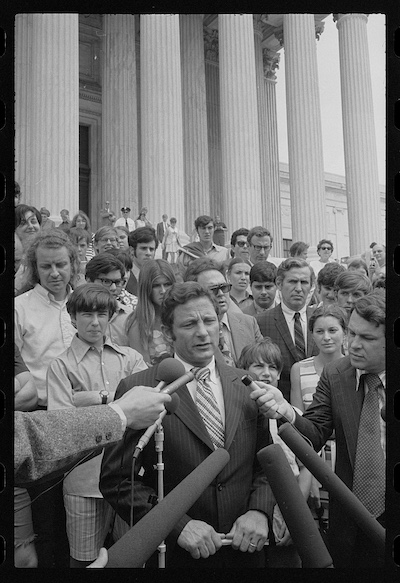
Supreme Court announces decision on pentagon papers suit
Senator Birch Bayh outside the Supreme Court after the Pentagon Papers case is decided, Library of Congress


Recommended for:

  • 11th Grade US History
  • 12th Grade Government
  • Undergraduate History

Table of Contents

Guide Introduction:
This introductory essay provides historical context on the First Amendment, government secrecy, and the rights of leakers and the press. Drawing attention first to more recent examples of these issues, the essay then introduces the 1971 Pentagon Papers leak which segues into a teaching activity on the topic.

Classroom Activities:
Exercise 1: Ellsberg's Memoir. A guided reading of an excerpt from Daniel Ellsberg’s memoir and an introduction to the Supreme Court case. Guiding Question: What’s the line between the government’s national security interest and the right of the public to know what the government is doing?
Exercise 2: Classifying Government Secrets. Small group, then whole classroom activity to help students understand the government classification process.
Exercise 3: Debating the Ellsberg Outcome. A discussion with students about the impact of the Pentagon Papers including the still unresolved legal questions around national security and free speech. Guiding Question: How does democracy operate amongst ambiguity and competing priorities?

Appendix:
Image of Pentagon Papers Cover
Excerpt of Ellsberg Memoir


Guide Introduction

        In the first and second guides in the Free Speech Teaching Guides series, we explored how speech that might cause a crime became increasingly protected under the First Amendment because it became harder to prove that speech, on its own, was harmful. But what if someone leaks a national security secret to the press? Is that sufficiently harmful or sufficiently criminal to allow censorship to protect the secret? This legal issue is inseparable from the question of how information gets classified as a “secret” in the first place. This guide explores the relationship between secrecy and the First Amendment by exploring two interrelated legal problems: the rights of leakers and the press to publish secret information; and the bureaucratic process by which information is classified as secret in the first place.
       These issues are at the heart of recent conflicts about whistleblowers and classified information – individuals like Chelsea Manning and Edward Snowden have faced jail time for sharing secrets with the public. The need to protect national security secrets has become a frontline of free speech debates. Introducing students to these topics can seem daunting because the law is complicated and confusing – one Supreme Court justice famously noted that the relevant sections of the Espionage Act are “singularly opaque.” (These are different sections of the same WW1-era law that we looked at in Free Speech Teaching Guide 1 and they remain on the books today.)
       My approach to teaching this subject at the introductory level is to focus less on the intricacies of the law than on the political and moral issues raised by the place of secrecy in a democracy. Can the government keep secrets to keep us safe? Or does the public have a right to know what its government is doing? Who gets to decide? The Pentagon Papers case provides an excellent case study to get students debating these questions.


Classroom Exercise 1: Ellsberg's Memoir

Contents:
Overview
Memoir Excerpt, Questions, and Takeaways
Visual Aids
Concluding Concepts

Overview:
The Pentagon Papers were a 7,000 page, 47-volume history of America’s policy in Vietnam that had been prepared, in secret, by the U.S. government in the late 1960s. Included in this history were the many ways that the U.S. government had lied to the American public about the origins and conduct of the Vietnam War. They were stamped “Top Secret” and very few people had access to them. One of the people who had access to the document was Daniel Ellsberg, a former marine with a Harvard PhD, who had worked in the highest levels of the U.S. government. At first, he was a believer in the American war in Vietnam. In the included excerpt of Ellsberg’s memoir, he wrote powerfully about the ways that access to secret information was intoxicating.
This excerpt can be assigned for pre-class or homework reading or can be done as an in-class exercise. Regardless of modality, the set of questions included in this exercise will help students engage with the source. Finally, the Concluding Context will explain how this case quickly became central to national decisions regarding the rights to free speech and public knowledge.

Exercise Steps:

  1. Read the Framing Essay and Overview of this exercise yourself and use both to introduce students to this topic.
  2. Have students read the excerpt of Ellsberg’s memoir either as homework or in class.
  3. Based on the reading, ask questions and guide conversation.
  4. Draw on the provided Concluding Context to explain how the Pentagon Papers incident played out politically and legally as far as rights of the press.

Memoir Excerpt, Questions, and Takeaways:
This source can be either a pre-class reading assignment or an in-class exercise. In either case, here are three questions to ask students:

  1. Why does Ellsberg think that there are relatively few leaks of secret information in the U.S.?
  2. How does Ellsberg describe the way that having access to secrets made him feel?
  3. Is this attitude toward state secrets democratic? Explain your reasoning.

The key takeaways for students are:

  1. That while secrets do leak, it’s surprisingly rare.
  2. That these leaks are rare largely because there is a glamour to having access to inside material, it makes you feel more important and knowledgeable than outsiders, and thus less likely to leak. Elsewhere in Ellsberg’s memoir, he writes that “the incredible pace and the inside dope made you feel important, fully engaged, on an adrenaline high much of the time. Clearly it was addictive.”
  3. That members of the intelligence community also take seriously their need to protect the national security.
  4. Ellsberg thinks this attitude is paternalistic and undemocratic — an opinion that students can debate and discuss.

[See Appendix for Image of Pentagon Papers Cover and Excerpt of Ellsberg's Memoir]

Visual Aids:
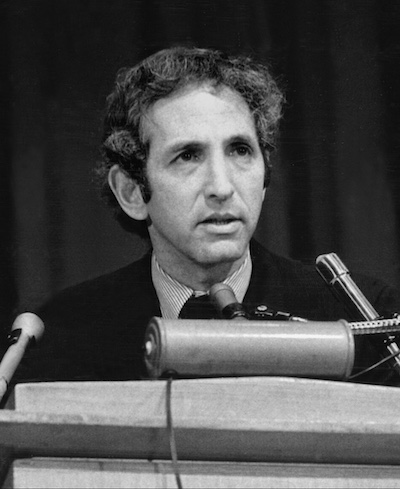
By the late 1960s, Ellsberg had become disillusioned about the war. He had seen too much on tours in Vietnam; he had become inspired by the anti-war movement. In class, I show some images of Ellsberg to show his political evolution: 
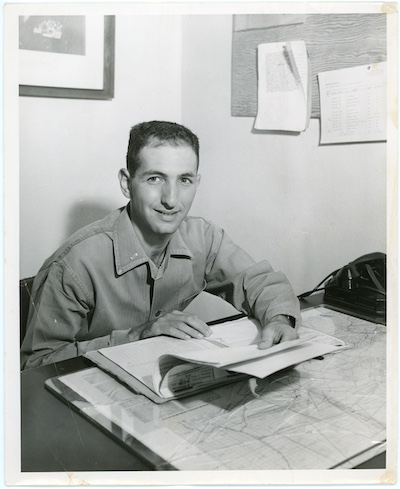
Ellsberg in the Marines in the 1950s. Sitting at a desk looking over papers
Daniel Ellsberg seated at desk, May 8, 1956. Daniel Ellsberg Papers (MS 1093). Special Collections and University Archives, University of Massachusetts Amherst Libraries
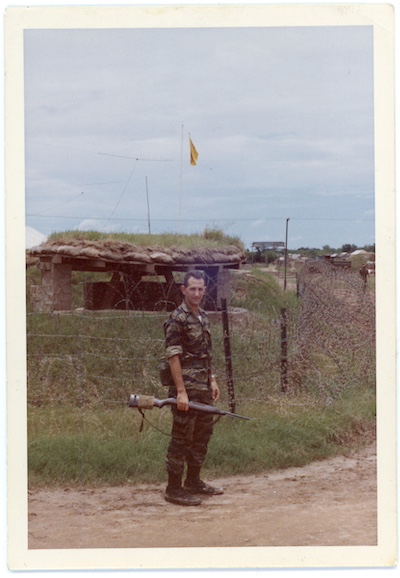
In Vietnam in the 1960s. He stands on a dirt road in his marine uniform with a rifle in hand
Daniel Ellsberg holding a rifle in front of bunker, ca. 1965. Daniel Ellsberg Papers (MS 1093). Special Collections and University Archives, University of Massachusetts Amherst Libraries
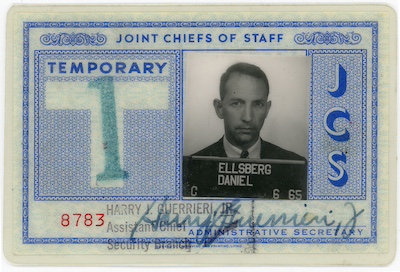
Ellsberg's Joint Chiefs of Staff ID card
United States. Joint Chiefs of Staff. Daniel Ellsberg Joint Chiefs of Staff temporary identification card, July 1, 1965. Daniel Ellsberg Papers (MS 1093). Special Collections and University Archives, University of Massachusetts Amherst Libraries

Ellsberg at the time of the Pentagon Papers case sitting in front of 3 microphones
Wikimedia Commons


Concluding Context:
In 1969, Ellsberg decided that the public had a right to know the secret history he had read in the Pentagon Papers — he hoped disclosing that history would help end the war. In secret, he began smuggling the papers out of the office every night to photocopy them. In 1971, he gave a copy to the New York Times and then to the Washington Post. After vigorous internal debates about whether it was legal to publish these stolen and secret documents, both newspapers began running stories in June.


The Washington’s Post internal deliberations about whether to run the story are dramatized in the 2017 movie, The Post – Showing the movie to students would be a way to expand this guide to discuss the ethical obligations of journalists when it comes to publishing secret documents.


The Nixon administration’s response was extreme. They went to court to try to prevent the newspapers from publishing any more stories from the Pentagon Papers, claiming that every disclosure risked harming America’s national security. But blocking a newspaper from publishing is a heavy-handed form of censorship, known as prior restraint. And so the newspapers understandably argued that their First Amendment rights were being threatened. These questions were so fundamental, the stakes so urgent, that the case was heard by the Supreme Court less than two weeks after the first publications from the Pentagon Papers.
The rushed process produced a confusing decision. Rather than one clear majority decision, each of the justices issued their own opinion. Taken together, the court had ruled, six votes to three, that prior restraint of the Pentagon Papers was unconstitutional. Only in very particular cases, when the information published was likely to “inevitably, directly, and immediately cause” serious harm to the national security – something like “imperiling the safety of a [troop] transport already at sea” – could one justify prior restraint. The government could not show this level of harm in the Pentagon Papers case, and so the press could publish. (In fact, this bar is so high that it has never been met.) But the array of opinions left open some important questions, such as whether the newspapers could be punished for publishing state secrets after the fact, even if they could not be blocked from publishing them in the first place.  
       And because the decision was about the right of the newspapers to publish state secrets, it said nothing about whether Ellsberg had a right to give the Pentagon Papers to the newspapers in the first place. He was also on trial, facing 115 years in jail for giving secret information to unauthorized persons (a violation of a section of the Espionage Act). In response, he claimed a right to inform the public about government misconduct, arguing that just because a document was stamped secret didn’t mean that its disclosure would actually harm the nation’s security. In fact, he had not turned over every section of the Pentagon Papers to the press – he had only turned over those sections he believed to be wrongly classified.
The trial of Ellsberg should have been an important case, one that clarified whether government employees could claim a First Amendment right to disclose classified information to the public. Did the simple fact that a document was stamped secret mean that its disclosure posed an actual threat to national security?
To grapple with this question, students need to know how secrecy works. How does a government document become a secret? In the U.S. the process of defining secrets is guided by the classification system, which is established by Presidential order.
The first such order was passed by Harry Truman in 1951; at the time of the Pentagon Papers, the classification rules in place where those established by President Eisenhower in 1953 (seen in Exercise 2).


Exercise 2: Classifying Government Secrets

Contents:
Overview & Exercise Steps
Executive Order 10501, Annotated
Hypothetical, Alternative Executive Order
Scenarios
Debate & Conclusions


Overview & Exercise Steps:

  • To explore how different classification standards can shape the practice of classification, divide the class into small groups.
  • Each group will be given one of two sets of classification orders:
    • One half of the groups will be given the actual classification instructions in use at the time of the Pentagon Papers case (Executive Order 10501).
    • The other half of the groups will be given a fictional, revised set of instructions which ask the classifier to pay more attention to the public’s right to know.
      • Note: While reformers have called for these sorts of changes over the years, no classification order has ever looked like this.
  • The purpose of this exercise is to allow students to see how seemingly small changes in classification orders could change the process of stamping secrets – and so we are using a hypothetical set of orders to illustrate the point.
  • Give the groups scenarios with which to test their classification instructions.
  • End by encouraging students to debate the issue of classification and lead a concluding discussion.

Executive Order 10501, Annotated:
Link to Executive Order 10501

       “WHEREAS it is essential that the citizens of the United States be informed concerning the activities of their government; and
       WHEREAS the interests of national defense require the preservation of the ability of the United States to protect and defend itself against all hostile or destructive action by covert or overt means, including espionage as well as military action; and
         WHEREAS it is essential that certain official information affecting the national defense be protected uniformly against unauthorized disclosure:
         NOW, THEREFORE, by virtue of the authority vested in me by the Constitution and statutes, and as President of the United States, and deeming such action necessary in the best interests of the national security, it is hereby ordered as follows:
       Section 1. Classification Categories: Official information which requires protection in the interests of national defense shall be limited to three categories of classification, which in descending order of importance shall carry one of the following designations: Top Secret, Secret, or Confidential. No other designation shall be used to classify defense information, including military information, as requiring protection in the interests of national defense, except as expressly provided by statute. These categories are defined as follows: ...

  • The previous order under Truman had a fourth category - "restricted" - which this order abolished.  It seems to have made little difference - classifiers simply made more use of the "confidential" stamp.
    In reality, as the above photo from 1957 reveals, many different secrecy stamps and designations were adopted in the 1950s

        (a)  Top Secret: Except as may be expressly provided by statute, the use of the classification Top Secret shall be authorized, by appropriate authority, only for defense information or material which requires the highest degree of protection.  The Top Secret classification shall be applied only to that information or material the defense aspect of which is paramount, and the unauthorized disclosure of which could result in exceptionally grave damage to the Nation such as leading to a definite break in diplomatic relations affecting the defense of the United States, an armed attack against the United States or its allies, a war, or the compromise of military or defense plans, or intelligence operations, or scientific or technological developments vital to the national defense.
       (b)  Secret: Except as may be expressly provided by statute, the use of the classification Secret shall be authorized, by appropriate authority, only for defense information or material the unauthorized disclosure of which could result in serious damage to the Nation, such as by jeopardizing the international relations of the United States, endangering the effectiveness of a program or policy of vital importance to the national defense, or compromising important military or defense plans, scientific or technological developments important to national defense, or information revealing important intelligence operations. ...

  • My goal in teaching students how these orders work is to emphasize the subjective quality of these tests.
  • The difference between the levels is vague, despite the effort to bring clarity by examples. What is a disclosure that would cause "serious damage to the Nation" as opposed to "exceptionally grave damage"? How much does it help to say that the former would "jeopardize the international relations of the US" whereas the latter would lead to a "definitive break in diplomatic relations"?
  • For teachers who have also taught Free Speech Teaching Guides 1 and 2, you can note here that we are back in the world of predicting tendencies - trying to assess the likely outcome of information disclosures.

        (c)  Confidential: Except as may be expressly provided by statute, the use of the classification Confidential shall be authorized, by appropriate authority, only for defense information or material the unauthorized disclosure of which could be prejudicial to the defense interests of the nation.
       Section 2. Limitation of Authority to Classify: The authority to classify defense information or material under this order shall be limited in the departments and agencies of the executive branch as hereinafter specified….
       Section 3. Classification: Persons designated to have authority for original classification of information or material which 
requires protection in the interests of national defense under this order shall be held responsible for its proper classification in accordance with the definitions of the three categories in section 1, hereof. Unnecessary
classification and over-classification shall be scrupulously avoided.”

  • Note here the warning against over-classification. Even in the early 1950s, it was widely understood that over-classification was a major problem. One Defense Department study concluded that 90% of classified documents had been classified unnecessarily.
  • But such warnings have not been effective in reducing over-classification. Nixon's defense secretary later conceded that 95% of the Pentagon Papers, all of which were classified Top Secret, did not need to be classified at all.
  • The problem is that this warning has no enforcement mechanism.  Classifiers are not instructed to actively weigh the public right to know in making a classification decision - when deciding they are instructed to think only about potential harms.


Hypothetical, Alternative Executive Order:

In determining whether to classify information, you must weigh the public’s right to know about its government’s policy – if the secrecy poses a greater risk to American democracy than the risk to national security posed by disclosure, then the material should not be classified. Wherever possible, to maximize the amount of information available to the public, only the most specific level of information should be segregated and classified secret. Illegal acts should never be classified. These categories are defined as follows:
              (a) Top Secret: Except as may be expressly provided by statute, the use of the classification Top Secret shall be authorized, by appropriate authority, only for defense information or material which requires the highest degree of protection. The Top Secret classification shall be applied only to that information or material the defense aspect of which is paramount, and the unauthorized disclosure of which could result in exceptionally grave damage to the Nation such as leading to a definite break in diplomatic relations affecting the defense of the United States, an armed attack against the United States or its allies, a war, or the compromise of military or defense plans, or intelligence operations, or scientific or technological developments vital to the national defense.
            (b)  Secret:  Except as may be expressly provided by statute, the use of the classification Secret shall be authorized, by appropriate authority, only for defense information or material the unauthorized disclosure of which could result in serious damage to the Nation, such as by jeopardizing the international relations of the United States, endangering the effectiveness of a program or policy of vital importance to the national defense, or compromising important military or defense plans, scientific or technological developments important to national defense, or information revealing important intelligence operations.

              (b)  Secret:  Except as may be expressly provided by statute, the use of the classification Secret shall be authorized, by appropriate authority, only for defense information or material the unauthorized disclosure of which could result in serious damage to the Nation, such as by jeopardizing the international relations of the United States, endangering the effectiveness of a program or policy of vital importance to the national defense, or compromising important military or defense plans, scientific or technological developments important to national defense, or information revealing important intelligence operations.

              (c)  Confidential: Except as may be expressly provided by statute, the use of the classification Confidential shall be authorized, by appropriate authority, only for defense information or material the unauthorized disclosure of which could be prejudicial to the defense interests of the nation.

         Section 2. Limitation of Authority to Classify: The authority to classify defense information or material under this order shall be limited in the departments and agencies of the executive branch as hereinafter specified….
         Section 3. Classification: Persons designated to have authority for original classification of information or material which  requires protection in the interests of national defense under this order shall be held responsible for its proper classification in accordance with the definitions of the three categories in Section 1, hereof. Unnecessary
classification and over-classification are as serious a threat to American democracy as under-classification. Classification decisions will be audited, and over-classifiers will face disciplinary proceedings.

Scenarios:
Give each group three scenarios and ask whether they would classify them based on their instructions. Here are three that I use; you can develop others, of course: 

  1. The government is secretly providing weapons to an ally that is using them to fight a regional war against a nation hostile to the US. The government credibly believes that the ally would lose the war without the weapons; that the public would not support the use of US weapons in the war; and that disclosure would therefore threaten the ally’s standing and the balance of power in the region. Should the existence of the weapons program be classified?
  2. The government has a program to monitor social media for threats of terrorism. It believes the disclosure of the program would impair the effectiveness of the program. Should the existence of the program be classified?
  3. The government has a program of placing undercover operatives in a number of foreign nations. It wants to classify the existence of the program, as well as the names of the agents and the particular countries in which they will be placed. What should be classified?

Conclusions:

        Students should see that applying the standards of the Eisenhower order makes it very easy to justify classification; the fictional version of the orders introduces many more questions.  For instance, in scenario three, I would think that the groups using the fictional second set of orders would be tempted to only classify the names of the officers and perhaps some of the operational details; groups using the Eisenhower order would want to classify the entire program.
        I often pause here to let students debate whether it is better to be extra-cautious and deferential to national security concerns – the government does have an obligation to protect its citizens, after all – or whether transparency is more important.
       To wrap up the discussion, I suggest that this is an important debate for all citizens to have an opinion about; but the point of this lesson is simply that the classification orders can have a big impact on how classification decisions are made.
       And that is leaving to one-side the institutional pressures that Daniel Ellsberg discussed in his memoir. If you add those pressures to the bias created by the classification standards, students can see how easy it is to over-classify. Imagine working late in the afternoon on a stressful, difficult national security matter – would you prefer to take the risk that disclosing information poses no potential risks? Or would it be easier to stamp it classified, better safe-than-sorry?


Exercise 3: Debating the Outcome of the Ellsberg Case

Contents:
Exercise Steps
Questions & Debate
Conclusion

Exercise Steps:

  1.  Review the Overview & Context below for yourself.  
  2. Provide students with Overview & Context.
  3. Either all together or in groups, have students respond to questions and debate this topic.
  4. Connect this topic to the present with the Conclusion and any further discussion.

Context:
        Part of what the Ellsberg case could have done was clarify whether it is illegal to disclose all classified information to the public, or only properly classified information. This is a difficult debate – because you don’t necessarily want any one government employee to decide they know what should and shouldn’t be classified. But it also seems extreme to say that once a document is classified, the public has no right to it, even if it wouldn’t actually pose a harm to national security.
        In the end, the Pentagon Papers case shed no new light on these issues because it was thrown out of court. Richard Nixon had formed a small group in the White House to deal with the problem of “leaks” like Ellsberg’s. One of them told his mother-in-law that he was fixing leaks in the White House, and she said it was nice to have a plumber in the family – the group took the name “the Plumbers” as an in-joke. In an effort to discredit Ellsberg in the press, the Plumbers broke into the office of Ellsberg’s psychiatrist. Later, after the Plumbers had broken into the Watergate hotel during the 1972 election, and the whole Watergate scandal became a national fixation, the break-in at Ellsberg’s psychiatrist also came to light. The judge threw Ellsberg’s prosecution out of court for government misconduct. Ellsberg went free, but the laws of secrecy and leaking were not put to the test.
        The result is that the basic classification scheme continues to operate in much the same fashion as it did in the 1960s. Subsequent presidents have tinkered with these orders – Presidents Carter, Clinton and Obama, for instance, instructed classifiers to err in the direction of under-classification when in doubt; President Reagan urged over-classification when in doubt – but none have required proactive consideration of the public’s right to know.
        Was this a satisfying outcome to the Pentagon Papers affair?  Richard Nixon didn’t think so: “the son-of-a-bitching thief [Ellsberg] is made a national hero and is going to get off on a mistrial. And the New York Times gets a Pulitzer Prize for stealing documents…. what in the name of god have we come to?” [I often put this quote on an overhead].
        Others thought the outcome reflected a balancing act – the government retained some ability to punish leakers, and thus to keep information secret in the interests of national security. But the press had the right to publish, and thus to inform the public. Alexander Bickel, a law professor who represented the New York Times in the Pentagon Papers case, described this as a “game theory” of the First Amendment – a contest between the press and the government over who got to control what information the public learned.
        One problem with this balancing act is that it requires a leaker to risk punishment to inform the press in the first place. Can we trust that people will be motivated to speak out in face of such threats? In 1971, Ellsberg was asked how he felt about facing 115 years in jail for leaking government secrets. “Wouldn’t you go to jail to help end the war?” was his famous response.

Questions & Debate:
Ask students to debate whether this is a healthy state of affairs for a democracy. The following questions could be built out to include more hypotheticals:

  1. Would students be willing to face jail to inform the public?
    1. For what sort of crimes?  To end a war, to stop an abuse of power, to reveal corruption?
    2. Is the risk worth the reward?
      1. What if the paper chooses not to publish?
      2. Do they believe that releasing government documents actually would change public opinion? Or do they think people are so committed to their beliefs that new information wouldn’t change their mind?
  2. Do they trust the judgement of an individual government employee to make the decision about which secrets can be revealed? What if that employee thinks the public has a right to know, but they get this wrong, or inadvertently reveal a vital secret?
    1. Ask students how many Americans they think have security clearances?
      1. In reality, it is more than 4 million. Should each and all of them have the right to make decisions about what should be disclosed?
    2. Does it matter if Ellsberg wasn’t acting alone? In reality, he was working with a group of antiwar activists, who helped him smuggle the documents to the press, and who helped him go underground to avoid arrest. They represented a much broader antiwar movement which was very opposed to the war; Ellsberg was, in many ways, taking his moral cues from this broader social movement. Does that change how you think about his act of moral conscience?
    3. Is it enough that the source takes the secret to a journalist, and asks the journalist to decide if the information is safe to disclose?
      Is that better than simply putting information online?

Conclusion:
During the War on Terror, a number of government insiders have, like Ellsberg, released secret information to the public. Chelsea Manning, Edward Snowden, Terry Albury, Daniel Hale and others have faced Espionage Act charges and have not been able to claim either that the material they released was improperly classified, or that the public had a right to know. Many of them served jail time for their disclosures. The newspapers that published their leaks, meanwhile, did not face any effort to bar them from publication, or to criminally prosecute them. The balancing act created by the Pentagon Papers case lives on.


Appendix

(Both items are also available in the pdf download of this teaching guide- see left)

Image of the Pentagon Papers Cover:
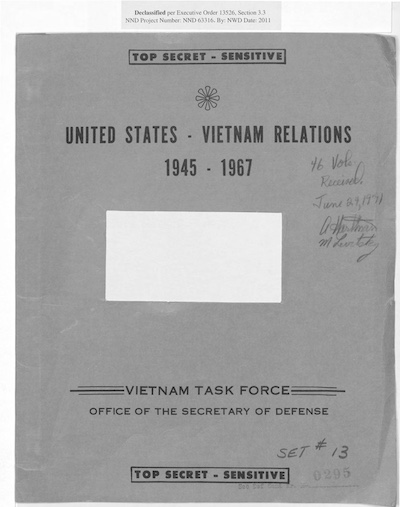
Cover of the Pentagon Papers. Reads: Top Secret-Sensitive. United States-Vietnam Relations 1945-1967. Vietnam Task Force. Office of the Secretary of Defense.

Excerpt of Ellsberg Memoir:

        “Even within the executive branch, self-discipline in sharing information—lack of a ”need to tell”—and a capability for dissimilation in the interests of discretion were fundamental requirements for a great many jobs. There was an abundance of people who, like John and me, could and did meet those requirements adequately. The result was an apparatus of secrecy, built on effective procedures, practices, and career incentives, that permitted the president to arrive at and execute a secret foreign policy, to a degree that went far beyond what even relatively informed outsiders, including journalists and members of Congress, could imagine.
       It is a commonplace that “you can’t keep secrets in Washington” or “in a democracy,” that “no matter how sensitive the secret, you’re likely to read it the next day in the New York Times.” These truisms are flatly false. They are in fact cover stories, ways of flattering and misleading journalists and their readers, part of the process of keeping secrets well. Of course eventually many secrets do get out that wouldn’t in a fully totalitarian society. Bureaucratic rivalries, especially over budget shares, lead to leaks. Moreover, to a certain extent the ability to keep a secret for a given amount of time diminishes with the number of people who know it. As secret keepers like to say, “Three people. can keep a secret if two of them are dead.” But the fact is that the overwhelming majority of secrets do not leak to the American public. ...

        This is true even when the information withheld is well known to an enemy and when it is clearly essential to the functioning of the congressional war power and to any democratic control of foreign policy. The reality unknown to the public and to most members of Congress and the press is that secrets that would be of the greatest import to many of them can be kept from them reliably for decades by the executive branch, even though they are known to thousands of insiders.
       As one of those insiders I had no particular objection to this. I shared the universal ethos of the executive branch, at least of my part of it: that for the Congress, the press, and the public to know much about what the president was doing for them, with our help, was at best unnecessary and irrelevant. At worst, it was an encouragement to uninformed (uncleared), short-sighted, and parochial individuals and institutions to intervene in matters that were too complicated for them to understand, and to muck them up. This sounds paternalistic to the point of being antidemocratic, and so it was. (And is: I doubt that this has ever changed.) But we’re talking foreign policy here, and national security matters, in which we didn’t see that people without clearances had any really useful role to play in the nuclear cold war era. It was in the national interest, as we saw it, simply to tell them whatever would best serve to free the president from their interference. ...
        Even when I regarded the administration’s policy as inadequate or misguided, as I often did on nuclear matters, I saw little hope for improvement by Congress, with its committees generally headed by conservative southerners. Once I was inside the government, my awareness of how easily and pervasively Congress, the public, and journalists were fooled and misled contributed to a lack of respect for them and their potential contribution to better policy. That in turn made it easier to accept, to participate in, to keep quiet about practices of secrecy and deception that fooled them further and kept them ignorant of the real issues that were occupying and dividing inside policy makers. Their resulting ignorance made it all the more obvious that they must leave these problems to us.
       There was one more feature of our environment within the executive branch that contributed to a disregard of the opinions or criticisms of outsiders, that made it hard to listen to or learn from them. Perhaps the most startling discovery on entering the government at this level form having been a consultant was the unrelenting pace of the work. I’ve already described the almost inconceivable amount of information and demands for information pressing on you.”
Free Speech Teaching Guide 2: Brandenburg v. Ohio (1969): Defining and Arguing Hate Speech

Article Body
This Teaching Guide is part of a series. Each of the four total teaching guides speaks to one aspect of the history of free speech. Although they work together to tell different parts of this history, it is not necessary to teach all of the guides or to teach them in a certain order. Each guide is a self-contained lesson.
(A PDF version of this teaching guide is also available for download-see left) 

Other guides in the series:
Free Speech Teaching Guide 1: The Birth of the Modern First Amendment: How Oliver Wendell Holmes Changed His Mind
Free Speech Teaching Guide 3: The Problem of National Security Secrets
Free Speech Teaching Guide 4: Mandel v. Kleindienst (1972): Censorship via Visa


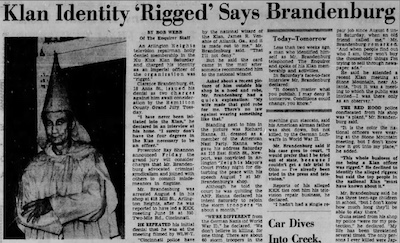
newspaper article with photograph of Brandenburg in his KKK robes. Title: "Klan Identity 'Rigged' Says Brandenburg

Recommended for:

  • 11th Grade US History
  • 12th Grade Government
  • Undergraduate History

Table of Contents

Guide Introduction:
This introduction briefly previews the how this guide will cover Brandenburg v. Ohio 1969 and why that case is useful in teaching students about the basic legal principles of free speech in the United States.

Classroom Activities:
Exercise 1: How to read a court case. A structured guide on how to explain the case to students and facilitate classroom conversation. Includes a link to the original case and relevant Constitutional Amendments.
Exercise 2: Thinking about free speech principles, not politics. A full-class group activity on the white board. What makes some forms of speech so "harmful" that they fall outside of the First Amendment's protection?
Exercise 3: What's the harm in hateful speech? An exercise intended to invite and address questions of how violence is defined. It includes questions alongside arguments in favor of either restricting or tolerating speech.

Appendix:
Excerpt of the Supreme Court's 1969 decision in Brandenburg v. Ohio to refer to during the Classroom Activities. The entire source (external) is linked here.


Guide Introduction

        This case from the late 1960s, about the right of Ku Klux Klan members to call for racial violence, marks an important turning point in the law of free speech.  The court firmly and finally rejected the notion that one could be punished for publicly advocating for a crime – closing the books on the long period in which left-wing advocacy for revolution had been criminalized.  And it announced a new rule that was very protective of even the right to advocate for crime – a rule that still guides the law today, and that embodies, for many commentators, the essence of modern free speech law.
       The case is therefore a good one to teach to show students the basics of free speech law.  It is also a short decision issued by a unanimous court (rather than being signed by one judge, the decision was issued per curiam, or for the court, normally a sign that it is non-controversial). Leaving out the two concurrences, the decision runs for only about five pages, and its reasoning is fairly straightforward. It thus serves as a useful case to teach students how to read a supreme court decision.

This teaching guide includes:

  1. A structured guide to explaining the case to students
  2. A classroom exercise on the value of tolerating hateful speech
  3. A classroom exercise to think about the harms of hateful speech

Note: there are links throughout this guide to the end of the document where an appendix houses excerpts of the Supreme Court decision and an external link to the entire resource.


Classroom Exercise I: How to read a court case

Contents:
Overview
Introduction & Context
Hypotheticals
Final Context & Wrap Up

Overview:
This exercise will introduce students to the Brandenburg case itself and help them begin to grapple with its main debates. It works best as a whole classroom activity, although the reading may be assigned as homework to be reviewed before class. The goal of this lesson is for students to be able to draw connections between Brandenburg and the relevant constitutional amendments, as well as understand the complexity of free speech logic as seen in the case. 

Introduction & Context:
        The place to begin is by having students read the decision and asking them to identify the facts in the case. This can be assigned as homework or conducted as a guided reading in the classroom. In clear prose, the court outlines the essential facts on pp.444-447 of the decision. The key details for students to grasp are that Clarence Brandenburg was a member of the KKK in Ohio, and late in the June of 1964 he was filmed at a meeting of about a dozen Klansmen making racist statements and suggesting that if the U.S. continues to “suppress the white, Caucasian race, it’s possible that there might have to be some revengeance taken.” He then proposed marching on Washington DC on July 4.
       The next question is how Brandenburg was charged.  The court tells us in the opening sentences of its decision – he was convicted under an Ohio Criminal Syndicalism statute for advocating the “duty, necessity or propriety” of crime or violence.  The law dated from 1919, one of a series of state laws – 20, the courts tells us on p.447 – passed during the First Red Scare in an effort to criminalize revolutionary socialist and anarchist parties.
       So what question is the Supreme Court answering in this case? Whether the Ohio Syndicalism law is constitutional, or whether it violates Brandenburg’s First and Fourteenth Amendment rights (p.444). The First Amendment issue is straightforward – he was sentenced to jail and fined for his speech. 
        But you might want to explain the 14th Amendment piece to your students, particularly if it is a more advanced class, or if you have spent time discussing federalism. The First Amendment says only that “Congress shall make no law”– in the 19th century, it was understood that it did not apply to state laws, like the Ohio law in question here, it only applied to the federal government. (To the extent that one wanted to challenge state laws, you had to rely on whatever bills of rights were included in state constitutions.) But beginning in the 1920s, the Supreme Court began to hold that the First Amendment did apply to the states – they did so by ruling that the 14th Amendment’s guarantees of “due process” included the First Amendment right to free speech and free press, and thus that the First Amendment applied to state as well as federal laws. This process is known as incorporation. One needn’t get into this with students unless they are curious – the upshot is that there is no discrete 14th Amendment issue at stake in this case; the 14th Amendment is being cited as a way to activate the free speech issues.
       And what did the Supreme Court rule? In the final paragraph, the court outlines that the law is unconstitutional, because it punishes “mere advocacy.” This, it suggests, is too broad. In the highlighted section on p.447, the Court argues that previous decisions have made clear that you can only bar advocacy of crime if it the speech is “directed to inciting or producing imminent lawless action and is likely to incite or produce such action.”

Find the text of the First Amendment Here

Find the text of the Fourteenth Amendment Here

        This is known as the Brandenburg test, and it still guides the law today. The idea is that if someone is advocating that a crime should be committed, then that should be protected speech unless the crime is likely to be committed right away. Only in that case is it appropriate to criminalize speech to prevent the crime from happening, to treat the speech as causing the crime in some direct sense.  In all other cases, if a crime is committed, we hold the person committing the crime accountable. We give the speaker wide latitude to express their point of view to encourage full expression; and we trust that people are not easily persuaded to commit crimes. Rather than run the risk of repressing politically valuable speech, we trust in the deterrent power of the criminal laws. And we trust, too, that in the interim between the speech and the criminal act, there is plenty of time for individuals to reconsider and there is plenty of time for others to speak out against committing the crime.

Hypotheticals:
To illustrate this point, I use a little sequence of hypotheticals:

  • If I hate a building on campus – I think it is named for someone whose politics I abhor; I find it aesthetically awful; I have some other extreme gripe – and I say it should be torn down, does that meet the standard?
    • Students should see that it doesn’t, and for obvious reasons – it is not directed to inciting lawless action, that action is not imminent, and it is not likely to produce the action. And by calling for destruction in this more abstract way, I am expressing the strength of my political feelings about the building.
  • What if I say someone should dynamite it overnight in a few months, over the school break?
    • That is explicitly directed to a crime, but is neither imminent nor likely, and so doesn’t meet the standard.
  • But what if there is a protest outside the building, I have a megaphone, and I tell the crowd to smash the building right now?
    • Well, if the crowd is angry, and the crime looks likely to happen, and I am explicit that I want the crowd to break the law, I might have a problem. But as students should see, this is a very hard standard to prove, and so the Brandenburg test is very protective of free speech.

At this point, I normally need to clarify that this is about public advocacy for law-breaking. Conspiring to commit a crime is an entirely different matter – we don’t consider it a matter of free speech because it is done privately. There are no communicative benefits to the planning of the crime – there is no risk that we will chill public discussion or critique or the venting of anger – and so the same First Amendment issues do not arise. Conspiring to commit a crime is, of itself, a crime.

Final Context & Wrap Up:
        The final question to explore is how did the court get to this conclusion? It reviewed a series of previous cases in which it had ruled on criminal advocacy cases, and distilled from them its test, which had not previously been stated so plainly. The cases are listed on 447-448, and two things are important to draw out. The first is that there was a case on the books from 1927 – Whitney v. California – in which the law in question was very similar to the Ohio law (they were passed around the same time). In that case, the Supreme Court ruled that it was constitutional to punish a woman – Anita Whitney – for joining an organization – the Communist Party – that advocated revolution.  The decision was part of a long sequence of cases in which the Court had ruled that it was constitutional to criminalize Communist speech. This approach led to McCarthyism and the Second Red Scare. In the Dennis case in 1951, the Supreme Court ruled that it was constitutional to send 11 Communist Party leaders to jail for “conspiring to advocate” revolution – for teaching that revolution is an ultimate end-goal of the Communist movement (a decision that falls far short of the test established in Brandenburg!).
        But, and this is the second piece of context to provide, over the late 1950s and early 1960s, as the fears of the McCarthy period cooled, the Court began to rethink these decisions, and to outline new tests that protected much more speech. These are the cases cited on 447-448, and which form the basis for the test newly elaborated in Brandenburg. And making that the standard required also overturning the Whitney decision from four decades earlier – an example of how the law evolves, and earlier precedent is overturned.
      That explains the internal logic of the case. The remainder of class can be devoted to asking students to work through how they think about this decision. Normally, students find themselves quite uncomfortable with the fact that the Court has ruled in favor of a KKK member, and that it seemed to treat the case as the culmination of its tortured relationship with Communist speech rather than confronting directly the fact that this was a Klansman advocating racial violence.

The following two exercises can be useful for helping students work through these questions. 

Classroom Exercise II: Thinking about free speech principles, not politics

Contents:
Overview
Context & Questions

Overview:
To help students grapple with the complexity of the Brandenburg case, I provide them with information about who his legal team was and what their motivations were for representing him. Included in this exercise is an interview with one of Brandenburg’s lawyers and a series of questions I find useful in prompting student discussion about this complicated topic.

Context & Questions:
        Take students to the top of the case and ask them to identify the lawyers representing Brandenburg. The first lawyer named is Allen Brown – he was a Jewish lawyer for the American Civil Liberties Union (ACLU). The other lawyers were also civil libertarians, including the fourth name: Eleanor Holmes Norton. Norton worked for the ACLU at the time, and later went on to serve for decades as Washington DC’s congressional representative. These were not, in other words, lawyers who shared Brandenburg’s politics. Here is a short clip of Norton explaining her role in the case:


Link to Video: C-SPAN- Supreme Court Landmark Case Brandenburg v. Ohio


       I ask students what they think of Norton’s idea that she has a duty to defend the speech of speakers who would not defend her speech? There is no easy answer to this question, which will be deeply personal to individual students – the key is just to let students begin to work through their ideas about the importance of neutrality in speech rights.
      I often pose some additional questions to prompt more discussion. Do students share Norton’s concerns about governments deciding which sorts of speech to prosecute? Do they share her faith that a “free for all” will produce a decent outcome? Do they share her faith that courts will apply neutral principles to protect all speech? Is it smart politics for liberals like the ACLU to defend groups that would not respect their rights? Or is it naïve?


Classroom Exercise III: What's the harm in hateful speech?

Contents:
Overview
Toleration Arguments
Restriction Arguments

Overview:
       Students can be surprised to see that nowhere in the Court’s opinion does the court discuss Brandenburg’s speech as hateful or racist speech. As it seeks to assess whether Brandenburg’s speech might cause a harm that would justify punishment, the court focuses exclusively on the harm that the specific violence Brandenburg advocates – “revengeance” after the July 4 march – might actually come to pass. This is because of the Ohio law under which Brandenburg was charged (making it illegal to advocate crime) – and underlining this point can be a useful moment to discuss with students the Supreme Court’s role as an appeals court, limited to hearing the specifics of the cases that come before it.
        But what if there had been a law barring Brandenburg’s speech because it was racist? Many other countries have hate speech laws, which criminalize speech because it is racist or derogatory. The U.S. does not; American free speech law protects the right to say even racist or hateful things.
        The facts of Brandenburg offer an opportunity for students to think through how they feel about this controversial free speech question. As with Exercise II, the goal is not to lead students to a “correct” answer, but to help them understand some of the ways that the arguments have been made, and to begin to develop their own philosophies of free speech.

Toleration Arguments:
         The arguments for tolerating even hateful speech flow from Eleanor Holmes Norton’s perspective on free speech that we looked at in Exercise II; they also flow from the idea of a “marketplace of ideas” that was established in the 1919 Abrams v. United States case, which is dealt with in the Free Speech Teaching Guide 1 In short, they are that that any standards that could be established will be vague and open to abuse, that there is much risk in allowing governments to pick and choose which speech to censor, and that there are benefits to society for allowing the airing out of controversial ideas – where they can be critiqued, rebutted, and, where necessary, debated – rather than driving them underground, where they may gain the mystique of “secret knowledge.”
       The arguments against tolerating such speech require identifying harms that would be sufficient to justify censorship. In Brandenburg, the Court measured the likelihood that Brandenburg’s speech would cause the sort of mob violence on July 4 that he called for; the court found that such an outcome was not sufficiently imminent, likely, and explicit to punish the speech. But that is not the only harm one could imagine wanting to regulate.
Next, I provide two important examples of such arguments for restricting racist speech to avoid different types of harm.

Restriction Arguments:
       An argument could be made that racist speech can lead to crimes in a more general sense, by heightening racial animosity, and degrading the status of some members of the community so much that they seem legitimate targets for violence. Brandenburg was decided in 1969, but the case began with Brandenburg’s speech 1964 at a time when the conflict over civil rights was causing very real political violence: in the September before Brandenburg’s speech, for instance, a splinter group of the Ku Klux Klan bombed the 16th Street church in Alabama, killing four Black girls. One obviously cannot hold Brandenburg himself accountable for these crimes – they happened before his speech – but do students think that censoring hateful, violent speech like his would make such crimes less likely? And what about the risks of such censorship? And is it sufficient that bombing is outlawed?
       The second argument, as made by philosopher Jeremy Waldron, argues that the harm of hate speech is not that it will lead to crime, but that hateful speech is, of itself, an attack on the dignity of particular groups of people and denies them of full inclusion in the political community. Whether or not this sort of speech leads to a crime, Waldron suggests, this is itself harmful enough to justify censorship. After all, it is illegal to defame individual people under U.S. law – though in the case of individual libel charges there are complex rules intended to balance this principle with the First Amendment; and any similar group defamation law would need to be similarly complex. But one can ask students whether the sorts of statements Brandenburg made in the footnote on p.446 are sufficiently harmful to the respect and status of members of the community that they fall outside the protections of the First Amendment. 
       In Brandenburg, the court did not consider these issues. But thinking about the case in these contexts helps students better understand the stakes of the free speech questions involved and also helps them think about how the court identifies the harms it analyzes in its decisions.


Appendix

Available in the PDF version of this guide, downloadable on the left of this page. 


Free Speech Teaching Guide 1: The Birth of the Modern First Amendment and How Oliver Wendell Holmes Changed His Mind

Article Body
This Teaching Guide is part of a series. Each of the four total teaching guides speaks to one aspect of the history of free speech. Although they work together to tell different parts of this history, it is not necessary to teach all of the guides or to teach them in a certain order. Each guide is a self-contained lesson.
(A PDF version of this teaching guide is also available for download-see left) 

Other guides in the series:
Free Speech Teaching Guide 2: Brandenburg v. Ohio (1969): Defining and Arguing Hate Speech
Free Speech Teaching Guide 3: The Problem of National Security Secrets
Free Speech Teaching Guide 4: Mandel v. Kleindienst (1972): Censorship via Visa


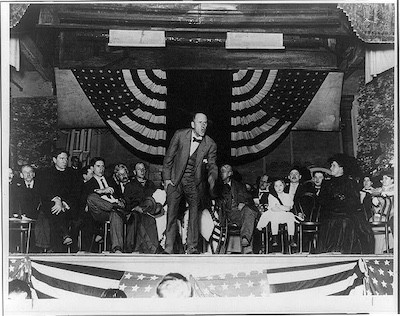
Eugene V. Debs making a speech on stage with two American flags and a group of people seated behind him

"Eugene V. Debs Making a Speech," c.1912-1918, Library of Congress

Recommended for:

  • 11th Grade US History
  • 12th Grade Government
  • Undergraduate History

Table of Contents

Framing Essay:
This essay provides historical background on modern ideas about free speech and the First Amendment through analysis of two 1919 Supreme Court cases:

  • Selection: Schenck v. United States 249 U.S. 47 (1919)
  • Selection: Abrams and others v. United States 250 U.S. 616 (1919)


Classroom Activities
Exercise 1: What does Freedom of Speech Mean? A guided reading of the Holmes opinion in Schenck v. United States 249 U.S. 47 (1919). Why did the Supreme Court decide it was acceptable to limit certain forms of speech?
Exercise 2: What Kinds of Speech are Protected? A full class group activity on the white board. What makes certain forms of speech so harmful that they fall outside First Amendment protection?
Exercise 3: Holmes Reconsiders. A detailed reading of Abrams and others v. United States 250 U.S. 616 (1919) and a comparison to Schenk. How might judges apply or avoid precedent?

Annotated Primary Sources
A section of Justice Oliver Wendell Holmes Jr. majority opinion in the Schenck case.
A section of Justice Oliver Wendell Holmes Jr. dissenting opinion in the Abrams case.

Homework Activity

Framing Essay

When I teach students the history of the First Amendment, the most basic thing I want them to learn is that the First Amendment has a history. Free speech seems like an enduring American value. After all, it is protected in the First Amendment to the constitution. But the idea that we should protect the "marketplace of ideas," that all sorts of speech should be protected from punishment, is barely more than a century old. In fact, its emergence can be traced to one year: 1919.

This guide focuses on the history of free speech in one crucial year (1919), exploring how one influential Supreme Court justice changed his mind about the value of antiwar speech and in the process wrote opinions that have shaped our attitudes to free speech ever since. It provides students an opportunity to see the First Amendment evolve at a crucial hinge in its history, and it also provides them an opportunity to think about how far the rights to free speech should extend during wartime.

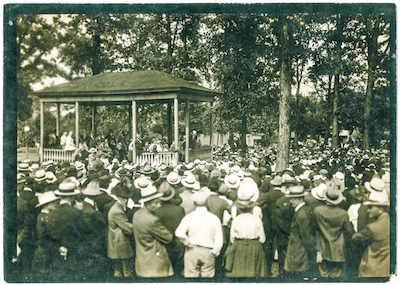
During World War I, the US government sent critics of the war to jail. The Espionage Act of 1917 made it illegal to interfere with the draft, and government prosecutors successfully claimed that criticism of the war was a form of interference with the draft – if drafted soldiers thought the US should not be fighting the war, wouldn’t they be less likely to comply with the draft? On this theory, more than a thousand Americans were imprisoned for speech crimes. The most famous of them was Eugene Debs, the labor organizer and perennial Socialist presidential candidate, who was convicted for a Socialist stump speech in an Ohio park in the summer of 1918.

Find the text of the First Amendment Here


Eugene V. Debs making a speech on stage with two American flags and a group of people seated behind him
"Eugene V. Debs Making a Speech," c.1912-1918, Library of Congress
Large crowd gathers around a gazebo to listen to Eugene Debs
Eugene Debs Speaking in Canton, Ohio, c.1918, National Archives

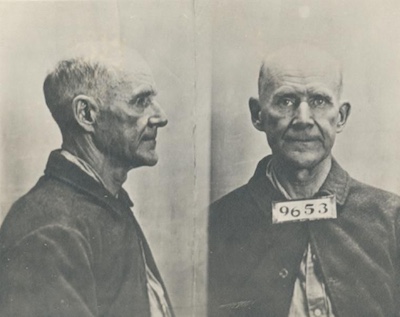
Mug shot of Eugene Debs. His number reads 9653.

"Eugene Debs Mug Shot," c.1912-1929, New York Public Library

During class, I project the above images of Eugene Debs to force students to think about the human character at the center of this story. Debs was a noted orator, but we have no videos of him speaking.

We have to rely instead on photographs and the words of his audience, who described him as a captivating, moving speaker, who had the ability to make everyone in the crowd feel like he was addressing them directly.

Look Closer:
One technique Debs used was to lean out over the crowd – as you can see in the photo of his speech in Canton, Ohio.
You can find a transcript of Debs’ Canton Speech here: Eugene V. Debs' Canton Speech, 1918, Internet Archive

After the end of the war, in the Spring of 1919, the Supreme Court heard appeals from a number of the socialists prosecuted under the Espionage Act. The socialists claimed that the First Amendment protected their right to criticize the war. In unanimous decisions, the Supreme Court rejected their claims. During war time, Justice Oliver Wendell Holmes Jr. wrote for the court, it was perfectly acceptable for the government to criminalize speech that could interfere with the draft. The first classroom exercise will explore Holmes’s decision in this case: Schenck v. United States 249 U.S. 47.
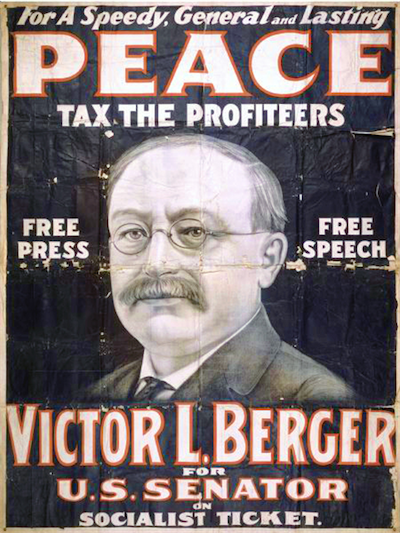
Poster with Victor Berger's picture on it. It reads "For a Speedy, General, and Lasting Peace, Tax the Profiteers. Free Press. Free Speech. Victor L. Berger for U.S. Senator on Socialist Ticket." 
Victor L. Burger Campaign Poster, 1918, Wisconsin Historical Society

This campaign poster for Victor Berger reveals the centrality of free speech to the Socialist party and the connection between the right to free speech and opposition to the war.

Berger himself was prosecuted for speech crimes — a fascinating history that is well documented Wisconsin Historical Society site linked below.

Victor L. Berger Campaign Poster, 1918, Wisconsin Historical Society


Classroom Exercise I: What does Freedom of Speech Mean?

Contents:
Overview
Schenck WWI Anti-Draft Pamphlet, 1917
Excerpt of Schenck v. U.S.(1919)
Annotated excerpt of Schenck v. U.S. (1919)
Conclusion and Takeaways: What does free speech really mean?

Overview:
Holmes’ understanding of free speech was explained most clearly in the Schenck v. U.S. (1919) case, which concerned a pamphlet (pictured below) sent to drafted soldiers which encouraged them to protest the draft by writing to their congressional representatives.

It is useful to walk students through this excerpt from Holmes’ decision closely in class explaining the relevant steps of the logic. I do so by:

  1. Have students read the dense legal text of the Holmes’ decision out loud.
  2. Paraphrase and explain each sentence. My annotations provide the context and explanation I use. The following pages provide an annotated exploration of an excerpt of the Schenck decision.

Charles Schenck, WWI Anti-Draft Pamphlet, 1917, National Archives

Primary Source: Schenck v. U.S.​ (1919):

“It well may be that the prohibition of laws abridging the freedom of speech is not confined to previous restraints, although to prevent them may have been the main purpose, as intimated in Patterson v. Colorado, 205 U. S. 454, 462. We admit that in many places and in ordinary times the defendants in saying all that was said in the circular would have been within their constitutional rights. But the character of every act depends upon the circumstances in which it is done. Aikens v. Wisconsin, 195 U.S. 194, 205, 206. The most stringent protection of free speech would not protect a man in falsely shouting fire in a theatre and causing panic. It does not even protect a man from an injunction against uttering words that may have all the effect of force. Gompers v. Buck’s Stove & Range Co., 221 U. S. 418, 439. The question in every case is whether the words used are used in such circumstances and are of such a nature as to create a clear and present danger that they will bring about the substantive evils that Congress has a right to prevent. It is a question of proximity and degree. When a nation is at war many things that might be said in time of peace are such a hindrance to its effort that their utterance will not be endured so long as men fight and that no Court could regard them as protected by any constitutional right. It seems to be admitted that if an actual obstruction of the recruiting service were proved, liability for words that produced that effect might be enforced. The statute of 1917 in § 4 punishes conspiracies to obstruct as well as actual obstruction. If the act, (speaking or circulating a paper,) its tendency and the intent with which it is done are the same, we perceive no ground for saying that success alone warrants making the act a crime. Goldman v. United States, 245 U. S. 474, 477.”
For the Full Decision see: U.S. Reports: Schenck v.US 249 U.S. 47 (1919) Library of Congress.


Annotated excerpt of Schenck v. U.S.:

"It well may be that the prohibition of laws abridging the freedom of speech is not confined to previous restraints, although to prevent them may have been the main purpose, as intimated in Patterson v. Colorado, 205 U. S. 454, 462."

Previous or Prior Restraint:

  • A particularly dangerous form of censorship because it prevents one from speaking at all without approval.
  • In the 19th century, it was well understood that the First Amendment prevented this kind of licensing system - Holmes sees this as the "main purpose" of the First Amendment.

Patterson v. Colorado was a 1907 Supreme Court case in which a newspaper was punished for criticizing a court in Colorado. The newspaper claimed that the First Amendment protected their right to criticize the judiciary, but the Supreme Court ruled that it was acceptable to punish speech if it would interfere with the "course of justice." Holmes wrote the opinion for the court; two judges dissented.

Holmes cites this decision for two purposes:

  1. FIRST: in the sentence prior to the citation, he says that the main purpose of the First Amendment is to prevent the establishment of a censorship board that can approve or deny the right to speak or publish before one has spoken.
    1. The question at stake was whether the First Amendment also protected you from punishment after you have spoken.
    2. Holmes here begins by conceding that the First Amendment might offer some protections to post-speech punishment - it is not only limited to a ban on prior restraint.
  2. SECOND: the implication is that the First Amendment offers fewer protections against post-speech punishment than it does against prior restraint.

“We admit that in many places and in ordinary times the defendants ... circumstances in which it is done. Aikens v. Wisconsin, 195 U.S. 194, 205–206 (Volume, Publication Name, Page Numbers)...

This is an opportunity to explain to students how to read Supreme Court decisions. The citation of cases, followed by the numbers, is placed in the text which will be new to many students.
The citation is the equivalent of a footnote or parenthetical reference. If you just want to read the substance of the opinion, students can jump over the citation, which will make the opinion easier to follow. I often explain to students, familiar with finding material online, how bound volumes of cases look on library shelves, and why such a reference system is helpful.

Holmes cites an opinion from a 1904 case about unfair trade practices. The Aikens case established that the decision to sign or not sign a business contract might be protected in some cases, but not if it is part of a criminal conspiracy to harm a competitor.

The details are not directly relevant to the speech context; he is citing the case to support the abstract proposition that acts which can be constitutionally protected in some cases may not be constitutionally protected in different contexts.

In Schenck - the right to say what was said in the pamphlet might be protected in some contexts, but that doesn't resolve the question of whether it is in this case.

"The most stringent protection of free speech would not protect a man in falsely shouting fire in a theatre and causing panic.”

  • This is a famous metaphor. But how does it work in this case?
  • Holmes is arguing that you do not have a right to falsely shout fire in a theater - this will cause a panic, a harm which societies would reasonably want to prevent.
  • But it matters that he assumes that the shout of "fire" is false - if there actually was a fire in the theater, you definitely want someone to yell!
  • The metaphor seems to have been introduced into case history by the federal lawyer prosecuting Eugene Debs. When Debs's lawyers claimed a right to free speech, the prosecutor said that this was the same thing as claiming the right to "go into a crowded theater...and yell 'fire' when there was no fire and people [would be] trampled to death."
  • It seems likely that the prosecutor was thinking of a recent incident in Calumet, Michigan, where striking copper workers had organized a children's Christmas party on the second floor of a hall in 1913. During the party, someone yelled fire, and there was a stampede which killed 73 people. It made the front-page of the New York Times and entered the political culture. Woody Guthrie's 1939 ballad  “1913 Massacre" is about the event - and captures the assumption by left-wing Americans that the false shout of fire had come from an anti-union vigilante.
  • If this is the origin of Holmes' metaphor, it is deeply ironic that the socialists in these World War I cases were being accused of a "false shout of fire."

Questions for Students:
Is it fair to compare Schenck’s pamphlet to a false shout of fire?
Is the harm of the pamphlet as immediate as a stampede?
Is the pamphlet ‘false’ in the same way as the shout in the theater?
If the alarmist shout about the draft is the equivalent of a true fire, might there be benefit in hearing it?
What might the merits be of debating the pamphlet, even if it is difficult to establish whether or not it is true?
Why might Holmes have chosen this metaphor?
Why do courts use analogy, metaphors, and comparisons in their decisions?

Find the song here: Woody Guthrie, “1913 Massacre,” Smithsonian Folkways Recordings.

“It does not even protect a man from an injunction against uttering words that may have all the effect of force. Gompers v. Buck’s Stove & Range Co., 221 U. S. 418, 439. The question in every case is whether the words used are used in such circumstances and are of such a nature as to create a clear and present danger that they will bring about the substantive evils that Congress has a right to prevent. It is a question of proximity and degree. When a nation is at war many things that might be said in time of peace are such a hindrance to its effort that their utterance will not be endured so long as men fight and that no Court could regard them as protected by any constitutional right. It seems to be admitted that if an actual obstruction of the recruiting service were proved, liability for words that produced that effect might be enforced.”

  • Samuel Gompers was a union leader organizing a consumer boycott of Buck’s Stove, an anti-union company. A court ruled that this kind of boycott was an illegal interference with commerce, and Gompers claimed that the ban violated his rights to free speech.
  • In 1911, the Supreme Court rejected the claim, saying Gompers’ speech was a "verbal act...exceeding any possible right of speech which a single individual might have."
  • Here, Holmes is saying that it is possible to consider Schenck's pamphlet in the same way - as a verbal act which has such effects in the world that they should be treated as acts, not as part of freedom of speech.
  • Holmes here assumes that constitutional rights during wartime are different, and this is crucial to his decision. This is a useful place to discuss with students whether they agree.

Questions for Students:

  1. What constitutes a “war”?
    1. US fought the Vietnam War, for instance, without a formal declaration of war.
  2. If the right to free speech should be limited during wartime, how do we define a war?
  3. Does a national security emergency count, or only when congress formally declares war?
    1. For a useful discussion of the ambiguities of the legal term "wartime," see Mary L. Dudziak, Wartime: An Idea, Its History, Its Consequences. (Oxford, 2012).

“The statute of 1917 in § 4 punishes conspiracies to obstruct as well as actual obstruction. If the act, (speaking or circulating a paper,) its tendency and the intent with which it is done are the same, we perceive no ground for saying that success, alone warrants making the act a crime. Goldman v. United States, 245 U. S. 474, 477.” 

  • Goldman was a case from 1918 about a conspiracy to interfere with the draft - it cited "settled doctrine" that conspiring to do an illegal act is a crime whether or not it is successful.
  • This is another citation similar to Aikens. Students don't need to know the details of the case to grasp the general point: for certain crimes we punish attempts as well as successes. Attempted murder is the most obvious example.
  • In some of his earlier writings on the law, Holmes had explained that we punish attempts as well as successes because we want to prevent certain dangerous outcomes - "the danger becomes so great that the law steps in" See G. Edward White, Justice Oliver Wendell Holmes: Law and the Inner Self, 261-262.

Conclusion and Takeaways:

  • To modern eyes, the decision seems to make a mockery of the First Amendment.
  • If you can be jailed for telling people to write to their congressional representatives, what does freedom of speech even mean?
  • But Holmes’ decision reflected prevailing understandings of the First Amendment. Throughout the nineteenth century, it was understood that freedom of speech had limits – that there were some sorts of speech acts – such as obscenity, or certain forms of criticism of public officials – that fell outside the protection of the First Amendment.
  • In his influential 1833 treatise on Constitutional law, the Supreme Court Justice Joseph Story put it like this: “that this amendment was intended to secure to every citizen an absolute right to speak, or write, or print, whatever he might please, without any responsibility, public or private therefore, is a supposition too wild to be indulged by any rational man.” “Freedom of speech” didn’t mean you could say anything at all, with no consequences. Speakers could be held responsible—could be punished—for speech acts that went beyond the pale.
    • The amendment being referred to here is the First.
  • Even today, in fact, we still criminalize some sorts of speech which we believe to be outside of the “freedom of speech”: no-one can claim First Amendment rights to insider trading, to conspiring to commit a crime, to blackmail, to breaching patient or client confidentiality.


Classroom Exercise 2: What Types of Speech are Protected?

Contents
Overview
Group Activity Directions
Group Activity Example

Overview:
To help students grasp the nuances of free speech, I often do a classroom exercise exploring the differences between speech-acts which are considered protected parts of freedom of speech and which are considered verbal acts not warranting protection. After completing the exercises below, students should be able to better grasp the following ideas:

  • In the spring of 1919, Holmes was simply saying that war criticism was a sort of speech that fell outside the meaning of “freedom of speech” under the First Amendment.
  • Speech that created a “clear and present” danger to the war effort could be regulated – and criticism of the war effort created such a danger.
  • Eugene Debs' appeal was denied along with that of Schenck He ran for president in the 1920 election from jail, where he received 913,000 votes.
  • But the legal meaning of free speech did not end with Schenck and Debs. As we will see in the final exercise (and additional teaching guides in this series), classifications of free speech would continue to be debated throughout the rest of the twentieth century.

Group Activity Directions:

  • Step 1:
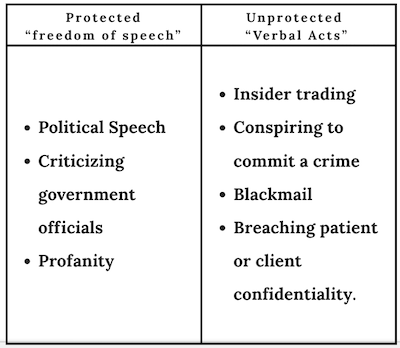
    • Use the language from the Gompers decision to create two categories on the board: speech protected by “freedom of speech” and “verbal acts” that are unprotected. It might be helpful to explain that this means that simply because words are used is not enough to make it “Speech” that is protected under the First Amendment.
  • Step 2:
    • Ask students to name some sorts of speech that are protected by the First Amendment. Depending on their level of awareness, it is normally not too hard to generate a few examples: political speech; criticizing a government official; profanity; and so forth. This should only take a minute – you just want a few examples.
  • Step 3:
    • Ask students what types of verbal acts can they think of that are not protected by free speech? They often struggle for a while, naming hard cases but ones implicated by free speech rights – for instance, pornography. You can put these in the middle of the two categories, as you can for anything you are not sure of. But some sorts of speech are clearly just verbal acts that raise no First Amendment concerns- insider trading, conspiring to commit a crime, blackmail, breaching patient or client confidentiality. If students are struggling, I give them one (insider trading) and see if they can come up with others. It normally only takes about 5 minutes or so, but it usually produces a fairly animated discussion, and helps clarify the conceptual issue by having students practice applying it.
  • Step 4:
    • After outlining the two categories, ask the students where Holmes was putting Schenck’s pamphlet. This one has a correct answer: He was saying it wasn’t like a piece of political speech; it was an act of interfering with the draft – one that just happened to be verbal, to take the form of speech – that could be regulated.

two column chart. The first column is titled "Protected "freedom of speech"" and in that column is listed 1) political speech, 2) criticizing government officials, 3) profanity. The second column is titled "Unprotected "Verbal Acts"" and below it is listed 1) insider trading, 2) conspiring to commit a crime, 3) blackmail, 4) breaching patient or client confidentiality

Classroom Exercise 3: Holmes Reconsiders

Content:
Overview & Primary Source: Abrams Pamphlet
Context
Holmes' Dissent Annotated
Group Questions
Conclusions and Key Takeaways

Overview:
If desired, you could assign the Abrams Pamphlet or the case dissent as homework reading. First, review the Context for yourself, then break students into groups for the activity.

  1. Have students read the Abrams dissent if they have not already.
  2. Have groups discuss the questions listed in the annotation.
  3. Provide students with information in the Context and Conclusion 

Jacob Abrams Pamphlet and Transcript

image of Jacob Abrams Pamphlet
“The Hypocrisy of the United States and her Allies,” August 1918, National Archives.

"THE HYPOCRISY OF THE UNITED STATES AND HER ALLIES

“Our” President Wilson, with his beautiful phraseology, has hypnotized the people of America to such an extent that they do not see his hypocrisy.
Know, you people of America, that a frank enemy is always preferable to a concealed friend. When we say the people of America, we do not mean the few Kaisers of America, we mean the “People of America.” You people of America were deceived by the wonderful speeches of the masked President Wilson. His shameful, cowardly silence about the intervention in Russia reveals the hypocrisy of the plutocratic gang in Washington and vicinity.
The President was afraid to announce to the American people the intervention in Russia. He is too much of a coward to come out openly and say: “We capitalistic nations cannot afford to have a proletarian republic in Russia.” Instead, he uttered beautiful phrases about Russia, which, as you see, he did not mean, and secretly, cowardly, sent troops to crush the Russian Revolution. Do you see now how German militarism combined with allied capitalism to crush the Russian revolution?
This is not new. The tyrants of the world fight each other until they see a common enemy — WORKING CLASS — ENLIGHTENMENT as soon as they find a common enemy, they combine to crush it.
In 1815 monarchic nations combined under the name of the “Holy Alliance” to crush the French Revolution. Now militarism and capitalism combined, though not openly, to crush the Russian revolution. What have you to say about it?
Will you allow the Russian Revolution to be crushed? YOU: yes, we mean, YOU the people of America!
THE RUSSIAN REVOLUTION CALLS TO THE WORKERS OF THE WORLD FOR HELP.
The Russian Revolution cries: “WORKERS OF THE WORLD! AWAKE! RISE! PUT DOWN YOUR ENEMY AND MINE!”
Yes friends, there is only one enemy of the workers of the world and that is CAPITALISM.
It is a crime, that workers of America, workers of Germany, workers of Japan, etc., to fight THE WORKERS’ REPUBLIC OF RUSSIA.
AWAKE! AWAKE, YOU WORKERS OF THE WORLD! REVOLUTIONISTS
P.S. It is absurd to call us pro-German. We hate and despise German militarism more than do your hypocritical tyrants. We have more reasons for denouncing German militarism than has the coward of the White House."

“The Hypocrisy of the United States and her Allies,” August 1918, National Archives


Context

  • In the fall of 1919, six months after the Schenck decision, another group of radicals appealed their conviction for wartime dissent. This time, the case concerned anarchists who had distributed a pamphlet calling for a general strike in New York City in an effort to prevent the production of war materials. They had been charged under a different section of the Espionage Act, one which made it illegal to interfere with wartime production.
  • In the Abrams case, seven of the justices simply applied the Schenck precedent from the spring and dismissed their appeal. As your class discussion might reveal, that seems sensible enough—if it had been illegal to advocate writing to a congressman, then calling for a general strike seemed even more of a “clear and present danger.”
  • But then Holmes did a surprising thing. Rather than applying his own precedent from only six months prior, he dissented – arguing that the anarchists had a First Amendment right to call for a general strike. What had happened?
  • Over the summer, Holmes’ decisions in the Schenck and Debs cases had been criticized by a newly emerging group of free speech advocates – intellectuals, lawyers and journalists that Holmes respected, and who were often friends. In particular, Harold Laski, a British-born academic teaching at Harvard and a close confidant of Holmes, waged a subtle influence campaign: sending Holmes reading material on the history and philosophy of free speech; arranging for Holmes to meet with a Harvard Law professor who had criticized the Debs decision. At the same time, Laski and other friends of Holmes at Harvard faced their own free speech crisis – they had spoken out in support of a strike of Boston police in 1919, and many were calling for them to be fired from the university.
  • These experiences changed Holmes’ mind about the value of free speech, and his dissent in Abrams reflected this new understanding. 


Holmes' Dissent Annotated:
Abrams v. U.S.​ Dissent
Persecution for the expressions of opinions seems to me perfectly logical. If you have no doubt of your premises or your power and want a certain result with all your heart you naturally express your wishes in law and sweep away all opposition. To allow opposition by speech seems to indicate that you think the speech impotent, as when a man says that he has squared the circle, or that you do not care whole-heartedly for the result, or that you doubt either your power or your premises. But when men have realized that time has upset many faiths, they may come to believe even more than they believe the very foundations of their own conduct that the ultimate good desired is better reached by free trade in ideas-that the best test of truth is the power of the thought to get itself accepted in the competition of the market, and that truth is the only ground upon which their wishes safely can be carried out. That at any rate is the theory of our Constitution. It is an experiment, as all life is an experiment. Every year if not every day we have to wager our salvation upon some prophecy based upon imperfect knowledge. While that experiment is part of our system I think that we should be eternally vigilant against attempts to check the expression of opinions that we loathe and believe to be fraught with death, unless they so imminently threaten immediate interference with the lawful and pressing purposes of the law that an immediate check is required to save the country."

  • The first thing to point to in this passage is that Holmes is not citing any cases. This is a sign that he is thinking more philosophically about what free speech should mean; and also that he is venturing into new territory, not covered by previous cases.
  • Classroom Discussion (Advanced Classes):
    • Does the role of judges only apply to already-existing law when deciding cases?
    • Or are judges creating law when they judge particular cases?
  • "If you have no doubt of your premises or your power and want a certain result with all your heart you naturally express your wishes in law and sweep away all opposition."
    • This sentence more or less sums up the approach Holmes took in the Schenck case six months prior - if you want to stop interference with the draft, why not ban speech that seeks to interfere with the draft?
  • "...ultimate good desired is better reached by free trade in ideas-..."
    • This is a crucial passage in the history of the First Amendment, where Holmes introduces the idea that there is a "Free trade in ideas" and that the best test of truth is whether it succeeds in the "competition of the market." While he doesn't use the exact phrase, this would come to be known as the "marketplace of ideas" - and the idea is closely related to his relativistic theory of truth: there are no guarantees that you can realize absolute truths, but the best method is to let all ideas be expressed, and see which becomes the most popular.
    • It is ironic that this defense of the free speech rights of radical socialists and anarchists is expressed in the language of the free market - for they were critics of the market. But Holmes had translated their calls for free speech into his own language, influenced by his reading of 19th century liberal philosophy.
  • "That at any rate is the theory of our Constitution..."
    • Holmes here warns us that there is no promise that truth will emerge from the competition of the market - you can't be sure that the best or most correct ideas will catch on.
    • But what it means to live in the American democracy, he says, is that you have to believe in that process of experimentation and trial and error, and that public opinion - even if based on imperfect knowledge - should be the guide to determining what is correct.
  • If it is true that the democratic experiment relies on the free formation of public opinion, Holmes suggests, then it is a dangerous thing to let governments block any expressions of opinion, even those we hate.


Compare Frameworks: Schenck & Abrams

Schenck:

  • Holmes says it is legitimate to police speech that might cause something you believe to be an evil.

Abrams:

  • Holmes warns against such censorship.
  • Censorship should be allowed only when it threatens "imminent" and "immediate" interference with a "pressing purpose."

Find the Abrams dissent here: Abrams v. United States (1919), National Constitution Center 


Group Questions:

  1.  Is the harm to the war effort here more or less severe than that in Schenck?
    1. In Schenck, the pamphlet asked people to write to their congresspeople to protest the draft; here the pamphlet calls for a general strike. Students should be able to see that a general strike would interfere with production more directly than a criticism of the war would interfere with the draft.
  2. Is the danger more "clear and present" in Abrams ​ or Schenck?
    1. Arguably, throwing leaflets out to workers is more direct than mailing them to soldiers or speaking to a picnic – you are directly addressing the audience you want to act, and asking them to act soon.

Portrait of Oliver W. Holmes in his judge robes. He has a large white handlebar mustache and is sitting in a chair.
“Holmes, Oliver W. Justice,” c. 1905-1945, Library of Congress 


Conclusions and Key Takeaways:

  • Holmes was not a radical, and he had no sympathy for the anarchists at the heart of the case – he thought they were advocating a “creed of ignorance and immaturity.” But he had come to believe that it was important to democracy to protect their rights to speech.
  • In the short-term, of course, that didn’t matter to the defendants in Abrams. A dissent doesn’t have any impact on the outcome of the case, which is determined by the majority decision – the anarchists were sent to jail, and later deported, for their pamphlet. But a dissenting opinion in a Supreme Court case also creates a record of the fact that some Justices disagreed with the opinion of the majority – and Holmes’s dissent in Abrams would become so famous and influential that it would end up becoming the legal consensus.
  • Over the twentieth century, Holmes’ dissent would guide the development of First Amendment law and philosophy, playing a crucial role in the rise of our contemporary right to free speech. Following from Holmes’ Abrams dissent, Americans today tend to speak of a “marketplace of ideas,” in which there is value to hearing from a diverse range of voices, even if you disagree with them, even if you think they might cause some harm you would prefer to avoid. But it wasn’t inevitable that this would be the way Americans came to think about the First Amendment.
  • It came out of a particular moment of history – the clashes between socialists and the government in World War I, the police strike at Harvard, and the influence of a small group of civil libertarians seeking to change the mind of one Supreme Court justice.


Optional Classroom or Homework Exercise:

  1. Ask students to identify a sort of speech today that they believe could be treated as a “verbal act” outside of the protection of the First Amendment.
  2. Ask them to make two arguments, one on either side of the question:
    1. If they had to make the case that it creates a “clear and present danger,” how would they do so?
    2. What are the benefits of protecting that speech as part of the marketplace of ideas? 

Remember: The goal here is not for students to necessarily decide on a complicated question, nor to correctly understand the current state of First Amendment law on these issues, but to practice applying the two different visions of free speech implicit in the Schenck decision and the Abrams dissent – one which focuses on regulating harms, the other on the democratic value of hearing all speech.

Amy Trenkle on Experiencing the First Amendment

Date Published
Image
Photo, students learning linoleum-cut printing
Article Body
Welcome our blog's first guest writer!

In the future, look for more entries by practicing teachers we've selected to bring you their experiences connecting students with primary sources and/or using technology and digital resources to support and enrich their teaching. Teachers will come from elementary, middle, and high school; some have been teaching for years and some have just started out. Each will have their own unique insights on teaching U.S. history and social studies.

Amy Trenkle teaches 8th-grade U.S. history at Stuart-Hobson Middle School in Washington, DC. A National Board Certified Teacher in early adolescence social studies/history, she has taught in DC since 1999. Amy believes in experiential learning and using the museums in her city and across the country to make concrete connections for her students to their history curriculum. She has served on several advisory boards to local museums, including the Smithsonian Center for Education and Museum Studies, the National Museum of American History, the Newseum and the National Building Museum. An active participant in the DC Council for the Social Studies, National Council for the Social Studies, and DC Geographic Alliance, Amy the received the DC History Teacher of the Year Award in 2005 as sponsored by the Gilder Lehrman Institute of American History. Currently, Amy is serving as an adjunct professor of education at American University.

Picturing the First Amendment

This year, celebrating Constitution Day was a school-wide affair.

Thanks to a special grant opportunity offered through the Newseum and 1 for All, students at my school became aware of, or reviewed, their First Amendment rights.

Students took a field trip to the Newseum, where they had a class taught by a Newseum educator about the First Amendment, and then visited the First Amendment Gallery, both highlighting issues related to the First Amendment today.

Upon returning to school, students in each grade level shared what they learned in different forms. The 5th grade made sidewalk chalk drawings, the 6th graders made a mural about their First Amendment rights, 7th graders left their impressions of the First Amendment via window drawings with washable window paint, and 8th graders made a linoleum print about the First Amendment.

Finding Your Freedoms

As the 8th-grade U.S. History teacher, I really wanted to emphasize the importance of the First Amendment—we will be studying it more in-depth later this year, but what a great opportunity to bring it to life now! To prepare my students for this trip, we took a walk around several blocks near the school. Students listed as much evidence as they could for our five First Amendment rights in action. I directed them not to just look for signs, but to listen for them and to really observe.

Students came up with the following:

  • Assembly: We are all walking as one group on the sidewalk.
  • Religion: The Imani Temple Church, Tibetan worship flags, a cross (for Christianity)
  • Speech: the Redskins sign, bumper stickers on car, mayoral candidate signs
  • Press: Newspaper stands, Washington Post newspaper

Armed with our examples in our neighborhood, I felt we were ready for our field trip. We had a great time—the students LOVE going to the Newseum. As a teacher, I felt that they deepened their understand of the First Amendment and connected it to what we did in class.

What Do Freedoms Look Like?

Our final activity, upon our return, was to synthesize what we learned through a print. Students were first asked to choose one of the five parts of the First Amendment to focus on. They then were tasked with finding a quote, lyrics, or saying that they felt related to that part of the First Amendment, and to cite it. Then, they drew a sketch of how they would illustrate this on a print.

The next day a local artist, Alexandra Huttinger, came in and taught the students how to make linoleum-cut prints. Each student carved his/her own linoleum and then printed their print. They then wrote what their print was about. These will be displayed in our school's foyer.

Taylor chose to focus on the Freedom of Assembly because "the right to assemble is very important to me." She chose to illustrate her drawing as she did because "to protest you could have megaphones and signs." From this activity she learned "that our First Amendment rights are important to us as Americans."

Virgil chose to illustrate the Freedom of Petition "because it got my attention because I remembered the Tea Partiers." He used a quote from his father: "We have a right to protest against things that we feel are not right." He chose to illustrate his right as he did "because people signing a paper to get things or to relieve things is a form of petition." As for the activity? Virgil says, "It is a really fun experience!"

Ashley chose to highlight Freedom of Speech. "I chose to focus on this particular part of the First Amendment because I think that the Freedom of Speech is used the most," wrote Ashley. She used a quote from Benjamin Franklin that she found on thinkexist.com: "Without the freedom of thought, there can be no such thing as wisdom, and no such thing as public liberty, without freedom of speech." Ashley explains her choice: "I chose to illustrate the First Amendment as I did because I thought it really illustrates what my feelings are about Freedom of Speech. The mouth represents speech and the flag as the tongue in the mouth represents freedom." She "enjoyed learning how to print and about our First Amendment rights again."

Whether it was new or a review for students, I felt, as a teacher, that my students were thinking about the First Amendment and their rights on Constitution Day. I'm very proud of their work!

For more information

Visit the Newseum's website to explore the museum's resources for students and teachers yourself.

Also check out 1 for All, a nonpartisan educational campaign seeking to celebrate and publicize the rights granted by the First Amendment. The website offers lesson plans for all grade levels, and links to further resources.

Oyez: U.S. Supreme Court Multimedia

Image
Supreme Court 1890. Photo by Napoleon Sarony. Courtesy Library of Congress.
Annotation

These audio files, abstracts, transcriptions of oral arguments, and written opinions cover more than 3,300 Supreme Court cases. Materials include 3,000 hours of audio arguments in selected cases since 1955 and all cases since 1995. Users can access cases through keyword searches or a list of thirteen broad categories, such as civil rights, due process, first amendment, judicial power, privacy, and unions.

Cases include Roe v. Wade (abortion), Gideon v. Wainwright (right to counsel), Plessy v. Ferguson (segregation), Grutter v. Bollinger (affirmative action), and Bush v. Gore (election results). Biographies are provided for all Supreme Court justices and "The Pending Docket" provides briefs and additional materials on upcoming cases. The website also includes links to written opinions since 1893 and podcasts featuring discussions of cases starting in 1793.

The Supreme Court and the Rights of the Accused

Description

Professor Jeffrey Sikkenga examines freedom of speech and continues on to examine the definition and development of the rights of individuals formally accused of crime. He focuses on the 1966 Supreme Court case Miranda v. Arizona and the 2000 case Dickerson v. U.S., which established and upheld the "Miranda rights"—that is, the reading of an individual's rights to silence and representation upon arrest.

To listen to this lecture, scroll to session 11, and select the RealAudio link to the left of the main body of text.

The First Amendment: Religion

Description

Professor Ken Masugi discusses legal definitions and development of the First Amendment's freedom of religion. He focuses on the 1992 U.S. Supreme Court case Lee v. Weisman, in which the Supreme Court decided in favor of continued limitation of prayer in public schools.

To listen to this lecture, scroll to session 10, and select the RealAudio link to the left of the main body of text.

The First Amendment: The Freedom of Speech

Description

Professor Jeffrey Sikkenga discusses legal definitions and development of the First Amendment's freedom of speech. He focuses on the 1989 U.S. Supreme Court Texas v. Johnson, which declared flag-burning an act of free speech and the 2003 Supreme Court case Virginia v. Black, which declared cross-burning a free-speech act. He begins with an examination of textual interpretation of the Constitution.

To listen to this lecture, scroll to session nine, and select the RealAudio link to the left of the main body of text.

The 4th Estate as the 4th Branch

field_image
speak to the world via radio
Question

Why is it that, while the media is referred to many times as the 4th branch of government, it is not explicitly stated as such? Is this something that would be or has been up for consideration? What arguments would favor or oppose this amendment to the body of our Constitution?

Answer

Calling the media the "4th branch of government" is a rhetorical device, not a serious statement of fact. The point is to emphasize that the press is not a mere passive reporter of the facts, but a powerful actor in the political realm.

Calling it "the 4th branch" not only emphasizes the amount of power it wields, but is often meant to suggest that that power is not under the control of the people in the same way that their elected representatives are. The implication is that it acts as a shadow government, unaccountable to the people, but is instead beholden to special interests of one sort or another, or that the press's supposed separation from the government is largely an illusion. The corollary is that the press sometimes menaces rather than protects, or controls rather than serves, the public.

The Phrase "4th Branch of Government"

The "4th branch of government" is a phrase that appears to have first surfaced among critics of FDR's New Deal in the 1930s. It referred not to the press, but to the collection of new Federal regulatory agencies with top officials appointed by the Executive Branch. Their function was quasi-judicial, and they were not directly accountable to the people.

Identifying the "4th branch of government" as the press came a decade or so later. Hartford Courant editor Herbert Brucker, in his 1949 book, Freedom of Information, devoted some ink to it. He explicitly equated "the 4th Estate" (another, older phrase often applied to the press, which has its own linguistic history derived from British and French politics) with "the 4th branch of government."

Journalist Douglass Cater entitled his 1959 book on the practical relationship between the government and the press, The Fourth Branch of Government. Both authors were convinced that, insofar as the press did act as a true political player (rather than an unbiased observer of politics), it corrupted itself and went astray from its primary responsibility—to convey important information and to act as a nonpartisan watchdog for the public against all trespassers on their rights.

Lately, some political writers have used the phrase, "the 4th branch of government," to mean the voters' power to form law directly through petition or referendum, as in California.

Freedom of the Press

The 1st Amendment of the Constitution says, “Congress shall make no law ... abridging the freedom ... of the press.” The Constitution establishes a government with three branches, but it does not establish a press or a media. What it does do is prohibit the government from trying to control what people say, either in the press (and by extension in other forms of media) or outside the press.

The core principle is that in the U.S., as distinct from many other countries, the media (and the people in general) are not established or granted rights or status at the discretion or pleasure of the government. Rather, the government's power is entirely derived from the "just consent of the governed." The point of the 1st Amendment is to make sure that the government does not overreach itself by trying to limit the basic rights of the people, such as their right to speak freely, including their right to criticize the government. The government does not grant that right. It already exists, no matter what the government might say or do.

The 1st Amendment states the consequence of that fact: Congress cannot limit freedom of speech. The Constitution recognizes the press's freedom as fundamental and prevents the government from infringing on it.

Another way of demonstrating this: The government, barring a few exceptional situations, has not put itself in the business of funding the press, much less actually running a news organization (rather than a public information office). One exception is the grant money that partially funds the Corporation for Public Broadcasting and National Public Radio (and fully funds international broadcasting entities such as Radio Free Europe, Radio Liberty, and Radio Free Asia).

Another exception is Voice of America, the government agency that broadcasts radio and television abroad. VOA is prohibited by the Smith-Mundt Act, however, from disseminating its programming directly to the American people. This was partly out of fear that an administration would find it a useful tool for selling itself to its own constituents and thereby unfairly consolidating its own power against its political opposition.

Potential Upside of Making the Press a Separate Branch of the Government

Incorporating the press into the government would make the media more accountable in some sense for what it says and does, and would make it less dependent on large commercial interests for success. It would likely make the media more careful and guarded about what it said. No matter what your political perspective, it is not difficult to think of instances where that would have been a good thing.

Politicians and journalists have recently talked about giving government subsidies to news organizations suffering from a dwindling subscriber base and shrinking audience or advertising revenues. This idea they justify under the notion that the press or the media is a kind of public service or utility and is valuable to the general welfare of the country. This would be an of extension of the idea of the electromagnetic broadcast spectrum as a public resource that is allocated and protected by the Federal Communications Commission.

Potential Downside of Making the Press a Separate Branch of Government

Trying to bring the press under the umbrella of the government, even as a separate "branch," would join the interests of the press with the interests of the government that funded it, making it less likely to criticize the government. The press, then, as a government entity, would be perceived (and truly function) as a propaganda ministry, a partisan political tool.

This would jeopardize the press's credibility as objective, making it less valuable to the public. It would also introduce a largely unpredictable period of experimentation, resetting the most fundamental structure of the government by adding a 4th branch. It would also re-frame the relationship of the government to the people, from one in which the government is granted its limited power by the people (who always maintain their rights), to one in which the government is the granter and administrator of rights, such as, here, freedom of speech.

There are many countries in the world where this is the model. Many of them have media that are largely or even exclusively government-run (or at least government-funded). Despite the occasional desire of politicians or government bureaucracies to control a media that annoys or criticizes, the Constitutional guarantees of freedom of speech and of the press have largely prevented such action here.

Exceptions to the Freedom of the Press

By law, the press is limited in its content when such content would be libelous, obscene, seditious (leading to "imminent lawless action"), or would threaten national security or the public safety. Restrictions on "hate speech" also limit the freedom of the media, as do copyright laws. It has been along the border of these limitations that skirmishes between the press and the government have been fought for nearly the entire history of the U.S.

Such skirmishes began in earnest with the passage of the Sedition Act of 1798, which, for a time, made it an offense "To write, print, utter or publish, or cause it to be done, or assist in it, any false, scandalous, and malicious writing against the government of the United States, or either House of Congress, or the President, with intent to defame, or bring either into contempt or disrepute, or to excite against either the hatred of the people of the United States, or to stir up sedition, or to excite unlawful combinations against the government, or to resist it, or to aid or encourage hostile designs of foreign nations."

Nevertheless, it is a sign of how little support the Constitution gave to the government to define for itself the content of what the press could publish that 1st Amendment cases involving questions of the freedom of the press were decided in what historian Lucas Powe calls a "haphazard" fashion until the 1964 Supreme Court decision of The New York Times v. Sullivan, which clarified what constituted libel and what did not.

Bibliography

Herbert Brucker. Freedom of Information. New York: Macmillan, 1949, pp. 9-16.
Douglass Cater. The Fourth Branch of Government. Boston: Houghton Mifflin, 1959.
Lucas A. Powe, Jr. The Fourth Estate and the Constitution: Freedom of the Press in America. Berkeley: University of California Press, 1991.
Lyrissa B. Lidsky and R. George Wright. Freedom of the Press: A Reference Guide to the United States Constitution. Westport, CT: Praeger, 2004.
Text of the Sedition Act of 1798.