Research, Sports, and Civil Rights

Date Published
Article Body

Civil rights units often focus primarily on Black Americans and male leaders, which can unintentionally disconnect the Black Civil Rights Movement from similar movements it inspired or that developed alongside it. Movements such as disability rights and women’s rights were influenced by similar historical developments, including World War II and the GI Bill. A hyperfocus on figures like Martin Luther King Jr. and Rosa Parks can also narrow students’ understanding of the Black Civil Rights Movement by limiting the perspectives they are encouraged to consider. Additionally, students sometimes struggle to see how the civil rights movement continues to influence their own lives.

Placing civil rights in the context of sports gives students a familiar backdrop to engage with. It also provides teachers with an opportunity to incorporate movement into the classroom, perhaps through a short game of basketball or baseball at the conclusion of the lesson. Teachers can structure the discussion by modeling the historical research process.

To begin this sports-based civil rights inquiry, the class could work together to develop a historical question related to one of the following subjects:

  • Jackie Robinson
  • Bill Russell
  • Women’s Basketball
  • Wheelchair Basketball

Jackie Robinson and Bill Russell were influential figures in their respective sports who challenged and spoke out against racial segregation in different ways. Russell confronted racial attitudes in Boston and sometimes expressed views that differed from Martin Luther King Jr.’s approach. Comparing Russell to Robinson—whose story is often more familiar to students and more aligned with the standard narrative of the Black community’s approach to civil rights—exposes students to regional differences and diverse perspectives within the movement.

Additionally, Jackie Robinson, like Tim Nugent—the founder of wheelchair basketball—was a veteran who received GI benefits for his service. Nugent worked at a VA hospital at the University of Illinois with disabled veterans and developed wheelchair basketball to foster confidence and independence among students. His team, known as the Gizz Kids, competed in the National Wheelchair Basketball Tournament, which was formed in 1949. Wheelchair basketball was also one of the sports played at the first Paralympics in Rome in 1960.

The history of women’s basketball can also be connected to women’s suffrage and the broader struggle for equality. A useful point of comparison is the GI Bill and Title IX—examining what each provided for Americans and which groups were able to benefit from those policies.

Building on these connections, students should research each figure, sport, or league through guided inquiry rather than simply receiving information. Walk them through advanced searches using resources such as JSTOR, the Internet Archive, and Google Scholar.

An example might look like this:

Teacher: “How does Jackie Robinson connect to the Black Civil Rights Movement?”
Students: “He broke the race barrier in baseball.”
Teacher: “What were his personal views on the movement? How did his status as a veteran shape his civil rights story?”

At this point, turn to JSTOR or Google Scholar and demonstrate how to use advanced search tools to locate relevant scholarship. After selecting an article, show students what to look for in a credible source. Model how to skim for key arguments, conduct targeted keyword searches within the text, and take concise notes. These notes can also help gauge participation, especially from quieter students.

Repeat this process for the other figures, sports, and movements, asking students to reflect on the commonalities and differences they observe.

Some content can be delivered through brief mini-lectures when necessary to manage time effectively. For example, Jackie Robinson and Bill Russell could be incorporated into guided research activities, while wheelchair basketball and the different waves of feminism might be addressed through concise mini-lectures. Below are some potential sources and databases that teachers can either guide the class through or present during the class discussion as needed. 

Sources: 

  1. Chinese-American Women in Basketball
  2. Sports and Society 
  3. Disabilities and Sport
  4. Black Civil Rights and Sport Activism
  5. Black Power Movement
  6. 1968 Mexico City Olympics Reflections
  7. White Power, Black Power and the 1968 Olympics Protests
  8. Timeline of Women’s Legally Protected Rights
  9. Special Education and Disability Services
  10. The Philadelphia Tribune Girls

Accessible databases and archives: 
  1. Jstor
  2. Internet Archive
  3. Google Scholar
  4. Library of Congress


Jacob Lawrence: The Migration Series

Annotation

The Jacob Lawrence: The Migration Series is a project of the Phillip Collection to showcase the story and work of the painter Jacob Lawrence (1917-2000) in the context of the Great Migration period (1910-2010) in American history. Lawrence’s art focused on the experience and history of African Americans and was further impacted by his experiences during the Great Depression of the 1930s and after. During the Great Depression, Lawrence worked with the W.P.A., and in the decades that followed, he became one of the most celebrated African American artists who traveled the world and nation. The Migration Series is one of Lawrence’s most famous and impactful bodies of work that showcases the story of the Great Migration that reshaped the racial geographical layout of the nation throughout the 20th century. The Great Migration can be seen in two parts: an exodus from the Southern states during the early 20th century and then a return to those states in the later parts of the 20th century and into the early 21st century. Both mass movements were driven by economic and social hardships, and by the promise of work and personal freedoms. In the early parts of the 20th century, Black Americans did not have the same liberties and work opportunities in the South as they did in the North. Following the Black civil rights movement, a decline in job growth in the North, and the passage of the 1965 Civil Rights Act, Black Americans returned to the South.

Despite its narrow focus, the site readily lends itself to the classroom through its resources and engaging nature. There is an interactive map showing the movement of Black Americans during the migration period of 1910-1970 and the reverse migration of 1980-2010. Videos filled with contemporary commentary connected to the artworks of Jacob Lawrence are also shown, and a playlist with music connected to the overall theme of the project that further engages with the user. Additionally, there is a collection of primary sources, like photos and transcribed letters, showing what life was like during these migrations, shaping the social and cultural framework of the nation. 

This project covers a largely overlooked part of American history in the classroom that did not impact Black Americans in an isolated manner, but the whole of the nation. The Great Migration fits into three main additional subjects already covered: the Black Civil Rights movement of the 1950s and ‘60s, the Interwar Period, and labor history. Often, the experiences and impact of Black Americans during the Interwar Period and labor history are not included to their full depth. This project allows for such inclusions within the class time used to discuss the Interwar Period and labor history, and a deeper understanding of the Black civil rights movement. The Great Migration and the Black civil rights movement are linked and feed from each other in the ebb and flow of people and their ideas across the nation. 

This project can be used to explain the factors that led to the Black civil rights movement of the 1950s and ‘60s within a Civil Rights unit.  Another unit this project works within is the Great Depression; highlighting the movement and experiences of Black Americans in response to the economic hardship of the Depression will allow Black American history to exist outside the silo, or units, covering slavery, the Civil War, and the Black civil rights movement. The Migration Series can be part of a larger effort to correct the over-fixation on white American history in a nation that is known as a melting pot.    

Teaching American History

Annotation

Teaching American History was created after the late Senator Robert Byrd secured funding for the project from the Department of Education with a goal to improve civics and American history education. In 2001, the site started with a $50 million budget as part of the No Child Left Behind efforts of President Bush. While the grants from the Department of Education have ceased since Senator Byrd died in 2010, the non-profit Byrd Center continues to fund the maintenance of the site through the Annual Teacher Institute Program. This was done in collaboration with the Ashbrook Center at Ashland University in Ohio. Ashbrook Center is an independent academic center aiming to counteract political influence on the education of K-12 students.

In line with their goal to minimize the impact of political biases on students’ education received by the students, the site contains a solid foundation in primary documents and reliance on historians’ expertise.  The site has collections of historical documents compiled into books, which are available either for purchase or free download. The ability to freely download the books makes them financially accessible. 

The emphasis is on the Founding and Civil War Eras, through legal and government-based primary sources; such a focus will allow this site to lend itself nicely to units on the aforementioned topics. However, the site does not provide primary sources produced outside the legal and governmental worlds, such as newspapers, photos, or average people’s writings, that would provide an expanded pool of sources to pull from for lessons. 

One great resource provided by the site is the podcasts created for teachers, which provide in-depth discussions and understanding on topics connected to the Founding and Civil War Eras. Podcasts can be listened to while completing other tasks, cutting down prep time for lessons. Additionally, the lesson plans provided by the site provide not only additional resource suggestions for the teacher, but also outlines of classroom activities fit for specific grade ranges with appropriate grading rubrics and selected suggested primary documents to use within the classroom. This site may be used to cut down planning time for these units that may be used for other units or other time-consuming tasks. The only unfortunate part of the lesson plans is that some of the links to the lesson plans are not functioning. Despite some of the links not working, those that do offer a blueprint for similar topics for teachers to use to create their own lesson plans, as the non-operational links are scattered between topics covered by the site. For example, the Great Depression and World War II section has a few links to lesson plans that do not work, but others do, which themselves may be used by educators to form their own plans covering the topics that the broken links would cover. 

This site is a good starting point for the topics it covers for teachers, such as the government, the Founding Era, and the Civil War. It features free resources that help to provide useful context to the primary documents. These defects are likely the result of the lack of continuous funding for the project. Defects that may be improved upon if further funding were provided to the scale it was first seen in the early 2000s. The best resources from this site are the lesson plans, primary documents, and podcasts. The plans given could be used as a framework for the teachers to draft their own lesson plans for topics not covered by the site

Open Parks Network

Image
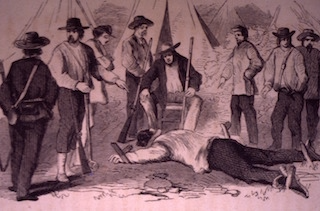
Drawing of prisoners of war, Andersonville, Georgia.
Annotation

In conjunction with the National Park Service, Clemson University has digitized over 350,000 cultural heritage objects and 1.5 million pages of unpublished sources housed in over 20 national parks and historic sites. All images are high-resolution and downloadable.

Each park’s page contains a number of source collections, generally grouped by topic or time period. Open Parks Network allows users to find sources in a number of ways. Users may search by park, source collection, or keyword. For instance, the user can choose to see all collections and items from Andersonville National Historic Site by clicking on the park’s name.

Alternatively, users can navigate directly to a collection of Outer Banks Shipwrecks by browsing an overview of each park’s collections. Open Parks Network also features a map illustrating the number of sources from each geographical location that users can use to access sources. Each of these options are conveniently located in a single “Explore” tab.

The classroom utility of Open Parks Network’s sources varies widely. While the sources within some collections could be beneficial for classroom source analysis and research (e.g., the collection of Civil War Newspaper Illustrations on the Fort Sumter National Monument page), other collections would be of greater use to those with a specialized interest in a park’s operational history (e.g., the collection of Kings Mountain National Military Park Personnel). None of the sources come with any descriptive text, which can make it difficult to contextualize sources.

Instructors and students may find Open Parks Network useful for a variety of classroom activities, including using sources to encourage historical thinking about the past that the parks memorialize or about the parks themselves. This site might be of particular interest for teaching about the National Park Service, given its centennial anniversary in 2016.

Aitkin County Historical Society, Depot Museum, and Log Museum

Description

The Society operates a museum complex, complete with research resources, special exhibits, and a museum gift shop. The Depot Museum is housed in the historic 1916 Northern Pacific Depot. The building is listed on the National Register of Historic Places. The museum features a rotating schedule of exhibits regarding the heritage of Aitkin County. Riverboating on the upper Mississippi, native culture, and unique artifacts are explored and displayed in the exhibit halls. The Log Museum was the first home of the Society and was constructed in 1950 with native cedar logs. It was originally located on the court house lawn and moved to its present location in the mid-70s. Exhibits relate to the county's logging heritage, agricultural implements, and tools from the building trades.

The society offers occasional living history events, research library access, and educational and recreational events; the museums offer exhibits and tours.

Digital Public Library of America

Image
DPLA logo
Annotation

The Digital Public Library of America (DPLA) serves as a portal to the digital collections of more then 40 state, regional, and online-only libraries, museums, archives, and other cultural institutions. Created to strengthen access to public resources and to "create novel environments for learning, tools for discovery, and engaging apps," the DPLA is an invaluable first stop for teachers and students looking for primary sources, particularly regional history sources.

Visitors to the website can search the more than 4,500,000 objects in the collections of participating institutions using keywords, returning results they can filter by format, owning institution, partner, date, language, location, and subject. Clicking on an object brings up detailed metadata, including creator, date of creation, and a description of the object, as well as a link to its original location online. Visitors who create a free account can save their search results, make them private or public, and share them via Facebook, Twitter, or Google+.

Visitors can also browse objects on a map or timeline—a fantastic way to prompt thinking about how primary sources are located in time and space. The timeline stretches from 1000 BCE to the present. (Note that zooming into the map returns finer results.) In addition, more than eight virtual exhibits demonstrate how DPLA sources can be curated to tell stories about themes and events.

The DPLA's API (application programming interface) allows visitors with the know-how to create apps drawing on the DPLA's collections. An eclectic set of more than 10 apps lets visitors browse DPLA's search results as a "river of images," discover primary sources related to their Zotero bibliographies, and more.

A fantastic starting point for anyone looking for primary sources, teachers can feel confident pointing students towards the DPLA to begin research projects or turning to the DPLA themselves to find resources to support lesson plans.

Acton-Shapleigh Historical Society [ME]

Description

The Acton-Shapleigh Historical Society is dedicated to preserving the history of the Acton and Shapleigh areas of rural Maine. The society boasts an impressive collection of historic artifacts and photographs, along with a one room schoolhouse which showcases the early history of the area.

The society offers guided tours of the schoolhouse and special events. The website offers an events calendar along with detailed historical information regarding the Acton-Shapleigh area.
