Tennessee's Social Studies Curriculum
field_image
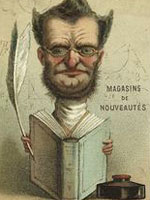
Chromolithograph, "Trade cards. . . ," c. 1876-1890, NY Public Library
Question

When did Tennessee adopt a Social Studies curriculum? Have there been changes made over the years?

Answer

Tennessee, as far as we can tell, adopted its first curriculum framework during the 1982-83 school year. Previous to that effort, frameworks with standards were not formally articulated as they are today. James Akenson of Tennessee Tech (who was helpful in putting together this response), pointed out that the curriculum framework emerged at the same time as the "A Nation at Risk" report, which many scholars see as the birth of the standards movement. Those standards were in place until 1996, when they were revised for the first time. In 2001, a major revision effort took place under the direction of a committee of K-12 teachers, state department of education personnel, and representatives from higher education.

In crafting the Tennessee Social Studies Curriculum Standards, the group used the previous standards, the National Council for the Social Studies standards, current educational research, and curriculum frameworks from other states as guides. Finally, according to a representative in the state department of education, Tennessee will begin the revision process again prior to the next textbook adoption four years from the current (2009-2010) school year.

Take Me Out To The Ball Game: 100 Years of Musical History

Description

This Electronic Field Trip takes a look at the song, "Take Me Out to the Ball Game," written by Jack Norworth and Albert Von Tilzer a century ago. Today, "Take Me Out to the Ball Game" is synonymous with a baseball game's seventh-inning stretch, but the song was originally written to be performed on home pianos and the vaudeville stage.

Broadcast from Brooklyn, NY, this presentation explores not only the history of "Take Me Out to the Ball Game", but also the influence of various musical styles of the past 100 years from vaudeville and swing to rock and hip hop.

Unpublished, as the page no longer exists.

Worklore: Brooklyn Workers Speak

Image
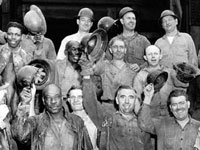
Photo, Brooklyn Battery Tunnel Construction Workers, 1947
Annotation

This site explores the work lives of Brooklynites (historic and present) as they made their living in the borough. The site has four main sections: Confronting Racial Bias documents discrimination in the workplace; Women Breaking Barriers examines the ways in which women's work roles changed over the decades; Seeking a Better Life takes a look at the issues facing new immigrants; and Changes in the Workplace discusses challenges such as unemployment and job displacement.

Each section contains an approximately 2,000-word article on its respective topic, photographs, and audio files of people speaking about their various vocations. The site also includes eight help wanted advertisements from the 1850s, 1860s, 1920s, and 1930s.

Visitors should not miss the interactive feature Can You Make Ends Meet?, where they can pick one of four vocations, and see if they can stretch their salary out to adequately include housing, transportation, and entertainment.

Telling Your Story allows visitors to share their own recollections of Brooklyn life. The site includes few primary sources, but the personal stories of Brooklyn workers may be useful to students, teachers, or researchers.

Brown@50: Fulfilling the Promise

Image
Photo, School integration. Barnard School, Washington, D.C., May 27, 1955
Annotation

Created for the 50th anniversary of the Brown v. Board of Education decision, this website provides the legal history of the court case, and focuses attention on Howard University's contributions.

The website is divided into five main sections. Chronology presents a timeline of events and offers links to external resources. Brief History is a concise background of the Brown v. Board case and an overview of the case details and impact. Cases & Other Law provides a "legal road to Brown," with court decisions leading up to and following the Brown decision. Biographical Sketches introduces key figures. And Educational & Other Resources links to a wide variety of external websites and resources pertaining both to Brown v. Board of Education and to civil rights more generally.

Brown@50 will be especially useful to those researching the legal arguments of the Brown v. Board of Education Supreme Court case.

SpaceProgramArchive.com

Image
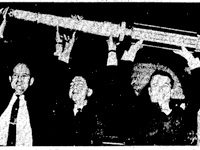
Photo from Press Telegram, February 1, 1958
Annotation

On October 4, 1957, the Soviet Union launched the satellite Sputnik, effectively beginning the "space race" with the U.S. that would last throughout the Cold War. Sputnik followed more than 25 years of research by scientists interested in rocket propulsion. This extensive archive presents more than 50,000 scanned newspaper pages, shedding light on virtually all aspects of the space program from 1930 through 2009. A good place to begin is the website's "Timeline" section, which highlights prominent events in the history of space discovery, such as the Guggenheim Foundation's decision in 1935 to support Dr. Robert H. Goddard's research into self-propelled rockets, and the launch of the Challenger in 1985 which made Sally Ride America's first woman in space. It also provides links to newspaper articles. An "Advanced Search" features allows users to input specific search terms and dates and retrieve newspaper pages—primarily from newspapers published in smaller and medium-sized cities in the south, mid-west, and California (Fresno, Jefferson City, Tuscon, Danville, VA) covering those events. The archive's decision to provide full scanned newspaper pages (as opposed to transcribed articles) allows users to better historically contextualize these events with other prominent contemporaneous events.

Classic African American Literature

Image
Logo, Multicultural Pavilion
Annotation

Provides links to 49 full-text versions of books, essays, articles, and poems about African-American life and culture, from the 18th century to the present day. Authors represented include Frederick Douglass, Harriet Beecher Stowe, Chester W. Chesnutt, James Weldon Johnson, Marcus Garvey, Rita Dove, Booker T. Washington, Phillis Wheatley, and Maya Angelou. Many texts are from the University of Virginia's Electronic Text Center.

Doing Oral History

Image
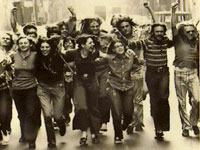
Photo, From project, "The Stonewall Riots and Their Aftermath"
Annotation

A collection of 17 oral histories conducted by secondary students focusing on topics relating to "The American Century": World War II; the Cold War; Vietnam; the "rights revolution"; immigration; education; and science and technology. Each oral history entry contains a biography of the interviewee, historical contextualization and evaluation essays, and bibliography.

The site provides tools for teachers to use in designing oral history courses: release form for interviewees, pre-interview worksheet, "do's and don'ts," guidelines for transcribing and editing interviews, how to analyze the historical value of an interview, grading rubrics, and student feedback. Also offers a 36-title bibliography, including 24 links to related sites. Of interest to teachers preparing oral history courses and for those studying selected 20th-century American history topics.

Central Pacific Railroad Photographic History Museum

Image
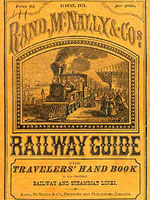
Travel guide, Rand, McNally, & Co., 1871
Annotation

On May 10, 1869, in Promontory Summit, UT, a rail line from Sacramento, CA met with another line from Omaha, NE. When the last spike was driven, the Central Pacific became the first transcontinental railroad. This site provides a vast collection of online materials documenting the history of the Central Pacific Railroad and rail travel in general, as well as material on the history of photography. The site boasts more than 2,000 photographs and images, including stereographs by Alfred Hart and Eadweard Muybridge; engravings and illustrations from magazines, travel brochures, and journals; and more than 400 railroad and travel maps. Also included are more than 60 links to images and transcriptions of primary documents dealing with the construction and operation of the railroad, including government reports, travel accounts and diaries, magazine and journal articles, travel guides, and railroad schedules.

A separate section documents the Chinese-American contribution to the transcontinental railroad, including four scholarly articles, two links to Harper's Weekly articles and illustrations about Chinese workers, a bibliography of 15 scholarly works, and links to more than 20 related websites. Timelines on the building of the transcontinental railroad from 1838 to 1869, the history of photography from 1826 to 1992, and the development of the railroad from 1630 to 1986 also help to contextualize the history of the railroad in America. The volume of information on the home pages make this site slow loading, unwieldy, and confusing to navigate, and there are no descriptive captions or other information on most of the images. But the site is keyword searchable, and for those interested in the history of railroads, this site is certainly worth the time.

The North Star: A Journal of African-American Religious History

Image
Logo, North Star Journal
Annotation

The complete archives and current editions of a journal about African-American religious history from the 18th to the 20th centuries. The first issue was published online in the fall of 1997. Each issue includes one or two scholarly articles of 30 to 40 pages, two to four book reviews, and a 200- to 2000-word discussion of research resources. In addition, each issue provides a list of Internet resources for research in African-American Religious history. Articles address topics such as "church media and racial discourse" (Lawrence Little) and "rap, religion and the politics of a culture," (Charise Cheney). The site will be useful for research in African American history and the history of religion in America.

Voices of Civil Rights

Image
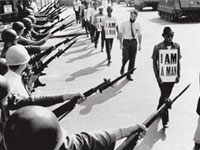
Photo, Protesters on Beale Street, 1968
Annotation

This website represents the initial effort to create an archive of stories about the civil rights movement (both historical and contemporary), including essays, interviews, project updates, and special reports. While the site is under construction, currently there is already substantial material available, most of which is organized into one of five sections.

An interactive "Timeline" serves as in introduction to the Movement, highlighting major events and accomplishments. "Stories" allows visitors to read more than 100 personal stories about America's civil rights history (10 stories include audio excerpts). Visitors can peruse the section devoted to the contemporary civil rights movement and its historical legacy. Here visitors can listen to interviews about the promise of equal education with Wade Henderson, Executive Director of the Leadership Conference on Civil Rights, as well as many other activists. Students and teachers will find this site a convenient collection of primary accounts of the Civil Rights Movement, including the Chicano Movement and the National Organization of Women.