Plattekill Historical Society
Description
Cannot find a website with substantial information.
Cannot find a website with substantial information.
The mission of the Society is to operate and maintain the Lauder Museum and to encourage and promote the discovery, collection, preservation, and display of historical objects. In addition, the Society disseminates and publishes historical facts and knowledge about the activities, sites, memorabilia, and materials of the South Shore of Long Island in and around Amityville.
The museum offers exhibits, tours, and research library access.
Seems to be modern urban design organization.
"The Homeville Antique Fire Department started in 1979 with the purchase of the 1927 Brockway truck and has grown over the years to what you see listed above. The apparatus are stored in a 48' x 60' steel building erected in 1994. All the apparatus except the '27 Brockway and the '35 Ward LaFrance are fully equipped and operational. Those two units are undergoing frame up restorations. I offer information, parts, manuals, and paint numbers and other technical assistance to anyone needing such American LaFrance related info. If I do not have it, I can more likely than not, get you in touch with some one who does."
The Neighborhood Preservation Center is a project of the St. Mark's Historic Landmark Fund, and is dedicated towards helping and aiding organizations and citizens across New York with preservation and restoration projects dealing with both the natural and built environments. The center is housed in the 1901 Beaux Arts building, which was designed by Ernest Flag. The center is primarily a resource center which provides the public with meeting rooms, office space, and an online resource database and library, though the center also puts on educational events and exhibits from time to time.
The site offers database and library access, as well as information on upcoming events.
All regularly accessible resources are digital. Above listing was pre-existing.
Video 1:
Video 2:
Video 3:
Video 4:
What does an 1853 daguerreotype have to say? Plenty, says Frank Goodyear. He examines a photograph taken at Niagara Falls and shows how, with a little analysis and research, the photograph fits into the context of the growth and spread of new technologies in the U.S. (including photography and railroads) and the tourist industry.
This particular image struck me, not only because of its early date—this particular image was done in 1853, less than 15 years after the introduction and invention of the photographic medium—but also because of its size. Most 19th-century photographs that you look at are quite small. And this is a full-plate daguerreotype that has been encased in this gilded frame. Obviously a tremendous amount of care has gone into constructing this image. This would not have been something that would have been bought for next to nothing. Somebody would have invested a certain amount of money and that the photographer has gone to extraordinary lengths to try to create, some type of souvenir maybe, a document that speaks to these tourists' experience at this very special American landmark—Niagara Falls.
When I saw it the first time, it of course reminded me of snapshots that we all take of family members on vacation at scenic landmarks whether it be Yosemite, Yellowstone, here the example being Niagara Falls. But as I looked at it more and more, it was obvious that this was a very carefully constructed image that was not simply spontaneously done. That it follows certain pictorial traditions in terms of the visual iconography of Niagara Falls, and that there was nothing spontaneous at all about it.
When reading photographic texts, I typically follow three lines of inquiry. And let me just review very briefly what those questions are. The first question of course is: "What is it?" For there is not one photography, but there are many 'photographies.' It is important, I think, to have students acknowledge or to understand the great variety of different formats, techniques, approaches; so it's very important to look very closely at what it is. In this case, "it" being a full-plate daguerreotype from 1853.
A second question would be: "How has the photographer figured his or her subject?" Indeed, what is the relationship between the photographer and his subject? What decisions has the photographer made in creating this image?
And a third series of questions that I would ask of a picture like this would be: "How is this photograph being used? What is the context in which this image is being seen?" Photographs are not made in a vacuum, there are reasons for taking pictures like this and I think it's important that—and this is what makes me excited as an historian—to try to unearth what this picture is about, why it was created, how it was used, how this subject that was depicted here was understood.
If we go inside the picture itself, you'll notice how a group of these tourists have been lined on the very brink of the American Falls. One of the things that strikes me as particularly curious is the fact that all these characters have their backs to us. They're not facing the camera, as we might typically do if we were standing at a tourist landmark today. One all of a sudden asks, "Are these people even aware they're being photographed? Has the photographer somehow surreptitiously taken their photograph?"
And as an historian, we don't necessarily have the answer—I don't have the answer for that question. But what I do know, of course, is that there's a long visual tradition of posing figures in front of sublime landscapes that goes back to 18th-century English landscape aesthetics. One of the things is the great number of these pictures that are absolutely identical to each other, except for the very fact that there are different configurations of characters here at the brink of the falls. Obviously you begin to understand that this particular image is not unique, it’s part of a well-constructed formula that the photographer has set out.
Actually the photographer has made, in this case, a great number of very deliberate decisions. So what are those decisions? Well, first of all he's decided to take pictures at this particular site itself. Why Niagara Falls as opposed to Trenton Falls, or the Potomac River? Well, Niagara Falls is this sort of "National Icon"; it is a landmark that Americans have invested with a great deal of significance—patriotic significance.
Other decisions that the photographer perhaps is making include what he has chosen to include and to leave out. I find it particularly interesting in this view that he does include a tree on the left-hand side of the image. It sort of frames the picture; it suggests that this is the left-hand margin of our picture. That he has also within the frame tried to capture the panoramic sweep of the falls. If you've ever been to the falls, you know that there are…it's not just one single fall, it's a series of three or four individual falls—American Falls, Horseshoe Falls—and here the photographer has tried to provide information about the entire panoramic sweep. That's another, I think, very deliberate decision.
Who exactly is Platt Babbit? Where did he come from? What is his background? Does he have artistic training? What type of business does he run? How has he gotten to this site? And, what of course is his relationship to the subjects that he's photographing?
A little bit of research will reveal that Babbit carved out a very successful career as a commercial landscape photographer in the service of tourism. Which provides a nice bridge in to a fourth concern, which would be that this photograph participates in the cultural practice of tourism; a phenomenon that grew into a mass-market phenomena in the mid-nineteenth century at places like Niagara Falls. And I would argue that photography was instrumental in defining the boundaries of the modern tourist experience. For photography taught people where to go, what was worth seeing. Photography educated the eye of the tourist, showing him or her how to see a particular site.
And last of all, photography served as one of the central rituals of one's tourist experience. These people are tourist who have traveled—as records from hotel registries at Niagara Falls indicate—from as far away as, not only New York and Boston, but also London and Paris. Niagara Falls, thanks to photography—and at the same time the promotional efforts of other tourists developers like the railroads and the hotels are responsible for advertising places like this to a clientele that reaches not only throughout the United States, but as far away as Europe as well. And these are those who have the disposable income at the time and the inclination to go to a place like Niagara Falls.
First of all would be to Niagara Falls itself, and to try to understand what this landscape actually looks like. I mentioned earlier that photographs are very interesting documents because they seem to be transparent windows into this site. And yet, at the same time, this is not all that Niagara is, that this transparency is not so…this is a very constructed image. So, I would sort of understand…where else could he have set up his camera? What other perspectives could he have used to shoot this picture? I'd also look at guidebooks—guidebooks to Niagara Falls. Where are the tourist developers, the hotels, the railroads, encouraging people (visitors) to go to see these particular images? For often times there are elaborate descriptive texts that shape how one navigates one's experience at a place like Niagara Falls. Interestingly, many of these tourist guidebooks were illustrated with engraved reproductions of photographs—by Babbit—in a sense holding out the photograph, "Here it is. This is what you're looking for. This is your goal," in a sense.
And then of course, another level of research involves trying to understand Babbit as a businessman. How did he make a living? Is all that he did landscape photography? Was there a market in the 1850's for simply landscape photography? Who was underwriting him? What is the machinery responsible for creating the tourism infrastructure at a place like Niagara Falls? One thing right away that you think about, of course, is the railroads. And there is some evidence that in looking at railroad archives related to lines that went to the falls, that Babbit was being commissioned to take photographs; that these railroads were buying his images to be used in their promotional materials.
I think looking at local newspapers, that speak to his sort of business at this very specific site, and what you learn, of course—if you do that type of archival research—is that Babbit had a thriving studio right on Main street in Niagara Falls. That he had commercial arrangements with souvenir shops at the site itself. That he had a little business pavilion, right next to his pavilion here at the brink of the falls. So that though we only see in the image itself a bunch of tourists lined up at the falls, in fact behind the picture is a vast world of information about Babbit, that I think allows us to better understand how we get to this [i.e. to the picture].
Freedom's Journal, published weekly in New York City between 1827 and 1829, was the first African American owned and operated newspaper in the U.S. This website presents digitized copies of all 102 issues of Freedom's Journal, available for download in PDF format. In the pages of this newspaper, visitors will find regional, national, and international news, anti-slavery and anti-lynching editorials, and biographies of prominent African Americans, as well as items of interest to New York's African American community, such as obituaries, births, and marriages. The website also provides several links to additional resources on the black press, including a brief biography of Freedom's Journal and a piece by one of the newspaper's subscription agents: David Walker's 1829 Appeal, which called for slaves to revolt against their masters, and is "arguably the most radical of all anti-slavery documents."
A collection of 10 essays on "the modern American city as a space of representation," using New York, Chicago, and Los Angeles in the years between the 1870s and 1930s as focal points for interdisciplinary explorations. The essays, originally presented at the 1999 conference "New York, Chicago, Los Angeles: Cultures and Representation," run from 3,000 to 12,000 words in length, include approximately 100 photographs and address topics such as the urban novel, Harlem sidewalk photographs, urban perception in the fiction of W. D. Howells, urban electronic history, how the physical redefinition of Chicago in the 1890s "presaged and enabled the virtual city of a century later," and how public art in New York and Los Angeles represented the cities and their inhabitants.
The 3Cities Project, based in the departments of American and Canadian Studies at the Universities of Nottingham and Birmingham, has also produced the electronic book City Sites, which offers an additional 10 multimedia essays on New York and Chicago (see separate "History Matters" entry for a detailed description of this component site).
Highly theoretical and intellectually challenging, these sites will be valuable to those studying urban history, human geography, cultural representations, and societal consequences of the transformation to modernity in American cities.
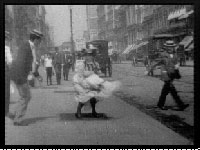
Part of the Library of Congress American Memory project, this site offers 45 films of New York City, 1898 to 1906, from the Paper Print Collection of the Motion Picture, Broadcasting, and Recorded Sound Division. Subjects of these films include buildings, parades, everyday activities like delivering newspapers, immigrants landing on Ellis Island, and the interior of a subway.
Each film is accompanied by a 75100 word summary of the film's contents and notes on the duration of the film, the cameraman's name, filming location, date filmed, and the call number and location information for the original film. The site also offers a 500-word essay on New York City at the turn of the century; a 750-word essay about America at the turn of the century; and a 200-word essay on the career of "Pioneer Cameramen" of the era.
A "Learn More About It" section includes links to 10 other American Memory resources and related exhibits, and selected bibliographies offer 24 works on the history of New York City and 14 works on the history of motion pictures. Visitors can search the site by keyword and browse by subject and film title.
Though somewhat limited in scope, this site is ideal for those interested in urban history, the history of New York, or the early motion picture industry.
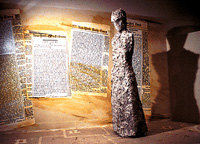
An introduction to Seneca Village, a multi-ethnic community of African Americans and Irish and German immigrants destroyed by New York city officials in 1857 to clear land for Central Park.
Through a selection of materials, currently limited to maps, images, and secondary essays, the site furnishes background on both Seneca Village and Central Park more generally. Also suggests "classroom activities" and provides a list of 63 related titles.
Based on The Park and the People—an award-winning history of Central Park by Roy Rosenzweig and Elizabeth Blackmar—the site promises to expand significantly (but, as of October 2000 had not changed significantly from when it was launched a few years earlier). "Primary documents will include the New York State Manuscript Census for 1855; birth and death records; church registers and records; newspaper articles; political cartoons, drawings, illustrations, photographs, and maps. Many of these will be interactive, so that students can query the data directly. "
