John F. Kennedy Presidential Library and Museum
Image
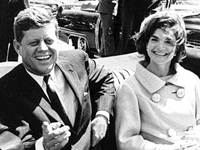
Photo, President and Mrs. Kennedy in motorcade, May 3, 1961
Annotation

This website is devoted to the life, work, and memory of John F. Kennedy, the 35th president of the U.S. Of primary interest to historians and teachers are the "Historical Resources and Education" and "Public Programs" sections of the website, which shed light on important events in early 1960s political history, including the Cuban missile crisis, the Vietnam War, the civil rights movement, the Peace Corps, the space program, and the 1963 Nuclear Test Ban Treaty. Users unfamiliar with the history of the Kennedy White House might begin with the "Timeline," which puts events important to the Kennedy administration in a larger political and cultural context, or "Biographies and Profiles," which presents a Kennedy family tree and profiles of early 1960s notables such as Fidel Castro, Robert McNamara, and Arthur M. Schlesinger, Jr. "White House Diary" further familiarizes users with Kennedy's day-to-day activities as President.

The website also includes hundreds of historical sources including speeches, photographs, telegrams, correspondence, eulogies for Bobby Kennedy, JFK, and Jacqueline Kennedy Onassis (all accessible through an Advanced Search feature), and transcripts of more than 170 oral interviews with notables such as John Kenneth Galbraith (Harvard University economic professor and Ambassador to India), Supreme Court Justice Felix Frankfurter, singer Harry Belafonte, and President Gerald Ford. In some cases, the original audio files of speeches are also included. Several lesson plans designed for elementary, middle, and high school students use materials from this archive to address topics such as Kennedy's inaugural address, the Cuban missile crisis, and the civil rights movement.
Jimmy Carter

Image
Photo, Jimmy Carter National Historical Site, 1966
Annotation

This well-designed website, companion to the PBS documentary, offers a wide variety of secondary material on the Carter presidency. "People and Places" offers short profiles of Carter, his wife Rosalynn, his brother Billy, Carter's White House staff (collectively known as "The Georgia Mafia"), Speaker of the House Thomas P. "Tip" O_Neill, and Vice-President Walter Mondale.

It also offers short essays on key events of Carter's presidency, including the election of 1976, the Egyptian-Israeli peace talks at Camp David, the Iranian hostage crisis, Carter's July 1979 "Crisis of Confidence" speech, and the election of 1980. Many of the essays link to special features, such as the extensive media coverage of the Iranian hostage crisis and the text of the "Crisis of Confidence" speech. "Teacher's Guide" offers nine suggestions for classroom learning activities in four categories: economics, civics, history, and geography. The site also includes a detailed chronology of Carter's life and a small photo gallery with 16 images. This site provides a useful overview of Carter's life and the political and diplomatic history of his presidency.

Mr. Lincoln's Virtual Library

Image
Logo, Mr. Lincoln's Virtual Library
Annotation

Part of the Library of Congress American Memory site, this online archive draws from two Library of Congress collections on the life of Abraham Lincoln, the 16th president of the United States. The Abraham Lincoln Papers in the Library's Manuscript Division contain over 20,000 items, over 2000 of which are contained on this site. Items include correspondence, speeches, and reports accumulated primarily during Lincoln's presidency (1860-1865). The documents are accompanied by annotated descriptions (roughly 150 words) composed by the Lincoln Studies Center at Knox College. The papers are in chronological order and are keyword searchable. The second collection highlighted in this exhibit is "We'll Sing to Abe Our Song," over 200 sheet music compositions that represent the popular music of the Civil War era. These pieces are drawn from the Alfred Whital Stern Collection in the Library's Rare Book and Special Collection division. The sheet music is searchable by title, composer, and subject. The site also offers links to other Library of Congress sources on Lincoln, including a photograph gallery of 16 images of the Lincoln family and other political figures of the Civil War era; over 50 Civil War maps; and a link to lesson plans for the entire American Memory Collection, including eight Civil War lesson plans appropriate for elementary and secondary students. This site is ideal for researching Lincoln's presidency and popular culture of the Civil War era.

Mount Vernon

Image
Photo, Mt. Vernon
Annotation

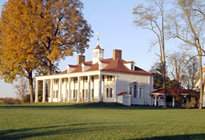
Homepage for Mt. Vernon Estate and Gardens, George Washington's Virginia estate, this site offers valuable sources for researching the life and home of the first U.S. President. An exhibit contains more than 50 images of furniture, art, documents, and other Mount Vernon household objects. Each image is accompanied by a 150-word description of the artifact and its location or significance to the estate. A virtual tour of Mt. Vernon's mansion takes visitors through every room with a photograph and 350-word description of the room and its furnishings. An archaeology section describes digs at eight sites on the estate, a 500-word description of a current excavation of Washington's distillery, and a 1500-word essay on the Mt. Vernon mansion's restoration beginning in 1858. An Educational Resources section offers a fifth-grade lesson plan, complete with trivia about Washington, excerpts from his Rules on Civility, and anecdotes from his military career and presidency; a 2000-word essay on Washington's attitude toward slavery and information on his slaves' lives, including links to a facsimile copy of Washington's 1798 slave census and 18 images of paintings and artifacts depicting the everyday lives of Mt. Vernon's slaves. This site is ideal for researching Washington's life and home, and it could also be useful for those studying material culture and archaeology.

James Madison's Failed Amendments

field_image
Medallion of James Madison
Question

James Madison proposed 12 amendments to the Constitution, but only 10 were approved. What were the two that were not?

Answer

When the Constitutional Convention sent the proposed Constitution to the states for ratification, Anti-Federalists voiced strong objections to it, especially criticizing the strength it invested in the national government and its lack of explicit protections for the rights of individuals. Politicians in several states were able to secure their states' ratification of the Constitution only with the promise that it would be almost immediately amended.

In 1789, James Madison, then an elected member from Virginia of the First Congress's House of Representatives, proposed 19 amendments meant to answer the objections already raised in the states. The Senate consolidated and trimmed these down to 12, which were approved by Congress and sent out to the states by President Washington in October, 1789.

The states ratified the last 10 of the 12 amendments. They became the first 10 amendments to the Constitution, and are now referred to as the Bill of Rights. Not enough states (10 were needed at the time) ratified the first two of Madison's original 12, however, and they did not become law.

The first of these would have established how members of the House of Representatives would be apportioned to the states. It was drafted to ensure that members of the House would continue to represent small constituencies even as the general population grew, small enough that Representatives would not be too far removed from the concerns of citizens. In addition, keeping the House of Representatives from being too small was thought to protect against its becoming a kind of oligarchy. Congress did send this amendment to the states, but the number of states that ratified it was just short of the number needed. Although the proposed amendment did not become law, Congressional apportionment is nevertheless grounded in the Constitution (Article 1, Section 2, Paragraph 3) and the total number of members of the House of Representatives is set by federal statute (currently at 435).

The second of Madison's 12 amendments forbade Congress from giving itself a pay raise: Congress could vote for a raise but it would only apply from the beginning of the next Congress. This amendment also failed to gather the required number of state ratifications in the years after it was introduced. In 1982, however, Gregory Watson, a university student doing research for a government class, ran across a description of this amendment and realized that it remained "alive" because it had included no language in it about a window of time in which it had to gain the needed number of state ratifications. Watson organized a successful effort to lobby various state legislatures, seeking their ratification of the amendment. As a result, the needed number was eventually reached and this amendment, first proposed in 1789, became the 27th (and most recent) amendment to the U.S. Constitution in 1992.

Bibliography

Richard E. Labunski, James Madison and the Struggle for the Bill of Rights (New York: Oxford University Press, 2006).

Jackson Turner Main, The Anti-federalists: critics of the Constitution, 1781-1788 (Chapel Hill: UNC Press, 2004)

David J. Siemers, The Antifederalists: men of great faith and forbearance (Lanham, Md.: Rowman & Littlefield, 2003).

John R. Vile, A Companion to the United States Constitution and Its Amendments, 4th edition (Westport, Ct.: Greenwood Publishing Group, 2006).

John W. Dean, "The Telling Tale of the Twenty-Seventh Amendment: A Sleeping Amendment Concerning Congressional Compensation Is Later Revived," September 27, 2002 (at FindLaw).

Images:
Portrait etching of James Madison and detail of broadside, printed by Bennett Wheeler, Providence, R.I., 1789.

James Madison medallion, frontispiece of William Cabell Rives, History of the Life and Times of James Madison (Boston: Little, Brown and Company, 1859).

Nixtontapes.org

Image
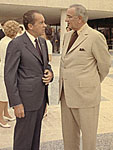
Photo, Nixon standing with Lyndon Johnson, 1971, NARA
Annotation

In February 1971 to July 1973, President Richard Nixon secretly began recording phone conversations and meetings, compiling thousands of hours of tape. Created in 2007 by a Texas A&M University history professor, this website intends to provide "the most complete digitized Nixon tape collection in existence."

At present, only a fraction of the recordings are available. Visitors may listen to MP3 versions of over 500 conversations organized by primary conversation participant; 29 conversations organized by topic themes; and more than 2,000 hours of conversations organized by the date of their release to the general public.

Though the site promises that all recordings will eventually be accompanied by full transcripts, accompanying material is spotty. Some recordings are accompanied by corresponding entries from the presidential daily diary, some by general outlines of the recording's topics, and a handful by full transcripts. The recordings vary in quality, from fully audible to inaudibly faint or noise-obscured.

The website is not searchable (the search engine on the home page searches the web at large). As it stands, it may be useful to educators as a casual introduction to the recordings for students, but locating specific content (to accompany lesson plans or complement events being taught in class) would require significant time.

Nixon Tapes

Image
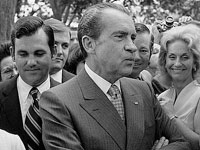
Photo, "White House wedding. Pres. Nixon," Warren K. Leffler, June 12, 1971
Annotation

This collection offers 32 transcripts and a dozen audio excerpts, all recently declassified, of conversations between former U.S. President Richard Nixon and the former president of Mexico, Luis Echeverria Alvarez. The audio files come close to 170 hours of conversation between the two leaders. Both men were involved in secret operations at the time of the conversations (Nixon was involved in the Cambodia bombings, while Echeverria was fighting a "Dirty War" against political opponents in Mexico), although only Nixon knew the conversations were being recorded. The two presidents often mused about geopolitics and only occasionally discussed the most-frequently debated issues between the two nations (such as drugs or trade). Although the tapes are available in other archives, the focus of the site makes it useful in exploring the relationship between Nixon and Echeverria.

Nixon and Sports

Image
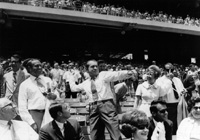
Photo, Nixon in the Crowd at a Baseball Game
Annotation

This site explores the not-so-obvious relationship between Richard Nixon's interest in sports, his politics, and his reputation as a public figure. Professional historian Nicholas Sarantakes designed the site as the electronic version of a forthcoming book. A timeline from 1969 to 1974 provides descriptions (5-20 words) on sports-related and other important events in Nixon's presidency. Watergate events, for instance, are intertwined with Nixon's interest in relocating the San Diego Padres to Washington, D.C. In 16 photographs and six cartoons, Nixon is shown as spectator and participant at sporting events. He is quoted talking about sports on 13 different occasions. The site refers visitors to two articles by Sarnatakes on the topic of Nixon and sports. The site may be interesting to cultural historians in general and useful for research in sports history and the history of the presidency in particular.

Monticello Explorer

Image
Photo, Monticello Photo, December 11, 2007, npslibrarian, Flickr
Annotation

President Thomas Jefferson worked on designing his estate, Monticello, throughout much of his adult life, drawing heavily on classical architecture as well as the French architecture he became acquainted with during his time in Paris in the 1780s. This website presents an interactive map of Monticello, at its height a 5,000 acre plantation—its buildings, fields, orchards, and slave quarters—providing a window into Jefferson's domestic life.

Visitors can click on one of more than 25 locations on the Plantation, and see a short explanation of that place's function, as well as a small selection of current and historical photographs and documents pertaining to that location, including some of Jefferson's original building plans. Visitors can then virtually move inside Monticello itself through a 3-D tour of Jefferson's home, accompanied by text highlighting the social function of each room.

Also offered are virtual tours of the house, highlighting domestic life at Monticello and Jefferson's relationship with farming and gardening. Each of these tours is accompanied by a useful video introducing these topics and providing other background information about Jefferson's life and work.

James Madison Papers

Image
Image, A Brief System of Logick, James Madison, 1763-5, James Madison Papers
Annotation

These 12,000 items (72,000 digital images) allow the visitor to explore James Madison's life, the Revolution, or the Early Republic. Materials include his father's letters, Madison's correspondence, personal notes, drafts of letters and legislation, and legal and financial documents. Material covers the period from 1723 to 1836.

Page images of correspondence can be browsed by title, name, or correspondence series or they can be searched by keyword or phrase appearing in the bibliographic records (descriptive information) of the collection. Additionally, the full text of correspondence for which transcriptions are available can also be searched by keyword or phrase. A timeline covers the period from 1751 to 1836 and is useful for placing the events of Madison's life in historical context. Three essays are available, including one on Madison's life and papers and one on Madison at the Federal Constitutional Convention.