Bureau of Economic Analysis

Image
Image for Bureau of Economic Analysis
Annotation

Comprehensive and summary data estimates concerning national, international, and regional economic activity are available on this website. Additional data is available according to industry. An overview of the economy provides data on production, purchases by type, prices, personal income, government finances, inventories, and balance of payments.

An easy-to-use keyword index to a set of annual and quarterly national income and product account (NIPA) tables from 1929 to 2006—found in the "National" section under "Personal Income and Outlays"—allows users access to data on specific product sales and ways that consumers have spent money. Forty-nine recent research papers by staff members address issues such as globalization, how the "new economy" is measured, and structural change of the economy over a 28-year period.
AIDS at 20

Image
Image for AIDS at 20
Annotation

A 1981 reference to an unusual pneumonia in Los Angeles, California, by the Centers for Disease Control and Prevention marked the beginning of public discussion of the Acquired Immunodeficiency Syndrome, known as AIDS. More than 350 selected New York Times articles from 1981 to 2001 related to the AIDS epidemic are available on this website. Materials also include nine articles specifically related to the course of the epidemic's devastation in Africa.

There are nine videos, six multimedia presentations, five fact sheets, and four in-depth reports on such subjects as HIV medications, AIDS in New York City, HIV and teens, women and AIDS, the Federal response to the crisis, and the history of AIDS. The in-depth reports cover a diverse range of people affected by AIDS, including those of different ethnic backgrounds, and cover a wide range of locations within the U.S., including rural and urban areas.

National Election Studies

Image
Image for National Election Studies
Annotation

This wealth of data presents National Election Studies surveys of the American electorate conducted in presidential and congressional election years from 1948 to 2006. Large files of raw data can be downloaded. In addition, The ANES Guide to Public Opinion and Electoral Behavior is available and is readily accessible.

Composed of more than 100 tables and graphs, the guide traces nine key variables in the makeup and opinions of the electorate. These include: social and religious characteristics; partisanship and evaluation of political parties; ideological self-identification; public opinion on public policy issues; support for the political system; political involvement and partisanship; evaluation of presidential candidates; evaluation of congressional candidates; and vote choice. This website also provides pilot studies on recent surveying issues, such as measuring exposure to television advertisements, and a 5,000-item bibliography.

Herblock's History: Political Cartoons from the Crash to the Millennium

Image
Image, "The other ascent into the unknown," Herbert Block, 1965
Annotation

The 150 cartoons presented here were drawn between 1929 and 2000 by three-time Pulitzer Prize-winning political cartoonist Herblock (Herbert Block). Cartoons comment on major events and public issues.

The website also presents an essay by Block on "the cartoon as an opinion medium"; a biographical essay; and 15 caricatures of the cartoonist by well-known colleagues. Cartoons are organized according to 13 chronological sections, with an additional segment devoted to presidents. Brief annotations provide historical context for each image.

A tribute site by the Washington Post, Herblock's longtime employer, offers additional cartoons and essays by Block.

Making the Macintosh: Technology and Culture in Silicon Valley

Image
Image, Apple II Reference Manual, 1978, Making the Macintosh
Annotation

The history of the Macintosh computer is presented on this website. Rather than profile Apple Computer's leader, Steve Jobs, and well-publicized software and hardware developers, materials include 13 interviews with designers, technical writers, Apple employees, a Berkeley user group organizer, and a San Francisco journalist who covered early developments.

In addition, nearly 90 documents from the late 1970s to the present chart company and user group developments, beginning with roots in the 1960s counterculture philosophy. Documents include "From Satori to Silicon Valley," a lecture by Theodore Roszak first delivered in 1985 with afterthoughts added in 2000. There are 13 texts by the first Mac designer, Jef Raskin, press releases and other marketing materials, and texts relating to user groups.

More than 100 images include patent drawings and product photographs.

Legacy Tobacco Documents Library

Image
Camel cigarettes advertisement, 1952, Legacy Tobacco Documents Library
Annotation

More than 40 million pages from more than seven million tobacco industry documents are presented on this website. Documents were made public as a stipulation of the 1998 Master Settlement Agreement to settle multiple lawsuits. Index records, prepared by tobacco companies, can be searched by full-text.

Documents range from the 1930s to 2002, though most were created since the 1950s, and deal with industry concerns such as marketing, sales, advertising, research and development, manufacturing, and expansion of business to developing countries. There are 80 links to related sites and promises to include more documents in the future. This project offers an abundance of material for studying the history of smoking, advertising, and 20th-century American business practices.

Fifty Years of Coca-Cola Television Advertisements

Image
Image, Coca-Cola advertisement, 1952, Fifty Years of Coca-Cola Advertisements
Annotation

Highlights of Coca-Cola television advertisements from the Library of Congress Motion Picture archives are exhibited on this site, with 50 commercials, broadcast outtakes, and experimental footage.

There are five examples of stop-motion advertisements from the mid-1950s, 18 experiments with color and lighting for television ads from 1964, and well-known commercials, such as the "Hilltop" commercial featuring the song "I'd Like to Buy the World a Coke" (1971). Additional resources include the "Mean Joe Greene" commercial (1979); the first "Polar Bear" commercial (1993); the "Snowflake" commercial (1999); and "First Experience," an international commercial filmed in Morocco (1999).

The site also includes a bibliography and links to finding aids for other television commercials at the Library of Congress. While this site is relatively small, it provides a good resource for studying the history of post-World War II consumer culture in terms of content and technique.

Internet Moving Images Archive

Image
Screencapture, Duck and Cover, U.S. Federal Civil Defense Ad., 1951, Moving...
Annotation

These resources come from a privately held collection of 20th-century American ephemeral films, produced for specific purposes and not intended for long-term survival. The website contains nearly 2,000 high-quality digital video files documenting various aspects of 20th-century American culture, society, leisure, history, industry, technology, and landscape. It includes films produced between 1927 and 1987 by and for U.S. corporations, nonprofit organizations, trade associations, community and interest groups, and educational institutions. More than 80 films address Cold War issues.

Films depict ordinary people in normal daily activities such as working, dishwashing, driving, and learning proper behavior, in addition to treating such subjects as education, health, immigration, nuclear energy, social issues, and religion. The site contains an index of 403 categories. This is an important source for studying business history, advertising, cinema studies, the Cold War, and 20th-century American cultural history.

Oyez: U.S. Supreme Court Multimedia

Image
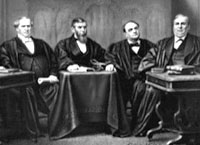
Supreme Court 1890. Photo by Napoleon Sarony. Courtesy Library of Congress.
Annotation

These audio files, abstracts, transcriptions of oral arguments, and written opinions cover more than 3,300 Supreme Court cases. Materials include 3,000 hours of audio arguments in selected cases since 1955 and all cases since 1995. Users can access cases through keyword searches or a list of thirteen broad categories, such as civil rights, due process, first amendment, judicial power, privacy, and unions.

Cases include Roe v. Wade (abortion), Gideon v. Wainwright (right to counsel), Plessy v. Ferguson (segregation), Grutter v. Bollinger (affirmative action), and Bush v. Gore (election results). Biographies are provided for all Supreme Court justices and "The Pending Docket" provides briefs and additional materials on upcoming cases. The website also includes links to written opinions since 1893 and podcasts featuring discussions of cases starting in 1793.

TRUMP: A Historical Look at the Donald

Description

From the Bowery Boys website:

"Donald Trump—financial wizard, reality star, or political distraction? The secret in figuring him out may be contained in the roots of his wealth—a saga that stretches back to the 1880s and begins with a 16-year-old boy named Drumpf who made his living in a barber shop. From there, the story unfolds during the early days of Queens, a borough once sparsely populated and ready for development.

Donald's father Fred built thousands of middle-class homes throughout Queens and Brooklyn and embroiled himself in some controversy regarding the remains of TWO Coney Island theme parks. The Donald built upon the reputation of his father to become a successful Manhattan developer and a flamboyant celebrity with seemingly bottomless levels of lucre. But of course everyone has their limit.

Featuring trivia about Trump Tower, Riverside South and other Trump-labeled properties, this is the brief history of the family behind the New York's glitziest name brand."