Bob Hope and American Variety
Image
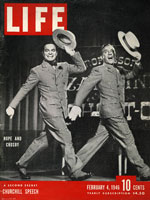
Cover, Life Magazine, February 4, 1946
Annotation

This tribute to Bob Hope examines his contributions to American culture and entertainment. The site includes a short (1,000 words with 150 photographs) history of vaudeville in the United States and four essays (1,000 words each) examining vaudeville's legacy. There is a 3,000-word biography of Hope, covering most of his 70-year career, and sections that deal with each of his many careers specifically. His early radio work, his long movie career, and his many television appearances are all documented.

Of particular interest are the 26 Bob Hope caricatures in photograph, cartoon, and sculpture. The Joke File includes six pages (out of a massive collection that exceeds 85,000 pages) of Hope's seasonal material. On the Road: USO Shows documents Hope's commitment to America's armed forces by highlighting his many trips overseas to entertain American troops. Although the essays are useful in explaining the relationship of vaudeville to American culture, the strength of the site is its approximately 250 primary sources (mostly photographs and documents).

Best of History Websites

Image
Introductory image and logo (edited together), Best of History Websites
Annotation

Designed for history educators and students, this useful portal provides access to more than 700 of the best history resources online. Sites are organized into 10 categories—Prehistory, Ancient/Biblical, Medieval, U.S History, Early Modern European, 20th Century, World War II, Art History, General Resources, and Maps. Many of the five-star Pre-history, Ancient, and Medieval sites are hosted by Smithsonian Institution, PBS, and the Internet History Sourcebooks; and the Library of Congress is the creator of a wide-range of top-rated sites for U.S. history. The 20th-century and World War II sections are voluminous, the latter presenting 42 sites. There are three special categories: Lesson Plans/Activities, Multimedia, and Research. "Multimedia" includes 18 map sites, including the Rumsey collection with more than 8,000 maps. Instructors will find the section on "Teaching with Technology" especially informative. It offers articles and advice about integrating computers into lessons and links to dozens of useful resources on teaching with technology. Visitors can sign up to receive monthly email updates.

Museum of Musical Instruments (MoMI)

Image
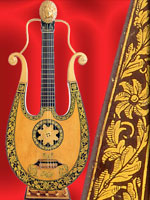
Lyre guitar, Clementi and Company, 1810
Annotation

The title of this site is somewhat misleading, as the history and artistry of the guitar and guitarists is the primary focus for the eight collections of images and 15 exhibitions—some produced in conjunction with other cultural institutions—that the site's creators, a collector and music scholar, offer. "Dangerous Curves: Art of the Guitar," an online version of a recent Boston Museum of Fine Arts exhibition, presents more than 20 photographs of guitars from the Baroque era to modern times, including a number of celebrity instruments. This exhibition provides up to 200-word annotations on each image and a 4,000-word essay. "Bound for Glory: The Life and Times of Woody Guthrie," a complement to the traveling Smithsonian Institution show, offers a 3,100-word narrative of the folksinger's life and songwriting career, with 23 audio files of songs and interviews, 32 photographs, four pieces of sheet music, and six reviews and articles on the original exhibition. "The Private Life of Mark Twain" displays photos of the author's 1834 Martin guitar, an edited version of Twain's poem "Genius," a 350-word article, an audio file of a song about Twain performed by the Kingston Trio, and a nine-minute National Public Record audio segment on Twain's guitar. O

ther exhibition topics include music in films, Elvis Presley, Django Reinhardt, music during World War II, and "the guitar as a potent sex symbol." The eight collections of images present historic guitars from the ragtime era to 1930s singing cowboy movies. The site also includes approximately 70 previously published articles on related topics. Valuable for those studying music history and American popular culture of the 20th century.

China and the United States: From Hostility to Engagement, 1960-1998

Image
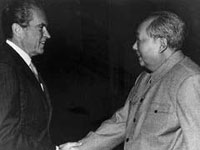
Photo, Nixon and Mao, 1972
Annotation

Presents 15 annotated U.S. government intelligence documents—most of which have been declassified through Freedom of Information Act requests—that illuminate various phases of the evolving U.S.-China relationship from the Cold War period to the recent past. These materials have been selected from a published microfiche collection of more than 2,000 documents. The site offers memoranda and directives on U.S. fears concerning China's weapons program; President Nixon's rapprochement in 1972; the changed U.S. policy regarding Taiwan; U.S. concerns over the sale by China to Saudi Arabia of intermediate-range ballistic missiles; human rights issues; and the resumption of a military relationship between the two powers after a falling out over Tiananmen Square. Includes a White House memo of the conversation held at the first meeting between Nixon and Chairman Mao Zedong, a message by President Ford to Mao on the day of Nixon's resignation, and two biographies of Chinese officials. Valuable for those studying U.S.-China relations and the role the U.S. intelligence community has played in that history.

Digital Archive of American Architecture

Image
Sears House, Boston, A. Parris, 1818
Annotation

Provides nearly 1,500 images of 280 architecturally significant American buildings from the colonial era to the present, compiled by Professor Jeffery Howe for classroom use. Images are arranged according to period, location, architect, building type, and style. The site offers examples of houses, churches, public buildings, commercial buildings, and skyscrapers. It includes images from three World's Fairs, as well as sections on urban planning and comparative materials. Professor Howe also has digitized images and text from two mid-19th century books on design and ornament. Although image annotations are minimal, in conjunction with other materials, the images in this site will be useful to those studying American architectural history and urban history.

Economic Data, Fred II

Image
Title graphic, Economic Data
Annotation

Offers statistical national economic and financial data in the following 12 categories: interest rates; business/fiscal (including federal debt, receipts and outlays, employment cost index, productivity and cost, and inventories and sales); consumer price indexes; monetary aggregates; commercial banking; employment and population; gross domestic product and components; producer price indexes; exchange rates, balance of payments and trade data; reserves; and daily/weekly financial data. Much of the data was compiled monthly. Periods covered vary according to category; some statistics go back to 1901. Also provides historical and recent statistics for the states of Arkansas, Illinois, Indiana, Kentucky, Mississippi, Missouri, and Tennessee. Useful for those studying business and economic history, and for social historians interested in employment trends.

Industrial Research and Development Information System

Image
Logo and website graphic (edited), National Science Foundation
Annotation

Provides data from more than 2,500 statistical tables on historical trends in expenditures on research and development (R&D) conducted in the U.S. from 1953-1998 by industrial firms, domestic and foreign-owned. Tables are accessed as downloaded Excel spreadsheets. Data for more recent years, presented under a new coding scheme, can be found in a linked site. Compiled by the National Science Foundation's Annual Survey of Industrial Research and Development. Statistics available include expenditures by industry, size of R&D programs, types of cost, comparison by states, comparison of R&D to net sales by industry, comparison by size of company, federal amounts of R&D, and cost of R&D per scientist and engineer. The site does not contain data for individually specified firms. Provides links to approximately 15 publications and sites on national patterns of R&D resources. Of great value to those studying business history, history of science, and government, in addition to policy makers.

Library of American Broadcasting Sound Bites

Image
Logo, Library of American Broadcasting
Annotation

A sample of 13 audio files of radio commercials from the late 1950s through the early 1960s—part of the Radio Advertising Bureau Collection. This is part of the larger collection of 850 discs, containing approximately 70 hours of material, that have been remastered. The Bureau, a national trade organization, was formed in 1950 (as the Broadcast Advertisers Bureau) to promote radio as a medium for advertisers. The samples—available in two formats, .WAV and .AIFF—include ads for toothpaste, cold medicine, soft drinks, gasoline, beer, cigarettes, cookies, automobiles, dog food, deodorant, and pimple cream. Useful for those studying consumer culture and the use of pop music and radio in advertising.

HistoryWired: A Few of Our Favorite Things

Image
Postcard, "Chinese Actor Impersonating a Female Character," San Francisco
Annotation

An experimental presentation of 450 items in the Smithsonian Institution's American History collections, many of which are not on public display. Visitors to this virtual tour will find a map divided into regions representing broad subject categories that contain smaller rectangles standing for individual objects. Moving a mouse to a particular square results in the appearance of the name of the object, a thumbnail image, a date projected onto a timeline, and lines emanating out to relevant subject areas. Users can then click to learn more, finding a 100-200 word description, an option to zoom in closer, and often links to further information in other Smithsonian sites. Also searchable by keyword and category. Objects selected by curators "include famous, unusual, and everyday items with interesting stories to tell. They are not intended to be representative of the Museum's entire collection."

Categories reflect the wide range of the Institution's holdings, including clothing, arts/entertainment, business, science/medicine, photography, home, print/communications, transportation, military, computers, and sports. Includes audio and video items. Users can submit ratings for each object that will affect the future relative size of each square. Although innovative in design, the site may be disappointing to those searching for in-depth information about American history and culture; this is history-lite, with bells and whistles given more prominence than context and meaning.

Free Speech Movement: Student Protest, U.C. Berkeley, 1964-65

Image
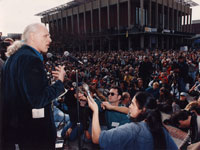
Photo, "Mario Savio Speaking at FSM Rally," Ben Ailes?, October 2, 1984
Annotation

The Bancroft Library has put its entire archive of material on the Berkeley Free Speech Movement (FSM) online. A 200-word chronology introduces visitors to the major events of the movement. Printed material includes five books, 29 leaflets (200 to 3,000 words each) produced by the FSM, 55 letters to and from FSM activists, 11 local radical newsletters, 36 statements, 21 press releases, and six speeches made by students and university faculty and administration. Visitors may read complete transcripts of 10 oral histories of between 85 and 1,000 pages: eight with university administrators and faculty; two with FSM activists. A collection of legal documents includes 40 pages of trial transcripts and 400 letters from FSM activists to Judge Rupert Crittenden, who presided over their trials.

This site also provides researchers with the first public access to 96 photographs of FSM rallies and sit-ins taken by Ronald L. Enfield in 1964 and 1965. Materials from related organizations include 63 documents from nine contemporary protest movements at Berkeley. The site may be searched by subject, but is somewhat difficult to navigate because pages within the collection do not link directly to an index or the collection's home page. The site will be most useful to experienced researchers.