Federal Township Plats of Illinois, 1804-1891
Image
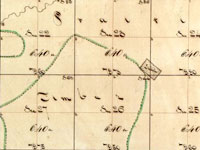
Plat, Virgil, 27-59
Annotation

Designed as both an archive and an online exhibit, this site features 3,457 hand-drawn township maps of Illinois. When the government began surveying in 1803 what would later become Illinois, they divided the land into squares six by six miles (36 square miles) called townships. This site includes a 1,000-word introductory history describing the surveying process and introducing the methods and tools of surveyors. Also included here are the maps, available to researchers and the public. A 1,000-word narrative outlines the role of the United States Surveyor General, and traces the custody of these records through the years.

Visitors use a map of Illinois to locate the region and county of the plat they wish to view, and can pan left and right or zoom in and out. A legend helps users decipher early 19th-century symbols. In addition, the site links to an Illinois state website (Illinois Public Domain Land Tract Sales), where researchers can search for the first owners of plats. This site is a great place to view original, early-19th-century maps of Illinois.

Knowing Poe

Image
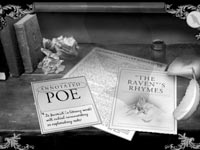
Graphic interface, Knowing Poe
Annotation

This site provides an interactive and engaging examination of the life and death of Edgar Allan Poe. The interactive "It'll Be the Death of Me" section walks visitors through the various explanations of Poe's mysterious death. It asks the viewer to make choices, and directs them based on the decisions they make. The "Point of View" feature uses Poe's short story "The Cask of Amontillado" to illustrate the effect of point-of-view in literature. Viewers choose to read the story from the point of view of Fortunato, Montresor, or a narrator.

Although this is not an archive of Poe's work, it nonetheless provides access to about a dozen of his stories and 16 primary documents. Many of Poe's writings are annotated on this site, allowing students to compare first, second, and third drafts of "The Lake," or to analyze the rhyme scheme of "The Raven." Another interactive feature allows visitors to examine the melody of Poe's poem, "The Bells." Visitors control the voice of the reader (male or female, emotive or monotonic), add or delete sound effects and background music, and then listen to the creation to see how those factors affect the emotional impact of poetry. "Talking About Poe" allows visitors to leave messages for other users.

Freedom: A History of Us

Image
Photo, Slave named Gordon with whip scars, Wounds inflicted December 25, 1862
Annotation

This site complements the 16-part PBS television series of the same name. Based on Joy Hakim's award-winning U.S. history textbook series, the site explores the theme of freedom chronologically from the American Revolution to the Civil Rights movement and concluding with the inauguration of George W. Bush. Designed to help teachers find lesson plans or design their own curriculum, the site includes sample activities and historical primers, each based on one of the 16 "Webisodes," such as "Liberty for all?" or "Whose land is this?" Teachers can search for lesson plans by Webisode or by multiple subject matters, from mathematics to physical education. There is also an interactive timeline that links to photographs, paintings, biographies, and quizzes. The site is visually and textually rich, but most valuable for K-12 teachers and students.

Cleveland Digital Library

Image
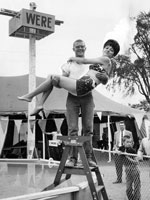
Photo, A man standing on a ladder holds a..., Cuyahoga County Fair, 1964
Annotation

Featuring primarily maps, texts, and images, this gateway site is designed to be a resource for those interested in the history of the greater Cleveland area. The site includes approximately 35 journal articles (from journals such as the Saturday Evening Post) on the history of Cleveland, its newspapers, its railroads and industries, and a few prominent citizens; 36 digitized books; seven manuscript collections (three merely describe the contents of the collection, while four offer digitized resources); an audio file and a video file; two cartoon collections; and nine photograph collections, containing about 600 photographs. Although many of the collections are located on outside websites, visitors can access the collections by subject, date, geographic location, or format.

For educators, the site includes 20 lesson plans, under such categories as American Heritage and Democratic Process. The classroom activities are well-conceived; they feature problem solving and critical thinking exercises like the Mystery Photo Album, in which students attempt to figure out where in the Cleveland area historical photographs were taken, and By the Neck Until Dead, an e-book that details the history of Cuyahoga County, OH, hangings. The site also maintains a list of local history websites.

Bob Hope and American Variety

Image
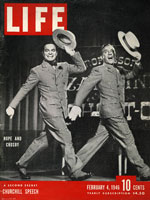
Cover, Life Magazine, February 4, 1946
Annotation

This tribute to Bob Hope examines his contributions to American culture and entertainment. The site includes a short (1,000 words with 150 photographs) history of vaudeville in the United States and four essays (1,000 words each) examining vaudeville's legacy. There is a 3,000-word biography of Hope, covering most of his 70-year career, and sections that deal with each of his many careers specifically. His early radio work, his long movie career, and his many television appearances are all documented.

Of particular interest are the 26 Bob Hope caricatures in photograph, cartoon, and sculpture. The Joke File includes six pages (out of a massive collection that exceeds 85,000 pages) of Hope's seasonal material. On the Road: USO Shows documents Hope's commitment to America's armed forces by highlighting his many trips overseas to entertain American troops. Although the essays are useful in explaining the relationship of vaudeville to American culture, the strength of the site is its approximately 250 primary sources (mostly photographs and documents).

Best of History Websites

Image
Introductory image and logo (edited together), Best of History Websites
Annotation

Designed for history educators and students, this useful portal provides access to more than 700 of the best history resources online. Sites are organized into 10 categories—Prehistory, Ancient/Biblical, Medieval, U.S History, Early Modern European, 20th Century, World War II, Art History, General Resources, and Maps. Many of the five-star Pre-history, Ancient, and Medieval sites are hosted by Smithsonian Institution, PBS, and the Internet History Sourcebooks; and the Library of Congress is the creator of a wide-range of top-rated sites for U.S. history. The 20th-century and World War II sections are voluminous, the latter presenting 42 sites. There are three special categories: Lesson Plans/Activities, Multimedia, and Research. "Multimedia" includes 18 map sites, including the Rumsey collection with more than 8,000 maps. Instructors will find the section on "Teaching with Technology" especially informative. It offers articles and advice about integrating computers into lessons and links to dozens of useful resources on teaching with technology. Visitors can sign up to receive monthly email updates.

Museum of Musical Instruments (MoMI)

Image
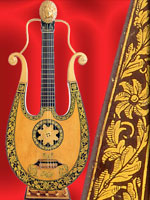
Lyre guitar, Clementi and Company, 1810
Annotation

The title of this site is somewhat misleading, as the history and artistry of the guitar and guitarists is the primary focus for the eight collections of images and 15 exhibitions—some produced in conjunction with other cultural institutions—that the site's creators, a collector and music scholar, offer. "Dangerous Curves: Art of the Guitar," an online version of a recent Boston Museum of Fine Arts exhibition, presents more than 20 photographs of guitars from the Baroque era to modern times, including a number of celebrity instruments. This exhibition provides up to 200-word annotations on each image and a 4,000-word essay. "Bound for Glory: The Life and Times of Woody Guthrie," a complement to the traveling Smithsonian Institution show, offers a 3,100-word narrative of the folksinger's life and songwriting career, with 23 audio files of songs and interviews, 32 photographs, four pieces of sheet music, and six reviews and articles on the original exhibition. "The Private Life of Mark Twain" displays photos of the author's 1834 Martin guitar, an edited version of Twain's poem "Genius," a 350-word article, an audio file of a song about Twain performed by the Kingston Trio, and a nine-minute National Public Record audio segment on Twain's guitar. O

ther exhibition topics include music in films, Elvis Presley, Django Reinhardt, music during World War II, and "the guitar as a potent sex symbol." The eight collections of images present historic guitars from the ragtime era to 1930s singing cowboy movies. The site also includes approximately 70 previously published articles on related topics. Valuable for those studying music history and American popular culture of the 20th century.

China and the United States: From Hostility to Engagement, 1960-1998

Image
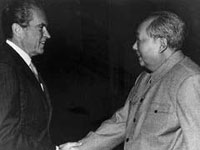
Photo, Nixon and Mao, 1972
Annotation

Presents 15 annotated U.S. government intelligence documents—most of which have been declassified through Freedom of Information Act requests—that illuminate various phases of the evolving U.S.-China relationship from the Cold War period to the recent past. These materials have been selected from a published microfiche collection of more than 2,000 documents. The site offers memoranda and directives on U.S. fears concerning China's weapons program; President Nixon's rapprochement in 1972; the changed U.S. policy regarding Taiwan; U.S. concerns over the sale by China to Saudi Arabia of intermediate-range ballistic missiles; human rights issues; and the resumption of a military relationship between the two powers after a falling out over Tiananmen Square. Includes a White House memo of the conversation held at the first meeting between Nixon and Chairman Mao Zedong, a message by President Ford to Mao on the day of Nixon's resignation, and two biographies of Chinese officials. Valuable for those studying U.S.-China relations and the role the U.S. intelligence community has played in that history.

Digital Archive of American Architecture

Image
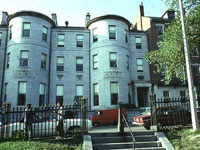
Sears House, Boston, A. Parris, 1818
Annotation

Provides nearly 1,500 images of 280 architecturally significant American buildings from the colonial era to the present, compiled by Professor Jeffery Howe for classroom use. Images are arranged according to period, location, architect, building type, and style. The site offers examples of houses, churches, public buildings, commercial buildings, and skyscrapers. It includes images from three World's Fairs, as well as sections on urban planning and comparative materials. Professor Howe also has digitized images and text from two mid-19th century books on design and ornament. Although image annotations are minimal, in conjunction with other materials, the images in this site will be useful to those studying American architectural history and urban history.

Meeting of Frontiers

Image
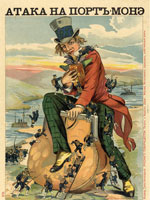
Chromolithograph, "Attack on Port Money," 1904
Annotation

In conjunction with the Russian State Library in Moscow, the National Library of Russia in St. Petersburg, and the Rasmuson Library of the University of Alaska in Fairbanks, the Library of Congress has digitized more than 2,500 items, comprising approximately 70,000 images, and provided transcriptions and commentaries in English and Russian to offer a comparative history of American and Russian expansion through frontier territories in each nation's continent. The site presents an overview of expansion into Siberia and the American West in six sections: Exploration, Colonization, Development, Alaska, Frontiers and National Identity, and Mutual Perceptions. Each section contains from two to 11 modules that call attention to similarities and differences between the two histories with regard to subjects such as migration—forced and otherwise, missionaries, religious flight, mining, railroads, agriculture, cities, popular culture, and tourism, and even compares Cossacks with cowboys.

The site offers more than 40 complete books, including manuals, handbooks, fiction, and travelers accounts; 77 maps and one atlas; 438 items from the Russian-Ukrainian Pamphlet and Brochure Collection; materials from six complete manuscript collections, regarding exploration, trade, and commercial activities; four tour-of-the-century films; 125 newspaper articles; 11 dime novel covers; five photographic collections; and one sound recording of a Russian folk song. Provides a 500-title bibliography and links to 30 related sites. Valuable for those studying the American West and Russian history and investigating ways to explore frontiers of comparative histories in order to expand beyond limits of national history narratives. Listen to the audio review: .