The Digital Classroom

Image
Annotation

A series of activities, primary documents, lesson plans, links, and worksheets designed to encourage "teachers of students at all levels to use archival documents in the classroom."

Includes tasks to help students understand how to use National Archives materials; 20 thematically-oriented teaching activities covering the period from the Constitutional Convention to Watergate; detailed information about National History Day, an annual educational program and competition; and 35 lessons and activities organized around constitutional issues ranging from well-known patent cases to the Civil Rights Act of 1964 and the establishment of the Equal Employment Opportunity Commission.

Many of the activities correlate to specific sections of the National History Standards and the National Standards for Civics and Government. Also contains a handful of links and material about books, workshops, and summer institutes for teachers.

A well-organized introduction to the practice of historical research.

WestWeb: Western Studies and Research Resources

Image
Annotation

This gateway offers a wide range of links to primary and secondary documents, bibliographies, maps, images, and other resources for the study and teaching of the American West. Its 31 topics include agriculture, economics, the environment, ethnicity, gender and sexuality, military history, political and legal history, religion, settlement, technology, and water. Also highlights six selected "outstanding sites."

Well-designed, comprehensive, and easy to navigate, the site also furnishes syllabi and additional teaching materials and suggestions.

Third Person, First Person: Slave Voices

Image
Annotation

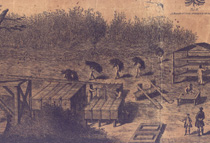
An exhibit of primary source material relating to slavery from the late 18th century to emancipation in the 19th century.

It reproduces or describes 33 documents, such as a broadside announcing a reward for the return of a runaway slave, a map delineating slave labor on an indigo plantation, a New York bill of sale for the purchase of a slave in 1785, and an 85-page memoir written in 1923 by Elizabeth Johnson Harris, an African American woman from Georgia who relates stories and experiences of her parents and grandparents, who had been slaves. The site "showcases the kinds of rare materials that under scrutiny reveal the ambitions, motivations, and struggles of people often presumed mute."

Voices from the Gaps: Women Writers and Artists of Color

Image
Annotation

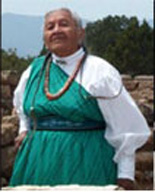
Descriptive information about the lives and works of 136 "women writers of color in North America" is provided in this site, designed primarily for high school and college classroom use. Offers introductory material, including images, bibliographies, quotations, biographical sketches, and critical views with regard to writers such as Toni Morrison, bell hooks, Evelyn Lau, Winona LaDuke, Terry McMillan, and Alice Walker.

While the site concentrates primarily on 20th-century figures, it also contains 10 entries on women from the 19th century, including Sarah Mapps Douglass, Harriet Jacobs, Elizabeth Hobbs Keckley, and Frances Ellen Watkins Harper.

The material is arranged into four indexes: name, birthplace, racial/ethnic background, and significant dates. Annotated links to 18 related resources are included.

The site relies on contributions from interested students and teachers, and promises to grow to more than 500 entries in the future.

First-Person Narratives of the American South, 1860-1920

Image
Annotation

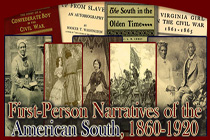
Features 141 texts relating to the culture of the American south "from the viewpoint of Southerners," during the latter half of the 19th and beginning decades of the 20th centuries, " a period of enormous change." Focusing on the voices of women, blacks, laborers, and Native Americans, the site offers a variety of documents--including ex-slave narratives, travel memoirs, personal accounts and diaries, and autobiographies, such as Narrative of the Life of Moses Grandy; Late a Slave in the United States of America (1843). Includes some materials published prior to 1860. Provides a 31-title bibliography, with some resources geared toward young readers, and links to 13 related sites. Part of the University of North Carolina's digital library project, Documenting the American South, which is described further in its own History Matters entry.

California Heritage Collection

Image
Annotation

An impressive archive of more than 30,000 digitally reproduced images "illustrating California's history and culture," taken from nearly 200 collections at UC Berkeley's Bancroft Library. The site, searchable by keyword, features photographs, sketches, and paintings in six categories: early California missions and mining activities, natural landscapes, Native Americans, San Francisco, World War II and Japanese relocation, and portraits of notable and ordinary Californians from diverse backgrounds. More than 100 images selected from the larger collection are included in an accompanying California Cornerstones Collection. Includes 158 finding aids, additional links to the Bancroft Library, and six "web-based lesson plans" for using the collection in K-12 classrooms. While the text accompanying each image is limited to artist/photographer, subject, and date, the sheer number of images available makes this a valuable resource for those studying California's history.

Doris Ulmann Photograph Collection

Image
Annotation

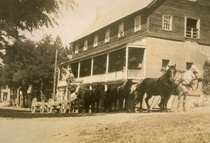
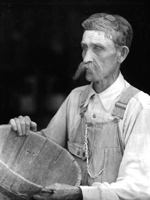
This collection of more than 1,700 photographs by Doris Ulmann (1882-1934) documents the rural people of the South, in particular the people of Appalachia and the Georgia-Carolina Sea Islands. "Ulmann's photographs represent important primary source material for historical and ethnographic studies of Appalachian and Gullah culture as well the subject of folk arts and craft traditions." Of particularly interest in the collection are the images of Appalachian craftspeople performing their crafts, such as quilting, whittling, weaving, hooking rugs, spinning, and making baskets and ceramic ware.

The visitor can browse all the images in the collection or search the collection by keyword. An advanced search by numerous categories including subject, title, date, place, and name is also available. Each image is accompanied by full bibliographic information. This collection is a useful resource both for those teaching or researching Appalachian or Sea Islands folk culture and for those with a broader interest in the social and cultural history of the South in the early 20th century.

Say it Plain: A Century of Great African American Speeches

Image
Annotation

This small website assembles transcripts and audio recordings of 12 important speeches by prominent African Americans of the late 19th, 20th, and 21st centuries. These include: Booker T. Washington, Marcus Garvey, Mary McLeod Bethune, Dick Gregory, Fannie Lou Hamer, Stokely Carmichael, Martin Luther King, Jr., Shirley Chisholm, Barbara Jordan, Jesse Jackson, Clarence Thomas, and Barack Obama.

Topics include Washington's speech to the 1895 Atlanta Cotton States and International Exposition, Bethune's 1939 speech "What Does Democracy Mean to Me?," a 1966 speech by Carmichael at U.C. Berkeley, and King's 1968 "I've Been to the Mountaintop" sermon delivered in Memphis just before his assassination. The speech by Marcus Garvey is his only known recording. Each speech is accompanied by a brief introduction. The site provides 40 links to related websites.

Louisiana State Museum Jazz Collection

Image
Annotation

This small site, part a larger collection, offers a music archive dealing primarily with traditional New Orleans jazz. Composed of photographs, audio recordings, and audio interviews of musicians and bands that were primarily active in New Orleans, the collection is currently composed of more than 1,000 total items, including more than 380 audio recordings. Of particular interest are the 160 Louis Armstrong items. The collection can be searched by keyword. The site's authors plan to make additional items available as they are digitized and catalogued. A useful resource for those studying the history of jazz or jazz culture.

U.S. Census Bureau

Article Body

The United States Census Bureau's mission is to collect and provide data on the economy and people of the United States.

The bureau's website is definitely worth an educator's time. Several sections are designed specifically for students of different ages, and the overall navigation is relatively simple and effective.

To start, perhaps you need current statistics to compare to historical data? In that case, the best recommendation would be QuickFacts, which offers data on the population of the states, individual counties, and all towns and cities with more than 25,000 inhabitants. State Facts offers similar data for states, presented in a more colorful, engaging, child-friendly manner. More detailed data can be found by choosing your area of interest from the navigation bar on the left of the American FactFinder page.

The bureau also offers a teacher and children's page. Highlights include lesson plans; warm-up activities; facts pre-selected for holidays and observances; and maps depicting city growth and distribution between 1790 and 2000.

A page for younger children provides counting, coloring, word, trivia, and memory games. Be aware that the site has a rather peppy little song clip, which may delight students or annoy them, depending on their ages and personalities.

Finally, if you're having a difficult time convincing individual teenage students that formal education is worthwhile, money is always a fantastic incentive. Consider showing them the financial payoffs of advanced education. The data also covers the earning differences among ethnicities in the U.S.