Reading Abraham Lincoln: A Case Study in Contextualized Thinking
Image
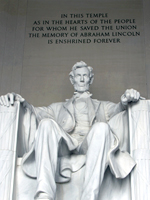
Abraham Lincoln statue from the Lincoln Memorial. NHEC
Article Body

Teaching history is not only about teaching students what happened in the past; it’s about teaching them how to think about the past. Many students instinctively employ modern perspectives when reading historical documents—a practice historians call "presentism." Students have to be taught to "think contextually," learning to recognize how the past differed from the present. In a significant study, Sam Wineburg revealed that even among teachers contextual thinking is a unique skill that needs to be intentionally developed.

Wineburg and his colleagues worked with 12 pre-service teachers participating in a fifth-year certification program at the University of Washington. They asked those teachers to "think aloud" and make visible how the teachers thought about six historical documents from the nineteenth century.

In this small study, being a history major turned out not to be a reliable predictor of being able to contextualize historical documents. Even college students with strong history content knowledge can fall prey to presentism. The most sophisticated historical readers, on the other hand, build a social context for the historical documents they are reading, drawing inferences from each document, establishing a spectrum of ideas for the period, and reading multiple documents in conversation with each other.

Drawing Inferences from Documents

Historical documents tell readers something not only about their author, but also about the world in which he or she lived. One document from the study, for instance, is a campaign speech made by Abraham Lincoln, in which Lincoln seemingly reveals deep bigotry toward African-Americans. But Lincoln’s words cannot be separated from the occasion on which they were uttered, the location of the debate, or the kinds of people who were in attendance. In short, the speech may tell us something about Lincoln, but it may tell us even more about middle America in 1858.

Establishing a Spectrum of Ideas

In order to build a social context for understanding historical documents, students need to have a general understanding of what people thought about particular issues at that time. In the case of Lincoln’s comments on race, students can better understand the context in which he made them by reading documents written by defenders and opponents of slavery. Examining excerpts from white supremacist John Bell Robinson and abolitionist William Lloyd Garrison, for instance, helped successful readers understand how slavery was understood in Lincoln’s own time.

Reading Across Documents

Looking at the ways in which different documents from the same period inform each other is another way of building the social context of the past. The technique, which historians call "intertextual reading," involves reading each document with the others as backdrop, weaving them together to bring to life the world of the past.
image
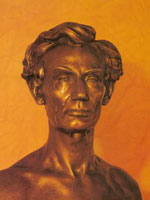
Image of bust, Abraham Lincoln, 1809-1865, New York Public Library
In the Classroom

The past, as L.P. Hartley wrote, is a "foreign country," which means that people thought, spoke, dressed, and lived in different ways than we do today.

  • Think about how you can help your students understand this strange place, where people lived differently, had different rights, and believed different things.
  • Begin by asking students to figure out where they stand on a particular issue. Then, reminding them that they are dealing with a different time and place, give them a number of documents focusing on a particular historical issue.
  • Have students make lists of what they can infer about the time period from these documents. How was it different from our world today?
  • See if students can use the documents to establish a spectrum of ideas for the period, and ask them if modern perspectives fall within the poles established by that spectrum.
  • Reminding them that they should be reading across the various documents, ask them to paint a general picture of this past world.
Sample Application

The two excerpts below are from think aloud exercises with two participants in the study. While those participants were teachers rather than students, they nevertheless reflect the same strengths and weaknesses exhibited by younger readers. Take a look at the first one:

Lincoln was not so much...working in the interest of the black man, for altruistic sense. . . he’s not giving them equality in personhood.

The criticism that Lincoln is not giving African-Americans “equality in personhood” is a distinctly modern one that ignores the fact that Lincoln was operating in a very different time in American history. Further, the reader draws conclusions about what Lincoln stood for, ignoring the fact that Lincoln was speaking in the context of a political campaign.

Now take a look at how the second reader approaches a historical text:

. . . I get the feeling that he is wrestling with something that doesn’t really have a good solution. This is the best you can have for now. . . He was real one-dimensional in the first article, kind of a slimy politician. Then he has another side with the letter to Mary Speed, kind of human. And now this is again another, it’s beginning to fill out, but now I see him more as the chief executive and trying to deal with problems, trying to balance a war, thinking ahead, what are we going to do after the war and sort of coming up with—and this is prior to the Emancipation Proclamation. Is this prior to the Emancipation Proclamation? Yes, this is prior. So, I mean he may have had this idea in mind, so he’s thinking forward, and how are we going to deal with this huge number of slaves? Maybe colonizing is certainly a viable option in 1862. It kind of reminds me of what the British did with Australia. Ship all the undesirables down to Australia.

Unlike the first reader, this seasoned one considers the fact that, however distasteful it strikes us today, creating a black colony may have been "a viable option in 1862." Further, instead of taking Lincoln’s words as clear evidence of what the future president believed, the reader notes that different Lincolns appear depending on the context: a "slimy politician" in one, a "human" side in a second, and a "chief executive" in a third.

For more information

Teachinghistory.org's Teaching Guide Structured Academic Controversy (SAC) in the History Classroom further discusses leading students toward synthesized, contextualized understanding.

Avishag Reisman and Sam Wineburg, "Teaching the Skill of Contextualizing in History," The Social Studies 99, no. 5 (Sep-Oct 2008), 202-207.

Bibliography

Sam Wineburg, Historical Thinking and Other Unnatural Acts (Philadelphia: Temple University Press, 2001).
Portal to Texas History

Image
Postcard, postmarked October 9, 1907, Portal to Texas History
Annotation

This archive offers a collection of more than 900,000 photographs, maps, letters, documents, books, artifacts, and other items relating to all aspects of Texas history, from prehistory through the 20th century. Subjects include agriculture, arts and crafts, education, immigration, military and war, places, science and technology, sports and recreation, architecture, business and economics, government and law, literature, people, religion, social life and customs, and the Texas landscape and nature. Some subjects include sub-categories. For instance, social life and customs, with 694 items, includes 13 sub-categories, such as clothing, families, food and cooking, homes, slavery, and travel. The visitor can also search the collection by keyword.

Resources for educators include seven "primary source adventures," divided into 4th- and 7th-grade levels, with lesson plans, preparatory resources, student worksheets, and PowerPoint slideshows. Subjects of the lessons include Cabeza de Vaca, Hood's Texas Brigade in the Civil War, life in the Civilian Conservation Corps, the journey of Coronado, the Mier Expedition, runaway slaves, the Shelby County Regulator Moderator war, and a comparison of Wichita and Comanche village life. This website offers useful resources for both researching and teaching the history of Texas.

OurStory

Image
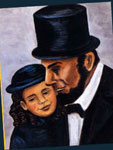
Illustration, Mr. Lincoln's Whiskers, 2009, Karen B. Winnick
Annotation

In partnership with the National Center for Family Literacy, the Smithsonian Institution's National Museum of American History shares its work in linking literature, history, and hands-on learning on this site. A spin-off of programs presented in the museum, OurStory highlights 18 notable children's fiction and nonfiction books, including Ken Mochizuki's Baseball Saved Us, Doreen Rappaport's Martin's Big Words, and Peter and Connie Roop's Keep the Lights Burning, Annie.

The site summarizes each book and offers parents and teachers a downloadable reading guide, including vocabulary; pre-, during, and post-reading activities; descriptions and images of Smithsonian artifacts related to the text or illustrations; and related NCHS History Standards. Downloadable activity guides, outlining activities such as making a Jailed for Freedom suffragist's pin or roleplaying contemporary debate on the March on Washington, also accompany each book summary.

Visitors may browse the featured books by time period, and the activity guides by activity type. In addition, visitors may search a database of 290 fiction and nonfiction books for young people by title, author, topic, age group, book type (fiction or nonfiction), and awards (Caldecott Medal, Newberry Medal, Coretta Scott King Award, Golden Kite Award, or Scott O'Dell Historical Fiction Award). Resulting entries are sparse, offering only a one-sentence summary and basic facts about the book, but teachers may still find the database useful if they're actively in search of tested titles for teaching U.S. history.

Finally, visitors can find basic suggestions on where to look locally for field trip destinations under "Field Trips."

Missouri Digital Heritage

Image
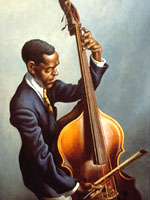
Painting, Portrait of a Musician, Thomas Hart Benton, 1949
Annotation

This massive mega-website presents thousands of documents and images related to Missouri's social, political, and economic history, linking to collections housed at universities, libraries, and heritage sites across the state. These resources are organized both into archival collections (by topic and source type) and virtual exhibits.

Archival collections include maps, municipal records, government and political records, newspapers, photographs and images, books and diaries, as well as topical collections on agriculture, medicine, women, business, exploration and settlement, art and popular culture, and family, rendering the website's resources as useful for genealogists as for those interested in history.

Exhibits encompass a diverse range of subjects, and include topics of relevance to Missouri history (Miss Carrie Watkins's cookbook from the mid-19th century, several exhibits on life at the University of Missouri and Washington University, Truman's Whistle Stop campaign), and topics outside of Missouri (the body in Medieval manuscripts, Roman imperial coins, propaganda posters from World War II, and drawings documenting dinosaur discovery before the mid-20th century).

Teachers will be especially interested in the large Education section, which includes curricular resources on topics such as African Americans in Missouri, Lewis and Clark's Expedition, Missouri State Fairs, and the history of dueling.

Florida State Archives Photographic Collection

Image
Image, Conch Town, WPA, C. Foster, 1939, Florida State Archives Photo Collection
Annotation

More than 137,000 photographs of Florida, many focusing on specific localities from the mid-19th century to the present, are available on this website. The collection, including 15 online exhibits, is searchable by subject, photographer, keyword, and date.

Materials include 35 collections on agriculture, the Seminole Indians, state political leaders, Jewish life, family life, postcards, and tourism among other things. Educational units address 17 topics, including the Seminoles, the Civil War in Florida, educator Mary McLeod Bethune, folklorist and writer Zora Neale Hurston, pioneer feminist Roxcy Bolton, the civil rights movement in Florida, and school busing during the 1970s.

"Writing Around Florida" includes ideas to foster appreciation of Florida's heritage. "Highlights of Florida History" presents 46 documents, images, and photographs from Florida's first Spanish period to the present. An interactive timeline presents materials—including audio and video files—on Florida at war, economics and agriculture, geography and the environment, government and politics, and state culture and history.

Federal Emergency Relief Administration (FERA) Photographs

Image
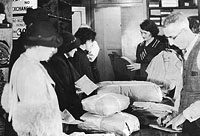
Photo, Distribution of clothing at 413 Fairview Avenue, Seattle, Oct. 10, 1934.
Annotation

When President Roosevelt created the Federal Emergency Relief Administration (FERA) in May of 1933, the nation was in the throes of the Great Depression. Roughly 15 million Americans were unemployed, many of whom had lost both their livelihoods and their life savings. FERA maintained local relief organizations that created work projects for the unemployed, primarily construction and engineering projects. This collection of close to 200 photographs documents the work of FERA in King County, Washington, which includes Seattle, Tacoma, and Bellevue.

The bulk of photographs depict construction projects for roads, bridges, schools, public buildings, and parks. Workers also appear working on sewing machines as well as at relief centers, the blacksmiths' forge, the furniture factory, and the sheet metal workshop. Together, these photographs shed light on not only the development of King County, but also on important general aspects of the New Deal program they sought to document.

Emma Goldman Papers

Image
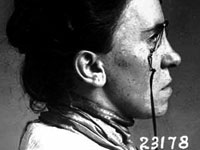
Image for Emma Goldman Papers
Annotation

Emma Goldman (1869–1940) was a major figure in the radical and feminist movements in the United States prior to her deportation in 1919. This collection of primary resources includes selections from four books by Goldman as well as 18 published essays and pamphlets, four speeches, 49 letters, and five newspaper accounts of Goldman's activities.

There are also nearly 40 photographs, illustrations, and facsimiles of documents. Additional items include two biographical exhibitions, selections from a published guide of documentary sources, and four sample documents from the book edition of her papers. A curriculum for students is designed to aid the study of freedom of expression, women's rights, anti-militarism, and social change. The site offers essays on the project's history and bibliographic references as well as links to other websites.

e-WV: The West Virginia Encyclopedia

Image
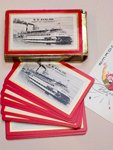
Photo, Deck of playing cards from the S.S. Avalon, Michael Keller, e-WV
Annotation

Take some time on this guide to all things West Virginia. This website offers a plethora of articles from "Abolitionism" to "John Zontini." To aid your search, you can sort through articles by topical category, alphabetical order, selecting "random article," or running a keyword search for specific interests. Your search will return media as well as text results, nicely sorted into separate categories. Articles are brief, but cross-referenced; and they also include citations and images, when available and appropriate.

The encyclopedia also includes larger sets of information and images referred to as exhibits. Topics include steamboats, John Henry, the Kanawha County Textbook Controversy, the Hatfield-McCoy Feud, coal mining, historic preservation, the Swiss community of Helvetia, the Greenbrier resort, and labor. A similar feature offers a handful of historical West Virginia maps.

Want something more interactive? Try the thematic 10-question quizzes, forums, or interactive maps and timelines.

Documents in Law, History, and Government

Image
Logo, Avalon Project
Annotation

The more than 3,500 full-text documents available on this website address the legal, economic, political, diplomatic, and government history of the U.S. Documents are divided into five time periods—pre-18th, 18th, 19th, 20th, and 21st centuries—and include treaties, presidential papers and addresses, and colonial charters, as well as state and federal constitutional and legal documents.

The materials are categorized into 64 document collections as well, such as American Revolution, Federalist Papers, slavery, Native Americans, Confederate States of America, World War II, Cold War, Indochina, Soviet-American diplomacy, and September 11, 2001. By clicking "What's New," the latest digitized documents become available. Material also can be accessed through an alphabetical list of 350 more specific categories, keyword searching, and advanced searching. Most of these documents are directly related to American history, but the site includes some materials on European and modern diplomatic history.

Disability History Museum

Image
Image, "The Polio Chronicle," Bolte Gibson, 1932, Disability History Museum
Annotation

This ongoing project was designed to present materials on the historical experiences of those with disabilities. The website currently presents nearly 800 documents and more than 930 still images dating from the late 18th century to the present.

Subjects are organized according to categories of advocacy, types of disability, government, institutions, medicine, organizations, private life, public life, and personal names. Documents include articles, poems, pamphlets, speeches, letters, book excerpts, and editorials.

Of special interest are documents from the Roosevelt Warm Springs Institute for Rehabilitation Archives, including the Polio Chronicle, a journal published by patients at Warm Springs, Georgia, from 1931 to 1934. Images include photographs, paintings, postcards, lithographs, children's book illustrations, and 19th-century family photographs, as well as postcard views of institutions, beggars, charity events, and types of wheelchairs.