SDA: Survey Documentation and Analysis
Image
Annotation

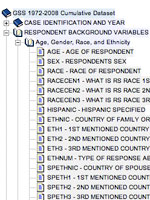
Within this site—designed primarily to aide social science researchers and analysts to construct large quantitative studies that can produce analytic results quickly—historians can find studies of importance relating to trends and shifts in American attitudes and opinions. The site presents 12 surveys on race and politics, Italian prejudice, health issues, and voter attitudes since 1952, among other topics.

Perhaps the most useful to historians of the late 20th century will be the General Social Survey, an "almost annual" study since 1972 that has interviewed U.S. households to produce a set of variables covering attitudes on an eclectic range of topics—from abortion to zodiac signs—that have been chosen by experts as "strategic for social science research" and related to public policy. Since 1982, surveys in other countries have replicated questions so that cross-national analyses may be achieved.

Includes data on beliefs concerning welfare, free speech, gun control, class structure, pornography, race, media exposure, working mothers, and women's rights, among other topics. Contains links to eight additional sites that use SDA. Valuable for those studying American social history.
Crime and Justice Data Online

Image
Annotation

Presents statistic tables showing trends in crime and law enforcement operations at state, local, and national levels. Users can find tendencies in types of crimes, types of victims, and types of weapons based on figures voluntarily reported to the FBI by state law enforcement agencies from 1960-1999, and by local agencies from 1985. In addition, statistics concerning law enforcement operations for states and large local agencies are searchable according to variables such as demographic composition of police forces, function, salary, and employment and training requirements. Valuable for those studying American social history, urban history, and human geography, in addition to students of the U.S. criminal justice system.

The American Presidency: A Glorious Burden

Image
Annotation

An engaging exhibit geared especially to schoolchildren, this site provides images, texts, and activities to explore the history and operation of the American presidency. Organized into four sections, the exhibit displays more than 375 images of documents, paintings, photographs, buttons, posters, paraphernalia, and objects along with short texts (50–200 words in length) explaining their significance. The Foundations pertains to the prehistory of the presidency, how the Framers defined responsibilities of the office, and the basic work that the office requires. The Campaign Trail covers the election process. Life and Death in the White House looks at the domestic world of the president, life after leaving office, and assassinations. Communicating the Presidency deals with the press, the entertainment industry, and advertising.

Most impressive are the many suggested activities, lesson plans, and games designed for children of varying ages. A Teacher's Manual contains five lesson plans each for grades 4–6, 7–9, and 10–12. In addition, there are activities for younger children, including analyzing letters between children and five presidents and creating a new official seal. Provides a timeline, bibliography of 88 titles arranged according to age group and exhibit section, and annotated list of 46 links to other sites. Very useful for classroom history and civics courses.

The Barbara McClintock Papers

Image
Annotation

Presents more than 200 items—including 51 articles, 28 lectures, 84 letters, and 35 photographs—by and about the Nobel-winning geneticist Barbara McClintock (1902–1992). Through experiments with maize in the 1920s and 1930s, McClintock discovered that genetic changes occur when chromosomes break and recombine, a process called "crossing over." In the 1950s, upon finding that genes "jump" around, she investigated the effects of transposable genetic elements.

The site includes an exhibit divided into seven chronological sections with a 4,000-word essay presenting McClintock's career highlights, accompanied by links to relevant documents and visuals. Materials in the collection can be retrieved through searches—basic and also geared to scientists—and in chronological and alphabetical listings. Valuable for serious students of genetics as well as those studying the history of American science and professional women.

Pittsburgh City Photographer

Image
Annotation

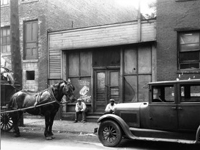
This photographic archive contains more than 1,500 images commissioned by the Pittsburgh Department of Public Works, Division of Photography, from c1890 through 1973. "The images show Pittsburgh parks, recreation facilities, and athletic events as well as hospital exteriors and interiors, mayoral events, traffic situations, and general street scenes."

The image collection emphasizes interior and exterior photographs of familiar and historic buildings and "interesting depictions of home life, and the famous and not so famous people of Pittsburgh." Each image is accompanied by bibliographic and descriptive information. The archive can be searched by image title, date, creator, location, address, description, or subject. A useful resource for those interested in urban development, city life, and architecture.

Popular American Music

Image
Annotation

This archive of American popular songs in their original form allows the user to explore the history of popular music in the U.S. from the 1850s to the present. It offers more than 400,000 pieces of sheet music, anthologies, and orchestra and band arrangements. Also available are 62,500 recordings.

The collection includes a wide variety of music genres, from music for theater, television, and motion pictures to rhythm and blues and rock. The collection can be browsed by name, title, cover art subject, or date. Or search the archive by keyword or combination of keyword, title, description, composer, or publisher. There are 12 links to other digital sheet music collections. Those researching American popular music should find this extensive collection very useful.

Reston Collection Images

Image
Annotation

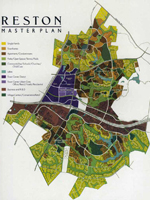
This collection of more than 160 texts, maps, photographs, and sketches is focused on the people, themes, and organizations important to Reston's history as a planned community. Textual materials include deeds, certificates, promotional brochures, studies, reports, and correspondence. Maps include Reston's Master Plan, major road systems, educational facilities, and recreational areas. Photographs include Lake Anne, various physical structures, and people significant to Reston's history. Sketches are mostly of building and community plans. Subject areas include health care, education, public services, parks, recreation, transportation, and population.

The collection can be browsed by title, subject, people, or organization and it can also be searched by subject, personal name, corporate name, or title. This is a website of interest to those researching the history of Reston or of planned communities.

The History of Sanitary Sewers

Image
Annotation

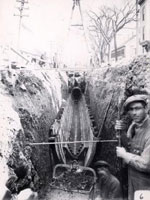
Documenting more than 5,000 years of sewage history, this site contains a plethora of sources addressing the historical, cultural, engineering, and even literary aspects of sewers. Beginning in roughly 3,500 BCE and continuing into the 20th century, the site includes a detailed timeline of major sewage developments, as well as links to histories of 14 major cities' sewage systems, including Washington, DC and Los Angeles.

In addition to two histories of the modern toilet, there are more than two dozen articles about aspects of sewage design, including short (500–1,000 word) introductions, engineering text, and even PDF diagrams. As well, there is a feature highlighting the many animals found living in metropolitan sewers and a virtual tour of the Paris, France, sewer system. A bibliography introduces users and researchers to major secondary works on sewage and sewer history. A Miscellaneous area collects literary references to sewers, including works by Robert Frost and Ben Jonson.

Washington History

Image
Annotation

This website offers resources in Washington history through three main sections: historical records research, historical newspapers and classics in Washington history, and presentations. Historical records offers county census records, naturalization records, other miscellaneous records, and genealogical research resources, as well as searches of the state archive records and the state library catalog. The newspapers and classics feature allows visitors to search and view articles from four state newspapers dating back to 1852. Users can search the newspapers by keyword, topic, or personal name. This section also has 91 classic works on Washington history, searchable by keyword, grouped under topics of county and regional history, exploration and early travel, Native Americans, pioneer life, special collections, territorial government, and wagon trails and the Oregon Trail. Individual works can also be searched. (Newspaper articles and classics must be viewed using the DJVU plugin software, available for free download on the site.)

Additionally there is a Corps 33 bibliography of more than 35 works on the Lewis and Clark expedition. There are six presentations that allow visitors to explore Washington's territorial history through an interactive timeline featuring photographs and documents, view documents relating to World War I and profiles of Washington's soldiers, read the history and view historical photographs of cities, counties and corporations, browse a collection of historical maps of the state and the Pacific Northwest, view all 78 pages of the original Washington State Constitution and learn the history surrounding it, and explore the history of elections and voting in the state. The site also offers a collection of 96 images showing the construction and early history of the state's Legislative Building.

Milwaukee Neighborhoods: Photos and Maps, 1885-1992

Image
Annotation

This website presents 638 images of the buildings and neighborhoods of Milwaukee that together document the development of the city of Milwaukee from the mid-1880s to the early 1990s. The collection brings together images from two rare books, the photograph collections of the American Geographical Society Library and the Archives Department at the University of Wisconsin, Milwaukee, Libraries, and two extensive photograph collections. Image subjects include residential and industrial facilities, local businesses, historic buildings, churches, and numerous Milwaukee parks.

An essay by professor Judith Kenny entitled Picturing Milwaukee makes use of images from the collection to examine the growth and development of Milwaukee and its 75 neighborhoods in the larger context of economic and social change. Topics addressed include early commercial development, industrialization, suburban development, and the post-World War II city. Additionally, there are 12 maps of Milwaukee that can be browsed separately. Each is accompanied by a descriptive record and a link to a larger image.

The collection can be searched by neighborhood, subject terms, or place/businesses. In addition to those interested in the history of Milwaukee, this site will be of interest to those studying urban development or historical architecture.