Dred Scott Case

Image
Annotation

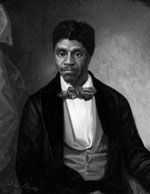
The Dred Scott case began in 1846 when slaves Dred and Harriet Scott sued for their freedom, basing their argument on the fact that they had lived in non-slave territories for a number of years. The case ended with the landmark U.S. Supreme Court decision of 1857 that not only denied Scott both citizenship and the right to sue in federal court, but ruled that he never had been free and that Congress did not have the right to prohibit slavery in the territories. The decision sparked increased sectional tensions in the years leading to the Civil War. Facsimiles and transcriptions of 85 legal documents relating to the Dred Scott case are provided on this website. The site also provides a chronology and links to 301 Freedom Suits—legal petitions for freedom filed by or on behalf of slaves—in St. Louis courts from 1814 to 1860.
Seattle Civil Rights and Labor History Project

Image
Annotation

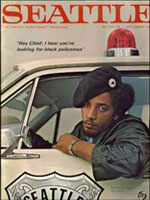
The long history of struggle for equal rights by various ethnic groups in Seattle, including Filipino, Chinese, Japanese, African, and Native Americans; Jews; and Latinos is documented on this website. Primary and secondary sources integrate labor rights movements with struggles for political rights, as is evident in the "special sections," that highlight the Chicano/a movement, the Black Panther Party, Filipino Cannery Unionism, the United Construction Workers Association, Communism, and the United Farm Workers. Each section brings together oral histories, documents, newspapers, and photographs that are accompanied by written and video commentary to provide historical context. The collection of more than 70 oral histories of activists is especially useful for understanding the lived experience of racism and its especially subtle workings in the Pacific Northwest. Together, these resources provide important national context for the civil rights struggle, too often understood as a solely southern phenomenon.

CQ Historic Documents Series: Online Edition

Image
Annotation

Each year since 1972, CQ Press has published a book of 100 significant documents in U.S. history accompanied by detailed annotations. The entire collection is available on this website, allowing for detailed keyword searching. Documents include U.S presidential speeches, government and international organization publications, legal decisions, scientific findings, and cultural discussions. The documents are grouped by year and by topic. Topics include the economy, defense, the environment, health care, international affairs, and life in America. A "Favorite Documents" feature allows users to mark and collect documents of interest, and a "CiteNow!" feature provides citations on demand. Though the depth of documents on any one topic is minimal, this website provides an overview of important events in a given year as well as U.S. perception of and response to topics over time.

Truman Presidential Museum and Library

Image
Annotation

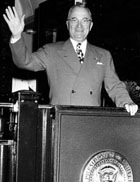
The presidency of Harry S. Truman is addressed through these hundreds of government documents, oral histories, photographs, and political cartoons. Materials cover topics including the Berlin airlift, the decision to drop the atomic bomb, desegregation of the Armed Forces, the election campaign of 1948, the Korean War, the Marshall Plan, NATO, the Truman Doctrine, Truman's Farewell Address, the recognition of the State of Israel, the United Nations, and the incarceration of Japanese Americans during World War II. Transcripts are available for approximately 120 oral histories conducted with members of Truman's administration and officials from other countries on the Korean War. The website also offers the full text of Truman's diary from 1947; more than 50 audio files with extracts of speeches, press conferences, and interviews; and more than 31,000 biographical photographs.

Jewish Women's Archive

Image
Annotation

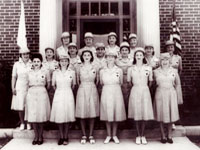
These exhibits and resources are valuable for studying American Jewish women's contributions to their communities and the wider world. Women of Valor focuses on 16 notable historic women—including Congresswoman Bella Abzug; radical Emma Goldman; philanthropist Rebecca Gratz; poet Emma Lazarus; actress Molly Picon; Hadassah founder Henrietta Szold; and nurse, settlement worker, and political leader Lillian Wald. Women Who Dared offers oral history interviews of Jewish women activists in text, audio, and video formats. Interviewees discuss activism in the context of Jewish and gender identity, values, and situations, and elucidate the path to activism, challenges, rewards, and impact. The Encyclopedia, browsable by keyword, time period, and country, includes 2,000 articles on Jewish women's history. This Week in History looks at moments in the lives of Jewish American women corresponding to the date; visitors can subscribe to this feature by RSS feed or email. On the Map pinpoints locations important to Jewish American women's history—and to Jewish American women today. Visitors can add their own locations with photos. Jewesses with Attitude, the JWA blog, features articles on Jewish American women past and present and on other topics relevant to the lives of Jewish American women today. The site has also digitized nine volumes of The American Jewess. Most recently, the Jewish Women's Archive has compiled objects, photographs, and personal accounts of the Hurricane Katrina disaster and the aftermath, complete with 100 oral histories, blog postings, emails, and other firsthand accounts.

Triangle Shirtwaist Factory Fire

Image
Annotation

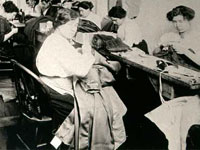
On March 25, 1911, a fire broke out at the Triangle Shirtwaist Factory in New York City causing the deaths of 148 garment workers—an event that came to be known as one of the hallmark tragedies of the industrial age. This website tells the story of the fire in six chapters: Introduction; Sweatshops and Strikes; Fire; Mourning and Protest; Relief Work; and Investigation, Trial, and Reform.

The text, targeted to a middle and high school audience, is accompanied by numerous primary sources that could be of use to more advanced researchers. These include close to 70 photographs, 18 newspaper articles, 17 testimonials, three oral histories, excerpts from investigative reports written in the years following the fire, several letters from witnesses, a lecture given by Secretary of Labor Frances Perkins in 1964, and a radio drama reenacting the event. Accompanying these primary sources is a list of victims and witnesses, a selected bibliography of works surrounding the fire, and tips for writing a paper.

Clash of Cultures in the 1910s and 1920s

Image
Annotation

This interpretive essay, more than 10,000 words, on the culture wars of the 1910s and 1920s, is organized into four sections. It offers 34 documents and 75 images—photographs, cartoons, posters, flyers, and maps—to provide historical context and connections between seemingly unrelated phenomena. "Prohibition" includes an exhibition of photographs, political cartoons, and documents from the Ohio Dry Campaign of 1918. "Anti-Immigration and the KKK" presents a Klansman's manual, anti-immigration magazine articles, and the text of the Immigration Act of 1924. "The New Woman" contains sections on image and lifestyle, sexuality, opposition, the African American New Woman, and work, education, and reform. "The Scopes Trial" includes documents on fundamentalism and evolution and trial transcripts. The website provides 28 related links and bibliographies of 42 titles. This valuable site emphasizes the complexity of conflicts persistent throughout 20th-century American history.

Chicago Anarchists on Trial: Evidence from the Haymarket Affair, 1886-1887

Image
Annotation

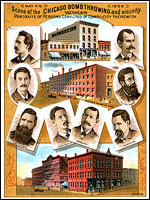
This collection of documents—roughly 3,800 pages of court proceedings—concerns the Haymarket Affair. This watershed event in the history of American radicalism led to the first "Red Scare" in America. Materials include autobiographies of two of the eight anarchists tried for conspiracy in the murder of seven Chicago police officers. The officers died after a bomb exploded at an anarchist meeting in May 1886, the day after two workers died in a struggle between police and locked-out union members at the McCormick Reaper factory. Four defendants were executed, despite lack of evidence connecting them to the bombing. The site presents approximately 221 newspaper clippings, 55 photographs, 19 letters, nine broadsides, and images of more than 20 artifacts. A linked exhibition, "The Dramas of Haymarket," furnishes a historical narrative and contextual interpretation. This website is valuable for the study of late 19th-century American radicalism, law enforcement, and political climate.

Votes for Women: Selections from the NAWSA, 1848-1921

Image
Annotation

Covering the years from 1848 to 1921, this website presents materials from the suffrage movement in America, including 167 books, pamphlets, handbooks, reports, speeches, and other artifacts totaling some 10,000 pages. Formed in 1890 from two rival groups, the National American Woman Suffrage Association (NAWSA) orchestrated passage of the 19th Amendment in 1920 through state campaigns. Materials include works by Carrie Chapman Catt, the Association's longtime president, as well as from other officers and members, including Elizabeth Cady Stanton, Susan B. Anthony, Lucy Stone, Alice Stone Blackwell, Julia Ward Howe, Elizabeth Smith Miller, and Mary A. Livermore. There are two bibliographies, an essay on Catt, a timeline, and links to 18 related collections, most of them associated with the Library of Congress American Memory.

World War I Document Archive

Image
Annotation

Hundreds of documents and thousands of images relating to World War I, with particular emphasis on military, diplomatic, and political resources, are available on this website. Documents are arranged chronologically and by type, including more than 100 official documents from 16 countries, 100 personal reminiscences, and 24 treaties from 1856 to 1928. A photo archive provides 1,844 images in 15 categories, including individuals, locations, heads of state, commanders, refugees, and war albums. The website also offers substantial sections on the maritime war and the medical front, an alphabetical bibliographical dictionary with over 200 names, and approximately 125 links to related sites. The authors—volunteers from a World War I electronic discussion network—encourage user participation in expanding the site.