In Motion: The African-American Migration Experience
Image
Image for In Motion: The African-American Migration Experience
Annotation

Migration, both forced and voluntary, remains a prominent theme in African American history. This website is built around the history of 13 African American migration experiences: the transatlantic slave trade (1450s–1867), runaway journeys (1630s–1865), the domestic slave trade (1760s–1865), colonization and emigration (1783–1910s), Haitian Immigration (1791–1809), Western migration (1840s–1970), and Northern migration (1840s–1890).

Twentieth-century migrations include the Great Migration (1916–1930), the Second Great Migration (1940–1970), Caribbean immigration (1900–present), the return South migration (1970–present), Haitian immigration in the 20th century (1970–present), and African immigration (1970–present). More than 16,500 pages of texts, 8,300 illustrations, and 67 maps are included. An interactive timeline places migration in the context of U.S. history and the history of the African Diaspora.
Images of African Americans from the Cook Collection of Photographs

Image
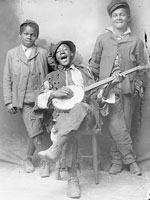
Photo, Boys with Banjo, 1880s
Annotation

This site consists of nearly 300 images of Afro-Virginians dating from the 1880s to the early 20th century. Images are scanned from prints taken by father and son, George S. Cook and Huestes P. Cook, principally in the Richmond and Central Virginia area. Users can search the digital collection by keyword or browse images, including agriculture, education, recreation, religion, tobacco, and urban life. Documentation of labor is the most extensive, while the images of children ad education are fascinating. This site is valuable to those studying African-American life at the turn of the century or Virginia history.

Images of African Americans from the 19th Century

Image
Logo, Images of African Americans from the 19th Century
Annotation

Part of the Digital Schomburg/New York Public Library project, this site contains roughly 500 images selected primarily from the Photographs and Prints Division of the Schomburg Center for Research in Black Culture at the New York Public Library. The items, selected by Marilyn Nance, freelance photographer, and Mary Yearwood, Curator of Photographs and Prints, include prints, original negatives, and transparencies from the 19th century, drawn from collections of family photographs, African-American school photographs, and personal collections. The images in this archive depict the social, political, and cultural worlds of their African American subjects. The site can be searched through 17 subject categories, such as family, labor, Civil War, slavery, social life and customs, and portraits. Under each subject category is a list of images with 15-word descriptions. This easily-navigable site also offers a keyword search engine through which collection items can be accessed. The images download quickly and are of good quality. Ideal for researching African American and 19th century history.

Gilder Lehrman Center for the Study of Slavery, Resistance, and Abolition

Image
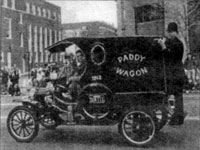
Photo, "Paddy Wagon," "Irish Echo," v. 71, n. 49, p. 4, December 9-15, 1998
Annotation

This collection of essays, documents, and bibliographies addresses Atlantic slavery, resistance, and abolition. Source Documents includes about 200 speeches, letters, cartoons, graphics, and articles (visitors may browse by author, date, subject, or document type—no searching), that document slavery in the Americas. Bibliographies contains about 12 detailed bibliographies by scholars of slavery and abolition that can be used in teaching or studying in this area, as well as links to book reviews on the internet. A Scholars Forum posts a 4,500-word featured essay by a noted scholar, and visitors can read past essays as well. Teachers may find useful a Curriculum section, where lesson plans are available, including one for the Amistad affair. It includes a timeline of abolition, a narrative of the incident and the subsequent trials, and an essay. Tangled Roots uses a 1,000-word essay to examine the history shared by Irish Americans and African Americans in America. Neither the most complete digital archive nor the greatest collection of essays, this site is nonetheless a valuable resource for the most recent scholarship of American slavery and abolition.

Geography of Slavery in America

Image
Image, March 14, 1766 slave ad, Geography of Slavery in America
Annotation

Transcriptions and images of more than 4,000 newspaper advertisements for runaway slaves and indentured servants between 1736 and 1803 can be browsed or search on this website. The runaways are primarily from Virginia, but also come from states along the Eastern seaboard and locations abroad. Materials include ads placed by owners and overseers as well as those placed by sheriffs and other governmental officials for captured or suspected runaway slaves. Additional advertisements announce runaway servants, sailors, and military deserters.

"Exploring Advertisements" offers browse, search, and full-text search functions, as well as maps and timelines for viewing the geographic locations of slaves. The site also provides documents on runaways—including letters, other newspaper materials, literature and narratives, and several dozen official records, such as laws, county records, and House of Burgess journals. Information on the currency and clothing of the time, a gazetteer with seven maps of the region, and a 13-title bibliography are also available.

From Slavery to Freedom: The African-American Pamphlet Collection, 1822-1909

Image
Address, Negro education not a failure, Booker T. Washington, 1904, LoC
Annotation

From Slavery to Freedom: The African-American Pamphlet Collection, 1822-1909 is precisely what it says, a collection of 396 pamphlets written by African Americans or by non-African Americans writing about slavery, Reconstruction, the colonization of Africa, and other pertinent topics.

According to the website, "[. . . t]he materials range from personal accounts and public orations to organizational reports and legislative speeches." Prominent authors include, but are certainly not limited to, Frederick Douglass and Booker T. Washington.

Material can be browsed by title, author, or subject; or you can run a key word search. If you need more material than what is available in the collection itself, there is a list of external resources with related content.

Freedom Bound: The Underground Railroad in Lycoming County, PA

Image
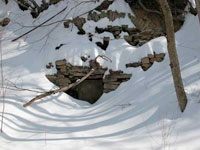
Photo, Caves, Lycoming County, PA
Annotation

An interactive site on the Underground Railroad in Lycoming County, PA. Users go to a map of the environs near Williamsport dotted with 13 relevant locations. Clicking on a location brings up images and streaming audio testimony from oral historian Mamie Sweeting Diggs, who details their significance using stories passed down from her great grandfather, Daniel Hughes, an agent and conductor on the railroad.

A river raftsman, Hughes brought logs down the Susquehanna River to Maryland, and then returned leading slaves on foot through a mountain trail. Slaves hid in warehouses, caves, and Hughes's own home. Helped by Hughes and his cohorts, the slaves headed for nearby Freedom Road, from which they would travel to Canada by foot or train.

More than 50 photographs and prints document the places where the story took place. Diggs relates four additional stories from Hughes. This site succeeds in illuminating the workings of the Underground Railroad.

Freedmen and Southern Society Project

Image
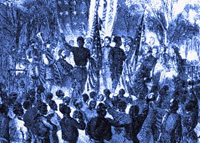
Print, Emancipation Scene
Annotation

Maintained by Steven F. Miller of the University of Maryland, this site provides 44 primary documents relating to the emancipation of African American slaves between 1861 and 1865. It includes a letter by General William T. Sherman explaining why he refused to return fugitive slaves to their owners; an 1864 letter from Annie Davis, a Maryland slave, to President Abraham Lincoln asking him to clarify her legal status; a description by a Union general of a bloody battle at Milliken's Bend, LA, where a brigade of black soldiers fought; and documents from the federal and Confederate governments relating to significant events.

The documents—transcribed from originals housed at the National Archives—are accompanied by sentence-long annotations, as well as an authoritative chronology of events leading to legal emancipation.

This site is part of a larger effort underway by the Freedmen and Southern Society Project, "supported by the University of Maryland and by grants from the National Historical Publications and Records Commission and the National Endowment for the Humanities" to publish the multivolume Freedom: A Documentary History of Emancipation, 1861-1867.

Frederick Douglass National Historic Site Virtual Museum Exhibit

Image
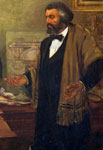
Mural, Frederick Douglass appealing to President Lincoln, 1943, LoC
Annotation

Opening this website, visitors are greeted with several pictures of Frederick Douglass throughout his lifespan, while a five-part historical overview of his life explains what the exhibit entails. Visitors can access more of the site's content through the three key feature links in the lower right corner of the home page: the "House Tour," "Lesson Plans," and "Portraits." The "House Tour" takes the user on a virtual room-by-room tour of Frederick Douglass's home, which is physically located in Washington, DC. This link may be useful for educators who would like their students to experience Douglass’s home but who cannot reach DC, offering a memorable classroom experience for any K–12 classroom studying the life of Frederick Douglass or of African Americans during the Antebellum and Reconstruction eras.

Additionally, educators could assign this website to students for research using primary source artifacts and documents. "Portraits" provides not only portraits with captions explaining their significance in Douglass's life, but of his children and close abolitionist friends, as well as personal items such as his Panama hat, eyeglasses, coffee pot and articles from his paper, the North Star. In total, the site offers more than 150 primary source documents and artifacts from the time period and Douglass's life. Clicking on the link for “All Image Galley” allows the viewer to step into Frederick Douglass’s world, viewing all of the primary sources in one exhibit gallery with nine subsections, including "Leisure Time" and "Presidential Appointments." This truly brings history to life!

One of the most useful links for educators is "Lesson Plans." This takes the user to a section of the National Park Service's website called Teaching with Museum Collections, where educators can download two lesson plans on Frederick Douglass, or download lesson plan templates to create their own artifact-based lessons. The lessons are clear and include state standards as well as differentiated instruction ideas. "Frederick Douglass's Hat" is appropriate for middle school students, but can be modified and integrated to the needs of all students. "Forced March," created by an 8th-grade middle school teacher, can also be modified or enhanced to meet the needs of a differentiated classroom.

Teachinghistory.org Teacher Representative Lynn Roach wrote this Website Review. Learn more about our Teacher Representatives.

Finishing the Dream: Learning from the Civil Rights Era

Image
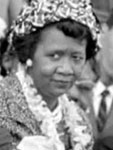
Screenshot, Remembering the Godmother of Civil Rights. . . , Finishing the Dream
Annotation

This subsection of the NBC Learn website offers 132 streaming short videos related to the civil rights movement.

Videos include commentaries following major events (closely or years in retrospect), original testimonies, and video of events such as the signing of the Voting Rights Act of 1965. Topics include Emmett Till, bus boycotts, Brown v. Board of Education, the Freedom Riders, Little Rock, African American attendance at the University of Mississippi, Medgar Evers, the March on Washington, the Birmingham Church Bombing, Malcolm X, 1964 voter registration volunteer disappearances, and King's assassination.

The last section, Finishing the Dream, contains footage from four town hall events, which brought together activists, educators, religious leaders, and high school and college students for discussion of issues related to the civil rights movement.

The 132 videos are divided into subsections by year, beginning with 1954 and continuing through 1968. All videos include a transcript. Select the clip, and the word "transcript" will appear to the right of the video. Click it to bring up a scrollable transcript alongside the film.

You may also be interested in exploring further on the NBC Learn website. However, the majority of the content is subscription-based. You can sign up for a 30-day free trial, though, in order to test the waters.